Skip to comments.
Catholic Caucus: Sunday Mass Readings, 06-07-15,SOL, Most Holy Body & Blood of Christ-Corpus Christi
USCCB.org/RNAB ^
| 06-07-15
| Revised New American Bible
Posted on 06/06/2015 8:47:55 PM PDT by Salvation
June 7, 2015
The Solemnity of the Most Holy Body and Blood of Christ (Corpus Christi)
When Moses came to the people
and related all the words and ordinances of the LORD,
they all answered with one voice,
"We will do everything that the LORD has told us."
Moses then wrote down all the words of the LORD and,
rising early the next day,
he erected at the foot of the mountain an altar
and twelve pillars for the twelve tribes of Israel.
Then, having sent certain young men of the Israelites
to offer holocausts and sacrifice young bulls
as peace offerings to the LORD,
Moses took half of the blood and put it in large bowls;
the other half he splashed on the altar.
Taking the book of the covenant, he read it aloud to the people,
who answered, "All that the LORD has said, we will heed and do."
Then he took the blood and sprinkled it on the people, saying,
"This is the blood of the covenant
that the LORD has made with you
in accordance with all these words of his."
R. (13) I will take the cup of salvation, and call on the name of the Lord.
or:
R. Alleluia.
How shall I make a return to the LORD
for all the good he has done for me?
The cup of salvation I will take up,
and I will call upon the name of the LORD.
R. I will take the cup of salvation, and call on the name of the Lord.
or:
R. Alleluia.
Precious in the eyes of the LORD
is the death of his faithful ones.
I am your servant, the son of your handmaid;
you have loosed my bonds.
R. I will take the cup of salvation, and call on the name of the Lord.
or:
R. Alleluia.
To you will I offer sacrifice of thanksgiving,
and I will call upon the name of the LORD.
My vows to the LORD I will pay
in the presence of all his people.
R. I will take the cup of salvation, and call on the name of the Lord.
or:
R. Alleluia.
Brothers and sisters:
When Christ came as high priest
of the good things that have come to be,
passing through the greater and more perfect tabernacle
not made by hands, that is, not belonging to this creation,
he entered once for all into the sanctuary,
not with the blood of goats and calves
but with his own blood, thus obtaining eternal redemption.
For if the blood of goats and bulls
and the sprinkling of a heifer's ashes
can sanctify those who are defiled
so that their flesh is cleansed,
how much more will the blood of Christ,
who through the eternal Spirit offered himself unblemished to God,
cleanse our consciences from dead works
to worship the living God.
For this reason he is mediator of a new covenant:
since a death has taken place for deliverance
from transgressions under the first covenant,
those who are called may receive the promised eternal inheritance.
Laud, O Zion, your salvation,
Laud with hymns of exultation,
Christ, your king and shepherd true:
Bring him all the praise you know,
He is more than you bestow.
Never can you reach his due.
Special theme for glad thanksgiving
Is the quick’ning and the living
Bread today before you set:
From his hands of old partaken,
As we know, by faith unshaken,
Where the Twelve at supper met.
Full and clear ring out your chanting,
Joy nor sweetest grace be wanting,
From your heart let praises burst:
For today the feast is holden,
When the institution olden
Of that supper was rehearsed.
Here the new law’s new oblation,
By the new king’s revelation,
Ends the form of ancient rite:
Now the new the old effaces,
Truth away the shadow chases,
Light dispels the gloom of night.
What he did at supper seated,
Christ ordained to be repeated,
His memorial ne’er to cease:
And his rule for guidance taking,
Bread and wine we hallow, making
Thus our sacrifice of peace.
This the truth each Christian learns,
Bread into his flesh he turns,
To his precious blood the wine:
Sight has fail’d, nor thought conceives,
But a dauntless faith believes,
Resting on a pow’r divine.
Here beneath these signs are hidden
Priceless things to sense forbidden;
Signs, not things are all we see:
Blood is poured and flesh is broken,
Yet in either wondrous token
Christ entire we know to be.
Whoso of this food partakes,
Does not rend the Lord nor breaks;
Christ is whole to all that taste:
Thousands are, as one, receivers,
One, as thousands of believers,
Eats of him who cannot waste.
Bad and good the feast are sharing,
Of what divers dooms preparing,
Endless death, or endless life.
Life to these, to those damnation,
See how like participation
Is with unlike issues rife.
When the sacrament is broken,
Doubt not, but believe ‘tis spoken,
That each sever’d outward token
doth the very whole contain.
Nought the precious gift divides,
Breaking but the sign betides
Jesus still the same abides,
still unbroken does remain.
The shorter form of the sequence begins here.
Lo! the angel’s food is given
To the pilgrim who has striven;
see the children’s bread from heaven,
which on dogs may not be spent.
Truth the ancient types fulfilling,
Isaac bound, a victim willing,
Paschal lamb, its lifeblood spilling,
manna to the fathers sent.
Very bread, good shepherd, tend us,
Jesu, of your love befriend us,
You refresh us, you defend us,
Your eternal goodness send us
In the land of life to see.
You who all things can and know,
Who on earth such food bestow,
Grant us with your saints, though lowest,
Where the heav’nly feast you show,
Fellow heirs and guests to be. Amen. Alleluia.
R. Alleluia, alleluia.
I am the living bread that came down from heaven,
says the Lord;
whoever eats this bread will live forever.
R. Alleluia, alleluia.
On the first day of the Feast of Unleavened Bread,
when they sacrificed the Passover lamb,
Jesus’ disciples said to him,
"Where do you want us to go
and prepare for you to eat the Passover?"
He sent two of his disciples and said to them,
"Go into the city and a man will meet you,
carrying a jar of water.
Follow him.
Wherever he enters, say to the master of the house,
'The Teacher says, "Where is my guest room
where I may eat the Passover with my disciples?"'
Then he will show you a large upper room furnished and ready.
Make the preparations for us there."
The disciples then went off, entered the city,
and found it just as he had told them;
and they prepared the Passover.
While they were eating,
he took bread, said the blessing,
broke it, gave it to them, and said,
"Take it; this is my body."
Then he took a cup, gave thanks, and gave it to them,
and they all drank from it.
He said to them,
"This is my blood of the covenant,
which will be shed for many.
Amen, I say to you,
I shall not drink again the fruit of the vine
until the day when I drink it new in the kingdom of God."
Then, after singing a hymn,
they went out to the Mount of Olives.
TOPICS: Catholic; General Discusssion; Prayer; Worship
KEYWORDS: catholic; corpuschristi; mk14; prayer
Navigation: use the links below to view more comments.
first previous 1-20, 21-40, 41-55 last
To: All
The Word Among Us
Meditation: Mark 14:12-16, 22-26
The Most Holy Body and Blood of Christ (Corpus Christi)
This is my body. (Mark 14:22)
Wouldn’t it be great if you could just pick up the phone and call God and ask him anything you want? Not to ask him to give you gifts, but to ask him for answers to the mysteries of life. Maybe you could ask why there is suffering in the world. Maybe you would ask something silly, like why there are fleas or whether the chicken or the egg came first. Or maybe you would want to know the secret to a peaceful life. Wouldn’t you love to ask God?
Well, you can—but not with a phone call! Today, we celebrate the fact that Jesus has made himself—body, blood, soul, and divinity—available to us in the form of bread and wine. In the Eucharist, he is always with us, “until the end of the age” (Matthew 28:20). No matter where we go, he is with us: in towering cathedrals or run-down prisons, in ornate golden chalices and in the palms of sinners’ hands.
From the time of the Last Supper until today, Jesus “disdains no dwelling, but consents to come like a guest to any heart, even one that is defiled” (St. Thomas Aquinas). He comes to transform us just as the Host is transformed: not in outward appearance but in our inner lives.
No, you can’t call God on the phone, but you can visit him in person. Just to sit in Jesus’ presence with a quieted heart can do wonders. There, in the still of adoration, he may give you a sense of peace or whisper a new thought, insight, or idea to your heart.
Will you go to him? Even if you can spend only five minutes, it’s worth it. That’s five minutes with your King! So go; he is waiting just for you.
“We adore you, Lord Jesus Christ, here and in all your churches throughout the world, and we bless you, for by your holy cross you have redeemed the world.” (St. Francis of Assisi)
Exodus 24:3-8
Psalm 116:12-13, 15-18
Hebrews 9:11-15
Questions for Reflection or Group Discussion:
Mass Readings:
1st Reading: Exodus 24:3-8
Responsorial: Psalm 116:12-13, 15-18
2nd Reading: Hebrews 9:11-15
Gospel: Mark 14:12-16, 22-26
1. The first readings recounts how, through Moses, the Israelites entered into a special covenant with God at Mt. Sinai. We are also presented with Old Testament rituals of the sacrificial blood of animals. The reading ends with these words: “Then he (Moses) took the blood and splashed it on the people, saying, ‘This is the blood of the covenant which the LORD has made with you according to all these words of his.’” In what ways do these words pre-figure the Blood of Christ and the New Covenant?
2. The Responsorial Psalm begins with this challenging question: “How shall I make a return to the LORD for all the good he has done for me?” The psalmist responds to this question by saying: “The cup of salvation I will take up, and I will call upon the name of the LORD.” He goes on to say the following: “To you will I offer sacrifice of thanksgiving, and I will call upon the name of the LORD. My vows to the LORD I will pay in the presence of all his people.” How would you respond to the question posed by the psalmist? What are the some ways you can give a “sacrifice of thanksgiving” to the Lord in your own life? What more can you do to “increase” your offering?
3. In the second reading, no longer do we have a covenant though the sacrifice and blood of animals. God's new covenant with us, a covenant of love and intimacy, has been sealed with the Body and Blood of Christ. How would you describe the differences between the Old and the New Covenant? How would you explain the Father’s great love for us in allowing his Son to suffer and shed his blood on the cross for us? In what ways can we also respond to this great love by laying down our lives more fully for Jesus Christ and for one another?
4. In the Gospel, Jesus tells the disciples that his Body and Blood are truly present in the Eucharist. It is the symbol and bond of unity between Christ and his faithful followers who feed on it. How can you further your unity with Christ, and with your fellow Catholics, who also partake of the body and blood of Christ through the Eucharist?
5. With these words, the meditation encourages us to spend time with Jesus at Mass or in Eucharistic Adoration: “Just to sit in Jesus’ presence with a quieted heart can do wonders. There, in the still of adoration, he may give you a sense of peace or whisper a new thought, insight, or idea to your heart. Will you go to him? Even if you can spend only five minutes, it’s worth it. That’s five minutes with your King! So go; he is waiting just for you.” What are some steps you can take to spend more time in Jesus’ presence at Mass or in Eucharistic Adoration before the Blessed Sacrament?
6. What steps can you take to better prepare yourself to receive Christ in the Eucharist at Mass? How does the Eucharist aid you in drawing nearer to Jesus? To the Holy Spirit? To the Father?
7. Take some time now to pray and thank the Lord for the great gift of his life and presence in the Eucharist, and for the great gift of salvation through his Cross. Use the prayer at the end of the meditation as the starting point.
41
posted on
06/07/2015 5:18:58 PM PDT
by
Salvation
("With God all things are possible." Matthew 19:26)
To: All
A Christian Pilgrim
THE BODY AND BLOOD OF CHRIST
(A biblical reflection on SUNDAY AFTER TRINITY SUNDAY: THE BODY AND BLOOD OF CHRIST – June 7, 2015)
Gospel Reading: Mark 14:12-16,22-26
First Reading: Exodus 24:3-8; Psalms: Psalm 116:12-13,15-18, Second Reading: Hebrews 9:11-15
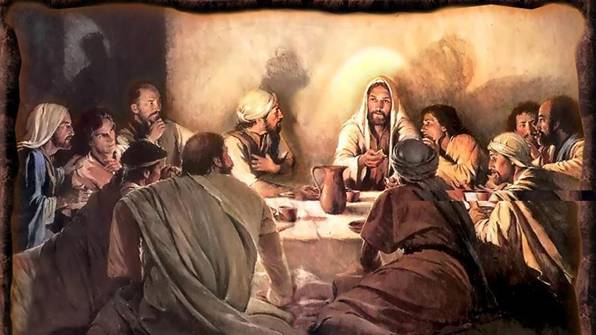
The Scripture Text
And on the first day of Unleavened Bread, when they sacrificed the Passover lamb, His disciples said to Him, “Where will You have us go and prepare for You to eat the Passover?” And He sent two of His disciples, and said to them, “Go into the city, and a man carrying a jar of water will meet you; follow him, and wherever he enters, say to the householder, ‘The teacher says, Where is My guest room, where I am to eat the Passover with My disciples?’ And he will show you a large upper room furnished and ready, there prepare for us.” And the disciples set out and went to the city, and found it as He had told them; and they prepared the Passover.
And as they were eating, He took bread, and blessed, and broke it, and give it to them, and said, “Take; this is My body.” And He took a cup, and when He had given thanks He gave it to them, and they all drank of it. And He said to them, “This is My blood of the covenant, which is poured out for many. Truly, I say to you, I shall not drink again of the fruit of the vine until that day when I drink it new in the Kingdom of God.”
And when they had sung a hymn, they went out to the Mount of Olives. (Mark 14:12-16,22-26 RSV)
“…… all those are damned who see the sacrament of the Body of Christ which is consecrated on the altar in the form of bread and wine by the words of our Lord in the hands of the priest, and do not see or believe in spirit and in God that this is really the most holy Body and Blood of our Lord Jesus Christ. It is the Most High Himself who has told us, This is My Body and Blood of the new covenant (Mark 14:22-24), and, He who eats My flesh and drinks My blood has life everlasting” (John 6:55) [St. Francis of Assisi, THE ADMONITIONS, I ]

Today’s celebration of Corpus Christi is an opportunity to renew our appreciation of the Holy Eucharist, by trying to realize just one truth among many about the Eucharist. That one truth is the “Real Presence of Christ” in the Eucharist.
The hallmark of Catholic piety is the belief in the Real Presence of Christ in the Eucharist. This belief is so fundamental a part of our faith that one simply cannot be a Catholic without it. It is very appropriate, then, that we celebrate each year this feast of Corpus Christi, the feast of the holy Eucharist.
And yet we must not concentrate so much on the fact that Christ is present in the Eucharist, that we fail to see why He is present. We should not think that Christ becomes present solely so that we may receive Him in Communion, nor should we confuse the Mass with a Eucharistic devotion such as a holy hour. In other words, we need a larger view of the Eucharist.
In the early days of the Church, the Eucharist was reserved after Mass only for the purpose of giving Communion to the sick and dying who could not come to Mass. Our own devotion helps us to see that there are other reasons for reserving the Blessed Sacrament in our churches. But we need not fear that the early Catholics doubted in any way what we call “the Real Presence”. The “Real Presence” was, you might say, taken for granted as only the starting point for the profound meaning of the Eucharist, which was celebrated as an event, a happening, making real on the altar the one sacrificial death and resurrection of Jesus Christ as the supreme worship of the Father.
The Mass is the un-bloody sacrifice of the cross. Jesus died once; He cannot die again. But through the consecration, Jesus is shown forth to us in the state of victimhood. In the words of the late Pope Pius XII, “The Eucharistic Sacrifice is the un-bloody immolation of the divine victim, which is made manifest in a sacramental manner by the separation of the sacred species and by their offering to the Father.”
Christ is present, then, in the Eucharist not as we are to one another: sometimes loving, sometimes not; sometimes interested, sometimes indifferent. Rather, He is present precisely in the highest expression of His identity as the loving Son of God the Father, who offered Himself for our sake in sacrifice. Christ is present in the reality of His death and resurrection. Every moment of Jesus Christ’s life was lived as God’s loving Son and our Savior. But in His death and resurrection this beautiful life bursts forth in a brilliant expression of devotion and concern. This expression, through the power of the Eucharist, does not end but remains without fading, freed from the limits of time and space.

Jesus is present in the Mass in the one, unique act of dying and rising as the exalted victim of sacrifice. He is present in His body, given up for us. He is present in His blood, shed for us. Under the sign of spiritual nourishment, He is the source and pledge of our resurrection from the dead. To put it another way, Jesus comes among us not in a static fashion, as in a person asleep in his bed. Rather, He is present dynamically in the great event of His dying as the victim of sacrifice and in His rising to glory.
The wonder of the Mass is that, even though we live many, many centuries after the sacrifice of Christ, we share in His offering of Himself in perfect love to the Father. With Mary, we too in a certain sense stand at the foot of the cross. This truth is proclaimed in all of the Eucharistic Prayers following the consecration. Notice particularly the words of the Third Eucharistic Prayer: “Father, calling to mind the death Your Son endured for our salvation, His glorious resurrection and ascension into heaven, and ready to greet Him when He comes again, we offer You in thanksgiving this holy and living sacrifice.” The Mass is our expression with Christ of complete love for God the Father. And, the Father responds in love by giving us in Communion His Son. The gift is God’s sign of His magnificent love for us.
To sum up, Jesus is present on our altar so that through Him, with Him, and in Him we may give all glory and honor to the Father in union with the Holy Spirit. He is still our great high priest, our mediator with the Father. The Eucharist is the sacramental reality of His death and resurrection, our offering to the Father, and Father’s pledge that we are His children who will share His life forever as His resurrected sons and daughters. How right it is that we celebrate this feast of the body and the blood of our Lord Jesus Christ.
Prayer: Lord Jesus Christ, we worship You living among us in the sacrament of Your body and blood. May we offer to our heavenly Father a solemn pledge of undivided love. May we offer to our sisters and brothers a life poured out in loving service of that Kingdom where You live with the Father and the Holy Spirit, one God, for ever and ever. Amen.
42
posted on
06/07/2015 5:29:30 PM PDT
by
Salvation
("With God all things are possible." Matthew 19:26)
To: All
43
posted on
06/07/2015 5:36:16 PM PDT
by
Salvation
("With God all things are possible." Matthew 19:26)
To: All
Marriage=One Man and One Woman 'Til Death Do Us Part
Daily Marriage Tip for June 7, 2015:
“Take it; this is my body…This is my blood of the covenant.” (Mk 14:22, 24) Marriage finds its nourishment in the Eucharist, Jesus’s Body and Blood given to us. Take, eat; take, drink, and be strengthened!
44
posted on
06/07/2015 5:43:20 PM PDT
by
Salvation
("With God all things are possible." Matthew 19:26)
To: All
Sunday Scripture Study
The Solemnity of the Most Holy Body and Blood of Christ (Corpus Christi) - Cycle B
June 7, 2015
Click here for USCCB readings
Opening Prayer First Reading: Exodus 24:3-8
Psalm: 116:12-13, 15-18
Second Reading: Hebrews 9:11-15
Gospel Reading: Mark 14:12-16, 22-26
- This Sunday’s Gospel reading takes place in Jerusalem on Holy Thursday, the night Jesus was betrayed. It is on the first day of the Jewish feast of Passover.
- Rather cryptically, Jesus instructs his disciples to prepare for the Passover meal in a certain place in the city. According to tradition, the mother of St. Mark, the writer of this gospel, owned this room. She was also thought to own the Garden of Gethsemane.
- In words identical to those he uses when he multiplied the loaves and fed the 5000 (Mark 6:41, CCC 1335), Jesus accomplishes three things: (1) He changes the Passover bread and wine into his Body and Blood—the same Body and Blood that will be sacrificed for the sins of the world on the Cross. (2) Since a sacrifice requires priests, he establishes the priesthood. His apostles, and their successors the bishops, will comprise that priesthood. (3) He establishes the Holy Eucharist, so that in receiving Communion his people for all time and places may participate in his once-for-all sacrifice until he comes again in glory.
- Thus, just as the Old Covenant was sealed by sacrifice and blood on Mt. Sinai (Exodus 24:3-8), the New Covenant is sealed in Christ’s blood on Calvary (Romans 5:9; Hebrews 9:22), anticipated at the Last Supper, and perpetuated in the Sacrifice of the Mass (John 6:53; CCC 610, 1392-93).
QUESTIONS:
- Read the other, parallel, accounts of the Last Supper found in the New Testament (Matthew 26:26-28; Luke 22:17-20; 1 Corinthians 11:23-26). What other interesting and enlightening details about the institution of the Eucharist do you find there?
- Why would secrecy be needed as this meal was planned? What risk was involved?
- How does the Last Supper relate to the Passover (see Exodus 12)? To this Sunday’s first reading (Exodus 24:3-8)?
- What new meaning does Jesus give to the unleavened Passover bread (see John 6:51-58)? The wine?
- How much do you think the disciples understood when Jesus spoke about his Body and Blood? What might they have been thinking? How would you have felt had you been there?
- What is your focus when you receive Holy Communion? What should it be?
Closing Prayer
Catechism of the Catholic Church: §§ 1323, 1328, 1339-1344, 1403
In all He did from the Incarnation to the Cross, the end Jesus Christ had in mind was the gift of the Eucharist, his personal and corporal union with each Christian through Communion. He saw in It the means of communicating to us all the treasures of His Passion, all the virtues of His Sacred Humanity, and all the merits of His Life. -St. Peter Julian Eymard
45
posted on
06/07/2015 5:46:43 PM PDT
by
Salvation
("With God all things are possible." Matthew 19:26)
To: All
Pope Francis and the Eucharistic Miracle of Buenos Aires
Pastor’s Column
Corpus Christi
June 7, 2015
One of the great themes of the gospel for those who are listening is that things are quite frequently not as they seem in this world, and nothing typifies this more than the Holy Eucharist. Here, Jesus hides himself under the form of bread and wine, not unlike he hid his divinity while on earth, all of this so that those who follow him will have faith.
The great Eucharistic miracle of Buenos Aires occurred in 1996, when Pope Francis was an auxiliary bishop there. This great miracle began when someone found a discarded consecrated host that had been stuck to a candleholder. Things like this happen occasionally in our church as well, and the common way of handling this is to place the host in a glass of water in the tabernacle until it disintegrates, after which it is no longer the Body and Blood of Christ. This is precisely what they did in 1966, giving it to the local priest. Eight days later, this priest, Fr. Alejandro Pezet, discovered that the host had turned to a bloody substance in the glass where it was soaking, after which he promptly informed Bishop Bergoglio (now Pope Francis), who immediately ordered that the potential miracle be photographed and then placed back in the tabernacle. There it sat for three years.
After three years, having become now Archbishop, he had the miracle (still in existence and not in any way dissolved) examined scientifically. Archbishop Bergoglio decided not to let the scientists studying it know from where the sample came so as not to prejudice the investigation. And what they found was startling! One of the investigators was a very well known cardiologist, Dr. Frederick Zugiba, who concluded that the sample he was given was human flesh with human DNA, a fragment of the heart muscle from the left ventricle of real human heart. Furthermore, the doctor concluded that the sample was alive (!) at the time the sample was taken, since it was full of living white blood cells!
The doctors also concluded from where the presence of the white blood cells were in relation to the heart tissue that the person had been severely beaten. When the scientists were informed that the sample had been soaking in plain water for three years prior to the investigation, they were dumbfounded, as such a piece of tissue should have died almost immediately without nourishment and then dissolved. So the Archbishop, now Pope, approved this Eucharistic miracle and has allowed it for public veneration. Please feel free to look this up on the internet, as well as another approved miracle I have spoken of often, the Miracle of Lanciano, Italy, which has been equally scientifically studied, is also inexplicable to science and has existed, without embalming of any kind, for over 1100 years now.
While there are many other such (approved) Eucharistic Miracles in the world (whole books have been written about them), the reality is that every single Mass properly celebrated is a Eucharistic Miracle, for Christ is truly present there. The question is, do we really believe this? It wasn’t any easier for the disciples who actually saw Jesus in person with their own eyes. Jesus wants us to have faith in him. Jesus wants us to prepare a place for him to live within us by regular confession and reverence when we receive him! Father Gary
46
posted on
06/07/2015 6:07:52 PM PDT
by
Salvation
("With God all things are possible." Matthew 19:26)
To: All
Reflections from Scott Hahn
Blood of the Covenant: Scott Hahn Reflects on Corpus Christi
June 01, 2015
Download Audio File

Readings:
Exodus 24:3-8
Psalm 116:12-13, 15-18
Hebrews 9:11-15
Mark 14:12-16, 22-26
All of today's readings are set in the context of the Passover. The First Reading recalls the old covenant celebrated at Sinai following the first Passover and the exodus.
In sprinkling the blood of the covenant on the Israelites, Moses was symbolizing God's desire in this covenant to make them His family, His "blood" relations.
Quoting Moses' words in today's Gospel, Jesus elevates and transforms this covenant symbol to an extraordinary reality. In the new covenant made in the blood of Christ, we truly become one with His body and blood.
The first covenant made with Moses and Israel at Sinai was but a shadow of this new and greater covenant made by Christ with all humankind in that upper room (see Hebrews 10:1).
The Passover that Jesus celebrates with His 12 apostles "actualizes," makes real, what could only be symbolized by Moses' sacrifice at the altar with 12 pillars. What Jesus does today is establish His Church as the new Israel, and His Eucharist as the new worship of the living God.
In offering himself to God through the Spirit, Jesus delivered Israel from the transgressions of the first covenant. And, as we hear in today's Epistle, by His blood He purified us, and made us capable of true worship.
God does not want dead works or animal sacrifices. He wants our own flesh and blood, our own lives, consecrated to Him, offered as a living sacrifice. This is the sacrifice of praise and thanksgiving that we sing of in today's Psalm. This is the Eucharist.
What we do in memory of Him is to pledge our lives to Him, to renew our promise to live by the words of His covenant and to be His servants.
There is no other return we can offer to Him for the eternal inheritance He has won for us. So let us approach the altar, calling upon His name in thanksgiving, taking up the cup of salvation.
47
posted on
06/07/2015 6:13:38 PM PDT
by
Salvation
("With God all things are possible." Matthew 19:26)
To: All
Sunday: Christ to be eatern; Christ to be shared
Ex 24: 3-8
Hb 9: 11-15
Mk 14: 12-16, 22-26
The Word for Sunday: http://usccb.org/bible/readings/060715.cfm
There is a well-known and beautiful prayer called “St. Patrick’s Breastplate” and the most quoted part of it prays:
Christ be with me, Christ within me,Christ behind me, Christ before me,Christ beside me, Christ to win me, Christ to comfort and restore me.
Christ beneath me, Christ above me, Christ in quiet, Christ in danger,
Christ in hearts of all that love me, Christ in mouth of friend and stranger.
The first time I heard this, an image came to my mind. Imagine making several huge signs of the cross over your entire body and reciting at each move the words above, line by line as you move your hand. Try it head to toe and left to right and pray it slowly thinking about what it implies. Just to save any embarrassment either do it with others or alone in your room. Small children would enjoy this very much yet it’s anything but child’s play actually.
You can picture that we are wrapped around or covered with a large blanket of protection: within, behind, before, beside, comforted, restored, beneath, above, in quiet, in danger, in our hearts by Christ Jesus. As a people of faith, embraced and saturated by the protection of Our Lord, what have we to fear of anything?
This weekend we mark a beautiful Solemnity of the Church as we celebrate the Feast of the Holy Eucharist, the Body and Blood of Christ. It is a core Sacrament of our faith and a great mystery. Still, didn’t we have enough “mystery” to deal with last weekend as we contemplated the very mystery of God himself in the Holy Trinity? Yet, this weekend’s remembrance of Jesus’ Last Supper and the origin of the Eucharist seem somehow much closer through our lived experience.
After all, we have something to touch, taste, hold on to or see with our eyes. We all are familiar with our Mass and participate in prayer, song, and listening to the Word of God. So, this “mystery” seems more understandable based upon our experience. Something, or someone, invisible is made visible to us. That “someone” is Christ – above, beneath, within, around, behind, before. We believe that this Jesus, God made human, who walked among us in a human body with human blood, is now alive and risen in that same body which he now shares with us in a way that is both mysterious and touchable. This sacrament provides us a moment to touch God as we encounter him in the Holy Eucharist. Yes, to touch God and for him to feed us, literally in a spiritual yet mysterious encounter like two people who stand face to face.
The readings this weekend intimately connect us to our Jewish roots. The Book of Exodus 24: 3-8 relates the bloody sacrifice by Moses upon a constructed altar that symbolically sealed the covenant between God, his Law, and the People. The blood of a sacrificed bull was spread upon the altar then sprinkled on the people in what may seem to us a primitive ritual but richly symbolic of a life given and a covenant sealed. That blood was the sign of life shed and life shared.
Here we also have an altar and on this altar another sacrifice is remembered but with even more eternal effect. Our second reading from Hebrews makes the entire ritual tied to the blood of Jesus himself, who made himself a sacrifice: “The blood of Christ . . . offered himself unblemished to God.” And created a new covenant of which we are his people. His blood was shed and is now shared with his body for us. We too are sealed and signed in the new Covenant which implies a personal and forever relationship between us and the God of eternal unity.
The Gospel from Mark today, as do all the Gospels, relates to us the origin of the Eucharist. At the Last Supper Jesus took bread and wine, and at that meal which marked the freedom of the Jewish people, transformed that moment forever: “He took bread, said the blessing, broke it, gave it to them, and said, ’Take it; this is my body. ’Then he took a cup, gave thanks, and gave it to them, and they all drank from it. He said to them, ’This is my blood of the covenant, which will be shed for many.’” (Mk 14: 22-26)
From that point forward, after the glory of the resurrection, once the Apostles could grasp the full meaning of what Jesus did, they believed that in their gatherings, at the moments when they “broke bread” together, Jesus was truly in their midst as they remembered what he had done not long before on Calvary. They passed this truth forward.
St. Paul, in his missionary journeys, as he established Christian communities throughout the ancient world, likewise believed what the Apostles and other Christian converts passed on to him. He reminds his Corinthian converts that it was the Lord himself who taught him: (1Cor 11: 23-27). He then passed it on and on and on down through the centuries of Christian history to our own time.
Today we continue to believe as countless generations before us. That under the signs of unleavened bread and simple wine, Jesus Christ becomes present to us, not in a symbolic way, but in a true and substantial way – his precious body and blood. It is a mystery not less challenging than our belief in the Trinity of Persons in God as we recalled last Sunday.
This is a uniquely Catholic Christian belief and while our brothers and sisters in other Christian traditions have a similar meal at times, the Catholic Church alone can trace its belief back to Apostolic times and enhances its mystery. We “remember” Jesus sacrifice on the cross which is made present again to us as if there were no time between the Last Supper and today.
While the Eucharist is a rich source of prayer, full, conscious and active participation in our life of faith is the fruit of the Holy Eucharist. It is essentially food to be eaten and food to be shared. But, it is Christ to be received as gift and food and Christ to be shared. So, if we receive Christ we also take him to others. The social and mission dimension of the Eucharist has been defined in particular ever since the Second Vatican Council and Pope Paul VI called for a new direction of the Church that Pope Francis has so beautifully articulated for us – a God of encounter that is brought to others, especially those on the margins. In a real way, the Body of Christ (the People of God, the Church) moves to others and proposes what Jesus offers.
Our celebration of the Eucharist and the Christ we find here sends us to bring his Gospel above, within, beside, behind, before and to extend comfort and healing to others. The corporal works of mercy we hear of in Matthew 25 is likely an obvious way to bring Christ to the lonely, the unloved, the non-believers, those in need of mercy, in need of acceptance and those who feel estranged.
It’s a great challenge that does not promise a smooth road but with Christ who surrounds us on every side, who are we to fear anything?
Grant your Church, O Lord, we pray,
the gifts of unity and peace,
whose signs are to be seen in mystery
in the offerings we here present.
Through Christ our Lord.
(Prayer over the Offerings)
48
posted on
06/07/2015 6:30:52 PM PDT
by
Salvation
("With God all things are possible." Matthew 19:26)
To: All
Catholic World Report
The Bible and the Eucharist
On the Readings for The Solemnity of the Most Holy Body and Blood of Christ (Corpus Christi)
June 06, 2015 06:22 EST
Carl E. Olson

Pope Francis elevates the Eucharist during Mass outside the Basilica of St. John Lateran in observance of the feast of Corpus Christi in Rome June 4. (CNS photo/Paul Haring)
Readings:
• Ex 24:3-8
• Psa 116:12-13, 15-16, 17-18
• Heb 9:11-15
• Mk 14:12-16, 22-26
I’ve written several times about the centrality of the Eucharist in the decision made by my wife and I when we decided to become Catholic. Our recognition, by God’s grace, of the Body and Blood of Jesus Christ in the Blessed Sacrament was not sudden; I would be hard pressed to think of an exact moment when I realized, “The Eucharist really is Jesus!”
Rather, it was a long and rather steady process.
Reflecting on it these many years later—we entered the Church in 1997—I liken it to the gradual and mysterious recognition of my love for the woman who has now been my wife for 21 years this week. There was, of course, the initial spark of attraction, followed by the sort of relational dance—awkward, exciting, confusing—that many couples go through as they embark on a courtship. There were conversations, questions, and time spent thinking about each other. And when it finally dawned on us that we did, in fact, love each other, it was as though the wonderful fact had been staring us in the face for many weeks and months before we “got it”!
My recognition of the Eucharist was set in motion when I was a young boy, a Fundamentalist who knew nothing about the Eucharist or the Catholic Church. But I was taught to love Jesus and the Bible. And who better to bring me to the Catholic Church than the Incarnate Word who founded the Church and the written Word of God gifted to the Church by the Holy Spirit? While growing up I read and heard many of the key stories in the Old Testament, including that of Moses leading the people out of Egypt and being given the Law at Mount Sinai. I was familiar with the “blood of the covenant”, and the establishment of animal sacrifices for the forgiveness of sins.
Later, while in Bible college as a young Evangelical, I came to see more clearly how Jesus is the new Moses, sent by God to save his people from slavery to sin, and that as author of the Law, Jesus was able to perfectly fulfill the Law (see Mt 5:17-18). One of my final classes (bearing the clinical-sounding name “Bible Synthesis") explored both the continuity and differences between the Old and New Covenants. We learned that while Moses was the direct mediator between God and the people, able to speak directly to God and to relay “all the words and ordinances of the LORD,” Jesus is the perfect, final and everlasting mediator between God and all men. Moses was able, as God’s mediator and prophet, to play a vital role in God’s plan of salvation, overseeing the establishment of the covenant at Sinai. But it was only Christ, fully divine and fully human, who could establish a new and eternal covenant through his life, Passion, death, and Resurrection.
As the Epistle to the Hebrews relates with profound theological insight, Christ’s priesthood does not involve the sacrifice of animals in the Temple, but offering himself—the new Temple—as the perfect, unblemished sacrifice. He is the Lamb of God whose body was broken and whose blood was shed on the Cross. Risen from the grave and seated in glory, he now offers his flesh and blood, soul and divinity, in the Eucharist.
Scripture, then, was essential in my education in the Eucharist. But I also had to sit at the feet of the Church, listening to her supernatural wisdom. If the Church is the mystical body of Christ, as I was also seeing, then the Church is able to instruct about the Body and Blood of her head, Jesus Christ. The saints, doctors, and teaching office of the Church gave witness.
“For in the figure of bread His Body is given to you,” stated St. Cyril of Jerusalem, “and in the figure of wine His Blood, that by partaking of the Body and Blood of Christ you may become the same body and blood with him.”
(This "Opening the Word" column originally appeared in the June 10, 2012 edition of Our Sunday Visitor newspaper.)
49
posted on
06/07/2015 6:44:02 PM PDT
by
Salvation
("With God all things are possible." Matthew 19:26)
To: All
Regnum Christi
| The Feast of Champions |
| U. S. A. | SPIRITUAL LIFE | SPIRITUALITY |
|
|
|
June 7, 2015. Solemnity of the Most Holy Body and Blood of Christ (Corpus Christi)
|
|
|
Mark 14:12-16, 22-26 On the first day of the Feast of Unleavened Bread, when they sacrificed the Passover lamb, Jesus´ disciples said to him, "Where do you want us to go and prepare for you to eat the Passover?" He sent two of his disciples and said to them, "Go into the city and a man will meet you, carrying a jar of water. Follow him. Wherever he enters, say to the master of the house, ´The Teacher says, "Where is my guest room where I may eat the Passover with my disciples?"´ Then he will show you a large upper room furnished and ready. Make the preparations for us there." The disciples then went off, entered the city, and found it just as he had told them; and they prepared the Passover. While they were eating, he took bread, said the blessing, broke it, and gave it to them, and said, "Take it; this is my body." Then he took a cup, gave thanks, and gave it to them, and they all drank from it. He said to them, "This is my blood of the covenant, which will be shed for many. Amen, I say to you, I shall not drink again the fruit of the vine until the day when I drink it new in the Kingdom of God." Then, after singing a hymn, they went out to the Mount of Olives. Introductory Prayer: Lord Jesus, today I renew my faith in your true presence in the Eucharist. I believe you come down from heaven to be present in the host at every Mass and remain with me in the Tabernacle. You are the source of my hope. I long to be more united to you through this gift of yourself. Petition: Lord, increase my appreciation and devotion to you in the Eucharist.
- The Power of Love: As Jesus prepared to accept the cross, he showed the depth of his true love for humanity by giving himself. He promised to be with us until the end of time, and it was no empty promise. Christ, true God and true man, transformed bread and wine into his Body and Blood and gave the apostles and their successors the power to make Christ present in the Eucharist. Jesus’ love wasn’t just a passing love. His love makes itself present every day in the Eucharist. Lord, help me to grasp and be grateful for the depth of love you showed to us by giving us your Body and Blood as food.
- It All Started with Yes: Sometimes it is easy to take words for granted. How many times do we hear the words “yes” and “no,” but take no notice? Imagine if God had decided to not become man and let us die in our sins instead. Imagine too if Mary had said “No”. The Eucharist begins with God’s “YES” to save mankind from his sin. Through his sacrifice, Jesus offers us the supreme gift of love: his own body and blood. But like any story of love, Jesus offers us his love and asks for our love in return. Our “yes” is what it takes to bring to completion God’s love in us. Yes, Lord, I truly believe that you are present in the Most Holy Sacrament of the Eucharist!
- The Heavenly Banquet Awaits Us: Christ says that he will not drink of the fruit of the vine until the day he drinks it anew in the Kingdom of Heaven. What a privilege it will be to participate in this banquet of heaven. The Eucharist and Mass are a foretaste of that noble banquet. Let us resolve to inebriate ourselves with Christ’s love given us through the Eucharist. “If only you knew the gift being offered to you” (Cf. John 4:10).
Conversation with Christ: Lord Jesus Christ, you gave us the Eucharist as the memorial of your suffering and death. May our worship of this sacrament of your body and blood help us to experience the salvation you won for us and the peace of the Kingdom where you live forever and ever. Resolution: Today I will receive Christ in the Eucharist and make a profound act of faith in his presence. If possible, I will also participate in a Corpus Christi procession.
|
50
posted on
06/07/2015 7:14:04 PM PDT
by
Salvation
("With God all things are possible." Matthew 19:26)
To: All
Defeating the Inner Hypocrite
Dr. Mark Giszczak

June 7, 2015
Corpus Christi
First Reading: Exodus 24:3-8
http://www.usccb.org/bible/readings/060715.cfm
Nobody likes a hypocrite, a person who says one thing and does another. But often I wonder if our disgust at hypocrisy reflects something about ourselves. Maybe we can’t stand hypocrites because they remind us about what we can’t stand about our very selves. We make commitments we can’t keep, resolutions to exercise that go unfulfilled, promises to ourselves about waking up earlier, getting more organized, checking things off the to-do list. So many of our promises to ourselves end up deferred and eventually, forgotten. One of the ways that we combat the hypocrite within is by making firm, loud, public commitments that will help us to shy away from the cliff of duplicity when we are tempted to slip. In this Sunday’s first reading, the ancient Israelites face a similar moment of commitment.
Making a Pact
The Exodus generation witnessed God’s saving work at the Red Sea and received the law at Mt. Sinai. Yet they were terrified of God, so Moses acts as their representative on the mountain. At this point, Exodus 24, the people have already obtained the Ten Commandments and many other laws. In order to validate their formal reception of God’s law and covenant, they have a unique sacred ceremony, part of which is described in this reading. Our reading begins and ends with an expression of commitment on the part of the Israelites. They promise: “All the words which the LORD has spoken we will do” (Exod 24:3 RSV). After the ceremony, they re-affirm their promise.
Oath of Obedience
Through this oath of obedience the Israelites take a firm and public stand against hypocrisy. They recognize what God has done for them and they want to reciprocate, to give back in the only way they can: obedience. They cannot save themselves from the Egyptians or conquer the promised land or write their own law—they receive these things as gifts from God, who is able to do them. When God gives us gifts, we have trouble giving back, not because we don’t want to, but because God doesn’t need anything we have to offer. Yet we can offer our very selves, which is what he is really after. The Israelites promise obedience to his law, to the covenant that he makes with them.
Memorials and Sacrifices
After the people’s initial oath and Moses’ writing down of the covenant laws, Moses sets up twelve stone pillars at the base of the mountain. These stellae function as a permanent reminder of the covenant promises that were sworn on that day, along with the written document he had prepared. They remind me of a wedding ring or baptismal candle, something that we keep in order to remind us of a commitment made long ago. Stone pillars were a common religious object in the ancient Near East and many different kinds of them have been found by archaeologists. Some have writing or decoration, while others are plain. We don’t know what Moses’ stellae looked like, but their memorial purpose is clear enough.
The sacrifices that accompany the oath serve to seal the covenant. Earlier in Exodus, Moses had pleaded with Pharaoh many times to let the people go so they could offer sacrifice to God. This moment in Exodus 24 is the climactic sacrifice, which Moses’ requests anticipate. The only previous sacrifices were on Passover (still in Egypt) and with Jethro (Exod 18:12). Biblical covenants are typically confirmed with a bloody sacrifice, “and without the shedding of blood there is no forgiveness of sins” (Heb 9:22 RSV).
A Mysterious Consecration
While sacrificial rituals are common in the Bible, this is one of only two times that the blood of the sacrificed animal is actually sprinkled on the people participating in the rite. The other similar episode is the consecration of the Levitical priests (Lev 8:30, anticipated by Exod 29:21). In our reading from Exodus 24, the people are consecrated as “a kingdom of priests, and a holy nation” (Exod 19:6) as God had promised them. The sprinkling of blood could make us think of the boys’ ritual of becoming “blood brothers” by mixing the participants’ blood. And in fact, the blood is sprinkled both on the people and on the altar, which stands in for God in the ceremony. The blood also emphasizes the gravity of the ritual—it is an oath unto death. The participants imply by their action that if one was to violate the agreement, that his fate would be similar to that of the sacrificed animals. So the blood-sprinkling ritual confirms the covenantal commitment and serves to consecrate the people, to make them holy.
Defeating the Inner Hypocrite
The Lectionary offers us this reading about an ancient blood ritual on the Solemnity of the Most Holy Body and Blood of Christ. In fact, the Second Reading from Hebrews 9 reflects back on this episode in Exodus to explain Christ’s atoning death. While Moses sanctified the copies of heavenly things with the blood of animals (Heb 9:19-23), Jesus sanctifies us and the heavenly sanctuary with his very own blood (19:24). It takes more than a promise to defeat one’s inner hypocrite. We need God’s help. No matter how many oaths we profess or how much we protest our sincerity, our will is weak. We need God’s mercy, his consecration, his forgiveness, in order to conquer our own selves. Fortunately, his help was not limited to the ancient Israelites, but is available to us, through the New Moses, who happens to be the most hypocrisy-free person we’ll ever meet.
51
posted on
06/07/2015 8:16:31 PM PDT
by
Salvation
("With God all things are possible." Matthew 19:26)
To: All
Scripture Speaks: The Most Holy Body and Blood of Christ
Gayle Somers

Soon, we will return liturgically to the relative “quiet” of Ordinary Time, after so many celebrations of great historical events in Jesus’ life. Today, we pause to look back at the Last Supper. Why?
Gospel (Read Mk 14:12-16, 22-26)
Now that we have liturgically re-lived with Jesus the culmination of His earthly ministry and His return to Heaven, it might seem that Jesus has, in a sense, gone away. The celebration of Christ the King and His triumphant return to the world He died to save is many months away. To avoid thinking that the long period of Ordinary Time is a time of Jesus’ “absence,” the Church calls us to the observance of the Body and Blood of Christ, or Corpus Christi. Our Gospel takes us back to the institution of the Eucharist, lest we forget that although Jesus reigns now over His Church from His throne at God’s right hand, He has given us the extraordinary gift of His continuing Presence in the bread and wine at Mass. In a way, liturgically speaking, we are better able to truly understand this gift than when we remembered it during Holy Week. Why?
During Holy Week, our meditation of the Last Supper was an anticipation of something that lay ahead. Jesus offered the death He was about to undergo as an offering for sin. He knew that He would receive His life back again, conquering death, so He was able offer the apostles, mysteriously, that indestructible, glorified life in the bread and wine He gave to them. It took Easter and the Ascension for us to fully comprehend that when Jesus rose from death, He entered a new mode of human existence. In His post-Resurrection appearances, He did some things humans can do (eat, talk, be touched), as well as some things human can’t do (appear and disappear, be unrecognizable to His best friends, yet known to them). The Ascension took Jesus permanently away into that invisible mode of human existence, but, because His human Body is able to do things ours can’t, He can still be present to us in an unrecognizable but known way—in the Eucharist. No wonder the Church wants to remind us of this now!
Jesus’ gift of Himself to us in the Eucharist, as the centerpiece of His Church’s worship, breaks through the barriers of time and space to anchor us in mystery. For Catholics, the life of Jesus was not simply linear. That is, He did not simply accomplish a cluster of magnificent historical events and then disappear until His return. He did not simply send His Spirit into the world to take His place in the hearts of men and the life of the Church—as wonderful as all that is, of course. No, in addition to the life He lived and the Spirit He imparted, He grants us the same mysterious communion with His Body and Blood that His apostles first experienced at the Last Supper. Present on all the altars of the world, He has not left us orphans. The Body and Blood of Jesus (so human, so real) that saved us on the Cross and then rose to Heaven remains within time and space to be ever present for the salvation of the whole world, in all times and places. This is the gift that will enable us to persevere until the end of time. It is the abiding and irrefutable proof that God loves us, flesh and blood. Because of it, although we will soon resume Ordinary Time, nothing can ever be “ordinary” again.
Possible response: Lord Jesus, I know that I long to be close to You. Your gift of the Eucharist shows me how You long to be close to me, too. Please help me remember this.
First Reading (Read Ex 24:3-8)
Here we see one of the most important Old Testament events in Israel’s life, and it is crucial to our understanding of the Last Supper. When Moses had delivered God’s people from bondage, he took them to Mt. Sinai to meet their God. Prior to this, they had only known Him through the stories passed on in their oral tradition, which would have included Creation, the Flood, and the lives of the patriarchs. Of course, the incredible signs and wonders Moses worked in Egypt to free them from slavery taught them quite a bit, too. However, when they got to Sinai, God not only came down in a visible way (in terrifying pyrotechnics), but He also gave them a code of conduct (the Ten Commandments) and a way to worship Him (the Tabernacle). They were truly a real nation—a priestly nation—now. Before ratifying this covenant, God gave them a choice (as He always does with all men). Moses read the terms of the covenant to the people, then waited for their response. In essence, they said, “Sign us up!” That is when the blood from the animal sacrifice that was to be offered on the altar was splashed on the people as well. The blood sealed them into kinship with God, Who was represented by the altar. When the people looked at the blood on their own bodies, they knew that a remarkable relationship had now been established with God. It was an event never to be repeated in Israel’s long, tumultuous history.
Flash forward to the Last Supper. If we wonder why Jesus wants to give His followers His Body and Blood to take into their own bodies, we can see that he was drawing on the Jewish belief that sharing blood in covenant-making creates kinship. The Body and Blood of our Savior mingles with our own; we are one people with Him.
The people at Sinai who had altar blood on them knew something extraordinary was taking place. When we receive from our altars the Most Holy Body and Blood of Jesus, so should we.
Possible response: Lord Jesus, thank You for spilling blood so that I could share kinship with You.
Psalm (Read Ps 116:12-13, 15-18)
The best way to read this psalm is to imagine we can hear Jesus reading it, because truly it is His prophetic Voice written hundreds of years before He lived. On Jesus’ lips, this psalm is a prayer of praise and thanksgiving for God’s faithfulness to Him, especially in deliverance from death. This was a psalm recited in the Jewish celebration of Passover. Surely Jesus recited it at the Last Supper. Jesus took up “the cup of salvation,” which would mean death for Him. However, He knew that “precious in the eyes of the Lord is the death of his faithful ones.” He knew Himself to be “the son of [God’s] handmaid [Mary]”; He knew that death would not hold Him (“You have loosed My bonds”).
Now, in the Eucharist, Jesus offers His followers the same joy expressed in the psalm. The Eucharist is our “sacrifice of thanksgiving.” As we offer and receive it, we can sing our responsorial with confidence: “I will take the cup of salvation, and call on the name of the Lord.”
Possible response: The psalm is, itself, a response to our other readings. Read it again prayerfully to make it your own.
Second Reading (Read Heb 9:11-15)
The epistle gives us a rare glimpse behind the veil of invisibility that covered Jesus when he ascended to the Father in heaven. It draws back the curtain so we can have an image of what Jesus did when He left us. He fulfilled His work as High Priest on our behalf, entering the “sanctuary” of heaven with the perfect, final offering for sin—Himself, taking “His own blood.” He is there now as our “Mediator of a new covenant.” Each time we receive His Body and Blood from the altar at Mass, we share His exalted life and receive into our own bodies a guarantee of the “promised eternal inheritance,” the fruit of the Eucharistic meal. Our consciences are cleansed “from dead works to worship the living God.”
The Lauda Sion (Laud, O Zion) sequence, often part of the Corpus Christi liturgy, describes this beautifully:
Now the new the old effaces,
Truth away the shadow chases.
Light dispels the gloom of night.
What He did at supper seated,
Christ ordained to be repeated,
His memorial ne’er to cease:
And His rule for guidance taking,
Bread and wine we hallow, making
Thus our sacrifice of peace.
Possible response: Lord Jesus, I only barely comprehend how You have joined heaven and earth in Your Body and in mine. Help me ponder this mystery on this special day.
52
posted on
06/07/2015 8:18:28 PM PDT
by
Salvation
("With God all things are possible." Matthew 19:26)
To: All
One Bread, One Body
One Bread, One Body
Language: English | Español
All Issues > Volume 31, Issue 4
| << Sunday, June 7, 2015 >> |
Body and Blood of Christ
(Corpus Christi)
|
|
| |
Exodus 24:3-8
Hebrews 9:11-15
View Readings |
Psalm 116:12-13, 15-18
Mark 14:12-16, 22-26
Similar Reflections |
| |
DECIDE
|
| |
| "He took bread, blessed and broke it, and gave it to them. 'Take this,' He said, 'this is My body.' " —Mark 14:22 |
| |
|
At the Passover meal, Jesus took bread and said: "This is My body." Then He took a cup of wine and said: "This is My blood, the blood of the covenant" (Mk 14:24). Jesus means this literally. Despite losing many of His disciples because of this (Jn 6:60, 66), Jesus insisted that His flesh was real food and His blood real drink (Jn 6:55). Do you believe that Jesus gives us His body and blood in Holy Communion? The Lord does not want you to "straddle the issue" (see 1 Kgs 18:21), be lukewarm (Rv 3:16), or persist in doubt (see Jn 20:27). If you believe in the eucharistic Jesus, you will try to go to Mass and receive His body and blood daily or as often as possible. In eucharistic love, you will make visits to church to be in the intimate presence of Jesus, the Blessed Sacrament. If you decide to live the "mystery of faith" in the body and blood of Jesus, you will center your life on Jesus, the Eucharist. By grace decide once and for all to live and die for the eucharistic Jesus. |
| |
| Prayer: "Sweet Sacrament, we Thee adore. O, make us love Thee more and more." |
| Promise: "How shall I make a return to the Lord for all the good He has done for me? The cup of salvation I will take up, and I will call upon the name of the Lord." —Ps 116:12-13 |
| Praise: Praise You, risen Jesus, eucharistic Lamb of God! You have triumphed over death and given us "life from the dead!" (Rm 11:15) |
|
53
posted on
06/07/2015 8:20:28 PM PDT
by
Salvation
("With God all things are possible." Matthew 19:26)
To: All

Save the Children!
Support the couples who are expecting a child!
54
posted on
06/07/2015 8:21:21 PM PDT
by
Salvation
("With God all things are possible." Matthew 19:26)
To: All
CATHOLIC ALMANACSunday, June 7
Liturgical Color: White
Today is the Solemnity of the Most Holy
Body and Blood of Christ. "Truly I say to
you unless you eat the flesh of the Son of
man and drink His blood; you have no life in
you." (John 6:53)
55
posted on
06/10/2015 3:59:54 PM PDT
by
Salvation
("With God all things are possible." Matthew 19:26)
Navigation: use the links below to view more comments.
first previous 1-20, 21-40, 41-55 last
Disclaimer:
Opinions posted on Free Republic are those of the individual
posters and do not necessarily represent the opinion of Free Republic or its
management. All materials posted herein are protected by copyright law and the
exemption for fair use of copyrighted works.
FreeRepublic.com is powered by software copyright 2000-2008 John Robinson


