THE BODY AND BLOOD OF CHRIST
(A biblical reflection on SUNDAY AFTER TRINITY SUNDAY: THE BODY AND BLOOD OF CHRIST – June 7, 2015)
Gospel Reading: Mark 14:12-16,22-26
First Reading: Exodus 24:3-8; Psalms: Psalm 116:12-13,15-18, Second Reading: Hebrews 9:11-15
The Scripture Text
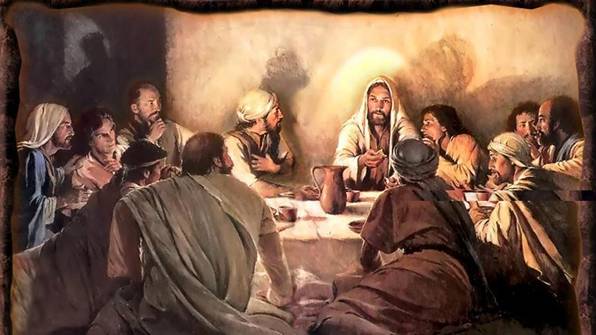
And on the first day of Unleavened Bread, when they sacrificed the Passover lamb, His disciples said to Him, “Where will You have us go and prepare for You to eat the Passover?” And He sent two of His disciples, and said to them, “Go into the city, and a man carrying a jar of water will meet you; follow him, and wherever he enters, say to the householder, ‘The teacher says, Where is My guest room, where I am to eat the Passover with My disciples?’ And he will show you a large upper room furnished and ready, there prepare for us.” And the disciples set out and went to the city, and found it as He had told them; and they prepared the Passover.
And as they were eating, He took bread, and blessed, and broke it, and give it to them, and said, “Take; this is My body.” And He took a cup, and when He had given thanks He gave it to them, and they all drank of it. And He said to them, “This is My blood of the covenant, which is poured out for many. Truly, I say to you, I shall not drink again of the fruit of the vine until that day when I drink it new in the Kingdom of God.”
And when they had sung a hymn, they went out to the Mount of Olives. (Mark 14:12-16,22-26 RSV)
“…… all those are damned who see the sacrament of the Body of Christ which is consecrated on the altar in the form of bread and wine by the words of our Lord in the hands of the priest, and do not see or believe in spirit and in God that this is really the most holy Body and Blood of our Lord Jesus Christ. It is the Most High Himself who has told us, This is My Body and Blood of the new covenant (Mark 14:22-24), and, He who eats My flesh and drinks My blood has life everlasting” (John 6:55) [St. Francis of Assisi, THE ADMONITIONS, I ]

Today’s celebration of Corpus Christi is an opportunity to renew our appreciation of the Holy Eucharist, by trying to realize just one truth among many about the Eucharist. That one truth is the “Real Presence of Christ” in the Eucharist.
The hallmark of Catholic piety is the belief in the Real Presence of Christ in the Eucharist. This belief is so fundamental a part of our faith that one simply cannot be a Catholic without it. It is very appropriate, then, that we celebrate each year this feast of Corpus Christi, the feast of the holy Eucharist.
And yet we must not concentrate so much on the fact that Christ is present in the Eucharist, that we fail to see why He is present. We should not think that Christ becomes present solely so that we may receive Him in Communion, nor should we confuse the Mass with a Eucharistic devotion such as a holy hour. In other words, we need a larger view of the Eucharist.
In the early days of the Church, the Eucharist was reserved after Mass only for the purpose of giving Communion to the sick and dying who could not come to Mass. Our own devotion helps us to see that there are other reasons for reserving the Blessed Sacrament in our churches. But we need not fear that the early Catholics doubted in any way what we call “the Real Presence”. The “Real Presence” was, you might say, taken for granted as only the starting point for the profound meaning of the Eucharist, which was celebrated as an event, a happening, making real on the altar the one sacrificial death and resurrection of Jesus Christ as the supreme worship of the Father.
The Mass is the un-bloody sacrifice of the cross. Jesus died once; He cannot die again. But through the consecration, Jesus is shown forth to us in the state of victimhood. In the words of the late Pope Pius XII, “The Eucharistic Sacrifice is the un-bloody immolation of the divine victim, which is made manifest in a sacramental manner by the separation of the sacred species and by their offering to the Father.”
Christ is present, then, in the Eucharist not as we are to one another: sometimes loving, sometimes not; sometimes interested, sometimes indifferent. Rather, He is present precisely in the highest expression of His identity as the loving Son of God the Father, who offered Himself for our sake in sacrifice. Christ is present in the reality of His death and resurrection. Every moment of Jesus Christ’s life was lived as God’s loving Son and our Savior. But in His death and resurrection this beautiful life bursts forth in a brilliant expression of devotion and concern. This expression, through the power of the Eucharist, does not end but remains without fading, freed from the limits of time and space.

Jesus is present in the Mass in the one, unique act of dying and rising as the exalted victim of sacrifice. He is present in His body, given up for us. He is present in His blood, shed for us. Under the sign of spiritual nourishment, He is the source and pledge of our resurrection from the dead. To put it another way, Jesus comes among us not in a static fashion, as in a person asleep in his bed. Rather, He is present dynamically in the great event of His dying as the victim of sacrifice and in His rising to glory.
The wonder of the Mass is that, even though we live many, many centuries after the sacrifice of Christ, we share in His offering of Himself in perfect love to the Father. With Mary, we too in a certain sense stand at the foot of the cross. This truth is proclaimed in all of the Eucharistic Prayers following the consecration. Notice particularly the words of the Third Eucharistic Prayer: “Father, calling to mind the death Your Son endured for our salvation, His glorious resurrection and ascension into heaven, and ready to greet Him when He comes again, we offer You in thanksgiving this holy and living sacrifice.” The Mass is our expression with Christ of complete love for God the Father. And, the Father responds in love by giving us in Communion His Son. The gift is God’s sign of His magnificent love for us.
To sum up, Jesus is present on our altar so that through Him, with Him, and in Him we may give all glory and honor to the Father in union with the Holy Spirit. He is still our great high priest, our mediator with the Father. The Eucharist is the sacramental reality of His death and resurrection, our offering to the Father, and Father’s pledge that we are His children who will share His life forever as His resurrected sons and daughters. How right it is that we celebrate this feast of the body and the blood of our Lord Jesus Christ.
Prayer: Lord Jesus Christ, we worship You living among us in the sacrament of Your body and blood. May we offer to our heavenly Father a solemn pledge of undivided love. May we offer to our sisters and brothers a life poured out in loving service of that Kingdom where You live with the Father and the Holy Spirit, one God, for ever and ever. Amen.