June 7, 2015
The Solemnity of the Most Holy Body and Blood of Christ (Corpus Christi)
When Moses came to the people
and related all the words and ordinances of the LORD,
they all answered with one voice,
"We will do everything that the LORD has told us."
Moses then wrote down all the words of the LORD and,
rising early the next day,
he erected at the foot of the mountain an altar
and twelve pillars for the twelve tribes of Israel.
Then, having sent certain young men of the Israelites
to offer holocausts and sacrifice young bulls
as peace offerings to the LORD,
Moses took half of the blood and put it in large bowls;
the other half he splashed on the altar.
Taking the book of the covenant, he read it aloud to the people,
who answered, "All that the LORD has said, we will heed and do."
Then he took the blood and sprinkled it on the people, saying,
"This is the blood of the covenant
that the LORD has made with you
in accordance with all these words of his."
R. (13) I will take the cup of salvation, and call on the name of the Lord.
or:
R. Alleluia.
How shall I make a return to the LORD
for all the good he has done for me?
The cup of salvation I will take up,
and I will call upon the name of the LORD.
R. I will take the cup of salvation, and call on the name of the Lord.
or:
R. Alleluia.
Precious in the eyes of the LORD
is the death of his faithful ones.
I am your servant, the son of your handmaid;
you have loosed my bonds.
R. I will take the cup of salvation, and call on the name of the Lord.
or:
R. Alleluia.
To you will I offer sacrifice of thanksgiving,
and I will call upon the name of the LORD.
My vows to the LORD I will pay
in the presence of all his people.
R. I will take the cup of salvation, and call on the name of the Lord.
or:
R. Alleluia.
Brothers and sisters:
When Christ came as high priest
of the good things that have come to be,
passing through the greater and more perfect tabernacle
not made by hands, that is, not belonging to this creation,
he entered once for all into the sanctuary,
not with the blood of goats and calves
but with his own blood, thus obtaining eternal redemption.
For if the blood of goats and bulls
and the sprinkling of a heifer's ashes
can sanctify those who are defiled
so that their flesh is cleansed,
how much more will the blood of Christ,
who through the eternal Spirit offered himself unblemished to God,
cleanse our consciences from dead works
to worship the living God.
For this reason he is mediator of a new covenant:
since a death has taken place for deliverance
from transgressions under the first covenant,
those who are called may receive the promised eternal inheritance.
Laud, O Zion, your salvation,
Laud with hymns of exultation,
Christ, your king and shepherd true:
Bring him all the praise you know,
He is more than you bestow.
Never can you reach his due.
Special theme for glad thanksgiving
Is the quick’ning and the living
Bread today before you set:
From his hands of old partaken,
As we know, by faith unshaken,
Where the Twelve at supper met.
Full and clear ring out your chanting,
Joy nor sweetest grace be wanting,
From your heart let praises burst:
For today the feast is holden,
When the institution olden
Of that supper was rehearsed.
Here the new law’s new oblation,
By the new king’s revelation,
Ends the form of ancient rite:
Now the new the old effaces,
Truth away the shadow chases,
Light dispels the gloom of night.
What he did at supper seated,
Christ ordained to be repeated,
His memorial ne’er to cease:
And his rule for guidance taking,
Bread and wine we hallow, making
Thus our sacrifice of peace.
This the truth each Christian learns,
Bread into his flesh he turns,
To his precious blood the wine:
Sight has fail’d, nor thought conceives,
But a dauntless faith believes,
Resting on a pow’r divine.
Here beneath these signs are hidden
Priceless things to sense forbidden;
Signs, not things are all we see:
Blood is poured and flesh is broken,
Yet in either wondrous token
Christ entire we know to be.
Whoso of this food partakes,
Does not rend the Lord nor breaks;
Christ is whole to all that taste:
Thousands are, as one, receivers,
One, as thousands of believers,
Eats of him who cannot waste.
Bad and good the feast are sharing,
Of what divers dooms preparing,
Endless death, or endless life.
Life to these, to those damnation,
See how like participation
Is with unlike issues rife.
When the sacrament is broken,
Doubt not, but believe ‘tis spoken,
That each sever’d outward token
doth the very whole contain.
Nought the precious gift divides,
Breaking but the sign betides
Jesus still the same abides,
still unbroken does remain.
The shorter form of the sequence begins here.
Lo! the angel’s food is given
To the pilgrim who has striven;
see the children’s bread from heaven,
which on dogs may not be spent.
Truth the ancient types fulfilling,
Isaac bound, a victim willing,
Paschal lamb, its lifeblood spilling,
manna to the fathers sent.
Very bread, good shepherd, tend us,
Jesu, of your love befriend us,
You refresh us, you defend us,
Your eternal goodness send us
In the land of life to see.
You who all things can and know,
Who on earth such food bestow,
Grant us with your saints, though lowest,
Where the heav’nly feast you show,
Fellow heirs and guests to be. Amen. Alleluia.
R. Alleluia, alleluia.
I am the living bread that came down from heaven,
says the Lord;
whoever eats this bread will live forever.
R. Alleluia, alleluia.
On the first day of the Feast of Unleavened Bread,
when they sacrificed the Passover lamb,
Jesus’ disciples said to him,
"Where do you want us to go
and prepare for you to eat the Passover?"
He sent two of his disciples and said to them,
"Go into the city and a man will meet you,
carrying a jar of water.
Follow him.
Wherever he enters, say to the master of the house,
'The Teacher says, "Where is my guest room
where I may eat the Passover with my disciples?"'
Then he will show you a large upper room furnished and ready.
Make the preparations for us there."
The disciples then went off, entered the city,
and found it just as he had told them;
and they prepared the Passover.
While they were eating,
he took bread, said the blessing,
broke it, gave it to them, and said,
"Take it; this is my body."
Then he took a cup, gave thanks, and gave it to them,
and they all drank from it.
He said to them,
"This is my blood of the covenant,
which will be shed for many.
Amen, I say to you,
I shall not drink again the fruit of the vine
until the day when I drink it new in the kingdom of God."
Then, after singing a hymn,
they went out to the Mount of Olives.
Archdiocese of Washington
Unless! A Homily for the Solemnity of Corpus Christi
By: Msgr. Charles Pope
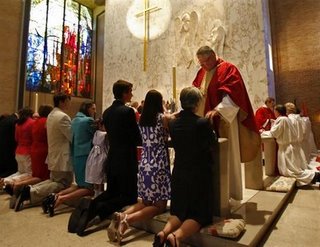
In many places, this Sunday features the (moved) Solemnity of the Most Holy Body and Blood of Christ, Our Lord.
While you may be puzzling over the title of today’s post, allow me to delay a bit before explaining. On a solemn feast like this many things occur that might be preached and taught. Hear are three areas for reflection: the reality of the Eucharist, the requirement of the Eucharist, and the reverence for the Eucharist. We will look at each in turn.
I. The Reality of the Eucharist – On this solemn feast we are called above all to faith in the fact (as revealed by the Lord Himself) that the Eucharist, the Holy Communion of which we partake, is in fact a reception of the very Body, Blood, Soul, and Divinity of Jesus Christ, whole and entire, in His glorified state. We do not partake of a symbol. The Eucharist is not a metaphor; it is truly the Lord. Neither is it a “piece” of His flesh; it is Christ, whole and entire. Scripture attests to this in many places.
A. Luke 22:19-20 And he took bread, and when he had given thanks he broke it and gave it to them, saying, “This is my body which is given for you. Do this in remembrance of me.” And likewise the cup after supper, saying, “This cup which is poured out for you is the new covenant in my blood.”
B. 1 Cor 10:16 The cup of blessing which we bless, is it not a partaking in the blood of Christ? The bread which we break, is it not a partaking in the body of Christ?
C. Luke 24:35 They recognized him in the breaking of the bread.
D. 1 Cor 11:29 For anyone who eats and drinks without recognizing the body of the Lord eats and drinks judgment on himself.
E. John 6:51 I am the living bread which came down from heaven; if any one eats of this bread, he will live for ever; and the bread which I shall give for the life of the world is my flesh.
This last quote is a profound theology of the Eucharist from Jesus Himself. He makes it clear that we are not to think of the Eucharist as symbolic or metaphorical.
As Jesus spoke the words saying that the bread was His flesh, the Jewish people grumbled in protest. But Jesus did not seek to reassure them or to say that He was speaking only symbolically when saying that they must eat His flesh. Rather, He became even more adamant, shifting His choice of words from the polite form of eating, öÜãçôå (phagete – meaning simply “to eat”), to the impolite form, ôñþãùí (trogon – meaning to “munch, gnaw or chew”).
So insistent was He that they grasp this, that He permitted most of them to leave, no longer following in His company due to this teaching (cf Jn 6:66). Yes, the Lord paid quite a price for His graphic and “hard” teaching (Jn 6:60).
Today, He asks us, Do you also want to leave me? (Jn 6:67) We must supply our answer each time we approach the altar and hear the words, “The Body of Christ.” It is at this time that we answer the Lord, “Amen,” as if to say, Lord, to whom shall we go? You have the words of eternal life! (Jn 6:68)
Would that people grasped that the Lord Himself is truly present in our Churches! Were that so, one would never be able to empty our parishes of those seeking to pray with the Lord. As it is, though, only 25% of Catholics attend Mass regularly. This is more evidence of the “narrow road” and of how few there are who find it. Jesus experienced that most left him 2000 years ago, and many today continue to leave Him (or stand far away), either through indifference or false notions.
What father would not be alarmed if one of his children stopped eating? Consider, then, God’s alarm that many of us have stopped eating. This leads us to the next point.
II. The Requirement of the Eucharist – This is where the “Unless!” in my title comes in. When I was young I thought of Church and Communion as just something my mother made me do; it was just a bunch of rituals and stuff. I never thought of it as essential for my survival. But Jesus teaches something very profound in John’s Gospel today. In effect, He says that without Holy Communion (the Eucharist) we will starve and die spiritually.
Here is what Jesus says: Unless you eat the flesh of the Son of Man and drink his blood, you have no life in you (John 6:53).
As a child and even as a young adult I never thought of Holy Communion as essential for my life, as something that, if not received regularly, would cause me to die spiritually. But it makes sense, doesn’t it? If we don’t eat food in our physical lives, we grow weak and eventually die. It is the same with Holy Communion with respect to our spiritual lives.
Remember in the Book of Exodus that the people in the desert were without food and feared for their lives. So God gave them bread from Heaven called “manna” that they collected each morning. Without eating that bread from Heaven they would never have made it to the Promised Land; they would have died in the desert.
It is the same with us. Without receiving Jesus, our Living Manna from Heaven, in Holy Communion we will not make it to our Promised Land of Heaven! I guess it’s not just a ritual after all; it is essential for our survival.
Don’t miss Holy Communion! Jesus urges you to eat.
A mother and father in my parish recently noticed that their daughter wasn’t eating. Within a very short time they took her to a doctor, who diagnosed the problem; now the young girl is able to eat again. Those parents would have moved Heaven and Earth to make sure their daughter was able to eat.
It is the same with God. Jesus urges us to eat, to receive the Holy Communion every Sunday without fail. Jesus urges us with this word: “Unless!” Holy Communion is our required food.
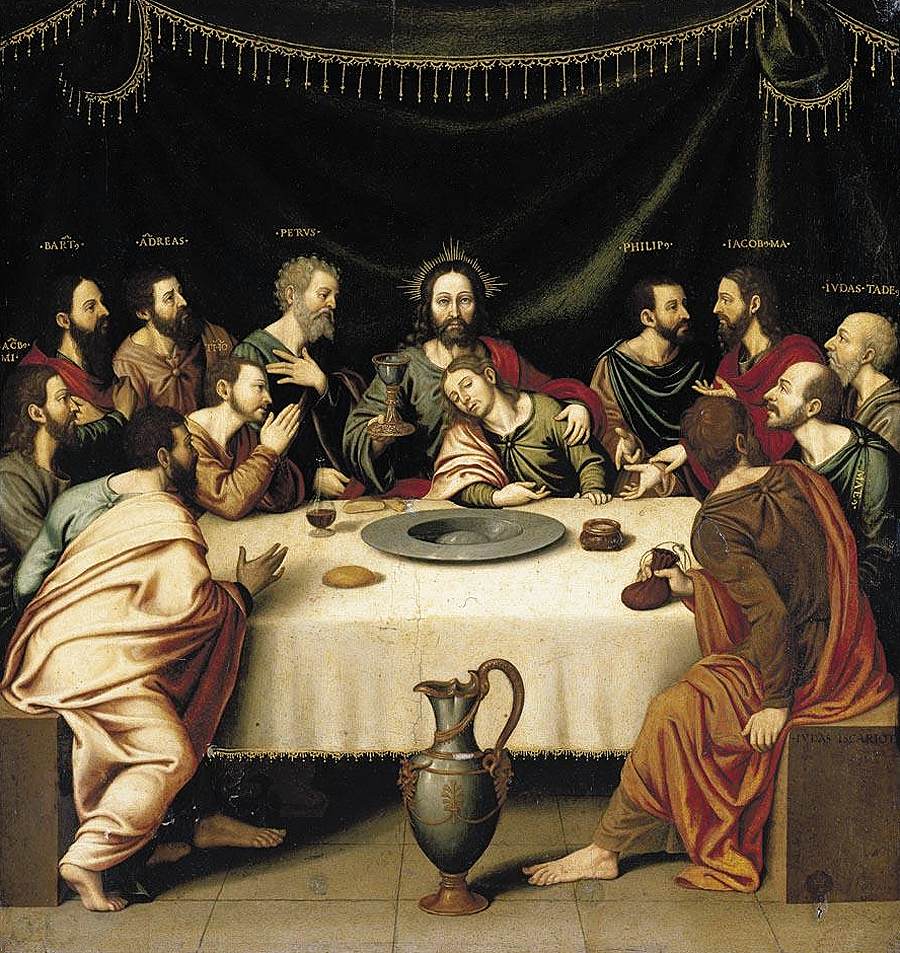
III. The Reverence for the Eucharist – One of the mistaken notions about the Eucharist is confusing this sacred meal with the table fellowship Jesus had with sinners. He was known to “welcome sinners and eat with them.” But Holy Mass is not one of those sorts of meals. The Last Supper, wherein the essential reality of the Mass was first set forth, was held in the context of the Passover. This was a sacred meal shared within the family. And thus Jesus celebrated that Last Supper with the twelve Apostles.
The confusion by many today about the difference between the sacred meal of the Eucharist and common table fellowship leads many to misconstrue the Eucharist; it also helps to explain the Church’s stance.
Those who think of the Mass as the mere table fellowship Jesus had with sinners, think of the Eucharist as a “Come one, come all” sort of meal. And many also add, “Come as you are.” In their view, there are no requirements; all that matters is that Jesus is offering. “Don’t worry,” they say, “about ‘membership’ or the need to be reconciled from sin. After all, Jesus ate with sinners and didn’t worry about that stuff.”
But again, this is not what the Last Supper was. Jesus celebrated the Mass in the context of the Passover. Such meals presupposed that the people gathered together were family. This was an intimate meal celebrated in the context of faith, however weak or strong, but a faith that was presupposed. Jesus said to them, “You are the men who have stood by me in my trials” (Lk 22:28).
This is one reason that the Church has always limited the Eucharist to those who are initiated, who are “members of Christ’s Body” through faith, and who keep communion with His Body the Church through assent to her teachings, remaining members of His Body by being in a state of grace.
It further explains the need to receive the Eucharist worthily by first confessing our serious sins through the Sacrament of Confession. St Paul teaches,
Let a person examine himself, then, and so eat of the bread and drink of the cup. For anyone who eats and drinks without discerning the body eats and drinks judgment on himself. That is why many of you are weak and ill, and some have died (1 Cor 11:28-30).
So here, too, we see that the Mass is not akin to the table fellowship that Jesus at times kept with sinners. Rather, it is a sacred meal that presupposes membership in Christ’s Body through faith and the forgiveness of all serious sins that might have severed that communion. Holy Communion is meant to strengthen a communion that already exists. And thus our “Amen” upon receiving Holy Communion is not a lie, but is consonant with the reality of existing communion.
I will write more on this in the coming week. But for now, simply note that our reverence for Holy Communion requires us to receive worthily, in a state of grace that has preserved the communion we celebrate. Further, to receive worthily also requires that we have the faith of the Church, the Body of Christ, and keep communion by a belief in conformity and communion with it.
On this Solemnity of the Body of Christ we are summoned to deepen our faith in the Lord, present in the Eucharist and acting through His Sacraments. Routine may have somewhat of a dulling effect, but it cannot be so much so that we receive the Lord of glory in any way that could be called mindless or lacking in the reverence we ought to have for Him.
Ask the Lord to anoint your mind so that you never forget your need for the Eucharist. Unless! Unless you eat the flesh of the Son of Man and drink His Blood, you have no life in you (cf Jn 6:53). But receive this great gift worthily and with a communion that befits the Holy Communion to which we are summoned.
Solemnity of The Most Holy Body and Blood of Christ, Corpus Christi
Solemnity of
The Most Holy Body and Blood of Christ
Corpus Christi
Second Sunday after Pentecost or
Thursday after Trinity Sunday

The High Feast of the Lamb ((detail) Ghent altarpiece - Jan Van Eyck 16th c
"Truly, truly, I say to you, unless you eat the flesh of the Son of man and drink His blood, you have no life in you; he who eats My flesh and drinks My blood has eternal life, and I will raise him up at the last day." -- John 6:53, 54
Corpus Christi Introduction | Catechism excerpt | Directory on Popular Piety excerpt | Readings for Corpus Christi | Family Activities | The Holy Eucharist: Resources for Devotion - Adoration - Benediction - Doctrine - Study - Link to order Holy Eucharist Booklets [the Adoremus Website] | Corpus Christi Novena [EWTN Website] | MYSTICI CORPORIS CHRISTI, Encyclical of Pope Pius XII on the Mystical Body of Christ [Vatican Website] | Homily of Pope Benedict XVI 2005 | Homily of Pope Benedict XVI 2006
Corpus Christi
The Solemnity of Corpus Christi commemorates the institution of the Holy Eucharist, paralleling Maundy Thursday (Holy Thursday) commemorating Our Lord's institution of the Eucharist. Corpus Christ was introduced in the late 13th century to encourage the faithful give special honor to the institution of the Holy Eucharist to the Blessed Sacrament. The official title of this Solemnity was changed in 1970 to The Body and Blood of Christ (Latin: Sollemnitas Sanctissimi Corporis et Sanguinis Christi); and it is still on the Roman Missal’s official Calendar for the universal Church on Thursday after Trinity Sunday; however, where it is not a day of obligation (as in the United States) it is usually celebrated on the Sunday following Trinity Sunday.
Corpus Christi became a mandatory feast in the Roman Church in 1312. But nearly a century earlier, Saint Juliana of Mont Cornillon, promoted a feast to honor the Blessed Sacrament. From early age Juliana, who became an Augustinian nun in Liége, France, in 1206, had a great veneration for the Blessed Sacrament, and longed for a special feast in its honor. She had a vision of the Church under the appearance of the full moon having one dark spot, which signified the absence of such a solemnity. She made known her ideas to the Bishop of Liége, Robert de Thorete, to the Dominican Hugh who later became cardinal legate in the Netherlands, and to Jacques Panaléon, at the time Archdeacon of Liége and who later became Pope Urban IV. Bishop Robert de Thorete ordered that the feast be celebrated in his diocese.
Pope Urban IV later published the Bull Transiturus (September 8, 1264), in which, after having extolled the love of Our Savior as expressed in the Holy Eucharist, ordered the annual celebration of Corpus Christi on the Thursday after Trinity Sunday. More than four decades later, Pope Clement V published a new decree which embodied Urban IV's decree and ordered the adoption of the feast at the General Council of Vienna (1311). Pope John XXII, successor of Clement V, urged this observance.
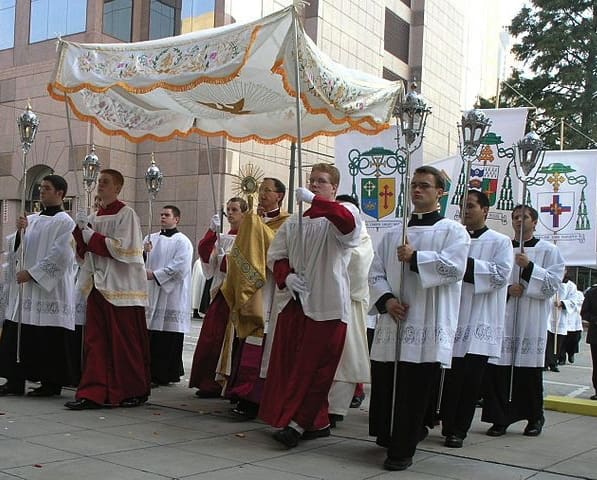
The processions on Corpus Christi to honor the Holy Eucharist were not mentioned in the decrees, but had become a principal feature of the feast's celebration by the faithfl, and became a tradition throughout Europe. These processions were endowed with indulgences by Popes Martin V and Eugene IV.
(Principal source - Catholic Encyclopedia - 1913 edition, )

Catechism of the Catholic Church - The Eucharist §§ 1322 - 1419
1324 The Eucharist is "source and summit of the Christian life." "The other sacraments, and indeed all ecclesiastical ministries and works of the apostolate, are bound up with the Eucharist and are oriented toward it. For in the blessed Eucharist is contained the whole spiritual good of the Church, namely Christ himself, our Pasch."
1325 "The Eucharist is the efficacious sign and sublime cause of that communion in the divine life and that unity of the People of God by which the Church is kept in being. It is the culmination both of God's action sanctifying the world in Christ and of the worship men offer to Christ and through him to the Father in the Holy Spirit."
1326 Finally, by the Eucharistic Celebration we already unite ourselves with the heavenly liturgy and anticipate eternal life, when God will be all in all.
1327 In brief, the Eucharist is the sum and summary of our faith: "Our way of thinking is attuned to the Eucharist, and the Eucharist in turn confirms our way of thinking."
Directory on Popular Piety and the Liturgy Excerpt:
Solemnity of the Body and Blood of Christ
160. The Solemnity of the Body and Blood of Christ is observed on the Thursday following on the solemnity of the Most Blessed Trinity. This feast is both a doctrinal and cultic response to heretical teaching on the mystery of the real presence of Christ in the Eucharist, and the apogee of an ardent devotional movement concentrated on the Sacrament of the Altar. It was extended to the entire Latin Church by Urban IV in 1264.
Popular piety encouraged the process that led to the institution of the feast of Corpus Christi, which reciprocally inspired the development of new forms of Eucharistic piety among the people of God.
For centuries, the celebration of Corpus Christi remained the principal point of popular piety's concentration on the Eucharist. In the sixteenth and seventeenth centuries, faith, in reaction to various forms of protestantism, and culture (art, folklore and literature) coalesced in developing lively and significant expressions Eucharistic devotion in popular piety.
161. Eucharistic devotion, which is so deeply rooted in the Christian faithful, must integrate two basic principles:
* the supreme reference point for Eucharistic devotion is the Lord's Passover; the Pasch as understood by the Fathers, is the feast of Easter, while the Eucharist is before all else the celebration of Paschal Mystery or of the Passion, Death and Resurrection of Christ;
* all forms of Eucharisit devotion must have an intrinsic reference to the Eucharistic Sacrifice, or dispose the faithful for its celebration, or prolong the worship which is essential to that Sacrifice.
Hence, the Rituale Romanum states "The faithful, when worshipping Christ present in the Sacrament of the Altar, should recall that this presence comes from the Sacrifice of the Eucharist, and tends towards sacramental and spiritual communion"(169).
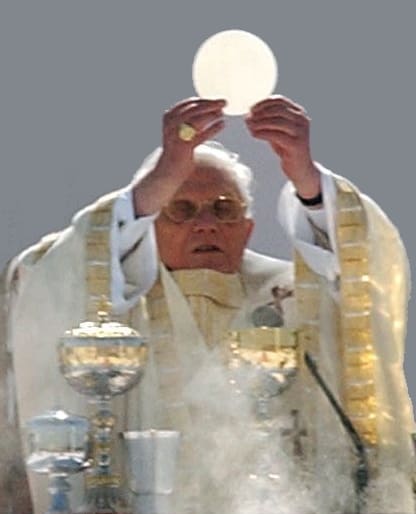
162. The Corpus Christi procession represents the typical form of an Eucharistic procession. It is a prolongation of the celebration of the Eucharist: immediately after Mass, the Sacred Host, consecrated during the Mass, is borne out of the Church for the Christian faithful "to make public profession of faith and worship of the Most Blessed Sacrament"(170).
The faithful understand and appreciate the values inherent in the procession: they are aware of being "the People of God", journeying with the Lord, and proclaiming faith in him who has become truly "God-amongst-us".
It is necessary however to ensure that the norms governing processions be observed(171), especially those ensuring respect for the dignity and reverence of the Blessed Sacrament(172). It is also necessary to ensure that the typical elements of popular piety accompanying the procession, such as the decoration of the streets and windows with flowers and the hymns and prayers used during the procession, truly "lead all to manifest their faith in Christ, and to give praise to the Lord"(173), and exclude any forms of competition.
163. The Eucharistic procession is normally concluded by a blessing with the Blessed Sacrament. In the specific case of the Corpus Christi procession, the solemn blessing with the Blessed Sacrament concludes the entire celebration: the usual blessing by the priest is replaced by the blessing with the Blessed Sacrament.
It is important that the faithful understand that this blessing is not an independent form of Eucharistic piety, but the end of a prolonged act of worship. Hence, liturgical norms prohibit "exposition of the Blessed Sacrament for the purpose of giving the blessing"(174).
(Link to complete Directory on Popular Piety andthe Liturgy on Vatican web site)
Readings for Corpus Christi
Collect:
O God, who in this wonderful Sacrament
have left us a memorial of your Passion,
grant us, we pray,
so to revere the sacred mysteries of your Body and Blood
that we may always experience in ourselves
the fruits of your redemption.
Who live and reign with God the Father
in the unity of the Holy Spirit,
one God, for ever and ever. +Amen.
Readings for Mass
Year A
First Reading: Deuteronomy 8:2-3, 14b-16a
Moses said to the people: "Remember all the way which the Lord your God has led you these forty years in the wilderness, that He might humble you, testing you to know what was in your heart, whether you would keep His commandments, or not. And He humbled you and let you hunger and fed you with manna, which you did not know, nor did your fathers know; that he might make you know that man does not live by bread alone, but that man lives by everything that proceeds out of the mouth of the Lord. Do not forget the Lord your God, who brought you out of the land of Egypt, out of the house of bondage, who led you through the great and terrible wilderness, with its fiery serpents and scorpions and thirsty ground hwere there was no water, who brought you water out of the flinty rock, who fed you in the wilderness with manna which your fathers did not know."
Second Reading: 1 Corinthians 10:16-17
The cup of blessing which we bless, is it not a participation in the Blood of Christ? The Bread which we break, is it not a participation in the Body of Christ? Because there is one bread, we who are many are one body, for we all partake of the one bread.
Gospel Reading: John 6:51-58
Jesus said to the Jews, "I am the living bread which came down from heaven; if any one eats of this bread, he will live for ever; and the bread which I shall give for the life of the world is My flesh." The Jews them disputed among themselves, saying, "How can this man give us his flesh to eat?" So Jesus said to them, "Truly, truly, I say to you unless you eat the flesh of the Son of man and drink His blood, you have no life in you; he who eats My flesh and drinks My blood has eternal life, and I will raise him up at the last day. For My flesh is food indeed, and My blood is drink indeed. He who eats My flesh and drinks My blood abides in Me, and I in him. As the living Father sent Me, and I live because of the Father, so he who eats Me will live because of Me. This is the bread which came down from heaven, not such as the fathers ate and died; he who eats this bread will live for ever."
Year B
First Reading: Exodus 24:3-8
Second Reading: Hebrews 9:11-15
Gospel Reading: Mark 14:12-16,22-26
Year C
First Reading: Genesis 14:18-20
And Melchizedek king of Salem brought out bread and wine; he was priest of God Most High. And he blessed him and said, "Blessed be Abram by God Most High, maker of heaven and earth; and blessed be God Most High, who has delivered your enemies into your hand!" And Abram gave him a tenth of everything.
Second Reading: 1 Corinthians 11:23-26
For I received from the Lord what I also delivered to you, that the Lord Jesus on the night when he was betrayed took bread, and when he had given thanks, he broke it, and said, "This is my body which is for you. Do this in remembrance of me." In the same way also the cup, after supper, saying, "This cup is the new covenant in my blood. Do this, as often as you drink it, in remembrance of me." For as often as you eat this bread and drink the cup, you proclaim the Lord's death until he comes.
Gospel Reading: Luke 9:11-17
When the crowds learned it, they followed him; and he welcomed them and spoke to them of the kingdom of God, and cured those who had need of healing. Now the day began to wear away; and the twelve came and said to him, "Send the crowd away, to go into the villages and country round about, to lodge and get provisions; for we are here in a lonely place." But he said to them, "You give them something to eat." They said, "We have no more than five loaves and two fish--unless we are to go and buy food for all these people." For there were about five thousand men. And he said to his disciples, "Make them sit down in companies, about fifty each." And they did so, and made them all sit down. And taking the five loaves and the two fish he looked up to heaven, and blessed and broke them, and gave them to the disciples to set before the crowd. And all ate and were satisfied. And they took up what was left over, twelve baskets of broken pieces.
Family Activities:
- It would be great to revive the Corpus Christi procession -- in your parish, parish school or home-schooling group. Children love processions, and this would be an excellent way to demonstrate to them the meaning and the importance of this feast of the Church year. (In some places, this was a yearly feature of parish life until about forty years ago. Your parents or grandparents might describe these festive processions.)
- Attend Eucharistic adoration with children today, if possible. -- or at least make a prayer "visit" to the Blessed Sacrament in your own church. Explain why we fall on our knees in worship before the Blessed Sacrament of our Salvation -- that the word "Eucharist" means "thanks-giving" for the Sacrifice of Christ on the Cross. (Adults would do well to review the entire section on the Holy Eucharist in the Catechism of the Catholic Church. (See links page for a web version of the Catechism on the Vatican web site.)
- Review religious vocabulary. Today presents a good opportunity to review or explore the specifically religious meaning of the words "Sacrifice", "Salvation", "Righteousness", "Redemption", "Sacrament", "Consecrate", "Feast", "Blessed".
- If you did not have a chance to do the Christian Seder Meal for Holy Thursday you may want to consider this for today.
- Pray for a priest. Talk to your children about vocations -- that is, about dedicating our lives to the service of Our Lord Jesus Christ as priests or in consecrated religious life.
- Novena Honoring the Body and Blood of Christ --
I thank You, Jesus, my Divine Redeemer, for coming upon the earth for our sake, and for instituting the adorable Sacrament of the Holy Eucharist in order to remain with us until the end of the world.
I thank You for hiding beneath the Eucharistic species Your infinite majesty and beauty, which Your Angels delight to behold, so that I might have courage to approach the throne of Your Mercy.
I thank You, most loving Jesus, for having made Yourself my food, and for uniting me to Yourself with so much love in this wonderful Sacrament that I may live in You.
I thank You, my Jesus, for giving Yourself to me in this Blessed Sacrament, and so enriching it with the treasures of Your love that You have no greater gift to give me.
I thank You not only for becoming my food but also for offering Yourself as a continual sacrifice to Your Eternal Father for my salvation.
I thank You, Divine Priest, for offering Yourself as a Sacrifice daily upon our altars in adoration and homage to the Most Blessed Trinity, and for making amends for our poor and miserable adorations.
I thank You for renewing in this daily Sacrifice the actual Sacrifice of the Cross offered on Calvary, in which You satisfy Divine justice for us poor sinners.
I thank You, dear Jesus, for having become the priceless Victim to merit for me the fullness of heavenly favors. Awaken in me such confidence in You that their fullness may descend ever more fruitfully upon my soul.
I thank You for offering Yourself in thanksgiving to God for all His benefits, spiritual and temporal, which He has bestowed upon me.
In union with Your offering of Yourself to Your Father in the Holy Sacrifice of the Mass, I ask for this special favor: (Mention your request). If it be Your holy Will, grant my request. Through You I also hope to receive the grace of perseverance in Your love and faithful service, a holy death, and a happy eternity with You in Heaven. Amen.
O Lord, You have given us this Sacred Banquet, in which Christ is received, the memory of His Passion is renewed, the mind is filled with grace, and a pledge of future glory is given to us.
You have given them bread from Heaven.
Having all sweetness within.
Let us pray. God our Father, for Your glory and our salvation You appointed Jesus Christ eternal High Priest. May the people He gained for You by His Blood come to share in the power of His Cross and Resurrection by celebrating His Memorial in this Eucharist, for He lives and reigns with You and the Holy Spirit, one God, forever. Amen.
O Jesus, since You have left us a remembrance of Your Passion beneath the veils of this Sacrament, grant us, we pray, so to venerate the sacred mysteries of Your Body and Blood that we may always enjoy the fruits of Your Redemption, for You live and reign forever. Amen.
Hymns
Saint Thomas Aquinas was given the task of composing hymns for the celebration of Corpus Christi by Pope Urban IV. These are among the best known (and beloved) of all Latin hymns, because they were traditionally sung by the people during regular Eucharistic Devotions, as well as by the choir on Holy Thursday and Corpus Christi. (Catholics over 50 can probably sing these by heart even yet.) The hymns are Lauda Sion - Pange Lingua - Tantum Ergo
BENEDICT XVI, GENERAL AUDIENCE
Wednesday, 17 November 2010
Saint Juliana of Cornillon
Dear Brothers and Sisters,
Our catechesis today deals with Saint Juliana of Cornillon, better known as Saint Juliana of Liège. Born at the end of the twelfth century, Juliana was orphaned young and became an Augustinian nun. Intelligent and cultured, she was drawn to contemplative prayer and devotion to the sacrament of the Eucharist. As the result of a recurring vision, Juliana worked to promote a liturgical feast in honour of the Eucharist. The feast of Corpus Christi was first celebrated in the Diocese of Liège, and began to spread from there. Pope Urban IV, who had known Juliana in Liège, instituted the solemnity of Corpus Christi for the universal Church and charged Saint Thomas Aquinas with composing the texts of the liturgical office. The Pope himself celebrated the solemnity in Orvieto, then the seat of the papal court, where the relic of a celebrated Eucharistic miracle, which had occurred the previous year, was kept. As we recall Saint Juliana of Cornillon, let us renew our faith in Christ’s true presence in the Eucharist and pray that the “springtime of the Eucharist” which we are witnessing in the Church today may bear fruit in an ever greater devotion to the Sacrament of Christ’s Body and Blood.
© Copyright 2010 - Libreria Editrice Vaticana
12. And the first day of unleavened bread, when they killed the Passover, his disciples said to him Where will you that we go and prepare that you may eat the Passover?
13. And he sent forth two of his disciples, and said to them, Go you into the city, and there shall meet you a man bearing a pitcher of water: follow him.
14. And wherever he shall go in, say you to the good man of the house, The Master said; Where is the guest chamber, where I shall eat the Passover with my disciples?
15. And he will show you a large upper room furnished and prepared: there make ready for us.
16. And his disciples went forth, and came into the city, and found as he had said to them: and they made ready the Passover.
CHRYS. Whilst Judas was plotting how to betray Him, the rest of the disciples were taking care of the preparation of the Passover: wherefore it is said, And the first day of unleavened bread, when they killed the Passover, his disciples said to him, Where will you that we go and prepare where you may eat the Passover.
BEDE; He means by the first day of the Passover the fourteenth day of the first month, when they threw aside leaven, and were wont to sacrifice, that is, to kill the lamb at even. The Apostle explaining this says, Christ our Passover is sacrificed for us. For although He was crucified on the next day, that is, on the fifteenth moon, yet on the night when the lamb was offered up, He committed to His disciples the mysteries of His Body and Blood, which they were to celebrate, and was seized upon and bound by the Jews; thus He consecrated the beginning of His sacrifice, that is, of His Passion.
PSEUDO-JEROME; But the unleavened bread which was eaten with bitterness, that is with bitter herbs, is our redemption, and the bitterness is the Passion of our Lord.
THEOPHYL. From the words of the disciples, Where will you that we go? it seems evident that Christ had no dwelling-place, and that the disciples had no houses of their own; for if so, they would have taken Him thither.
PSEUDO-JEROME; For they say, Where will you that we go? to show us that we should direct our steps according to the will of God. But the Lord points out with whom He would eat the Passover, and after l His custom He sends two disciples, which we have explained above; wherefore it goes on, And he sent forth two of his disciples, and he said to them, Go you into the city.
THEOPHYL. He sends two of His disciples, that is, Peter and John, as Luke says, to a man unknown to Him, implying by this that He might, if He had pleased, have avoided His Passion. For what could not He work in other men, who influenced the mind of a person unknown to Him, so that he received them? He also gives them a sign how they were to know the house, when He adds, And there shall meet you a man bearing a pitcher of water.
AUG. Mark says a pitcher, Luke a two-handled vessel; one points out the kind of vessel, the other the mode of carrying it; both however mean the same truth.
BEDE; And it is a proof of the presence of His divinity, that in speaking with His disciples,
He knows what is to take place elsewhere; wherefore it follows, And his disciples went forth, and came into the city, and found as he had said to them; and they made ready the Passover.
CHRYS. Not our Passover, but in the meanwhile that of the Jews; but He did not only appoint ours, but Himself became our Passover. Why too did He eat it? Because He was made under the Law, to redeem them that were under the Law, and Himself give rest to the Law. And lest any one should say that He did away with it, because He could not fulfill its hard and difficult obedience, He first Himself fulfilled it, and then set it to rest.
PSEUDO-JEROME. And in a mystical sense the city is the Church, surrounded by the wall of faith, the man who meets them is the primitive people, the pitcher of water is the law of the letter.
BEDE; Or else, the water is the layer of grace, the pitcher points out the weakness of those who were to show that grace to the world.
THEOPHYL. He who is baptized carries the pitcher of water, and he who bears baptism upon him comes to his rest, if he lives according to his reason; and he obtains rest, as being in the house. Wherefore it is added, Follow him.
PSEUDO-JEROME; That is, him who leads to the lofty place, where is the refreshment prepared by Christ. The lord of the house is the Apostle Peter, to whom the Lord has entrusted His house; that there may be one faith under one Shepherd. The large upper-room is the wide-spread Church, in which the name of the Lord is spoken of, prepared by a variety of powers and tongues.
BEDE; Or else, the large upper-room is spiritually the Law, which comes forth from the narrowness of the letter, and in a lofty place, that is, in the lofty chamber of the soul, receives the Savior. But it is designedly that the names both of the bearer of the water, and of the lord of the house, are omitted, to imply that power is given to all who wish to celebrate the true Passover, that is, to be embued with the sacraments of Christ, and to receive Him in the dwelling-place of their mind.
THEOPHYL. Or else, the lord of the house is the intellect, which points out the large upper room, that is, the loftiness of intelligences, and which, though it be high, yet has nothing of vain glory, or of pride, but is prepared and made level by humility. But there, that is, in such a mind Christ's Passover is prepared by Peter and John, that is by action and contemplation.
22. And as they did eat, Jesus took bread, and blessed, and broke it, and gave to them, and said, Take, eat: this is my body.
23. And he took the cup, and when he had given thanks, he gave it to them: and they all drank of it.
24. And he said to them, This is my blood of the new testament, which is shed for many.
25. Verily I say to you, I will drink no more of the fruit of the vine, until that day that I drink it new in the kingdom of God.
BEDE; When the rites of the old Passover were finished, He passed to the new, in order, that is, to substitute the Sacrament of His own Body and Blood, for the flesh and blood of the lamb. Wherefore there follows: And as they did eat, Jesus took bread; that is, in order to show that He Himself is that person to whom the Lord swore, You are a Priest for ever after the order of Melchizedec. There follows: And blessed, and broke it.
THEOPHYL. That is, giving thanks, He broke it, which we also do, with the addition of some prayers.
BEDE; He Himself also breaks the bread, which He gives to His disciples, to show that the breaking of His Body was to take place, not against His will, nor without His intervention; He also blessed it, because He with the Father and the Holy Spirit filled His human nature, which He took upon Him in order to suffer, with the grace of Divine power. He blessed bread and brake it, because He deigned to subject to death His manhood, which He had taken upon Him, in such a way as to show that there was within it the power of Divine immortality, and to teach them that therefore He would the more quickly raise it from the dead. There follows: And gave to them, and said, Take, eat: this is my body.
THEOPHYL. That, namely, which I now give and which you take. But the bread is not a mere figure of the Body of Christ, but is changed into the very Body of Christ. For the Lord said, The bread which I give you is my flesh. But the flesh of Christ is veiled from our eyes on account of our weakness, for bread and wine are things to which we are accustomed, if however we saw flesh and blood we could not bear to take them. For this reason the Lord bending Himself to our weakness keeps the forms of bread and wine, but changes the bread and wine into the reality of His Body and Blood.
CHRYS. Even now also that Christ is close to us; He who prepared that table, Himself also consecrates it. For it is not man who makes the offerings to be the Body and Blood of Christ, but Christ who was crucified for us. The words are spoken by the mouth of the Priest, and are consecrated by the power and the grace of God. By this word which He spoke, This is my body, the offerings are consecrated; and as that word which says, Increase and multiply, and fill the earth, was sent forth but once, yet has its effect throughout all time, when nature does the work of generation; so also that voice was spoken once, yet gives confirmation to the sacrifice through all the tables of the Church even to this day, even to His advent.
PSEUDO-JEROME; But in a mystical sense, the Lord transfigures into bread His body, which is the present Church, which is received in faith, is blessed in its number, is broken in its sufferings, is given in its examples, is taken in its doctrines; and He forms His Blood in the chalice of water and wine mingled together, that by one we may be purged from our sins, by the other redeemed from their punishment. For by the blood of the lamb our houses are preserved from the smiting of the Angel, and our enemies perish in the waters of the Red sea, which are the sacraments of the Church of Christ. Wherefore it goes on: And he took the cup, and when he had given thanks, he gave it to them. For we are saved by the grace of the Lord, not by our own deserts.
GREG. When His Passion was approaching, He is said to have taken bread and given thanks. He therefore gave thanks, who took upon Him the stripes of other men's wickedness; He who did nothing worthy of smiting, humbly gives a blessing in His Passion, to show us, what each should do when beaten for his own sins, since He Himself bore calmly the stripes due to the sin of others; furthermore to show us, what we who are the subjects of the Father should do under correction, when He who is His equal gave thanks under the lash.
BEDE; The wine of the Lord's cup is mixed with water, because we should remain in Christ and Christ in us. For on the testimony of John, the waters are the people, and it is not lawful for any one to offer either wine alone, or water alone, lest such an oblation should mean that the head may be severed from the members, and either that Christ could suffer without love for our redemption, and that we can be saved or be offered to the Father without His Passion. It goes on: And they all drank of it.
PSEUDO-JEROME; Happy intoxication, saving fullness, which the more we drink gives the greater sobriety of mind!
THEOPHYL. Some say that Judas did not partake in these mysteries, but that he went out before the Lord gave the Sacrament. Some again say that He gave him also of that Sacrament.
CHRYS. For Christ offered His blood to him who betrayed Him, that he might have remission of his' sins, if he had chosen to cease to be wicked.
PSEUDO-JEROME; Judas therefore drinks and is not satisfied, nor can he quench the thirst of the everlasting fire, because he unworthily partakes of the mysteries of Christ. There are some in the Church whom the sacrifice does not cleanse, but their foolish thought draws them on to sin, for they have plunged themselves in the stinking slough of cruelty.
CHRYS. Let there not be therefore a Judas at the table of the Lord; this sacrifice is spiritual food, for as bodily food, working on a belly filled with humors which are opposed to it, is hurtful, so this spiritual food if taken by one polluted with wickedness, rather brings him to perdition, not by its own nature, but through the fault of the recipient. Let therefore our mind be pure in all things, and our thought pure, for that sacrifice is pure. There follows: And he said to them, This is my blood of the New Testament, which is shed for many.
BEDE; This refers to the different circumstances of the Old Testament, which was consecrated by the blood of calves and of goats; and the lawgiver said in sprinkling it, This is the blood of the Testament which God has enjoined to you. It goes on: Which is shed for many.
PSEUDO-JEROME; For it does not cleanse all. It goes on: Verily I say to you, I will drink no more of the fruit of the vine, until that day that I drink it new in the kingdom of God.
THEOPHYL. As if He had said, I will not drink wine until the resurrection; for He calls His resurrection the kingdom, as He then reigned over death. But after His resurrection He ate and drank with His disciples, showing that it was He Himself who had suffered. But He drank it new, that is, in a new and strange manner, for He had not a body subject to suffering, and requiring food, but immortal and incorruptible. We may also understand it in this way. The vine is the Lord Himself, by the offspring of the vine is meant mysteries, and the secret understanding, which He Himself begets, who teaches man knowledge. But in the kingdom of God, that is, in the world to come, He will drink with His disciples mysteries and knowledge, teaching us new things, and revealing what He now hides.
BEDE; Or else, Isaiah testifies that the synagogue is called the vine or the vineyard of the Lord, saying, The vineyard of the Lord of hosts is the house of Israel. The Lord therefore when about to go to His Passion, says, I will drink no more of the fruit of the vine, as if He had said openly, I will no longer delight in the carnal rites of the synagogue, in which also these rites of the Paschal Lamb have held the chief place. For the time of my resurrection shall come, that day shall come, when in the kingdom of heaven, that is, raised on high with the glory of immortal life, I will be filled with a new joy, together with you, for the salvation of the same people born again of the fountain of spiritual grace.
PSEUDO-JEROME; But we must consider that here the Lord changes the sacrifice without changing the time; so that we never celebrate the Caena Domini before the fourteenth moon. He who celebrates the resurrection on the fourteenth moon, will celebrate the Caena Domini on the eleventh moon, which was never done in either Old or New Testament.
26. And when they had sung an hymn, they went out into the mount of Olives.
THEOPHYL. As they returned thanks, before they drank, so they return thanks after drinking; wherefore it is said, And when they had sung a hymn, they went out into the mount of Olives, to teach us to return thanks both before and after our food.
PSEUDO-JEROME; For by a hymn he means the praise of the Lord, as is said in the Psalms, The poor shall eat and be satisfied; they that seek after the Lord shall praise him. And again, All such as be fat upon earth have eaten and worshipped.
THEOPHYL. He also shows by this that He was glad to die for us, because when about to be betrayed, He deigned to praise God. He also teaches us when we fall into troubles for the sake of the salvation of many, not to be sad, but to give thanks to God, who through our distress works the salvation of many.
BEDE; That hymn in the Gospel of John may also be meant, which the Lord sang, returning thanks to the Father, in which also He prayed, raising His eyes to heaven, for Himself and His disciples, and those who were to believe, through their word.
THEOPHYL. Again, He went out into a mountain, that they might come to Him in a lonely place, and take Him without tumult. For if they had come to Him, whilst He was abiding in the city, the multitude of the people would have been in an uproar, and then His enemies, who took occasion against Him, should seem to have slain Him justly, because He stirred up the people.
BEDE; Beautifully also does the Lord lead out His disciples, when they had tasted His Sacraments, into the mount of Olives, to show typically that we ought through the reception of the Sacraments to rise up to higher gifts of virtue, and graces of the Holy Ghost, that we may be anointed in heart.
PSEUDO-JEROME; Jesus also is held captive on the mount of Olives, whence He ascended to heaven, that we may know, that we ascend into heaven from that place in which we watch and pray; there we are bound and do not tend back again to earth.
Catena Aurea Mark 14