Free Republic
Browse · Search
Religion
Topics · Post Article

To: All
Catholic Spiritual Direction.com

The Mystery of Faith

June 7, 2015 by Dan Burke  
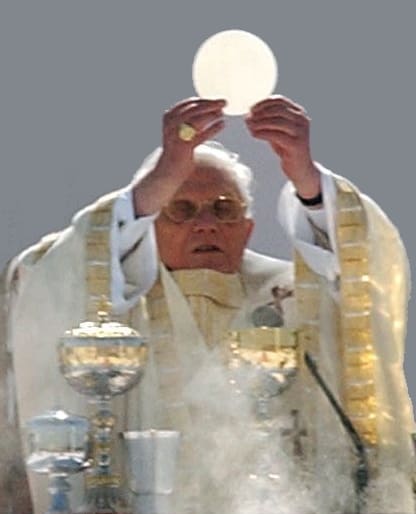
BenedictXVIEucharistJesusChrist2

Presence of God – O Jesus, I believe that You are present in the Blessed Sacrament of the altar,
and I adore You. Increase my faith.

MEDITATION

In the Canon [Eucharistic Prayer] of the Mass, the Eucharist is called “Mysterium fidei,” the Mystery of faith; indeed, only faith can make us see God present under the appearances of bread. Here, as St. Thomas says, the senses do not help at all—sight, touch, and taste are deceived, finding in the consecrated Host only a little bread. But what matters? We have the word of the Son of God; the word of Christ, who declared: “This is My Body … This is My Blood” and we firmly believe in His word. “Credo quidquid dixit Dei Filius, nil hoc verbo Veritatis verius.” I believe everything the Son of God has said; nothing can be truer than this word of Truth (Adoro Te Devote). We firmly believe in the Eucharist, we have no doubts about it; unfortunately, however, we must admit that our faith is often weak and dull. Although we may not live far from a church, although we may perhaps dwell under the same roof with Jesus in the Blessed Sacrament, it is easy to become rather indifferent, or even cold, in the presence of this great reality. Alas, our coarse nature gradually grows accustomed to even the most sublime and beautiful realities, so that they no longer impress us and have no power to move us, especially when they are near at hand. Thus it happens that while we believe in the ineffable presence of Jesus in the Blessed Sacrament, we pay little or no attention to the greatness of this reality, and we fail to have the lively, concrete appreciation of it which the saints had. Let us then repeat, very humbly and confidently, the Apostles’ beautiful prayer: “Domine, adauge nobis fidem,” Lord, increase our faith! (Luke 17:5).

COLLOQUY
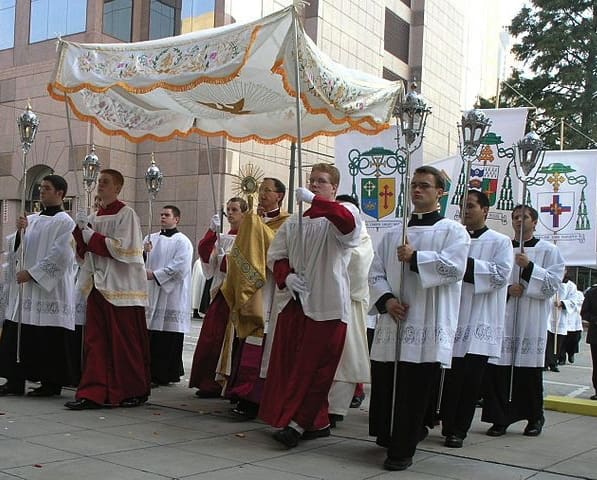
BlessedSacramentProcessionFirstAnnualSoutheasternEucharisticCongressCharlotteNorthCarolina20050924-01

“Praise and thanks to you, O blessed faith! You tell me with certitude that the Blessed Sacrament of the altar, the heavenly Manna, is no longer bread, but my Lord Jesus Christ who is wholly present there for love of me.

“One day, O Jesus, full of love and of goodness, You sat beside the well to await the Samaritan woman, that You might convert and save her. Now, You dwell on our altars, hidden in the consecrated Host, where You wait and sweetly invite souls, to win them to Your love. From the tabernacle you seem to say to us all: ‘O men, why do you not come to Me, who love you so much? I am not come to judge you! I have hidden myself in this Sacrament of love only to do good and to console all who have recourse to Me’; I understand, O Lord; love has made You our prisoner; the passionate love You have for us has so bound You that it does not permit You to leave us.

“O Lord, You find Your delight in being with us, but do we find ours in being with You? Especially do we, who have the privilege of dwelling so near Your altar, perhaps even in Your very own house, find our delight in being with You? Oh! how much coldness, indifference, and even insults You have to endure in this Sacrament, while You remain there to help us by Your presence!

“O God, present in the Eucharist, O Bread of Angels, O heavenly Food, I love You; but You are not, nor am I, satisfied with my love. I love You, but I love You too little! Banish from my heart, O Jesus, all earthly affections and give place, or better, give the whole place to Your divine love. To fill me with Yourself, and to unite Yourself entirely to me, You come down from heaven upon the altar every day; justly then, should I think of nothing else but of loving, adoring, and pleasing You. I love You with my whole soul, with all my strength. If You want to make a return for my love, increase it and make it always more ardent!” (St. Alphonsus).

39 posted on 06/07/2015 3:24:06 PM PDT by Salvation ("With God all things are possible." Matthew 19:26)
[ Post Reply | Private Reply | To 38 | View Replies ]


To: All
Catholic Culture

http://www.catholicculture.org/culture/liturgicalyear/pictures/corpus_christi.jpg


Daily Readings for:June 07, 2015
(Readings on USCCB website)

Collect: O God, who in this wonderful Sacrament have left us a memorial of your Passion, grant us, we pray, so to revere the sacred mysteries of your Body and Blood that we may always experience in ourselves the fruits of your redemption. Who live and reign with God the Father in the unity of the Holy Spirit, on God, for ever and ever.

RECIPES

o    Lebkuchen I

ACTIVITIES

o    Corpus Christi Hymns

o    Corpus Christi Processions

o    Customs for the Feast of Corpus Christi

o    Eucharist Hymn: Adoro Te Devote - Hidden God

o    Eucharist Hymn: Ave Verum Corpus

o    Eucharist Hymn: Pange Lingua

o    Eucharist Hymn: Sacris Solemniis - At This Our Solemn Feast

o    Eucharist Hymn: Tantum Ergo - Down in Adoration Falling

o    Eucharist Hymn: Verbum Supernum - The Word of God

o    History of Corpus Christi Processions

o    Stitching Feast-Day Symbols

PRAYERS

o    Book of Blessings: Blessing Before and After Meals: Easter (1st Plan)

o    Litany of the Most Blessed Sacrament

o    Chaplet of the Blessed Sacrament

o    Novena Honoring the Body and Blood of Christ

o    A Prayer to Jesus in the Tabernacle

o    Adoration Prayer

o    Eucharistic Procession on the Feast of Corpus Christi

o    Novena for Corpus Christi

o    Novena to the Sacred Heart

LIBRARY

o    Saint Juliana of Cornillon | Pope Benedict XVI

o    The Eucharist: To Be Loved and To Be Lived | Bishop Thomas J. Tobin

o    The Sacrament of the Eucharist | Rev. G. D. Smith D.D., Ph.D.

·         Ordinary Time: June 7th

·         Solemnity of the Most Holy Body and Blood of Christ


Old Calendar: Second Sunday after Pentecost ; Other Titles: Corpus Christi

While they were eating, he took bread, said the blessing, broke it, gave it to them, and said, "Take it; this is my body." Then he took a cup, gave thanks, and gave it to them, and they all drank from it. He said to them, "This is my blood of the covenant, which will be shed for many."

Where the Solemnity of the Body and Blood of Christ is not observed as a holy day, it is assigned to the Sunday after Trinity Sunday, which is then considered its proper day in the calendar.

Please see this special section on Corpus Christi.

Click here for commentary on the readings in the Extraordinary Form of the Roman Rite.


Corpus Christi Sunday
Corpus Christi (Body and Blood of Christ) is a Eucharistic solemnity, or better, the solemn commemoration of the institution of that sacrament. It is, moreover, the Church's official act of homage and gratitude to Christ, who by instituting the Holy Eucharist gave to the Church her greatest treasure. Holy Thursday, assuredly, marks the anniversary of the institution, but the commemoration of the Lord's passion that very night suppresses the rejoicing proper to the occasion. Today's observance, therefore, accents the joyous aspect of Holy Thursday.

The Mass and the Office for the feast was edited or composed by St. Thomas Aquinas upon the request of Pope Urban IV in the year 1264. It is unquestionably a classic piece of liturgical work, wholly in accord with the best liturgical traditions. . . It is a perfect work of art.

— Excerpted from The Church's Year of Grace, Pius Parsch.

In the words of St. Thomas:

"How inestimable a dignity, beloved brethren, divine bounty has bestowed upon us Christians from the treasury of its infinite goodness! For there neither is nor ever has been a people to whom the gods were so nigh as our Lord and God is nigh unto us.

"Desirous that we be made partakers of His divinity, the only-begotten Son of God has taken to Himself our nature so that having become man, He would be enabled to make men gods. Whatever He assumed of our nature He wrought unto our salvation. For on the altar of the Cross He immolated to the Father His own Body as victim for our reconciliation and shed His blood both for our ransom and for our regeneration. Moreover, in order that a remembrance of so great benefits may always be with us, He has left us His Body as food and His Blood as drink under appearances of bread and wine.

"O banquet most precious! O banquet most admirable! O banquet overflowing with every spiritual delicacy! Can anything be more excellent than this repast, in which not the flesh of goats and heifers, as of old, but Christ the true God is given us for nourishment? What more wondrous than this holy sacrament! In it bread and wine are changed substantially, and under the appearance of a little bread and wine is had Christ Jesus, God and perfect Man. In this sacrament sins are purged away, virtues are increased, the soul is satiated with an abundance of every spiritual gift. No other sacrament is so beneficial. Since it was instituted unto the salvation of all, it is offered by Holy Church for the living and for the dead, that all may share in its treasures.

"My dearly beloved, is it not beyond human power to express the ineffable delicacy of this sacrament in which spiritual sweetness is tasted in its very source, in which is brought to mind the remembrance of that all-excelling charity which Christ showed in His sacred passion? Surely it was to impress more profoundly upon the hearts of the faithful the immensity of this charity that our loving Savior instituted this sacrament at the last supper when, having celebrated the Pasch with His disciples. He was about to leave the world and return to the Father. It was to serve as an unending remembrance of His passion, as the fulfillment of ancient types — this the greatest of His miracles. To those who sorrow over His departure He has given a unique solace."


Symbols: The usual symbol for the Holy Eucharist is a chalice, with a host rising out of it.

The chalice is shown with a hexagonal base, as a rule, symbolizing the Six Attributes of the Deity (power, wisdom, majesty, mercy, justice and love), and with a richly wrought stem of gold, studded with precious stones. The host is shown as the typical circular wafer, upon which may be imprinted the letters I. N. R. I., from which proceed rays of light, symbolical of the Real Presence, the substantial presence of Christ under the species of bread and wine.

An altar, upon which is set a cross, two or more candles in their tall candlesticks, a chalice and a ciborium, is another symbol often seen.

Things to Do:

The fourteenth encyclical letter of Pope John Paul II Ecclesia de Eucharistia (On the Eucharist in Its Relationship to the Church) released on Holy Thursday, April 17, 2003. The focus of the papal encyclical is the celebration of the Eucharist; the Pope reminds us that the Eucharist is the center of Catholic spiritual life.

Redemptionis Sacramentum (On certain matters to be observed or to be avoided regarding the Most Holy Eucharist), an Instruction released by the Congregation for Divine Worship and the Discipline of the Sacraments on March 25, 2004.


40 posted on 06/07/2015 3:42:43 PM PDT by Salvation ("With God all things are possible." Matthew 19:26)
[ Post Reply | Private Reply | To 39 | View Replies ]

Free Republic
Browse · Search
Religion
Topics · Post Article


FreeRepublic, LLC, PO BOX 9771, FRESNO, CA 93794
FreeRepublic.com is powered by software copyright 2000-2008 John Robinson