Skip to comments.
Geologist resurrects Jesus family tomb spat
World Net Daily ^
| April 6, 2015
Posted on 04/06/2015 9:07:43 PM PDT by concernedcitizen76
(NBC NEWS) A long-running archaeological controversy has been resurrected, thanks to a newly revealed analysis of scrapings from a first-century tomb in East Jerusalem and a bone box attributed to “James, son of Joseph, brother of Jesus.” The analysis, described on Easter Sunday in The New York Times and the Jerusalem Post, links the limestone box (also known as an ossuary) to the tomb — which in turn has been linked to Jesus’ family story.
Both the box and the tomb have previously created media sensations: In 2004, Israeli authorities charged antiquities dealer Oded Golan with forging the “Jesus inscription” on the bone box, but the dealer was acquitted in 2012 after drawn-out legal proceedings.
Meanwhile, in 2007, a TV documentary titled “The Lost Tomb of Jesus” claimed that the tomb could have been the burial spot for Jesus and his family, based on a statistical analysis of the genealogical relationships between the names listed in the inscriptions.
(Excerpt) Read more at wnd.com ...
TOPICS: Religion & Culture
KEYWORDS: concerntroll; jamesossuary; jesus; odedgolan; ossuary; retread; smearofodedgolan; talpiottomb; thelosttombofjesus; tomb
Navigation: use the links below to view more comments.
first 1-20, 21-32 next last
Not sure if this article has been posted.
To: concernedcitizen76
2
posted on
04/06/2015 9:10:01 PM PDT
by
M Kehoe
To: M Kehoe
It seems the UK Independent had this story, as well. Here’s their take.
“While the results are likely to rekindle the debate surrounding the possible remains of Jesus, they are still far from accepted in scientific circles. The collector who owns the James ossuary told the Times Dr Shimron’s work determines nothing “conclusively”, while other Jerusalem archaeologists say they await its publication in a peer-reviewed journal.”
3
posted on
04/06/2015 9:17:40 PM PDT
by
concernedcitizen76
(Term limits. Repeal the 16th and 17th amendments. Sunset bureaucracies.)
To: concernedcitizen76
“While the results are likely to rekindle the debate surrounding the possible remains of Jesus,There is no "debate." However, maybe the remains of His kin?
5.56mm
4
posted on
04/06/2015 9:20:51 PM PDT
by
M Kehoe
To: M Kehoe
It seems they found a 1st century burial box for bones from the 1st century that reads: “James son of Joseph brother of Jesus.”
But it may or may not be a fake. It’s not an easy story to follow, so I don’t know. lol
5
posted on
04/06/2015 9:32:23 PM PDT
by
concernedcitizen76
(Term limits. Repeal the 16th and 17th amendments. Sunset bureaucracies.)
To: M Kehoe
If it Jesus’s brother James, mentioned in the NT, in the box that would be amazing. Maybe they could do a DNA analysis.
6
posted on
04/06/2015 9:35:45 PM PDT
by
concernedcitizen76
(Term limits. Repeal the 16th and 17th amendments. Sunset bureaucracies.)
To: concernedcitizen76
I’ve always wanted to believe this story but the collector they mention has a very chequered history of including some fakes in his stuff
not sure.
7
posted on
04/06/2015 9:56:53 PM PDT
by
faithhopecharity
(A brilliantly intelligent comment sent thru an amazingly stupid spell checker)
To: concernedcitizen76
But it may or may not be a fake. It’s not an easy story to follow, so I don’t know. lol
That is sort of how I viewed it.
8
posted on
04/06/2015 9:59:49 PM PDT
by
boycott
To: concernedcitizen76
9
posted on
04/06/2015 10:00:31 PM PDT
by
faithhopecharity
(A brilliantly intelligent comment sent thru an amazingly stupid spell checker)
To: concernedcitizen76
what would the DNA be compared to ?
10
posted on
04/06/2015 10:04:39 PM PDT
by
stylin19a
(obama = Eddie Mush)
To: concernedcitizen76
To: stylin19a
“what would the DNA be compared to ?”
Easy question
Modern day Jews because
Because the genealogy of Jesus makes him the lawful king of Israel. Since he died childless then the descendants of his brother James would have a valid claim to Davids’ throne.
12
posted on
04/06/2015 10:53:30 PM PDT
by
Fai Mao
(Genius at Large)
To: Fai Mao
“Because the genealogy of Jesus makes him the lawful king of Israel”
The Jews have never have accepted Jesus as King. Some claim he never existed.
13
posted on
04/06/2015 11:38:40 PM PDT
by
Politicalkiddo
(Gringa for Cruz 2016!)
To: concernedcitizen76
It seems they found a 1st century burial box for bones from the 1st century that reads: “James son of Joseph brother of Jesus.” All three of those names were common in 1st Century Jerusalem. . . but the name Jeshua was actually added to the ossuary and was not carved contemporaneously with the other inscriptions. Even though the antiquities dealer was acquitted, he had other antiquities in his workshop when arrested in the process of being faked. . . including having inscriptions being added to old items.
Here is an interesting analysis of the inscription on the James Ossuary by a specialist in ancient Aramaic.
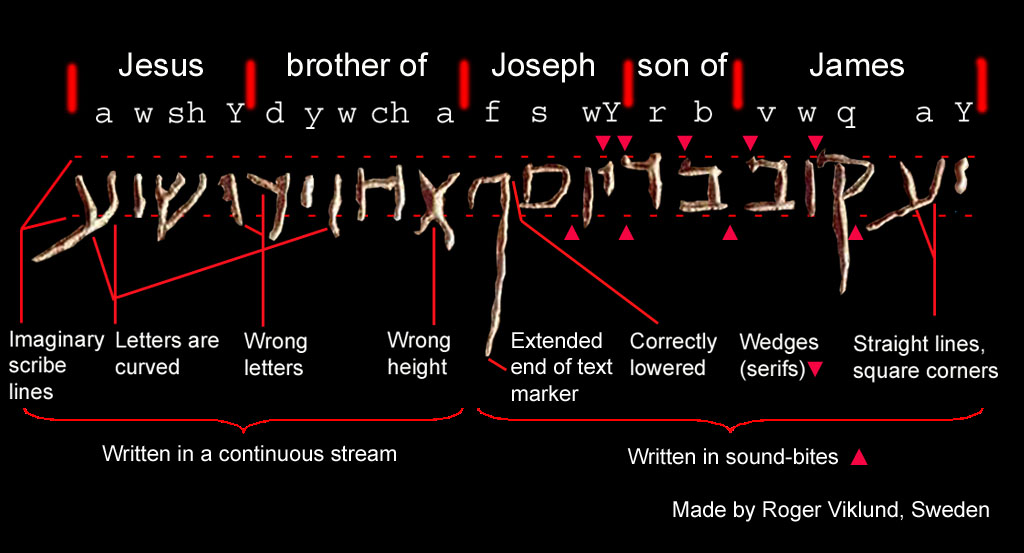
The two different types of Aramaic Script on the James Ossuary — the script on the left was added by someone who doesn't know Aramaic.
WHAT ARE THE DIFFERENCES BETWEEN THE TWO SCRIPTS?
- The first part is correctly spelled. The second part is not correctly spelled. Depending on how you chose to interpret certain letters of the second part, they are either incorrectly done or the sentence is misspelled. Two letters – d (dalet) in “brother of” and Y in “Jesus” – are done incorrectly. And even if you presuppose that the letters should be d and Y, the sentence is grammatically wrong.
- To be able to write in a straight line, one or two scribe lines were often drawn, on the top and the bottom respectively. The first part follows a straight line (apart from the last letters, which correctly drops). If these imaginary scribe lines are extended, the letters of the second part are below the lines.
- The letters of the first half are of the same size, while the letters of the second half differs from both the letters of the first half and each other.
- The letters of the first part are correctly formed with straight lines and square corners, while the letters of the second part often are curved.
- There are wedges (serifs) on some of the letters of the first half (those that should have) while there are no wedges on any letters of the second half (though there should have been on some).
- “The spacing of the first part … is extremely accurate. In Antiquity, texts were written as-spoken. The first part is written correctly in sound-bites: iA cov bAR io sEf and the second part is written in a continuous stream achoiiashoua.
- Not only is the first correctly written, but it is also correctly stressed. The final pe [in Joseph] drops because the voice drops at the end when the words are spoken.”, Rochelle Altman
- This final pe is also extended. This is a(n) “end of text”-marker, and it shows that the original inscription said "James, son of Joseph”.
- The second part (achwydyshwa) begins at the same height as the last letter of the first inscription (yaqwvbrywsf). However, the last letter of the first inscription was correctly lowered, as it would have been done. And if the same person did the entire inscription at the same time, he (or she) should have begun the achwydyshwa-inscription at the same height as the second last letter of the first inscription.
The spelling was done something like this: yaqwvbrywsfachwydyshwa when it should have been done something like this: yaqwvbrywsfachwydyshwa
“If this had been written at the same time. or even shortly after, the starting stroke of the aleph would have been at the same height as the samekh, bets, and the ayin-iod of Ya'acov. It is not. The starting stroke of the aleph erroneously begins at the same height as the correctly lowered peh.”, Rochelle Altman
“The script of the second part is a conglomeration of unrelated graphs from across the centuries and not a coherent script design. This peculiar diversity suggests that the writer chose graphs from examples on other ossuaries and documents stored in a cave or dug out tomb.”,
“The wedges also indicate that Jacob ben Josef lived and died during the age of Herod.” Rochelle Altman, Final Report on the James Ossuary, Rochelle Altman, Final Report on the James Ossuary
According to Rochelle Altman, the writer of the first part spoke fluid Aramaic and was fully literate, while it is doubtful whether the writer of the second part knew Aramaic at all.
14
posted on
04/07/2015 12:39:04 AM PDT
by
Swordmaker
(This tag line is a Microsoft insult free zone... but if the insults to Mac users contnue...)
To: Alamo-Girl; albee; AnalogReigns; AnAmericanMother; Angelas; AniGrrl; annalex; annyokie; ...
Shroud of Turin Ping to thread on the post just above this one debunking the Jesus Ossuary and through that debunking the Jesus Family Tomb. . . which this thread is about.
If you want on or off the Shroud of Turin Ping list, Freepmail me.
15
posted on
04/07/2015 12:42:32 AM PDT
by
Swordmaker
(This tag line is a Microsoft insult free zone... but if the insults to Mac users contnue...)
To: Swordmaker
Interesting stuff. Although as detailed as it is - I’m guessing they forgot to tell us that Aramaic is written from right to left!?
16
posted on
04/07/2015 1:25:14 AM PDT
by
21twelve
(http://www.freerepublic.com/focus/f-news/2185147/posts It is happening again.)
To: concernedcitizen76
The same thicket of questions arises as for other challenges to the classic Resurrection.
Why would Jesus’ family want to sustain a story that meant a huge amount of controversy and trouble. It would have been a lot easier on them to put the story to rest, if worldly standards are any guide.
17
posted on
04/07/2015 3:37:25 AM PDT
by
HiTech RedNeck
(Embrace the Lion of Judah and He will roar for you and teach you to roar too. See my page.)
To: 21twelve
Which it is. Also James and Jacob are considered the same name.
18
posted on
04/07/2015 3:41:06 AM PDT
by
HiTech RedNeck
(Embrace the Lion of Judah and He will roar for you and teach you to roar too. See my page.)
To: Swordmaker
Golan has been debunked as a faker.
To: Swordmaker; concernedcitizen76; Tax-chick; GregB; SumProVita; narses; bboop; SevenofNine; ...
Thank you, Swordmaker, for the well researched and cogent response to this thread. Twice a year, the msm use key christian holy days to publish baseless articles intended to arouse doubt in followers of Jesus Christ.
Imagine the reaction if they were to try a similar tactic with Mohammad.
20
posted on
04/07/2015 4:23:55 AM PDT
by
NYer
(Without justice - what else is the State but a great band of robbers? - St. Augustine)
Navigation: use the links below to view more comments.
first 1-20, 21-32 next last
Disclaimer:
Opinions posted on Free Republic are those of the individual
posters and do not necessarily represent the opinion of Free Republic or its
management. All materials posted herein are protected by copyright law and the
exemption for fair use of copyrighted works.
FreeRepublic.com is powered by software copyright 2000-2008 John Robinson