
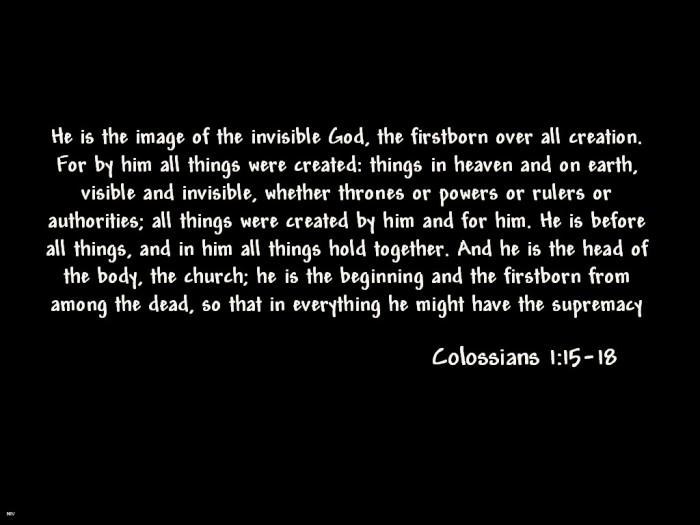
The lds-org denies that Jesus is the Creator, that everything was created THROUGH Him, BY Him and FOR Him.
They deny that Jesus created even the angels out of nothing.
They do NOT teach the truth about Jesus.
Posted on 02/13/2012 7:25:21 AM PST by greyfoxx39
The following is an essay by Robert L. Millet, professor of religion and emeritus dean of Religious Education at Brigham Young University.
The issue of whether Latter-day Saints (Mormons) are Christian is not a new one, but the current media climate has caused the question to be revisited in both private and public conversations. No matter the circumstances, the underlying question is an important one and a matter whose implications reach well beyond the momentary news cycle.
Backgrounds
In the early decades of the 19th century, upstate New York came to be known as the “Burnt Over District” during the second Great Awakening in American history. Many in that day were spiritual searchers, seekers who sought in earnest for “the ancient order of things.” This movement, known as Christian Primitivism or Restorationism, was made up of men and women who yearned for the simple Christianity of first century Galilean peasants, not what they saw as the sterile, creedalized and institutionalized religion the Christian church had become through the centuries. The two most successful products of this time were the Disciples of Christ, founded by Alexander Campbell, and The Church of Jesus Christ of Latter-day Saints, founded by Joseph Smith.
Joseph Smith explained that in his first vision, he was instructed to join none of the existing churches in the area, since they were believing in incorrect doctrines and lacked the apostolic power given to Peter and the apostles by Jesus (Matthew 16:13-19), and because God intended to bring about the scripturally-promised “restitution of all things” (Acts 3:21). Obviously this announcement was not received enthusiastically by pastors and priests and religious scholars of the day and became the rub between traditional Christianity and what the Mormons know as the “restored gospel.” That wedge has been in place for almost two centuries now. Joseph Smith’s ministry continued for 24 years after his first vision (he was murdered in June of 1844), and the Latter-day Saints remained an object of interest, curiosity and suspicion during that time. The movement west under the leadership of Brigham Young, Joseph’s successor, allowed the Saints to be isolated in the valley of the Great Salt Lake and to establish their “Zion,” a spiritual commonwealth. The 20th century dawned upon a Mormonism that was ready to become a contributing partner in America’s pluralistic society.
It’s worth noting that the cry of “Mormons are not Christian” was not something heard very often, if at all, during the days of Joseph Smith. People knew that the faith of the Latter-day Saints was in fact quite different than their own, that the followers of Joseph Smith believed in doctrinal matters that deviated from “traditional” Christianity, but folks seemed to assume that Mormonism fit under the umbrella of Christianity. I grew up in Baton Rouge, Louisiana, during the 1950s and 1960s. Most of my friends were either Southern Baptist or Roman Catholic. We spoke of religion occasionally and knew that doctrinal differences existed between us, but it would never have occurred to my buddies to exclude me and my family, or the other Latter-day Saints in our area for that matter, from the category of Christian. Simply put, we were Christian. My first encounter with the fact that there were people in the world who considered us to be non-Christian or that we constituted a “cult” came while I was serving as a young full-time missionary for the Church in the eastern United States. In those days conservative Protestants would meet us at the door with a copy of Walter Martin’s Kingdom of the Cults (1965). I think I had never heard the word cult before that time, and I certainly had never been told that I wasn’t Christian. Such sentiments spread within the evangelical Christian world during the 1980s with the release of Ed Decker’s movie The Godmakers, an anti-Mormon production one Presbyterian minister in Arizona called “religious pornography” for how it turned the sacred into the profane.
Questions and Answers
Well, that’s a bit of background. Let me now pose and respond briefly to some questions that are frequently asked. I am not an officer of the Church, nor do I speak with any authority beyond my own word. But I am a member of the faith in good standing, a serious student of the teachings and beliefs of the faith, and a professor of religion at the Church’s flagship academic institution, Brigham Young University, for the last 29 years.
1. Why do Mormons insist they are Christian?
The Church of Jesus Christ of Latter-day Saints is built upon the person, power, divine Sonship and teachings of Jesus Christ. He is our Savior, our Lord and our God. Salvation comes in and through Him and in no other way. He alone has the power to forgive sins, cleanse hearts and raise people from the dead. He is also the great Exemplar, the model for happiness and the abundant life.
2. Do Latter-day Saints want to be included within traditional Christianity?
Although we have many things in common with different denominations, we are not a part of Roman Catholic, Eastern Orthodox, or Protestant Christianity. Instead, we claim that ours is an entirely different expression of original Christianity—restored Christianity.
3. Then why do you want to be called Christian when you are not really a part of historical Christianity?
I am not bothered very much when I am speaking with religious scholars or ministers and they suggest that Mormons are not Christians; they are generally speaking theologically or historically. Because Mormons do not hold to or accept as spiritually binding the decisions and formulations of the post-New Testament church councils (Nicaea, Constantinople, Ephesus), and because we believe in an expanded canon of scripture, they do not consider us to be a part of “orthodox” Christianity. They are correct. On the other hand, when the man on the street or the woman in the pew hears the words “Mormons are not Christian,” what do they make of it? Do they think it means that Mormons do not accept the divinity of Jesus, do not accept the message and witness of the New Testament, do not believe that Jesus suffered and died for our sins, do not believe that He rose from the dead into glorious immortality? If they were to draw any of those conclusions, they would be incorrect and thereby misunderstand, misperceive and thereafter misrepresent the faith and beliefs held by their Latter-day Saint friends.
A few years ago I was in New York City and met with the late Father Richard John Neuhaus, a respected conservative voice among Roman Catholics. We conversed cordially for almost an hour, and he spoke fondly of the Mormon/Evangelical dialogue that had been underway for a decade. He indicated that a similar dialogue between Catholics and Mormons was long overdue and then said, “There is a great need for more conversation between Latter-day Saint Christians and Nicene Christians.” Now that’s a recognition and a distinction with which most Latter-day Saints would be quite comfortable.
4. Do Mormons worship Joseph Smith?
We do not. Our worship is reserved for the members of the Godhead. We do respect and revere Joseph Smith as a modern prophet, much as ancient Israel revered Abraham or Moses and as first-century Christians revered Peter or Paul.
5. How would Mormons define a Christian?
We believe a Christian is one who is a follower of Jesus. No one of us has the power or right to look into the hearts of men and women and discern the reality of their Christianity or the depths of their commitment to Christ. Faith is a personal matter and is really between that person and God.
6. Because Latter-day Saints believe that many truths and powers were lost from the earth following the deaths of the apostles, do they feel they are the only true Christians?
No. We see ourselves as a part of the larger Christian world, and we have no difficulty acknowledging that our Christian friends worship the same God we do, seek the redeeming power of the same Savior we do, and enjoy the illuminating and sanctifying influence of the same Holy Spirit we do. Now, to be sure, Latter-day Saints do believe they have something to add to the great reservoir of Christian truth in the world—important theological insights, as well as a broadened perspective on the purpose of life and the eternal destiny of individuals and families.
7. Why do the Mormons send missionaries into the world, especially to people who are already Christian and have a faith of their own?
Latter-day Saints take the Savior’s great commission very seriously (see Matthew 28:19-20) and feel a responsibility to share what they hold dear with others. Because we feel that God has restored the fulness of His gospel through living prophets and thus that we have something significant to offer, we have no hesitation in approaching everyone with our message, even those who have already aligned themselves with a denomination or faith tradition. Indeed, if I really believe that what I have to offer is a pearl of great price, that it has eternal implications for all of God’s children, just how much must I dislike you in order not to bring this message to your attention?
Latter-day Saints seek only the right to define themselves in today’s world and explain what they really do believe. While we have no desire to compromise our distinctiveness or ignore our differences with other religious groups, we feel it is appropriate to celebrate our similarities and work together to recognize and remedy many of the moral and family issues in our society. In that light, we ask only to be invited more regularly into the larger religious conversation; we think we have significant contributions to make.
The United States has been a melting pot or a stew (choose your metaphor) for over two centuries, and we have prospered and become a beloved land largely because we have welcomed those who were different ethnically, racially, culturally and religiously. Name-calling, categorizing, pigeon-holing, and even demonizing persons who are different are really unbecoming of a nation like ours. Surely we are better than that. Joseph Smith once observed: “If I esteem mankind to be in error, shall I bear them down? No. I will lift them up, and in their own way too, if I cannot persuade them my way is better; and I will not seek to compel any man to believe as I do, only by the force of reasoning, for truth will cut its own way. Do you believe in Jesus Christ and the gospel of salvation which he revealed? So do I. Christians should cease wrangling and contending with each other, and cultivate the principles of union and friendship in their midst.” I couldn’t agree more. There is too much at stake in the world today for God-fearing people to spend their time and energies attacking one another. Jesus called us to a higher standard.
***************************************************************************************************
A related article by Robert L. Millet, and Noel B. Reynolds [in which the creeds of Christianity are attacked by Millet]
Do Latter-day Saints believe in the Bible and biblical Christianity?
The Creeds
Latter-day Saints believe, however, that the creeds of the later Christian councils did not accurately preserve the biblical doctrine of God. Members of the restored Church of Christ do not recognize the authority of these councils to issue binding formulations of doctrine. Moreover, Latter-day Saints believe that the creeds are not consistent with each other, each becoming more removed from biblical teachings and doctrine as time went by. The earliest form of the Old Roman Creed (from the second century) is fairly simple and close to the Bible. Later forms, however, move step by step away from the Bible. The Caesarean Creed (late third century) and the received form of the Apostles' Creed confess God the Father—instead of Jesus Christ, as taught in the Bible (see John 1:3; Ephesians 3:9; Hebrews 1:2)—as the "Creator of all things" or "Maker of heaven and earth." The Nicene Creed (fourth century) began to speak of Jesus as being "from the substance of the Father" and "of one substance with the Father," introducing these nonbiblical expressions into the creedal formulas. Eventually, the so-called Athanasian Creed (about the seventh century) added notions such as "one God in Trinity, and Trinity in Unity" and dictated that to be saved a person "must think in this way of the Trinity."4 Latter-day Saints find certain aspects of these formal creeds to be unbiblical and spiritually limiting. They prefer the testimonies given in the Bible and in modern revelation to the formulations fashioned by councils or synods, however astute they may have been.
Do Latter-day Saints believe in the Bible and biblical Christianity?
The LSD church is positive proof that most people do not give a rat’s ass about theology. The church functions mainly as a support group for middle class people trying to raise children, often in quantities greater than 1.8, and also as a very necessary bulwark against the power of the federal govt. in areas in which something like 80% of all land is owned by BLM. The theological basis of the thing is about like that of Rastafari, no better, no worse.
Ping
They only publicly state the first half of what they believe:
We are Christians; [and you are not].
Christ died on the cross to free us from original sin. What was that sin? Adam and Eve ate from the forbidden tree of knowledge, committing the sin of pride (Believing they could be like God). Mormons would have us believe that after he ascended into heaven, he came back to earth and founded a “religion” that believes they will all be gods some day. Don’t think so.
Do Mormons really believe in the Deity of Christ? I do not believe they do. I get them mixred up with JW`s, but am quite certain they are not Christian.
I attended a Salvation Army Church when I was quite young, everybody was horrified when a young Christian convert was sucked into the Mormom Church, people were weeping as prayers went up for her.
Whatever happened to the language of Joseph Smith's "first vision" -- deemed as "scripture" and OFFICIAL doctrine of the Mormon church -- describing these Christian creeds as an "abomination" to the unnamed entities appearing to Joseph Smith?
This is how you know Mormon leaders are deceptive...when they avoid telling you full out what they believe, teach, and profess about YOU in their written slander of you they hurl all over the earth.
And tell us, Millet...what was so problematic about the Apostles Creed? Why is that one so "abominable" if it essentially agrees with Mormonism? What? Were the beings who appeared to Joseph Smith wrong about that? And if they were wrong about that creed, what else did they get wrong?
Some similarities to JW`s I think
The lds-org denies that Jesus is the Creator, that everything was created THROUGH Him, BY Him and FOR Him.
They deny that Jesus created even the angels out of nothing.
They do NOT teach the truth about Jesus.
Millet is exhibit A of the LDS proselyting axiom: milk before meat. They start with the Christian terms and similarities, then down the road they give you the other stuff.
Yes, they do. The problem here with Mormons is that they reduce Jesus to being a son of God -- just like you!
If you trace the Mormon line of thought for say, you, me, & the Mormon jesus...we were EACH spirit-born to a guy named elohim and his wife (wives)...the Mormon jesus was just spirit-born first...so he's your elder bro...Oh, and btw, the Mormon lucifer was/is also a "son of God" -- and he, too is your "elder bro" per Mormonism.
Then before we were "spirit born" in that way, we were all primordial spirits & intelligences (Lds Doctrine & Covenants 93:29,33). That means that YOU are as eternal-past as both the Mormon jesus and the Mormon guy who got the god-job.
So, Mormonism reduces the uniqueness of Jesus Christ by putting everybody -- including Lucifer -- on the same level. They further reduce Him even in a unique role as "Savior" by making all Mormons saviors, too. (Via baptisms of the dead...and their many "prophets" have had no qualms using that word -- "saviors" -- to apply to Mormons)
Read the first two chapters (available at Amazon) of Tricia Erickson’s book: CAN MITT ROMNEY SERVE TWO MASTERS?
Gives you all the history you need to know about Mitt’s faith. Tricia’s credentials are tops.
A few freepers have bought more than one of the paperbacks to share.
We’ve been studying all the Christian faiths and what they believe in our Sunday school class. The Mormon faith is not one of them.
On this latter one, I was corrected by a Mormon that it's not "self-mutilation" but "other-mutilation" -- IOW Mitt & others take temple vows to allow another to cut their throad, cut their heart out, and disembowel them...Of course, I didn't get an answer when I asked who within Mormonism would do the slicing & dicing? A Mormon bishop like Mitt was? A Mormon general authority? A modern-day Mormon danite? Who?
--AND/OR--
The Book of Mormon and the rites and doctrines that have grown out of that volume --are found diametrically opposed to the plain teachings of the New Testament --
Ummm....
Now we have a mutually exclusive proposition -- IF one Gospel is right and true-- THEN the other version cannot be decalred right and true....
(lest we jettison intellectual honesty & settle for double-mindedness)
"Something's gotta give"...
Soooo....
***********
Either Joseph Smith (& followers) in all of his revelations, writings & conflict-- have jumped the shark by disregarding the clear injunctions "neither to add or take away" from the Word...
--OR--
Smith, Young, et als... Have exalted themselves and their authorship... which includes the Mormon version of "another Jesus"... and extols "another gospel" ... And claim a higher (more recent, "Latter-Day") apostolic authority to supercede the New Testament -- above the Twelve apostles and other Biblical authors.
***********
Those are the only two logical options for Bible-believing Christians--
Dr.Miller -- Which is it?
So according to Joseph Smith, Arius was right and the Council of Nicea wrong? Basically Mormonism = Polytheism with "God" = Zeus and Jesus = Apollo.
Huey P. Long: “Every man a king.”
Joseph Smith: “Every man a god.”
So which one was the bigger con man?
“The Church of Jesus Christ of Latter-day Saints is built upon the person, power, divine Sonship and teachings of Jesus Christ. He is our Savior, our Lord and our God. Salvation comes in and through Him and in no other way. He alone has the power to forgive sins, cleanse hearts and raise people from the dead. He is also the great Exemplar, the model for happiness and the abundant life.”
from what this person wrote it does appear that Mormons accept the divinity of Jesus Christ.
“And tell us, Millet...what was so problematic about the Apostles Creed? Why is that one so “abominable” if it essentially agrees with Mormonism?”
is it the fact that all these early creeds were based on a council of men coming together to decide as a group what they should believe as part of the Community of Christ? whereas, the Mormons’ religious beliefs are based upon the supposed visions of one man, Joseph Smith. so it’s either a group of men or a single man sitting down to decide the nature of God and how He should be worshipped.
Great post. While reading it I had a sudden flash that mormonism has a lot in common with socialism.
Disclaimer: Opinions posted on Free Republic are those of the individual posters and do not necessarily represent the opinion of Free Republic or its management. All materials posted herein are protected by copyright law and the exemption for fair use of copyrighted works.