
Posted on 04/09/2010 1:21:51 PM PDT by NYer
In Norway's far north, amid a harsh landscape and unforgiving climate, Lund & Slaatto's convent for nuns of the reclusive Carmelite order embodies a pragmatic yet poetic sensibility.
Carmelite nuns belong to one of the most introverted and reclusive monastic orders within the Catholic Church. Communication with the outside world is strictly limited and daily life is ordered by sustained periods of contemplation and meditation. The sisters own nothing and are totally self-sufficient. The new Carmelite convent in Tromse, far above the Arctic Circle, has the distinction of being the world's most northerly outpost of the order. Designed by Lund & Slaatto, the building occupies a wooded site on the south-west slope of the Kvaloya mountains, whose dizzying, meringue-like peaks dominate the harshly beautiful landscape. The convent houses 25 nuns (each nun has a small, private cell), together with spaces for other associated liturgical and practical functions. Within the compass of the modest two-storey building, there is also a vegetable garden, hen house and churchyard. Self-sufficiency is a paramount concern.

Appropriately, the plan resembles a dumpy angel with its wings outspread, a configuration that both encloses and defines the convent's presence in the landscape. At the heart of the modestly scaled complex is the gently bulging womb like space of the main chapel. Two wings radiate out from this symbolic core. Cells, recreation and work rooms are grouped around a west-facing courtyard, the regular, incremental rhythm of the cells expressed on the dominant west elevation. At the tip of each wing are the larger communal spaces, such as the dining hall, library and recreation rooms. Corridors and hallways are arranged as a circuit for the purposes of meditation. Visitors and guests are accommodated in the semi-public link between focal chapel and its outstretched wings.

The intense spiritual seclusion and physical isolation of convent life (10 hours of prayer and liturgy daily, no newspapers, radio, television or mirrors), coupled with Tromso's unforgiving sub-Arctic climate, reinforced the need to bring light into the building. Large windows on the west elevation as well as rooflights in the distinctly Kahnian vaults, capture and diffuse the strong Nordic daylight, introducing a seasonally changing pattern of views and light that plays on the walls of corridors, cells and recreation rooms. In the chapel, light is filtered through narrow slivers of side openings; these may be embellished with coloured glass at some stage in the future. This is the only potential suggestion of ornament; materials are generally left unadorned. The raw grey concrete of the undulating vaults is set against the more delicate nuances of pink and ochre coloured bricks. Inside light-coloured stone combines with white ceramic tiles and bleached timber. The vaulted structure recalls an earlier Lund & Slaatto church at Lillestrom (AR June 1990), in which the building was treated as a series of additive units, pierced by slots of light, yet it also imparted a powerful sense of the numinous. Here, in the middle of Tromso's snow-covered wastes, there is an equally pragmatic yet poetic sensibility at work.

This unique documentary focuses on a new light in the highly secularized country of Norway: a monastery built just inside the Arctic Circle where an order of Carmelite nuns has become an oasis of healing and wisdom for believers and nonbelievers alike.
I always admired the Carmelite’s and the Poor Clares..
I'd be tempted now, but for two things, in looking into becoming a Carmelite nun/monk.
One: I'd miss my kids (5), grandkids, (15) and have a great great granddaughter on the way.
Two - it would have to be in a far warmer climate than northern Norway!
Super post! Thanks
The Carmelites have produced many Saints over the centuries, including St. Therese of Lisieux (aka. St. Therese of the Child Jesus).
Almost interchangeable with descriptions of fine wines, perfumes, and high-end tweak stereo gear.
You can see the actual convent here:
I think the writers for Arch Review need to tone down their language quite a bit. The Norwegian website is more restrained. But it is a very complex building (look at the plan), and it does pay close attention to gathering light (of which there is little at times up there). Look how the windows of each cell are stepped back so that everyone gets sunlight:

The writing of icons is considered a special vocation. The iconographer is expected to fast, pray, and live a holy life so as to be capable of expressing sacred and divine mysteries. Thus, the icon becomes, in a way, the fruit of the Holy Spirit often transmitting spiritual insight.
That’s an impressive ‘abode’ for 24 people...
My interest came about mostly through researching the Shroud of Turin from the art angle.
This is a good site for a start.
http://www.shroudofturin4journalists.com/pantocrator.htm
the one below is one of my favorites. I could write a book on the hidden messages the artist buried in this one’
http://www.nga.gov/fcgi-bin/timage_f?object=2.0&oimage=200&c=
A monastery must be large because the twenty-four nuns (or however many live there) never leave the grounds for any reason short of surgery in a hospital. Therefore there has to be everything needed for their everyday lives-bedrooms, bathrooms, dispensary(clinic), library, laundry room,kitchen, refectory (dining room),sewing room,barn,buildings for tractors, lawn mowers,etc., office for clerical duties and rooms/buildings for producing cheese, bread, candy, communion hosts, icons, etc. to generate funds for the monastery. You seem to imply they live in the lap of luxury. Far from it. They are all as poor as the carpenter from Nazareth to whom they are espoused. None of it belongs to them and they can be tossed out whenever the local Bishop tells them to go.
Your take.
I admire them. but neither are they living in poverty, by any stretch.
- you have seemed defensive from my first post - which had nothing offensive in it - outright or hidden.
Peace and have a good day.
(end of our 'conversation')
My ancestors came from Tromso a half dozen generations ago. It took til now but we finally made it to California when my husband and I moved here in ‘92. Though I’d love to see the place, I have no desire to go back and live in the old family stomping ground.
“Thats a picture of a two story house” With the posting of the site pix I can see why the architectural boasting because that pix of a 2 story house didn’t fit the presentation. But that area is still in the tree line. It would have been usefull if a map location was provided.
She's a favorite of mine
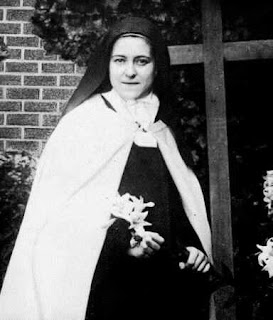
St. Therese
My favorite was once when I was reading a wine review that praised some plonk for its “winyness”. Jeez, at least give me some overblown description of its similarity to roasted quince or crushed Tahitian violets or something I can hang my hat on. Describing a wine as “winy” adds exactly nothing to my knowledge.
I’m not an audiophile but one of my partners is. My impression is that there are some companies making a handsome profit out of alleged modifications to audio signals that can’t be detected with an oscilloscope, much less the human ear. Stands to reason that they would use impenetrable unfalsifiable jargon to peddle it.
That site is an improvement, but still it reeks of architect gobbledygook.
“Light in the interior gradually shifts according to the change of season and daily rhythms”— yeah, and the same is true in my house and the local McDonalds and any fifth floor walkup in the Bronx, or really anywhere outside of a prison cell or submarine.
“In addition, the light changes when reflecting off of the concrete and brick exterior, something that signifies peace and constancy.” — Really? I would have thought that change represents change rather than constancy. But a smart guy with an architecture degree he’s never used to actually build a building says the opposite, so what do I know? And where can I get the kind of concrete and bricks that do NOT look different in different light?
I’m not letting you off the hook for your statements concerning something you know nothing about. What do you call sharing everything you have with twenty-three other women,having no choice in anything you eat, drink, or wear, not leaving the property you live on-ever-or doing whatever you want to, when you want to, for the rest of your life? And did I mention giving up sex, husbands, childrens, grandchildren, mother, father, siblings, etc. What do you call that? Being rich? You make the mistake of thinking they are “rich” because of the surroundings. Wrong! They have given up the only thing that makes anyone of us rich-their freedom.
Disclaimer: Opinions posted on Free Republic are those of the individual posters and do not necessarily represent the opinion of Free Republic or its management. All materials posted herein are protected by copyright law and the exemption for fair use of copyrighted works.