
Posted on 06/21/2009 4:50:42 PM PDT by Salvation

The same Parliament that had passed the Act of Attainder passed the Act of Succession on 30 March 1534. The marriage of Henry with Anne Boleyn involved a change in the succession to the crown. Princess Mary was to be set aside as illegitimate and the inheritance fixed on the king's children by Anne. The Act of Succession was proclaimed throughout the kingdom on 1 May of the same year. The act is preceded by a preamble which is nothing less than an apologia for Henry and a denunciation of the pope. This preamble is of great importance in the trials of both John Fisher and Thomas More as the oath that they were required to take included unconditional assent to the entire act, including the preamble. The act settles the succession to the crown upon the sons of Qeen Anne "and for default of such sons of your body begotten . . . to the eldest issue female, which is the lady Elizabeth, now princess."  This was a matter which Parliament had the authority to decide, and which the two Saints would have accepted no matter how much they may have privately deplored the exclusion of Mary. Monsignor Hughes has pointed out at least four points in the act to which no Catholic could assent as they constitute a repudiation of the authority of the pope. They are that: (1) the marriage between Henry and Catherine had always been against the laws of almighty God and hence invalid; (2) that Cranmer's sentence of separation was good and effectual, all (papal) dispensations to the contrary being void and of no effect; (3) the marriage to Anne Boleyn according to Cranmer's "just judgement" is a true marriage "consonant to the laws of almighty God"; (4) marriages within the forbidden degrees listed in Leviticus 20:21 are always and absolutely prohibited and dispensations allowing marriages within them are void, the pope having no such power to dispense ''as all the clergy of this realm . . . the most part of all the famous universities . . . and we also (i.e. Parliament) do . . . think." 64 Penalties are provided for three classes of offenders against the act Those who "maliciously give occasion by writing, print, deed or act, wherby your highness might be disturbed or interrupted of the crown" or do anything "to the prejudice, slander, disturbance, or derogation of the said lawful matrimony solemnized between your majesty and the said Queen Anne . . . shall be adjudged high traitors, and every such offence be adjudged high treason." The punishment for treason was death. Those who "by any words, without writing, or any exterior deed or act, maliciously or obstinately shall publish, divulge, or utter any thing or things to the peril of your highness, or to the slander or prejudice of the said matrimony...shall be taken and adjudged for misprision of treason." The penalty for this offence was the loss of all goods and life imprisonment. A completely unprecedented provision required that every subject of the king of full age must take an oath to "truly, firmly, and constantly, without fraud or guile, observe, fulfil, maintain, defend, and keep, to their cunning, wit, and uttermost of their powers, the whole effects and contents of this present Act." Refusal to take this oath was also adjudged misprision of treason. Monsignor Hughes writes: To refuse this oath is, again, an offence punishable with loss of goods and life imprisonment This last provision, and its penalty, mark a turning point in English history, the beginning of savageries and legal blood-thirstiness that soon pass beyond the frontiers of religious division, and stain political life in England for another two hundred years nearly. 65 The day after Parliament was prorogued the Convocation of Canterbury was summoned to decide "whether the Roman pontiff has any greater jurisdiction bestowed on him by God in the Holy Scriptures in this realm of England than any other foreign bishop." By a vote of thirty-four to four it was decided that he did not. The same conclusion was reached unanimously by the convocation of York a few days later. On 9 June 1534 by a royal proclamation "the usurped power of the Pope" was abolished. 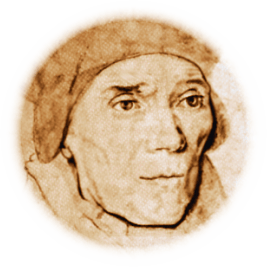 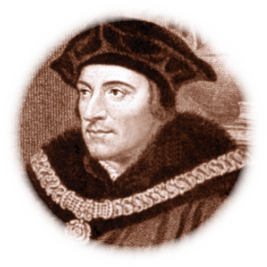 REFUSAL OF THE OATH Had Henry possessed the least vestige of Christian compassion he would have allowed the old and ailing prelate to pass his few remaining years unmolested in his diocese. But Henry was pitiless and unrelenting in his pursuit of those who dared to oppose him in the least respect. His treatment of Queen Catherine and Princess Mary after to the marriage with Anne Boleyn can only be described as sadistic. John Fisher and Thomas More were summoned to appear at Lambeth Palace on 13 April 1534 to take the oath. Shortly after Easter, the bishop was sufficiently improved in health to leave for London. He heartened his weeping servants, making provision for them and for the poor of Rochester, reserving something for himself "to defend his necessity in prison", nor forgetting Michael House and St. John's at Cambridge. Next morning, when he came out of the palace to mount his horse, he found that crowds had flocked in from the countryside to bid him farewell, "wailing and lamenting, to whom he gave his blessing on all sides as he rode through the streets bareheaded." They knew his constancy of character, which meant that this would be the last time they should see him. Men, women, and children pressed round him to receive his blessing as he rode through the little city. Babies were lifted up to his saddle-bow that he might put his hand upon their heads. He was familiar with them all, their names, their histories, their tasks in life. It was a heart-rending tribute from his flock to one whom they recognized as a true shepherd of souls, "Woe worth they that are the cause of his trouble." Such was the cry in Rochester on that early April morning. The journey was almost too much for the strength of the ailing bishop. Once he fell from the saddle in a faint, and it was only the anxiety of his companions which made them quick enough to catch him before he hit the ground. When the cavalcade reached Shooters Hill, he dismounted wearily and sat down by the roadside to rest They brought him food, and stood watching sadly while he ate it, slowly and calmly, in the open air. Would it not be better if he never reached London but died on the way as Wolsey had died at Leicester? He made an end of his eating, said his quiet grace, lay back awhile, his eyes peacefully shut, and then gave the word to remount So, at last light they came to his house in Lambeth Marsh. Monday, April 13th, was a hot day when Sir Thomas More and the Bishop of Rochester were summoned before the Council and told to take the Oath of Succession. This oath, as was explained supra, acknowledged Anne as queen and her children as heirs to the Crown, but also involved accepting the entire act, including clauses in the preamble that effectivdy repudiated any authority of the pope in England. More and Fisher both asked for time to consider the oath, which they now saw for the first time. Its text is no longer extant. It had not, in fact, been included in the Act and therefore had no statutory validity, but this did not trouble the commissioners entrusted with the task of enforcing it. Furthermore, taking advantage of the omission of the oath from the Act, Henry modelled and remodelled it at his pleasure. From the members of Parliament, and from the laity, the king accepted an oath of allegiance to himself and his heirs, according to the limitations in the Act; but from the clergy he required an additional declaration that the bishop of Rome had no more authority within the realm than any other foreign bishop. This was a recognition that the king was the supreme head of the Church of England, without the addition of the qualifying clause, which had been in the first instance admitted. More and Fisher were willing to swear to the succession but not to the Act. Both men were given a few days to reconsider their decision. On 17th April they appeared before the commissioners again, both refused to take the oath and were condemned to imprisonment for life and the loss of their goods. At the same time John Fisher was deprived of his bishopric, a startling example of the new powers assumed by the king. 66 With typical deviousness, Thomas Cranmer wrote to Cromwell suggesting that More and Fisher should be allowed to take a modified oath, swearing only to the succession. It could then be announced that they had taken the oath, without mentioning that it had been modified. It would then be presumed in England and abroad that they had capitulated, which would have a devastating effect upon opponents of the king's second marriage. Henry would not so much as consider this compromise. In his reply to Cranmer, Cromwell explained that: "The king's highness in no wise willeth but that they shall be sworn to the preamble as to the act." E. E. Reynolds writes: "Nothing reveals more clearly Henry's malignity than his relentless persecution of this aged bishop whose life was drawing to an end." 67 An attempt was made to browbeat Queen Catherine into taking the oath, but she refused with great courage and stated that she would abide by the decision of the pope who had upheld the validity of her marriage with Henry. Royal Commissioners were sent to Rochester to make an inventory of the Bishop's goods. They were astonished and disappointed at the small amount that there was for them to seize, so austere had been the Bishop's life. The word "old" appears again and again in their inventory. There was no sign of wealth whatsoever beyond a few piece of plate that he had been given by the Lady Margaret. The only truly valuable item was the Bishop's library which, in fact, was not his property as he had given it to St. John's College on the understanding that he would retain the use of it during his lifetime. The library did not reach Cambridge. The vindictive king seized it for his own use. When the Commissioners found a locked coffer in the Bishop's oratory they were certain that they had at last come upon a store of hidden wealth: "But, when it was open, they found within it, instead of the gold and silver they looked for, a shirt of hair and two or three whips wherewith he used full often to punish himself. 64. Hughes, op. cit., p. 258. 65. Ibid., p. 259. 66. Three other bishops refused to accept the Royal Supremacy and were deprived of their sees. They were all foreigners who held their sees in commendam (they received the revenues from the sees but did not occupy them, the episcopal duties being performed by suffragan bishops who received a salary). The three bishops were Athequa, a Spaniard, Llandaff; Campeggio, Salisbury, and Chinucci an Italian, Worcester. 67. E. E. Reynolds, Saint John Fisher (London, 1955), p. 224. |
Defensor Matrimonii - St. John Fisher
The Martyrdom of St. John Fisher - 22 June 1535 (By Michael Davies) [Catholic Caucus]
St. John Fisher: "I am come here to die for Christ's Catholic Church"
St John Fisher, 1460-1535[Bishop and Martyr]
St. John Fisher
Life of Blessed John Fisher, Bishop of Rochester, Cardinal of the Holy Roman ... By Thomas Edward Bridgett
http://books.google.com/books?id=0B03AAAAMAAJ&printsec=frontcover&dq=john+fisher&as_brr=1
I’ll go back and look for the site where I found the picture (didn’t save it — bah!)
It had a partial listing of chapters in the first part of one of his books. When I find it I post it to you.
Saint John Fisher, Bishop & Martyr
Optional Memorial with Saint Thomas More, Martyr
June 22nd

John Fisher, Bishop of Rochester
Born at Beverly, 1469 - martyred June 22, 1535, Tower of London
Canonizeed (with Saint Thomas More) 1935
Saint John Fisher studied theology in Cambridge, England and became Bishop of Rochester. His friend Saint Thomas More wrote of him, "I reckon in this realm no one man, in wisdom, learning, and long approved virtue together, meet to be matched and compared with him."
Saint John Fisher and his friend Saint Thomas More gave up their lives in testimony to the unity of the Church and to the indissolubility of marriage.
Source: Daily Roman Missal, Edited by Rev. James Socías, Midwest Theological Forum, Chicago, Illinois ©2003
Born at Beverly, 1469 + June 22, 1535, Tower of London
Reply to Bishops Stokesley, Gardiner and Tunstal, sent to the Tower by Thomas Cromwell to persuade Fisher to submit to the King:
Methinks it had been rather our parts to stick together in repressing these violent and unlawful intrusions and injuries dayly offered to our common mother, the holy Church of Christ, than by any manner of persuasions to help or set forward the same.
And we ought rather to seek by all means the temporal destruction of the so ravenous wolves, that daily go about worrying and devouring everlastingly, the flock that Christ committed to our charge, and the flock that Himself died for, than to suffer them thus to range abroad.
But (alas) seeing we do it not, you see in what peril the Christian state now standeth: We are besieged on all sides, and can hardly escape the danger of our enemy. And seeing that judgment is begone at the house of God, what hope is there left (if we fall) that the rest shall stand!
The fort is betrayed even of them that should have defended it. And therefore seeing the matter is thus begun, and so faintly resisted on our parts, I fear that we be not the men that shall see the end of the misery.
Wherefore, seeing I am an old man and look not long to live, I mind not by the help of God to trouble my conscience in pleasing the king this way whatsoever become of me, but rather here to spend out the remnant of my old days in praying to God for him.
On the scaffold he said to the people assembled:
Christian people, I am come hither to die for the faith of Christ's Holy Catholic Church, and I thank God hitherto my stomach hath served me very well thereunto, so that yet I have not feared death.
Wheefore I do desire you all to help and assist me with your prayers, that at the very point and instant of death's stroke, I may in that very moment stand steadfast without fainting in any one point of the Catholic faith free from any fear; and I beseech Almighty God of His infinite goodness to save the king and this Realm, and that it may please Him to hold His holy hand over it, and send the king good Counsel.
He then knelt, said the Te Deum, In te domine speravi, and submitted to the axe.
Collect:
Father,
You confirm the true faith
with the crown of martyrdom.
May the prayers of Saints John Fisher and Thomas More
give us the courage to proclaim our faith
by the witness of our lives.
Grant this through our Lord Jesus Christ, Your Son,
who lives and reigns with You and the Holy Spirit,
one God, for ever and ever. + Amen.
First Reading: I Peter 4:12-19
Beloved, do not be surprised at the fiery ordeal which comes upon you to prove you, as though something strange were happening to you. But rejoice in so far as you share Christ's sufferings, that you may also rejoice and be glad when His glory is revealed. If you are reproached for the name of Christ, you are blessed, because the spirit of glory and of God rests upon you. But let none of you suffer as a murderer, or a thief, or a wrongdoer, or a mischief-maker; yet if one suffers as a Christian, let him not be ashamed, but under that name let him glorify God. For the time has come for judgment to begin with the household of God; and if it begins with us, what will be the end of those who do not obey the gospel of God? And "If the righteous man is scarcely saved, where will the impious and sinner appear?" Therefore let those who suffer according to God's will do right and entrust their souls to a faithful Creator.
Gospel Reading: Matthew 10:34-39
"Do not think that I have come to bring peace on earth; I have not come to bring peace, but a sword. For I have come to set a man against his father, and a daughter against her mother, and a daughter-in-law against her mother-in-law; and a man's foes will be those of his own household. He who loves father or mother more than Me is not worthy of Me; and he who loves son or daughter more than Me is not worthy of Me; and he who does not take his cross and follow me is not worthy of Me. He who finds his life will lose it, and he who loses his life for My sake will find it.
Disclaimer: Opinions posted on Free Republic are those of the individual posters and do not necessarily represent the opinion of Free Republic or its management. All materials posted herein are protected by copyright law and the exemption for fair use of copyrighted works.