Posted on 07/21/2003 9:53:50 PM PDT by BenLurkin
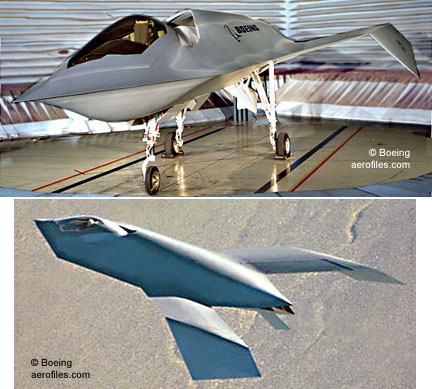
DAYTON, Ohio - Two Boeing technology demonstrator aircraft on Wednesday became part of the world's oldest and largest military aviation museum, the United States Air Force Museum.
The Bird of Prey technology demonstrator and the X-36 flight demonstrator were welcomed into the museum's collection in a ceremony on Wednesday afternoon.
Designed, produced and demonstrated by Boeing Phantom Works, the company's advanced research and development unit that serves as a catalyst of innovation for the enterprise, the aircraft will now be on permanent display at the museum at Wright-Patterson Air Force Base.
The Boeing-funded Bird of Prey, which had flown for years, wasn't unveiled until October 2002 in St. Louis.
The stealth aircraft pioneered breakthrough low-observable technologies and revolutionized aircraft design, development and production techniques.
The once highly classified project extended from 1992 through 1999 and developed technologies and capabilities that have become industry standards.
The Bird of Prey, a Buck Rogers-style aircraft, contributed to the body of knowledge Boeing used to develop its next wave of attack aricraft, among them the unmanned combat air vehicles, or UCAVs.
Before its unveiling, aviation journalists speculated about various aircraft that defense contractors and the armed services were flying "in the black" at Edwards Air Force Base and Area 51 at Groom Dry Lake in Nevada.
Before the Bird of Pray unveiling, an article in the November 2000 Popular Science speculated about an aircraft the publication described as "The Switchblade," an odd-looking craft with a purportedly forward swept wing.
The Bird of Prey project, funded by Boeing, cost $67 million.
The aircraft, which conducted a 38-flight test program, has a wingspan of 23 feet, a length of 47 feet and a weight of about 7,400 pounds. It is powered by a Pratt & Whitney JT15D-5C turbofan engine.
Jointly funded under an agreement between Boeing and NASA, the X-36 is a 28% scale tailless agility flight demonstrator, designed, built and successfully flight-tested between 1993 and 1998.
The remotely piloted research aircraft combined several key emerging technologies to demonstrate for the first time.
Those included tailless high angle of attack agility, and low observability in a combat-style unmanned configuration.
"Over a million people each year will be able to view not only the past but also the future of aerospace," said George Muellner, senior vice president and general manager of Air Force Systems for Boeing.
"The technical achievements and applications to future aircraft that the Bird of Prey and the X-36 Research Aircraft introduced will be forever noted, as they join the largest and finest collection of aircraft and missiles in the world."
"The addition of the Bird of Prey and X-36 to our growing collection is significant because these demonstrators helped pioneer stealth technology and revolutionize aircraft design and production," said Charles D. Metcalf, U.S. Air Force Museum director. "As proud as we are to portray Air Force history, we also want to present modern technology and give our visitors a picture of how today's evolving capabilities are shaping tomorrow's Air Force."
The United States Air Force Museum attracts 1.2 million visitors a year.
It boasts a collection of more than 300 aircraft and missiles, thousands of artifacts and a comprehensive storyline that connects the earliest days of flight with today's stealth age.
Through the use of its massive collection, sensory exhibits, special events and educational programs, the museum presents the mission, history and evolving capabilities of America's Air Force to the public and world at large.
A unit of The Boeing Co., Integrated Defense Systems is one of the world's largest space and defense businesses. Headquartered in St. Louis, Boeing Integrated Defense Systems is a $25 billion business that provides systems solutions to its global military, government and commercial customers.
It is a leading provider of intelligence, surveillance and reconnaissance; the world's largest military aircraft manufacturer; the world's largest satellite manufacturer and a leading provider of space-based communications; the primary systems integrator for U.S. missile defense; NASA's largest contractor; and a global leader in launch services.
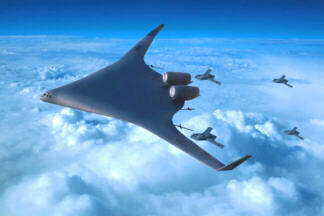


 In truth, U.S. museum pieces are more advanced than anything that any other nation can field today...
Disclaimer: Opinions posted on Free Republic are those of the individual posters and do not necessarily represent the opinion of Free Republic or its management. All materials posted herein are protected by copyright law and the exemption for fair use of copyrighted works.