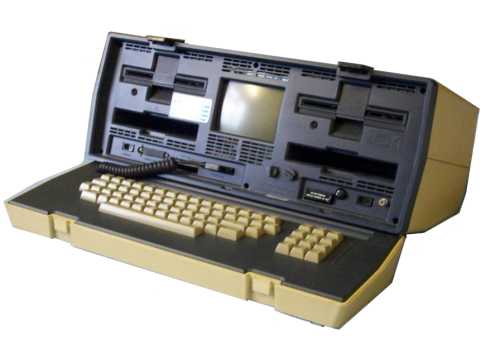
$1795. In 1981 dollars.
Posted on 03/24/2003 10:54:54 PM PST by HAL9000
SAN JOSE, California, Mar 25, 2003 (AP WorldStream via COMTEX) -- Adam Osborne, who co-founded a company that pioneered portable computers but met the same fate of countless future Silicon Valley firms that grew too quickly, has died. He was 64.Osborne died in his sleep in Kodiakanal, India, on March 18, after a series of strokes caused by a brain disorder, his first wife, Cynthia Geddes, said Monday. He was buried Tuesday in India.
Geddes said Osborne constantly thought up new ideas, including the concept of a portable computer that launched in 1981 - the same year International Business Machines Corp. unveiled its personal desktop computer.
At the time, Osborne targeted the young Apple Computer Inc., which in the 1970s started selling computers that fit onto office and home desktops.
Osborne Computer Corp. became the fastest-growing Silicon Valley company shortly after the launch of the 24-pound (11-kilogram), $1,795 Osborne 1. At its peak, it was selling at a rate of 10,000 a month.
But two years later, the company made a misstep that would plague many future firms. The Osborne 1's successor - dubbed Executive - was announced months before it was ready, causing shipments of the existing machine to plummet.
The company also faced an uphill battle against IBM, which introduced its PC in August 1981.
Company co-founder Lee Felsenstein said while Osborne had the ideas to create the company, he did not have the experience to run it after it matured.
"He wasn't a professional manager," Felsenstein said Monday. "He sort of found out the hard way you really needed to be one to make it go."
Though Osborne Computer did not survive, the idea of a portable computer did. Compaq Computer Corp. successfully introduced an IBM-compatible portable in 1982.
After Osborne Computer, he started a new firm Paperback Software International Ltd., which sold low-cost programs that mimicked higher-end software. But Lotus Development Corp. sued in 1987, alleging a Paperback product was too close to its 1-2-3 spreadsheet.
Lotus won the case in 1990.
After leaving Paperback, Osborne sought funding for startups in India. His brain disorder, which led to a series of small strokes, was diagnosed in 1992.
Copyright 2003 Associated Press, All rights reserved
He also wrote a column for InfoWorld trade magazine titled "From the Fountainhead". Apparently he was an Ayn Rand-style objectivist, but not a very good businessman.
Classic business mistake. Companies get to excited about the new, better, faster product they've just come up with and talk about it before its ready to ship. Customers start looking at the currently available product as old technology and decide to wait for the new stuff - if its not ready to ship you are screwed. I have made this mistake (on a very small level) and it did kill the "old" product until we renamed it and repackaged it.
Osborne had an overblown sense of his own importance! When Osborne Computers went Capture 11, I DANCED ON ITS GRAVE!!!
He was EXTREMELY anti SECOND Amendment!!
Thus be it to ALL Tyrants!!!
I sure wish I had kept them- like so many things technical, the advances in science quickly eclipsed them and I regarded them as "obsolete" when we moved in 1981 and so placed them in the yard sale pile of books. Along with others I still regret parting with!
$1795. In 1981 dollars.
You are about 15 years behind the times. IBM dropped the white shirt requirement at least that long ago.
Disclaimer: Opinions posted on Free Republic are those of the individual posters and do not necessarily represent the opinion of Free Republic or its management. All materials posted herein are protected by copyright law and the exemption for fair use of copyrighted works.