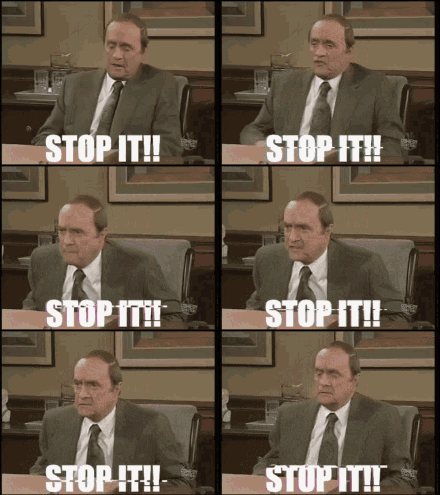
Posted on 09/09/2026 2:06:00 PM PDT by aimhigh
In the 1970s, psychiatric diagnoses were marked by considerable uncertainty and disagreement. Since then, organizations such as the American Psychiatric Association and the World Health Organization (WHO) have worked to develop standardized diagnostic criteria that psychiatrists around the world can use.
These efforts have shaped modern psychiatry by establishing common, criteria-based systems for diagnosing mental disorders across institutions and national borders. However, a new study, led by researchers at the University of Copenhagen, suggests that major challenges remain. In the study, 1,038 psychiatrists and physicians working in psychiatry from 19 countries were presented with nine written patient case descriptions. Each participant was assigned two cases and asked to determine the most appropriate diagnosis.
The results surprised the researchers.
“Our study shows that when two psychiatrists diagnose the same patient, they will agree only 55% of the time. We consider that worryingly low. In fact, it is similar to the levels reported in some of the studies conducted in the 1970s, which prompted the development of standardized diagnostic criteria in the first place,” says Professor and Consultant Psychiatrist Julie Nordgaard.
“This is not about psychiatrists doing a poor job. Rather, it reflects the fact that, despite the existence of diagnostic systems, clinicians continue to differ in how they interpret symptoms and which features they consider most important. We need a greater degree of consensus, otherwise patients risk receiving changing diagnoses and treatments,” she adds.
Same symptoms, different diagnoses
The study found substantial variation in diagnostic agreement across different mental disorders. Diagnoses within the schizophrenia spectrum proved particularly challenging. “Cases that could be diagnosed either as schizophrenia or schizotypal disorder generated especially high levels of disagreement. In many of these cases, agreement among participants was well below 50%,” says PhD candidate Mateo Boberg, the study’s first author.
According to Boberg, one reason is that symptoms frequently overlap across psychiatric disorders. For example, obsessive thoughts may occur in both obsessive-compulsive disorder (OCD) and schizophrenia. “These are not random errors. There is a clear pattern to the disagreements. This likely reflects the fact that diagnostic categories are not as clearly defined as we have assumed, when experienced psychiatrists can interpret the same symptom presentations so differently.”
Diagnostic uncertainty undermines research
Disagreement about diagnoses is an obvious concern for patients. But the researchers argue that diagnostic uncertainty also threatens the reliability of some kinds of psychiatric research¸ explains Professor Mads Gram Henriksen: “In research, it is essential that we know exactly what we are studying. If a considerable part of participants enrolled in a study on treatment of personality disorders actually suffer from schizophrenia, the study’s results become difficult to interpret. Which condition is the treatment having - or not having - an effect on? Personality disorders or schizophrenia?”
The researchers argue that progress in psychiatric research risks remaining limited until there is a clearer and more widely shared understanding of what mental disorders are and how they can be distinguished from one another. Greater diagnostic agreement, they say, is a prerequisite for the breakthroughs needed to improve patient care.
“WHO’s ICD-10 diagnostic system, which participants in the study used to assess the cases, contains more than 200 diagnoses, a complexity that may contribute to uncertainty. At the same time, many psychiatric conditions are inherently multifaceted,” says Julie Nordgaard and concludes: “In our view, it is necessary to take a step back and develop more precise descriptions of psychiatric disorders so that clinicians can distinguish them more clearly. It may also be necessary to reduce the number of diagnostic categories.”
“Soft ‘Science’ Alert!”

Imagine a convention of psychiatrists.
Might as well flip a coin then.
A gold coin.
That’s why they call it “practicing.”
It should be a pretty simple thing to set up an AI chat bot to simulate a session with a psychiatrist.
Have it listen to a patient describe what they are going through for about an hour, just as if they are in the shrink’s office.
When complete, the patient utters the trigger phrase “So what do you think is wrong with me?”
The bot simply replies “You’re an asshole.”
You’re in good company.
Richard Feynman had a hierarchy of the sciences:
Physics is applied mathematics.
Chemistry is applied physics.
Biology is applied chemistry.
Psychology is a bunch of witch doctors
To put it succinctly, how many psychiatrists are “just plain nuts”?
Like the cartoon classic put on thousands of coffee mugs.
But about the psychiatrists.
https://www.bing.com/images/search?q=images+mug+%22Just+Plain+Nuts%22&FORM=HDRSC3
I had to take some classes on “the other side of campus” for my engineering degree. (To “spread the wealth around,” according to my dean.) Many of the people I interacted with in the psychology department appeared to me to be deeply disturbed. I might not be able to put a diagnosis on it, but I recognize crazy when I see it. To me, they seemed to be there because they knew there was something wrong and they were trying to self-diagnose it.
Every time some liberal suggests that the government should provide free psychiatric help to the public, I remember these weirdos and can only imagine the horrible results. Speaking of which, how many liberals, as opposed to normal people, do you know who are in “therapy?” Yeah, quite a few.
The only real prrof I have seen on the legitimace of some of this is the MMPI test (Minnesota Multi-Phasic)
I had to take it from the child custody doctor assigned to out case- and ho lee crud did it NAIL it. (she was a nutjob, it said)
1) There are several types of disagreement.
a) Agree on the diagnosis but not on the degree
b) Agree on the diagnosis but not the treatment
c) Mildly Disagree on the diagnosis eg schizo and paranoia are not the same...but in some cases similar.
d) Drastically disagree. An Evangelical Christian and a Marxist aetheist are far apart often.
2) The treatment comes before the diagnosis. The Doctor owns the Rehab Facility, or gets a referral percentage. The treament comes first. The diagnosis fits the treatment.
3) The billable code & money come before the diagnosis and treatment. Diagnosis and treatment for B is double what it is for A. Guess what, the patient has B.
Ga Medicaid 2014-2025
Screenshot....
Another time.
Dangerfield: “I went to my psychiatrist and after a bunch of visits he told me I have a split personality. Two completely different personalities within my brain.”
“So he hands me this big bill for his services. I tell him “Here’s half the money. Get the rest from the other guy.”
the MMPI is one powerful test.
not used enough IMHO
Yes,
Not far from it.
You can tell psychology is a pseudo-science by how it is moved by the social currents of the time: feminism, LGBTQIA, etc. and how there are “fads” within psychology, ADHA, Bi-polar...
Psychology cannot truly isolate the variables.
It is more descriptive in nature and highly subjectively interpretive.
I would not discount psychology entirely, but much of it (Remember when every kid got Ritalin?).
Psychology is applied beyond its practical / useful application.
Psychiatrists are often nuttier than their patients.
“My psychiatrist told me I was crazy and I said I want a second opinion. He said okay, you’re ugly too.”
Rodney Dangerfield
Disclaimer: Opinions posted on Free Republic are those of the individual posters and do not necessarily represent the opinion of Free Republic or its management. All materials posted herein are protected by copyright law and the exemption for fair use of copyrighted works.