This should be our new national motto:

Posted on 07/28/2026 7:59:46 AM PDT by Sir_Humphrey
The Pentagon first outlined the goal of putting the United States industrial base on a “wartime footing”— the condition of being prepared to deter and, if necessary, prevail in a protracted conflict—in November 2025. What steps have government and industry taken since then to make this ambition a reality?
....
Yet industrial plans are not the same as results, and isolated bursts of investment are not the same as institutionalized industrial power. The time scales needed to deliver several critical munitions, for example, depleted after the war in Iran, continue to stretch more than three years. Though investment announcements have risen following China’s export controls in April and October 2025, U.S. and allied efforts to rebuild a secure rare earth ecosystem are in their early stages. While new entrants to the industrial base promise advanced technologies at low cost and high volume, moving defense innovations from concept to contract takes a sustained government demand signal and continued cooperation with private firms. .........
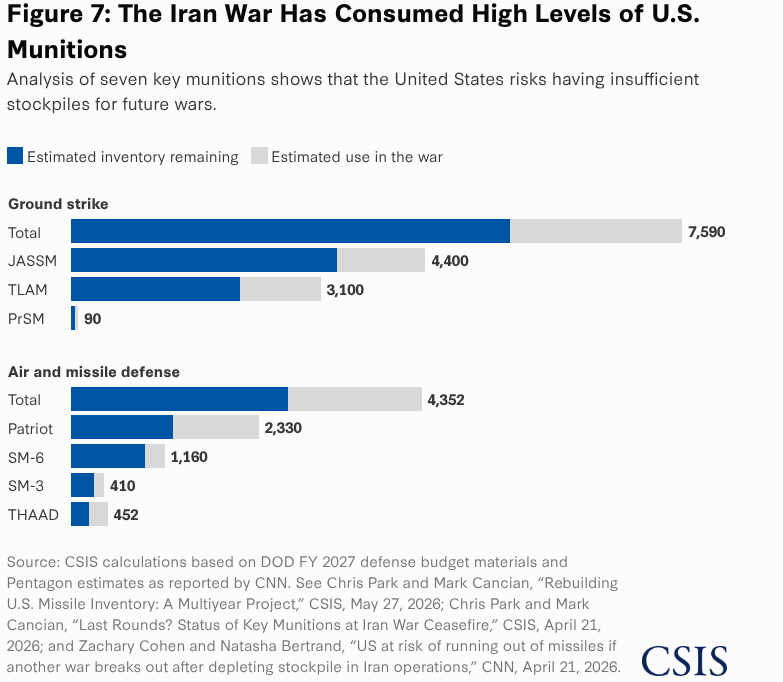
The recent conflict in the Middle East has also revealed the lengthy time horizons that prime defense contractors and their suppliers currently need to build and deliver critical munitions. Reflected in the service branches’ budget justification books, the manufacturing lead time for these weapons ranges from 25 to 51 months.....
Analysis of seven key munitions shows that the United States risks having insufficient stockpiles for future wars.
(Excerpt) Read more at csis.org ...
The real industrial infrastructure is in the education and training of the people. THAT is where a real transformation is in order.
This should be our new national motto:
Some how, some way, through some “yet-to-be creative”, but bogus method—the US will end up paying for a significant portion of any reconstruction and rebuilding of Iran.,,,,,,i.e. the Marshall Plan.
The official story will be,,,using Iran’s oil money, but we will still be stuck with a lot of it. Count on it happening—we just need a name for it.
Stockpile shortages are one of the reasons why Trump keeps claiming Iran wants to make a deal.
That and the comments by CENTCOM commander that bombing Iraq has lost its effectiveness.
You're kidding, right?
In 2026, US defense spending represents around 15% of the Federal budget and about 3% of GDP.
Federal deficits are not caused by defense spending, they're caused by the other 85% of spending.
National defense is the government's first priority, ahead of every other with the possible exception of interest on the national debt.
Eliminating waste, fraud & abuse in $ trillions of other programs would easily pay for necessary defense spending.
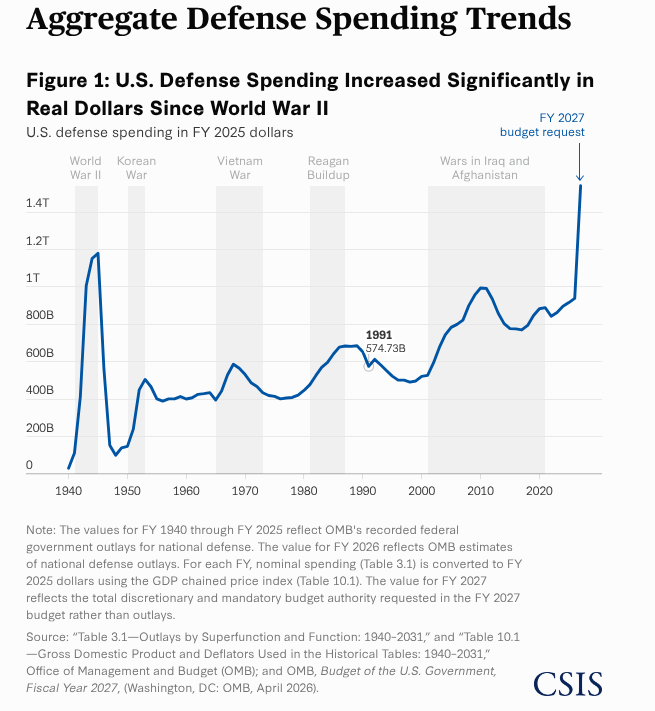
This graph from the link is very telling. Trump wants a 43% increase in the Defense Budget.
... the devices by which the rat party funds itself ...
“Federal deficits are not caused by defense spending, they’re caused by the other 85% of spending.”
I thought that before posting I’d look at the responses and yours was better than I’d have put together. The problem is people get this myopic view focused on the military and ignoring everything else. As a low-end landlord I’ve seen some amazing fraud, like the alcoholic woman who was filling the fridge with the most expensive meats and selling them at cents on the dollar to cover beer, cigarettes and pot.
Also, defense, deterrence, is expensive. But not having it is devastatingly expensive.
BTW, in 2018 total Federal, state and local government spending reached 37.8% of GDP. We're not far behind Europe in total gov spending.
And with a good defense, a devasting war remains a low probability high impact event. With poor defense, it becomes a much higher probability.
In 1944, U.S. federal government spending was roughly 44% of GDP, while national defense/war-related spending was around 37–38% of GDP depending on the accounting measure used. So the 37.8% figure is in the right ballpark for defense-related spending.
If you apply 37.8% to today’s U.S. GDP, which is roughly $30 trillion, the calculation is:
$30 trillion × 0.378 = $11.34 trillion
So $9 trillion is too low if you’re comparing 37.8% with today’s GDP. To get $9 trillion, today’s GDP would have to be about $23.8 trillion.
The important caveat is that “37.8% of GDP” does not mean the government literally spent the equivalent of 37.8% of today’s GDP. It’s a way of expressing the scale of spending relative to the economy at that time. If today’s economy were the same size as the 1944 economy in relative terms, then 37.8% would indeed represent about $11 trillion at a $30 trillion GDP.
For perspective, the U.S. government is nowhere near that level of defense spending as a share of GDP. The World War II peak was an extraordinary mobilization of the American economy. The OMB’s historical tables provide the underlying long-term federal spending and GDP data.
Yeah that was a little tongue in cheek and no, Defense isn't the driver of the deficit. But to put us in a position where we will need to spend more on defense due to this war next year, surely won't help the matter.And yeah, national defense is the top priority of the government but that doesn't mean you don't be judicious with money spent on a war that didn't need to be started. (Oh yeah, 47 years ago blah blah and better to fight them there than here blah blah) You're also overlooking the future "economic aid" we will most likely have to fork over in to help Iran rebuild.
What?? You mean we won't defeat Chinese munitions factories with our overwhelming superiority in app developers and social media influencers?
This is the real chart -- national defense % of GDP since WWII:
Compare to your BS chart of "real dollars":

Disclaimer: Opinions posted on Free Republic are those of the individual posters and do not necessarily represent the opinion of Free Republic or its management. All materials posted herein are protected by copyright law and the exemption for fair use of copyrighted works.