|
Posted on 12/24/2024 6:00:44 PM PST by Kathy in Alaska
|



MERRY CHRISTMAS!

Instrumental
Joy to the World - Percy Faith And His Orchestra
O Holy Night - National Philharmonic Orchestra
O come, All Ye Faithful - London Symphony Orchestra
O come, O come, Emmanuel - (Piano/Cello) - The Piano Guys
Little Drummer Boy - George Carlaw & the Avalon Pops Orchestra
Happy Christmas Eve, radu....thank you for the great Christmas music.


Howdy, Kathy.
Happy Christmas Eve.
Ready for a little R&R after the past two hectic days?
In 1741 George Frederick Handel had to face the fact that London audiences were no longer interested in Italian opera. His two latest operas had failed, and Handel was seriously thinking of leaving England.
During Holy Week, London’s theaters were closed, and Charles Jennens, Handel’s favorite librettist, came up with a religious work that could be presented in the theater during that week. An oratorio, which is a religious cantata, would guarantee Handel a full house, which is the goal of every composer who writes music for a living. Handel knew that the authorities would not make an exception for Holy Week even for a religious piece, so the idea went in another direction. Handel decided to take his new work, “Messiah,” to Dublin in the fall of 1741 where it was received with great acclaim.
The first London performance in 1743 got a less pleasant reception. There were objections to using a theater as a venue for the performance of a sacred work and to using operatic singers of dubious personal morality to sing it. Even Jennens had issues with some of Handel’s music, which brought on yet another stroke for poor Handel, who had experienced a major stroke in 1737.
Each time “Messiah” was staged, Handel made adjustments to the score. Sometimes a piece was lengthened or shortened due to artistic instincts. Sometimes it was re-scored for a different voice. Sometimes the weakness of a particular singer required a rewrite. This is the 1754 Foundling Hospital version, by which time Handel had settled on the score.
”Messiah” is written in three acts. Part 1 covers the prologue to Christ’s birth to his entry into Jerusalem. Part 2 covers his suffering, death and resurrection, and the spreading of the gospels by his disciples. Part 3 covers the promise of eternal life. Each part is structured like the act of a Baroque opera.
Jennens’ idea was to use quotes from the Old Testament to explain quotes from the New Testament. Direct narrative is avoided, and no singer has to impersonate Jesus, which would have been considered blasphemous. (The one exception to this was setting the various Passions to music, which Bach did.)
Instruments of that period were quite different from today, as were the performance practices of the Baroque era.
String instruments were played with gut strings, not steel. The sound decay rate for gut is more rapid, and that gives the strings a thinner, more plangent quality. Vibrato, which is ubiquitous today, was used only rarely and for expressive effect. At the time, there were a large number of markings in the score for bowing and articulation, most of which have been forgotten over the centuries. After Handel, Leopold Mozart, Wolfgang’s father, wrote the first violin tutorial, which explains in detail just how these various markings are to be played. The period instrument movement has revived these techniques, which are quite different from how string instruments are played today.
Wind instruments had not yet been supercharged and had smaller bores. The trumpets had holes rather than valves.
The vocal tradition of the era avoided vibrato. Singers were expected to improvise their own ornamentation using the written score as a guideline. This was especially true in da capo arias which are written in A-B-A format. The first time through the “A” section, the vocalist was expected to follow the score. The second time through, the vocalist was expected to ornament the written vocal line to show off his or her chops.
Both orchestras and choruses were small in size.
Speed indications had different meanings in the Baroque era. All Baroque music is dance music, even religious music. An instruction like allegro indicates a quick dance tempo, and adagio indicates a slower dance tempo. The modern interpretation of these instructions comes from Wagner and the Victorian era, when many traditions were lost. This performance avoids the modern for a Baroque understanding of what these instructions mean.
Baroque operas begin with an overture. The format is a slow introduction with dotted notes in duple time, followed by a fugue, followed by a march, jig or minuet. But Handel knew what he was doing, and he stops the fugue cold with a cadence, making way for human voice. Note the atmosphere, not so much of joy, but of anticipation.
The purpose of a recitative is to link larger musical numbers and change key. An unaccompanied recitative involves a singer backed by a harpsichord and often cello. An accompanied recitative backs the singer with the string section. “Comfort ye my people” is an accompanied tenor recitative leading into a tenor aria, “Every valley shall be exalted,” where Handel uses the Baroque technique of word painting. Note the music for the words “crooked” and “straight.” (The lyrics come from “Isaiah.”)
Handel introduces the chorus, “And the glory of the Lord,” with low voices first, giving him the ability to amplify as the piece goes on. (Isaiah) This leads into an accompanied recitative for bass, “Thus saith the Lord.” (Haggai & Malachi)
Every Baroque opera had a big production number in each act, and a soprano aria, “But who may abide the day of his coming,” is the big production number for Part 1. (Malachi)
Handel liked to recycle material from his Italian operas on occasion, and this chorus, “And he shall purify,” is an example. (Malachi) It is followed by a recitative for contralto, “Behold, a virgin shall conceive.” (Isaiah)
”O thou that tellest good tidings to Zion” is a mezzo aria that expands into a chorus.
Following is a recitative for bass, “For behold, darkness shall cover the earth.” Note the sudden change in atmosphere and how Handel shows darkness and the change to light. This leads into a bass aria, “The people that walked in darkness,” with a wandering string line minus harmony, symbolizing wandering in the darkness. The magic moments occur where the darkness is dispelled. (Isaiah)
Following is another chorus derived from one of Handel’s Italian operas, “For unto us a child is born.” (Isaiah)
”Pifa” is Handel’s attempt to recreate the sound of shepherds’ bagpipes. It grew in length over the years, but by 1754 Handel had reduced it to its original 11 bars as a lead-in to four short accompanied soprano recitatives, each intended to ratchet up the tension. They in turn lead into a chorus, “Glory to God,” where the trumpets appear for the first time. Note the word painting, high voices for heaven and the low voices for peace on earth. At the end, Handel marks the ending pianissimo as the vision fades. (Luke)
Even though there is no mention of the Lord as “bridegroom,” Handel’s original version of this soprano aria, “Rejoice greatly, O daughter of Zion,” featured a violin playing a jig, the instrument and dance associated with weddings. The time signature for this early version was 12/8. By 1754, Handel had changed the time signature to 4/4, and this little detail disappeared. (Zechariah)
This leads into a soprano recitative, “Then shall the eyes of the blind,” which in turns leads into a soprano aria, “He shall feed his flock.” This started out as a piece for mezzo, then for duet, but by 1754 Handel had settled on handing it to the soprano. (Isaiah & Matthew)
Handel turned to recycling Italian opera for this final number, “His yoke is easy, and his burthen is light.” Note the Elizabethan spelling of “burden” as “burthen.” (Matthew)
Part 2 is a long series of numbers intended to culminate in the resurrection, and Handel builds it slowly. It is similar to the Passion works of Bach. Handel uses the dotted rhythms of a Baroque overture to start “Behold the lamb of God” and brings in the lower voices first. (John)
But Handel wastes no time and launches into his big production number for Part 2, a mezzo da capo aria, “He was despised.” In the “B” section, Handel uses the strings in short staccato strokes to portray the sound of scourging. As the “A” section returns, note Esther’s ornamentation of the vocal line. (Isaiah)
Three short choral numbers are recycled from an earlier Italian opera. “Surely he hath borne our griefs” sets the table. “With these stripes we are healed” is developed as a fugue. The third, “And we like sheep,” is not what you think it is! (Isaiah)
The next two linked numbers start with a recitative for tenor, “All they that see laugh him to scorn.” Note how Handel word paints the sounds of scourging, laughing and the shaking of heads. This leads into a mob chorus, “He trusted in God,” a crowd scene developed as a fugue. (Psalm 22)
The next two numbers are a recitative for tenor, “Thy rebuke has broken his heart,” and a tenor aria, “Behold, and see if there be any sorrow.” (Psalm 69 & Lamentations)
Two numbers are joined: a recitative for soprano, “He was cut off from the land of the living,” and a soprano aria, “But thou didst not leave his soul in hell.” (Isaiah & Psalm 16)
They lead into a chorus, “Lift up your heads, O ye gates.” (Psalm 24)
”How beautiful are the feet” is an aria that went through a number of changes between 1741 and 1754, but Handel finally settled on handing it to the soprano. (Romans)
”Their sound has gone out” is a chorus aimed at brevity. (Romans)
It is followed by a “rage” aria for bass in operatic style, “Why do the nations so furiously rage together?” This performance returns to the 1741 version because Ashley has the chops to handle it. It leads into the next number, a mob chorus in the form of a fugue, “Let us break their bonds asunder.”
A tenor recitative follows, “He that dwelleth in heaven,” leading into a tenor aria, “Thou shalt break them.” (Psalm 2)
It’s time to release all that tension and bring Part 2 to a close. This is the best known number in “Messiah,” a chorus where the trumpets are heard for only the second time in the whole oratorio. It’s the first time for the tympani. This is the announcement of resurrection. Handel writes a canon, then a small fugue and then another canon. The ascending phrases backed by the trumpet are nothing short of magic, as he ratchets up the tension for the breakthrough. (Revelation)
Part 3, unlike the other two parts, begins with a sense of certainty rather than anticipation. The issues have been resolved, and it’s time for a short epilogue on eternal life. “I know that my redeemer liveth” is a soprano aria that is one of the few pieces that underwent no revisions. (Job & 1 Corinthians)
This is followed by a chorus, “Since by man came death” and a bass recitative, “Behold, I tell you a mystery.” (1 Corinthians)
It’s time for the big production number for Part 3, “The trumpet shall sound.” This piece features the only instrumental solo in the work, written for trumpet. There would be a temptation to write a march here, but Handel resists the obvious to write a bass aria in 3/4. This aria was even longer in 1741, but Handel shortened it for the 1754 performance. There is the odd setting of the word “incorruptible” in the original text with the accent on the wrong syllable, but Ashley Riches has taken his own liberty with the text to correct the pronunciation. Note also the use of the same musical phrase for “We shall be changed” everywhere it appears. This goes against the meaning of the line, which is why Jennens criticized the composer’s approach. (1 Corinthians)
”If God be for us” is an aria for soprano, then transposed for mezzo, and then handed back to the soprano. (Romans)
Now it's time for the grand finale, a series of three choruses beginning with “Worthy is the lamb that was slain,” followed by “Blessing and honor” set as a canon, finishing with a giant fugue with one word, “Amen.” Listen to that amazing wrap-up! (Revelation)

Howdy, Publius.
I always look forward to your "Messiah" post. Supper will come out of the oven in a few minutes and I'll settle in to listening as soon as it's out.
I hope all's well with you these days.
My sis gave me The Messiah on Vintage Vinyl, with leonard bernstein conducting.
All my other versions are on CD.
My favorite is Pinnock, my least favorite is Mariner with Joan Southerland. The tenor on that one thinks he’s Mariah Carey warbling the National Anthem. He doesn’t even work up to do his improv. He starts right out with it Cooommmmmmmfffforttttt Yeeeeeeeee. YIKES.
I really like this version you posted., especially the period instruments.
My husband and I have always enjoyed attending the Christmas Eve service at our church. In the early years of our marriage, we had a special tradition of bundling up in warm clothing after the service to hike up a nearby hill where 350 glowing lights were strung from tall poles in the shape of a star. There—often in the snow—we’d whisper our reflections on Jesus’ miraculous birth while we gazed out over the city. Meanwhile, many people in the town were looking up at the bright, string-light star from the valley below.
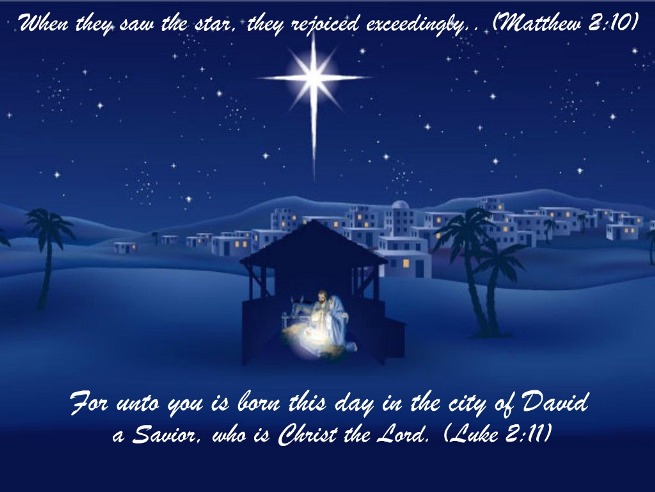
That star is a reminder of the birth of our Savior. The Bible tells of magi “from the east” who arrived in Jerusalem seeking “the one who [had] been born king of the Jews” (Matthew 2:1-2). They’d been watching the skies and had seen the star “when it rose” (v. 2). Their journey took them onward from Jerusalem to Bethlehem, the star going “ahead of them until it stopped over the place where the child was” (v. 9). There, they “bowed down and worshiped him” (v. 11).
Christ is the source of light in our lives both figuratively (as the one who guides us) and literally as the one who created the sun, moon, and stars in the sky (Colossians 1:15-16). Like the magi who “were overjoyed” when they saw His star (Matthew 2:10), our greatest delight is in knowing Him as the Savior who came down from the heavens to dwell among us. “We have seen his glory” (John 1:14)! <svg xmlns="http://www.w3.org/2000/svg" viewBox="0 0 16 16" fill="currentColor" aria-hidden="true" data-slot="icon" class="h-4 w-4 text-stone-900">
~ Merry CHRISTmas 2024 ~

FR CANTEEN MISSION STATEMENT
Showing support and boosting the morale of
our military and our allies' military
and the family members of the above.
Honoring those who have served before.
CLICK HERE TO FIND LATEST THREADS



CLICK FOR Current local times around the world
CLICK FOR local times in Seoul, Baghdad, Kabul,
New York, Chicago, Denver, Los Angeles, Anchorage
The FR Canteen is Free Republic's longest running daily thread
specifically designed to provide entertainment and moral support for the military.
The doors have been open since Oct 7 2001,
the day of the start of the war in Afghanistan.
We are indebted to you for your sacrifices for our Freedom.

I LOVE it when they overlap. YESHUACis the Light of the world!
Thank you for the beautiful songs!
And may all of you Canteeners and your families have a very Merry Christmas!
Thank you for all that you do.
Aaaaand...there it is! Can’t wait to listen to it later tonight! Thank you and Merry Christmas, Mr P!

Howdy, Allegra.
I hope you're having a nice Christmas Eve and have a Merry Christmas.
Yes...passover and Easter sometimes overlap too. I love when that happens.
Oh boy, am I...”they” talked about letting us off Thursday and Friday, but changed their minds. So, it’s back to work on Thursday.
Good evening, Publius, and thank you for Handel’s Messiah (playing in the background)...a Wonderful traditon. ((HUGS))
|

My favorite (on CD) is the Hogwood 1982 version with period instruments.
Disclaimer: Opinions posted on Free Republic are those of the individual posters and do not necessarily represent the opinion of Free Republic or its management. All materials posted herein are protected by copyright law and the exemption for fair use of copyrighted works.