
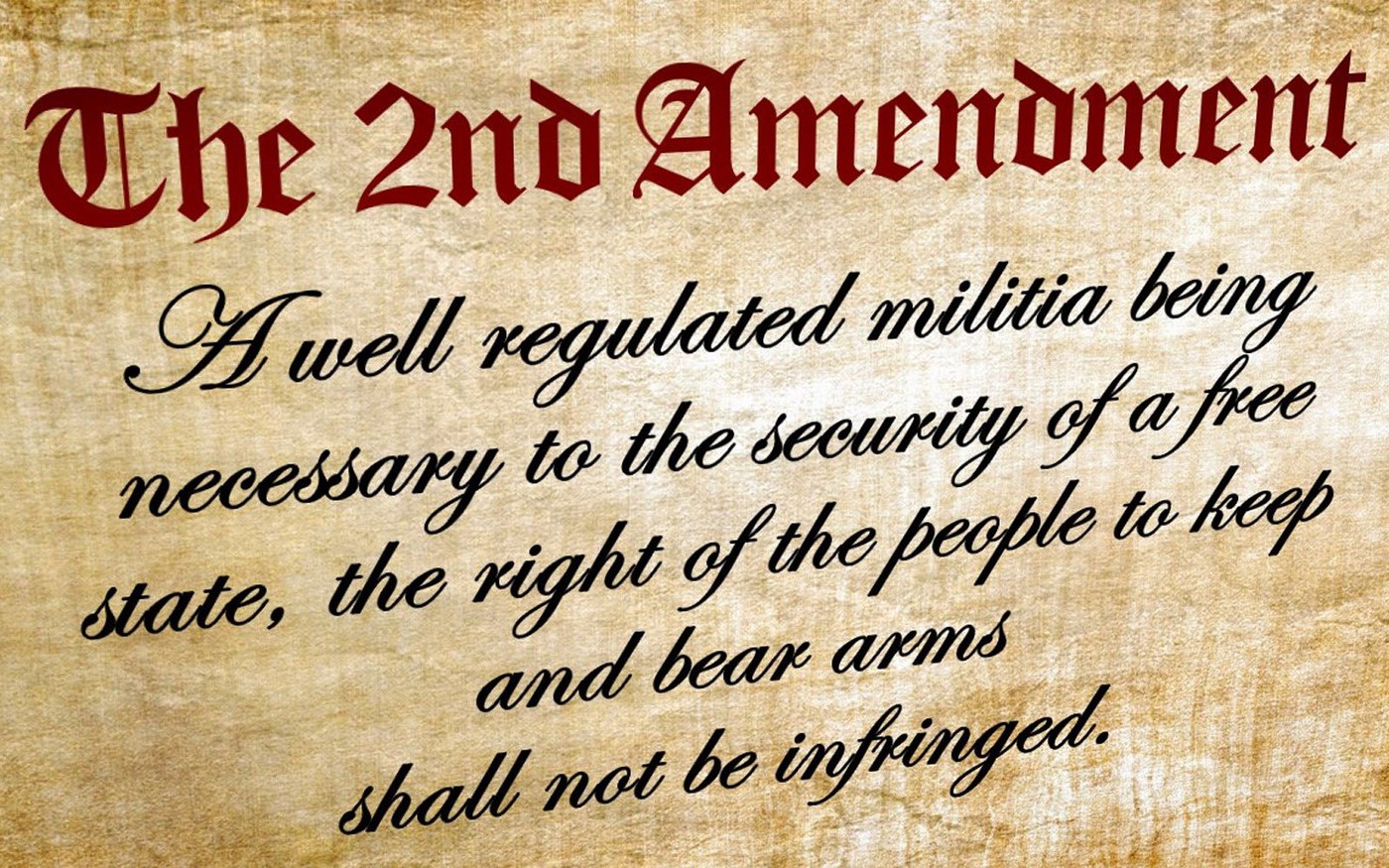
This Ping List is for all things pertaining to infringes upon or victories for the 2nd Amendment.
FReepmail me if you want to be added to or deleted from the list.
More 2nd Amendment related articles on FR's Bang List.
Posted on 08/23/2021 4:51:55 AM PDT by DoodleBob
The Supreme Court on Monday released the schedule for the justices’ November argument session, which begins on Nov. 1 and runs through Nov. 10. The justices will hear oral arguments in nine cases over six days, including the argument in one of the highest-profile cases of the term so far, the challenge to a New York law that requires anyone who wants to carry a gun in the state to show a good reason for doing so. That case, New York State Rifle & Pistol Association v. Bruen, will be argued on Wednesday, Nov. 3.
The court did not indicate whether it would hear oral argument by telephone, as it has done since May 2020 because of the COVID-19 pandemic, or whether it would instead return to the courtroom for in-person arguments. However, the U.S. Court of Appeals for the District of Columbia Circuit announced on Friday that it would hold all oral arguments in September and October remotely because of the pandemic “and the latest public health guidance.”
Here’s a full list of the cases scheduled for argument in the November session:
Thompson v. Clark (Nov. 1): Whether a plaintiff seeking to recover under federal civil rights laws for an allegedly unconstitutional conviction or imprisonment must show that the criminal proceedings ended in a way that is “not inconsistent” with his innocence or instead in a way that affirmatively shows his innocence.
Shinn v. Ramirez (Nov. 1): In a case involving a ruling by the U.S. Court of Appeals for the 9th Circuit that gave one death row inmate a new hearing and required a new trial for another, the justices will weigh in on the impact of their 2012 decision in Martinez v. Ryan on the general rule that a federal court cannot consider evidence outside the state court record when reviewing a state prisoner’s claim for post-conviction relief.
Houston Community College System v. Wilson (Nov. 2): Whether the First Amendment limits a local government’s power to censure its members.
Badgerow v. Walters (Nov. 2): Whether federal courts have the power to confirm or vacate an arbitration award under Sections 9 and 10 of the Federal Arbitration Act, which provide procedures to enforce and vacate an arbitration award, when the only basis for that power is that the underlying dispute involved a federal issue.
New York State Rifle & Pistol Association v. Bruen (Nov. 3): Whether New York’s denial of the plaintiffs’ applications for concealed-carry licenses for self-defense violated the Second Amendment.
FBI v. Fazaga (Nov. 8): Whether a provision of the Foreign Intelligence Surveillance Act trumps the state secrets privilege, which allows the government to block the release of sensitive national security information in litigation, and gives a federal district court the power to resolve (in private and without requiring all sides to be present) a lawsuit against the FBI by members of the Muslim community in southern California.
Unicolors, Inc. v. H&M (Nov. 8): Whether a copyright registration can only be invalidated based on an error when the registrant actually knew about the error when submitting the registration, or whether it is enough that the registrant had constructive knowledge of the error.
Pivotal Software v. Superior Court of California (Nov. 9): Whether the “discovery-stay provision” of the Private Securities Litigation Reform Act, which provides (as the name suggests) for a stay of discovery while a motion to dismiss is pending “[i]n any private action arising under” the Securities Act of 1933 applies to private cases in federal and state courts, or only to private cases in federal courts. [Disclosure: Goldstein & Russell, P.C., whose lawyers contribute to SCOTUSblog in various capacities, is counsel to the respondents in this case.]
City of Austin v. Reagan National Advertising (Nov. 10): Whether Austin’s “sign code,” which allows businesses to install digitized signs on site but bars digitized signs “off premises,” violates the First Amendment.
This post is also published on SCOTUSblog.
Americans mask:
Given that murdering Scalia and evading the Constitution
makes Roberts MORE than simply unfit,
why is Malta still running SCOTUS?
Reason number 1: To fight and defeat a tyrannical government.
You mean John “Epstein Flight Logs” Roberts?
A right needs no reason, and a reason to protect one’s self need not be a “good reason” to anyone else.
Ping for your consideration.
This Ping List is for all things pertaining to infringes upon or victories for the 2nd Amendment.
FReepmail me if you want to be added to or deleted from the list.
More 2nd Amendment related articles on FR's Bang List.
Never go peacefully.
Kavanaugh was sold as a big 2nd amendment supporter, and all we got was a liberal who likes beer.
The Supreme Court has always been anti-gun. Even Scalia in Heller only upheld the right to apply for a license to possess a firearm in the home for self defense. His opinion also dropped a footnote indicating that the gun grabbing laws then on the books were presumptively valid.
If our side wins, hopefully that will make it easier to get one in the first place.
The transcripts of Oral Arguments should be posted here in the afternoon of the day arguments are held...
https://www.supremecourt.gov/oral_arguments/argument_transcript/2021
// Kavanaugh was sold as a big 2nd amendment supporter, and all we got was a liberal who likes beer.
So was ACB. She wrote a very strong dissent in a 2nd Amendment case. So far I’ve been disappointed in what she has supported for cert.
A lot of people owe you an apology.
The court is basically a committee; not all members of the committee were popped out of the same 'big government' mould:
"When faced with a clash of constitutional principle and a line of unreasoned cases wholly divorced from the text, history, and structure of our founding document, we should not hesitate to resolve the tension in favor of the Constitution's original meaning."
Justice Clarence Thomas, 2005
Wow!!!! Thanks for the memories.
Sorry to have been right.
Yet Thomas signed onto Heller and its very limited 2nd Amendment holding and the footnote that held that most gun grabbing on the books was presumptively valid.
I will simply observe that the high court - a small committee of fallible human beings - was not originally intended to sit as the exclusive or final arbiter of constitutional law. As Thomas Jefferson noted:
"...the Government created by this [constitutional] compact was not made the exclusive or final judge of the extent of the powers delegated to itself; since that would have made its discretion, and not the constitution, the measure of its powers; but that as in all other cases of compact among parties having no common Judge, each [State as a] party has an equal right to judge for itself, as well of infractions as of the mode and measure of redress."
With regard to the high court, James Madison noted:
"...[I]t is objected, that the [federal] judicial authority is to be regarded as the sole expositor of the Constitution in the last resort..."
"...[T]he proper answer to the objection is, that the resolution... supposes that dangerous powers, not delegated, may not only be usurped and executed by the other [federal] departments, but that the [federal] judicial department, also, may exercise or sanction dangerous powers beyond the grant of the Constitution; and, consequently, that the ultimate right of the [States as] parties to the Constitution, to judge whether the compact has been dangerously violated, must extend to violations by one delegated authority as well as by another--by the judiciary as well as by the executive, or the legislature."
"However true, therefore, it may be, that the judicial department is, in all questions submitted to it by the forms of the Constitution, to decide in the last resort, this resort must necessarily be deemed the last in relation to the authorities of the other departments of the [federal] government; not in relation to the rights of the parties to the constitutional compact, from which the judicial, as well as the other departments, hold their delegated trusts. On any other hypothesis, the delegation of judicial power would annul the authority delegating it; and the concurrence of this department with the others in usurped powers, might subvert forever, and beyond the possible reach of any rightful remedy, the very Constitution which all were instituted to preserve."
If we are faced, two centuries later, with a federal government that "might subvert forever, and beyond the possible reach of any rightful remedy, the very Constitution", we can not claim that we were not forewarned...
Progressives see the Constitution as an impediment to be overcome.
Here is an article which shows Justice Stevens bragging about how he browbeat Justice Kennedy into holding the Second Amendment hostage until Scalia and others would agree to the limiting language in the Heller decision.
Disclaimer: Opinions posted on Free Republic are those of the individual posters and do not necessarily represent the opinion of Free Republic or its management. All materials posted herein are protected by copyright law and the exemption for fair use of copyrighted works.