Posted on 06/28/2021 1:43:23 PM PDT by blam
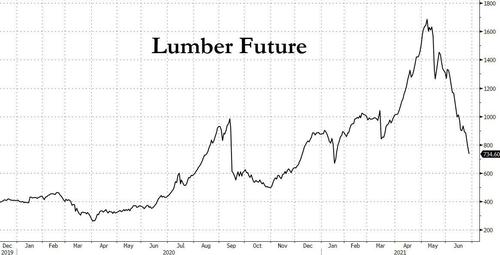
As we have been documenting daily (most recently in “More Container Ships Score “Astronomical” $100,000/Day Rates“), even as some signs of price normalization emerge, most notably the recent drop in commodity prices (lumber, copper)…
… widespread supply-chain disruptions remain and have become a serious challenge in many parts of the US economy, with large effects on both output and inflation.
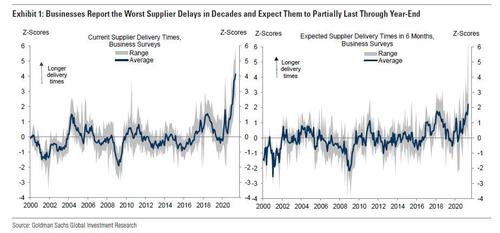
The Goldman chart below shows that businesses report the worst supplier delivery delays in decades and expect delivery times to remain longer than normal through year-end and potentially well into 2022. In special questions included in regional business surveys, a substantial majority of firms in the manufacturing sector have consistently reported experiencing supply chain disruptions over the last several months, although as the Fed’s Vice Chair for supervision Randy Quarles just said, he hopes that supply-chain bottlenecks are “likely temporary” as the economy reopens.
But what if they are not? It wouldn’t be the first time the Fed is dead wrong about something being temporary only to become permanent. For an example of that look not further than the Fed’s ballooning balance sheet which once upon a time was also a “temporary” fixture of monetary policy only to gradually become an immutable part of the Fed’s response.
To answer this and other questions, over the weekend Goldman’s economists looked at the underlying causes of the supply-demand imbalances in many areas of the economy, especially the goods sector, and discuss the timeline for normalization. The bank also discussed when and to what extent the price spikes generated by these imbalances should begin to reverse and what that means for the broader inflation outlook this year and next.
The bottom line for those pressed for time is that according to Goldman the current one-off inflationary boost from supply chain bottlenecks will eventually become a one-off disinflationary drag, with the bank expecting “fading fiscal support for households and a shift in spending to services over the next few months to ease demand pressures.” And on the supply side, look for the semiconductor shortage to improve later this year, especially for the autos sector. Overall, the contribution to year-on-year core PCE inflation from supply-constrained categories has risen from -20bp before the pandemic to +105bp today, but we expect it to decline to +35bp by end-2021 and to -55bp by end-2022
Below we pull the most notable highlights from the report:
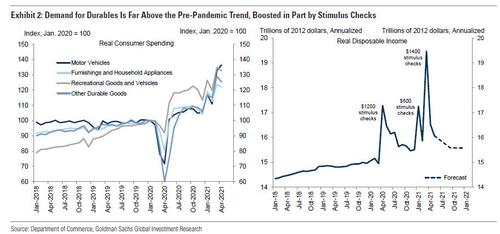
Goldman first looks at the demand side, where consumer spending on durable goods has risen to levels 15-25% above trend (Exhibit 2, left) due to the boost to disposable income from fiscal support, the unavailability of many services, and pandemic preference shifts. The further surge in demand for durables this year likely reflects the impact of the stimulus checks (Exhibit 2, right), which past experience has shown are disproportionately spent on durables and used for down payments on autos. Even under better circumstances, suppliers would likely have struggled to keep up with such a rapid surge in demand
On the supply side, there are three main contributing factors.
First, company anecdotes reveal that some businesses initially cut back because they expected demand to fall in a recession, and others had to stop production because of the virus. For example, automakers closed plants to improve safety at the start of the pandemic, resulting in a large drop in car production (Exhibit 3, left). They also reacted to the decline in demand at the start of the pandemic by ordering fewer microchips, which then led chipmakers to reduce production. Similarly, cash-strapped rental car companies that initially faced a sharp drop in demand sold roughly a third of their fleet (Exhibit 3, right).
Second, production has been hampered by supply chain disruptions, in particular the negative supply shocks that caused the global semiconductor shortage. The shortage of microchips has affected many consumer goods including electronics, appliances, and automobiles. The chip shortage caused auto production to fall for a second time over the last four months, bringing the shortfall of domestic auto production since the start of the pandemic to about 2.5mn (Exhibit 3, left). Combined with strong demand, this has resulted in a dramatic depletion of new and used car inventory (Exhibit 3, center), making it hard for consumers to find new cars and for rental companies to rebuild their fleets.
(snip)
Last week at WalMart the knife case in the camping/fishing section there was only one knife in stock in a case that has 60 displays.
Left out the part of less truck drivers to deliver stuff from the ports across the country.
The DAT Load Board has had over 1 Million loads waiting for trucks every week since April.
Shippers are calling 8-10 truckers hoping one will take their order.
The supply chain is one thing, and it well may get better. Other, larger inflationary forces are another story.
Higher oil.
Higher costs of labor (reacting to all of the government cheese as well as more unions).
More Regulations.
Higher taxes.
M2 money supply at all time highs.
Those things will NOT be fixed until Trump is re-elected.
have you not heard of warehouse fairies. they make sure we always have the supplies needed.
Add that very few young people want to be truck drivers - retirements in 2021 are at an all time high.
It is going to getting much worse for the trucking industry. Robot drivers are not the answer - yet.
We deserves this since our supply chain left the US for exotic places. MAKE IT HERE, DO IT NOW!!!
Fixed it.
flr
I believe it. My wife read an article last week that stated dealerships are selling preowned 2019 toyota tacoma’s for more than they sold them for when they were brand new.
Yeah, there is a sizeable used vehicle value increase.
But wait until you price out a vehicle replacement,
and you will see any profit erased (!),.. and then some !
I don't plan on ever buying another vehicle...I'm keeping this one.
Just like houses right now
I’m looking at trucks. A new truck costs less that the same model that is a few years old. Bizarre.
Macro economics 101:
Want to increase wealth? Increase productivity.
How does creating ever more jobs that do not add any value, standing at doors checking temperatures, the meter maid cop with his radar hiding on the side of the road, the EEOC representative, the EPA officer... actually add to the value some product?
They don’t. They are all leaches just living off the productive that actually do build a house or a car, treat the sick, fly a plane, or fix a computer.
We are grinding to a halt when it comes to wealth generation in this country because we have forgotten what actually creates it, “productive” work.
Productive = something which actually adds a value, that has a real demand in a market, not some imaginary demand as with the TSA which costs $9,000,000,000 a year and has caught 0 terrorists to date. If paying for the TSA were optional, how many would pay for this service? Artificial government construct which damages the airline industry by jacking up costs for air travel and providing no added value.
If you want to create wealth, push for policies that increase productivity and try to keep all the extra crap that does not add to the actual value lean.
So we need to reduce government at all levels by 50%
Bushie Republicans pushed productivity off shore and douche wads like Gates imported STEM 3rd worlders through H-1B to steal our best jobs. So the system had failed in a lot of ways...
there are so many useless business men that are involved in leaching off of society rather then creating wealth....so many people do not understand that wealth is created by making something that is a desired commodity. like you said it is not the extra expense created when you make people pay for a governmental service like the Tsa . or mandate a service not wanted by anyone. the death of small buisness is the death of Americas dominance in the world of economics.
Yes-
Big government simply creates this: https://www.independent.co.uk/news/world/americas/us-politics/tucker-carlson-nsa-biden-fox-news-b1874476.html
What do you expect? Who picks the heads of all these agencies and departments? All the senior level bureaucrats get hand picked by the appointees, do you think they walk tall or crawl on their knees looking for something to suck? Who controls the budget of all these agencies and departments?
Government is a political animal, and all of these government agencies and departments (all of them), become political instruments. Issues like Covid become the tool with which politicians drive their interests (win an election) and most of the solutions offered accomplished NOTHING with the exception of the rapid vaccine development and it’s mass fielding.
There is no fixing it except to keep government small.
The bigger government gets, the more it chokes the rights of citizens and impedes economic development.
Disclaimer: Opinions posted on Free Republic are those of the individual posters and do not necessarily represent the opinion of Free Republic or its management. All materials posted herein are protected by copyright law and the exemption for fair use of copyrighted works.