Skip to comments.
Skills Matter
Townhall.com ^
| June 10, 2021
| Jackie Gingrich Cushman
Posted on 06/10/2021 5:21:08 AM PDT by Kaslin
Controversy erupted Tuesday over a comment made by economist Art Laffer regarding hourly wages.
Asked by Fox News anchor Sandra Smith if the minimum wage should rise, Laffer replied that many minimum wage workers "aren't worth $15." Some people latched onto the statement as though it was about a person's intrinsic worth, rather than the value of their skills and attributes in a labor market.
This conflation of work value and human value might well be explained by the increased secularization of our society. As an Episcopalian, I believe that every person has the same value, and that that value is infinite. Every human is made in the image of God, and no one is inherently better than anyone else.
I also understand that, while we may all have the same intrinsic worth, workers who don't show up on time, don't show up at all, don't have a good attitude, don't develop skills or don't follow directions will have a lower value in the job market than those who do. Also, experience often brings with it better skills and higher pay. Minimum wage should be the starting point for a career -- not an ending point.
If you get to work early, stay late, ask what you can do to help, learn rapidly, think about how to make the company more efficient or effective and add value to your place of work, then you would be worth more to the company and should be paid more. But let's move from theory to reality.
This week, I attempted to buy lunch at a small local restaurant in downtown Decatur, a suburb of Atlanta. It was about 11:45 a.m., and there were two people in front of me in the restaurant, which served a variety of Greek and Mexican food cooked to order. The menu pasted on the wall looked great. There was a sign that said, "Due to shortage of workers, there may be delays in service."
One person was working the grill, and another was working behind the counter -- doing what, I could not tell. After a few minutes of waiting in line, with not a peep from anyone behind the counter, neither to me nor to any other customer, I decided to try another place. Even if they were busy, the simple act of welcoming me might have been enough to keep me in line.
A block away, I found another restaurant, where two people were working. There was the same setup -- one was working the grill and the second was at the counter. But that's where the similarity ended; the second greeted me warmly as I walked in the door and nodded to a menu for me to peruse before I ordered. I stayed, ordered, waited, got my food and left, leaving a nice tip.
Several times over the past few weeks, I have been greeted by signs in restaurants indicating that they were unable to find workers. According to the June 8 report by the NFIB, the small-business association, nearly half (48 percent) of small-business owners had job openings last month that they could not fill. This was the fourth consecutive month during which job openings were almost twice the historical average of 22 percent.
The challenge is that, despite the job openings, there is also a high rate of unemployment, 5.8 percent. Additionally, the percentage of people who are participating in the labor market has fallen to 61.6 percent from 62.9 percent two years ago. Before the 2008 recession, it was around 66 percent, a rate to which it has never returned.
This means one thing: People don't want to work for the current wages. The result could be wage inflation.
It appears to be happening already. This week, in a Bloomberg News article titled, "Surprise Jump in U.S. Wages Gives Inflation Debate a New Twist," Olivia Rockeman and Reade Pickert wrote about "the prospect of what's known and dreaded in economics as a wage-price spiral. The idea is that higher wages spur more spending growth that strains production capacity and drives up business costs. In turn, companies raise prices and workers demand even larger pay increases to stay ahead of a rising cost of living."
Back to real life: Chipotle Mexican Grill, Inc., recently announced both an increase in wages and an increase in the prices it will charge its customers. If businesses have to pay more for people to work, their options are to hire fewer people (possible through automation); lower their profits (which investors will not put up with); or pass along the higher costs in the form of higher prices to customers.
Then there is the question of paying people what they are "worth." The real problem with this approach is that the hourly wage is an indication of work; it's not necessarily an indication of what a person's skills and attributes are worth in the labor market. If we want to have an honest discussion about wages, then we also need to include skills and attributes of workers.
Laffer was correct: A simple hello would have kept me in line.
TOPICS: Business/Economy; Culture/Society; Editorial
KEYWORDS: bidenadmin; economy; inflation
1
posted on
06/10/2021 5:21:08 AM PDT
by
Kaslin
To: Kaslin
Some people latched onto the statement as though it was about a person's intrinsic worth Emotive dweebs who should be ridiculed
To: Kaslin
The proper term is that “they don’t add value” at $15/hour.
Employees should add value to the bottom line.
To: Kaslin
“a high rate of unemployment, 5.8 percent.” -— Not really that high. IIRC, 5% used to be considered “full employment” by the Feds.
4
posted on
06/10/2021 5:44:28 AM PDT
by
PghBaldy
(12/14 - 930am -rampage begins... 12/15 - 1030am - Obama's advance team scouts photo-op locations.)
To: Kaslin
Everyday, that $15 is of less value.
5
posted on
06/10/2021 5:53:03 AM PDT
by
Theoria
To: Vermont Lt
I used to work for minimum wage, but every time the minimum wage went up the hours got cut. Instead of getting 40 hours in per week, we only got 30 hours in and many times not even that.
Paying minimum page is unfair to those that are always on time and never late and are good workers.
There was one person were I worked but she only worked on Sundays, and used to whine " I am soooooo tired, because she was partying all Saturday evening.
Well if I stay out till 2:00 or 3:00 am in the morning and had to be at work at 8:00 am, I would be tired too.
6
posted on
06/10/2021 5:53:55 AM PDT
by
Kaslin
(Joe Biden will never be my President, and neither will Kamala Harris)
To: Kaslin
I thought this was a well written article. I think the photo of Biden was a non-sequitur because Art Laffer made the economic point. Am I missing something?
To: Kaslin
From the article:
"This week, I attempted to buy lunch at a small local restaurant in downtown Decatur, a suburb of Atlanta. It was about 11:45 a.m., and there were two people in front of me in the restaurant, which served a variety of Greek and Mexican food cooked to order. The menu pasted on the wall looked great. There was a sign that said, "Due to shortage of workers, there may be delays in service.""
So the restaurant is facing shortages of people willing to work for cr@p wages, to the extent that it is causing a decline in their service and possibly driving customers away. Looks like those workers do add value after all. Yet they still refuse to raise wages that will attract workers. Are they really so petty that they would rather drive away their customers with slow service than pay their workers a few extra bucks? If so, then maybe they deserve to fail.
"Back to real life: Chipotle Mexican Grill, Inc., recently announced both an increase in wages and an increase in the prices it will charge its customers. If businesses have to pay more for people to work, their options are to hire fewer people (possible through automation); lower their profits (which investors will not put up with); or pass along the higher costs in the form of higher prices to customers."
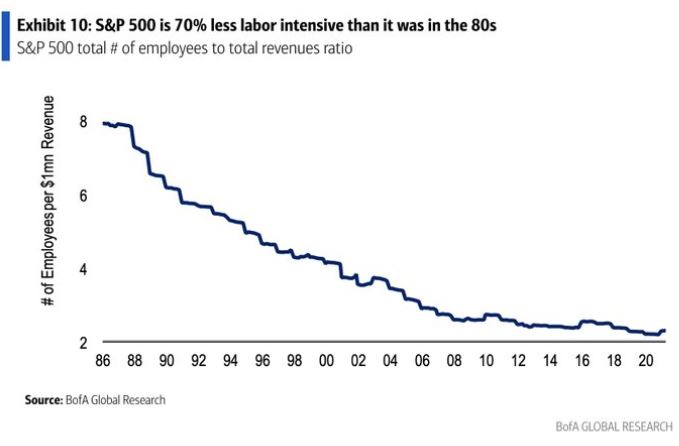
I go to Chipotle about once a month. Haven't noticed any price increases, at least not enough to drive me away as a customer. Labor is a very small portion of a business's costs.
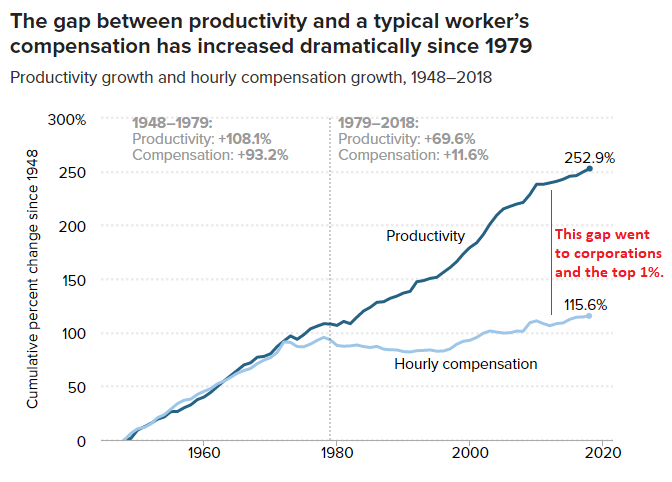
Wages have flatlined since the 1970's, in spite of greater productivity increasing profits for the shareholders. American workers are overdue a raise.
To: FormerFRLurker
9
posted on
06/10/2021 6:48:10 AM PDT
by
Theoria
To: Vermont Lt
Yeah, but when you say “they”, then someone would ask ‘who is they’?
10
posted on
06/10/2021 7:41:36 AM PDT
by
Kaslin
(Joe Biden will never be my President, and neither will Kamala Harris)
To: Kaslin
”Paying minimum wage is unfair to those that are always on time and never late and are good workers.” Being a “good worker” probably translates into “the business is more profitable with this worker than without this worker”. The cost of having somebody on the payroll is typically double their wages or more. The worker needs to exhibit sufficient productivity to cover this cost. Otherwise this cost would have to be covered by the productivity of other workers.
In a truly capitalist economy if your business doesn’t bring in revenue sufficient to cover total costs you will eventually cease to exist. Being on time is usually a part of the productivity calculation but not necessarily.
To: Kaslin
As a retired worker from a high-skilled field I can remember that there were some workers in fields calling for “skilled” folks & they weren’t worth minimum wage back then....when minimum wage was half what it is now.
12
posted on
06/10/2021 2:51:05 PM PDT
by
oldtech
Disclaimer:
Opinions posted on Free Republic are those of the individual
posters and do not necessarily represent the opinion of Free Republic or its
management. All materials posted herein are protected by copyright law and the
exemption for fair use of copyrighted works.
FreeRepublic.com is powered by software copyright 2000-2008 John Robinson