Skip to comments.
Wind turbines played significant role in historic Texas power - failures, data suggest
Just the News ^
| February 18, 2021
| Daniel Payne
Posted on 02/19/2021 4:38:59 AM PST by gattaca
Wind energy production dropped off sharply as cold moved in.
The historic power failures in Texas this week amid a major cold snap there appear to have been driven in no small part by the failure of the state's wind turbines to keep up with a spike in demand, according to energy data from federal sources.
Once-in-a-century cold weather in much of Texas this week sent energy demands skyrocketing, placing major strains on power grids and leaving millions of residents without power for extended periods of single-digit weather. Weather data show that temperatures throughout the state began plummeting sharply late Saturday, Feb. 13 and throughout the next day. In areas such as Fort Worth, the temperature has hovered around zero at times. February average lows in that area are around 40 degrees.
A statewide blame game has accompanied the crisis, with numerous industries and commentators alleging that, variously, wind, solar, natural gas and coal failed to meet the surge in heating demand accompanying the cold snap. Yet federal data from the U.S. Energy Information Administration indicate that, of the state's major energy sources, wind experienced the sharpest drop-off in energy production
The plunge in temperatures led to both a surge in heating demand and the concomitant power outages. Data from the EIA show that at nearly the exact same time demand was surging and energy grids were buckling, wind energy experienced a catastrophic drop-off: In the evening of Feb. 14, wind in the state was producing just over 9,000 MWh of energy, while 24 hours later it was putting out less than 800 MWh, a roughly 91% decrease in output.
Virtually every other energy industry in the state also saw decreased output over the same time period amid record demand, yet none saw as steep a decrease as did wind power. Natural gas, the state's largest source of energy, saw a 23% decline in output, as did coal, the second-largest source. Nuclear, which competes with wind for third place, dropped 26%.
Texas has come to rely increasingly on wind power in recent years. The Texas Comptroller of Public Accounts said last August that the state's usage of wind power has "more than quadrupled" since 2009, with wind rising to supply 20% of the state's total energy needs in 2019. Coal power, meanwhile, declined from 37% of the state's electricity generation in 2009 to 20% in 2019.
'A lot of issues with the infrastructure itself'
The overall data picture indicates that Texas' energy infrastructure across the board struggled heavily to meet the surge in demand, an assessment shared by Leticia Gonzales, a markets contributor at the industry group Natural Gas Intelligence.
Gonzales was asked which among the state's energy industries failed to meet the huge demand of the recent cold snap. "The short answer is, they all did," she replied.
"There is a lot of finger pointing, depending on which way you fall politically," Gonzales argued. "At the heart of it, it's not one generation's fault over the other."
Gonzales argued that the way Texas' primary electrical corporation, ERCOT, manages electricity in the state may have something to do with the recent outages.
"ERCOT operates as an energy-only market," she said. "Generators only get paid for the generation they are actually producing." In other regions, she said, industries operate a "capacity market," where grid managers "actually pay generators to have capacity available to meet any kind of unexpected spikes in demand."
"Reserve margins, having that cushion of extra capacity has been an issue in Texas for years," Gonzales added. "The reserve margin has been razor-thin. We just don't have a lot of spare capacity."
Gonzales said that, in addition to wind turbines freezing, "a lot of natural gas pipelines" also froze up.
"Production plummeted," she said. "It was a lot of issues with the infrastructure itself."
After several days of defending the renewable energy source, champions of wind power received partial vindication this week when, on Tuesday, ERCOT Senior Director Dan Woodfin told media that "a lot of the generation that has gone offline today has been primarily due to issues on the natural gas system."
The natural gas losses could also be partly explained by wind production having plummeted so steeply in the initial cold snap and remained at low levels in subsequent days while natural gas rates remained relatively elevated. With natural gas producing so much more KWh relative to other fuels, it stands to reason that its role now in ongoing outages would likewise be disproportionately large.
A 30-day review of energy production in Texas shows that, while natural gas and wind energy were at times neck-and-neck in production rates throughout January and into mid-February, natural gas production skyrocketed following the cold snap while wind plummeted.
Natural gas energy output in Texas hit a high on Feb. 15 before declining sharply in the following days, yet it still remained over 400% higher than it was on Feb. 7, compared to an overall 83% decrease in wind output.
TOPICS: News/Current Events
KEYWORDS:
Navigation: use the links below to view more comments.
first 1-20, 21-37 next last
1
posted on
02/19/2021 4:38:59 AM PST
by
gattaca
To: gattaca
It is strange though that wind seems to operate well in other, generally colder places than Texas. I wonder what was different? It gets very cold in Nebraska and Kansas, too, and I’ve never heard of this happening there.
2
posted on
02/19/2021 4:44:44 AM PST
by
babble-on
To: babble-on
New Lib Handbook. How to destroy Texas by selling them on Green Power.
To: gattaca
As I understand it the wind turbines in Texas have a de-icing feature available that might have helped with freeze up, but Texas for some reason opted to NOT have that feature installed on their wind turbines.
Heard that yesterday either on OANN or newsmax.
Somebody wanted to save $$ I would assume.
Also I hear gas lines froze because they were not winterized either, but if the resources from wind and solar would have gone to fossil from the beginning would that have kept this from happening I wonder.
4
posted on
02/19/2021 4:51:07 AM PST
by
V_TWIN
(Where's Hunter???)
To: gattaca
“There is a lot of finger pointing, depending on which way you fall politically,” Gonzales argued. “At the heart of it, it’s not one generation’s fault over the other.”
Essentially true but not entirely for the reasons stated. Wind/solar should not be such a large portion of the energy grid. These are not cheap, not reliable, not recyclable, and probably several additional negative points.
Texas needs several more nukes to be brought online. They don’t depend on external supplies like coal and natural gas which has to be shipped to the generating plant.
5
posted on
02/19/2021 4:52:02 AM PST
by
ByteMercenary
(Healthcare Insurance is *NOT* a Constitutional right.)
To: gattaca
We now know it was all Ted Cruz’s fault.
To: gattaca
7
posted on
02/19/2021 4:54:22 AM PST
by
Varsity Flight
( "War by the prophesies set before you." I Timothy 1:18)
To: gattaca
The greater point is, there is no NEED for wind and solar. We have more than enough NatGas to utilize this source for power generation where ever additional power is needed.
Texas Power companies used windmills and solar panels because of the Fed Gov’ts subsidies (our tax dollars) to the point where the state’s dependence on them grew to 23%!
The extreme arctic blast froze most of the windmills. Snow-covered the solar panels. The NatGas generators were stretched to the breaking point trying to make up for the loss and some of them began having issues operating at top capacity for many many hours on end. None of what happened was necessary. It happened because of greed, Green Subsidies and, stupidity.
8
posted on
02/19/2021 4:56:26 AM PST
by
ocrp1982
To: gattaca
I’ve been around a few generating stations. Freeze protection is always designed in, heat tape, insulation, heated structures. In southern locations these measures were thought to be unnecessary. As for wind turbines, calm days are associated with high pressure systems which is when extreme cold and hot events happen. Texas needs a Texas sized battery bank.
9
posted on
02/19/2021 4:57:21 AM PST
by
cicero2k
To: babble-on
I think it's a general issue of incompetence and lack of preparedness. For all the talk about a "free and independent" Texas, the place isn't any different than the rest of the U.S. Most people live in major metro areas and are completely unprepared for any kind of disruption in the normal course of daily life.
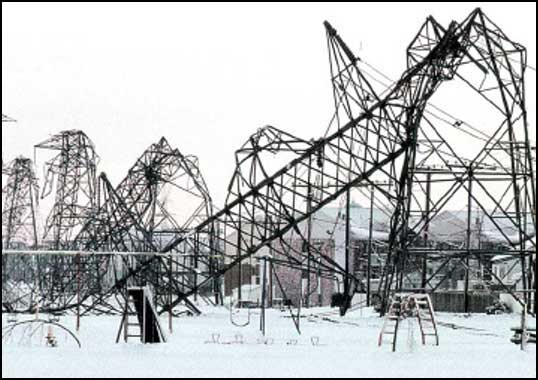
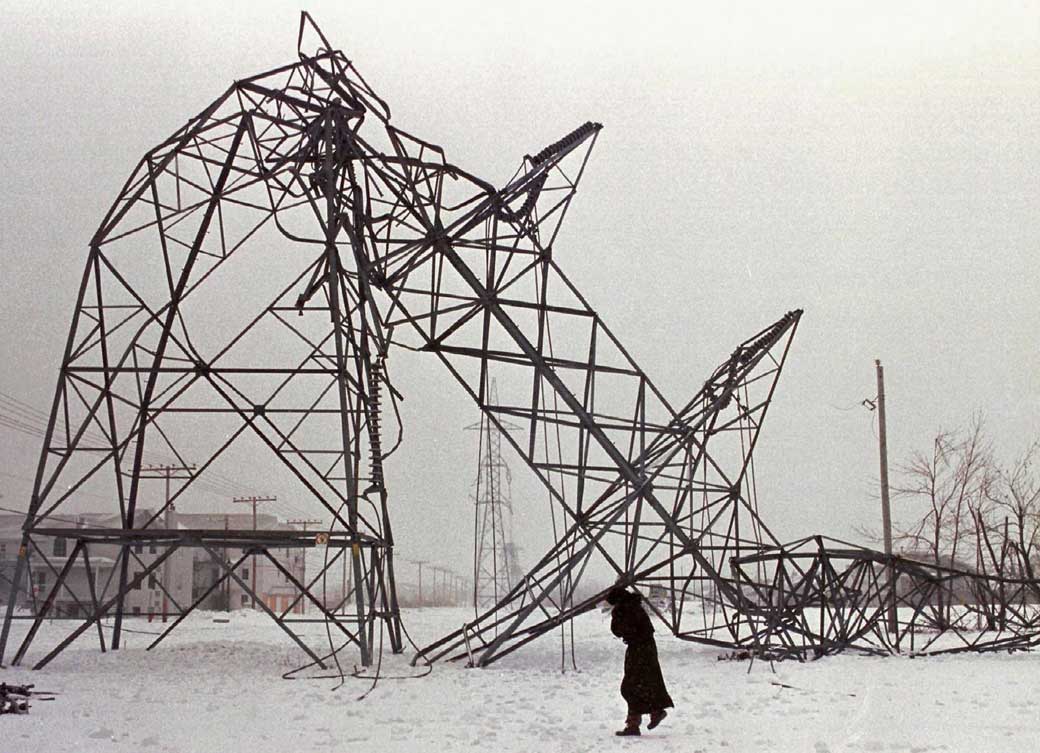
There was a major winter storm back in 1998 that hardly anyone even remembers. Heck -- it got very little media attention in the U.S. even back then. It was a massive ice storm across upstate New York and eastern Canada that toppled millions of trees, destroyed utility infrastructure, and left millions of people without power for up to six weeks ... in a place (unlike Texas) where winter conditions are deadly under normal circumstances.
One reason this catastrophic event got so little media attention is that it occurred in a place where people are used to harsh winters and were able to handle the disruption even under some very challenging circumstances.

10
posted on
02/19/2021 4:59:06 AM PST
by
Alberta's Child
("And once in a night I dreamed you were there; I canceled my flight from going nowhere.")
To: HighSierra5
You are correct. Libtard media trying to distract from green energy not being a viable energy source.
11
posted on
02/19/2021 5:01:39 AM PST
by
V_TWIN
(Where's Hunter???)
To: gattaca
Well yeah, but Joe, the Hoe, and their sidekick Circleback Jen Psucki said is was gas and coal that failed. Media said so too. /s
12
posted on
02/19/2021 5:01:40 AM PST
by
dforest
(RATS are criminals and frauds. Hide anything that belongs to you. They will steal it.)
To: babble-on; All
It gets very cold in Nebraska and Kansas, too, and I’ve never heard of this happening there. Nebraska and Kansas have not deliberately moved 25% of their energy production to wind, while decreasing the overall percent buffer of energy production.
Wind is inherently unreliable.
It wasn't cold so much in Texas that stopped production. It was lack of wind, with a high energy demand because of cold.
There wasn't enough extra capacity to meet the increased demand, which then caused a cascade of shutting down fossil fuel plants and nuclear, to protect the plants.
13
posted on
02/19/2021 5:03:25 AM PST
by
marktwain
(President Trump and his supporters are the Resistance. His opponents are the Reactionaries. )
To: gattaca
Jopedo and the Ho are really messing up the response to this storm disaster.
Texas is Biden's Katrina.
14
posted on
02/19/2021 5:12:35 AM PST
by
skimbell
To: marktwain
I have never read a more ignorant message....Kansas, and their ISO, SPP, is THE most reliant on wind region in the USA.
15
posted on
02/19/2021 5:14:48 AM PST
by
impimp
( )
To: gattaca
Bkmk Abbott and Bush spawn
16
posted on
02/19/2021 5:15:21 AM PST
by
ptsal
(Vote R.E.D. >>>Remove Every Democrat ***)
To: gattaca
I would sure like to know the whole story about Texas which is supposed to be a state with the most freedom, how in the world they moved to wind enegy. I’m sure there are Democrats and Rino Republicans who were paid off by the company hich built the turbines.
17
posted on
02/19/2021 5:18:29 AM PST
by
CincyRichieRich
(WHEN TYRANNY BECOMES LAW, REBELLION BECOMES DUTY 1-6-21, American Revolution II Began)
To: gattaca
Are they blaming this cold snap on global warming? I’m waiting to hear that crap. This is exactly why they changed it to “climate change” That happened around 10 years ago when Al Gore was going to give a speech in NYC about global warming and it was one of the coldest days ever in NYC and incredibly Gore blamed it on “global warming” and right after that the neo-Marxists changed it to “climate change”.
18
posted on
02/19/2021 5:21:06 AM PST
by
GrandJediMasterYoda
(As long as Hillary Clinton remains free equal justice under the law will never exist in the USA)
To: marktwain
In 2019, wind energy provided 41% of electricity generation in Kansas, the second-largest share for any state. In 2019, wind energy surpassed coal for the first time as the largest energy source for generating electricity in Kansas. - EIA
To: gattaca
Natural gas energy output in Texas hit a high on Feb. 15 before
declining sharply in the following days, yet it still remained over 400%
higher than it was on Feb. 7, compared to an overall 83% decrease in wind
output. Through the article it makes it sound as if natural gas was a problem. Then
In the last paragraph it seemed to prove otherwise.
20
posted on
02/19/2021 5:26:03 AM PST
by
DoughtyOne
(The Republican Party is dead. Long live the Founders Party.)
Navigation: use the links below to view more comments.
first 1-20, 21-37 next last
Disclaimer:
Opinions posted on Free Republic are those of the individual
posters and do not necessarily represent the opinion of Free Republic or its
management. All materials posted herein are protected by copyright law and the
exemption for fair use of copyrighted works.
FreeRepublic.com is powered by software copyright 2000-2008 John Robinson