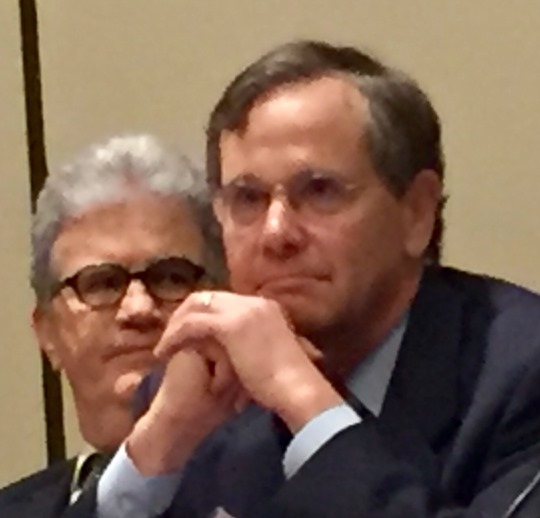
Rob with former US Senator Tom Coburn
Posted on 01/13/2016 9:41:01 AM PST by xzins
Rob with former US Senator Tom Coburn
Note: A shorter version of this article originally appeared at The Originalism Blog at the University of San Diego.
Some commentators are dismissing as merely frivolous the claim that Senator Ted Cruz is not a “natural born citizen†as the Constitution uses that term, and therefore ineligible for the presidency.
This dismissive attitude is a serious mistake. Although Senator Cruz’s belief that he is natural born may ultimately be vindicated, the case against him is very respectable.
At the outset, we should note that the requirement that a president be a “natural born citizen†is not an arbitrary rule. The Framers added it to the Constitution because history had taught them some hard lessons about the inadvisability of allowing a foreign-born person to become a country’s chief executive. In other words, the constitutional requirement is there for good reasons, and should be respected.
Senator Cruz was born in Canada of an American mother and a Cuban father. By congressional statute, he was a citizen at birth. His citizenship is not at issue. What is at issue is whether he is “natural born†as the Constitution uses the term.
When the Constitution was written, the default rule of international law was that, although for many purposes a person’s status followed the condition of the mother (according to the maxim partus sequitur ventrem), for citizenship or “allegiance†purposes status followed that of the father. Individual countries altered the default rule, and the Anglo-American statutory and common law altered it more than most. In Anglo-American countries, nearly all children born within a country were granted “natural born†status, even if their parents were both aliens. Although for several years Parliament may have allowed foreign-born children to claim citizenship through their mothers, well before the American revolution it has been firmly established that to be “natural born†such a child had to have a citizen father.
In other words, it was not sufficient, as some recent writings have implied, for the child to have a citizen mother. As I pointed out several years ago in my book, The Original Constitution: What It Actually Said and Meant:
We know exactly what the founders meant by the phrase “natural-born citizen†because they adapted it from the English legal term, “natural born subject,†which in Britain defined who could serve in Parliament or the Privy Council. Essentially, a natural-born citizen was one who met either one of two requirements. First, a person qualified if born within the United States or within American territory, even if the person’s parents were aliens. Alternatively, an individual qualified even if born outside the country if the individual’s father was an American citizen not then engaged in traitorous or felonious activities.
On at least two occasions the Supreme Court has confirmed that in citizenship matters the Constitution should be read to incorporate principles inherited from Great Britain.
In arguing the contrary, recent commentators have made several kinds of mistakes. Some seem to read founding-era sources that refer to the foreign-board children of citizen parents as natural born, not recognizing that the sources mean both parents—or the father alone rather than the mother. Admittedly, the sources can be tricky on this score. By way of illustration, the editor’s headnote to Bacon v. Bacon, an English decided by the Court of King’s Bench, seems to imply that the mother can pass citizenship. But the body of the case asserts clearly that the relevant status is that of the father.
Some writers have enlisted sources that directly contradict their thesis. For example, two writers cited Blackstone’s Commentaries to support their argument that a mother can convey natural born status to her foreign-born child. Actually, Blackstone affirms that the critical parent for these purposes is the father:
Professor Michael Ramsey, while correctly concluding that the concept of citizenship was based on British law, ingeniously argues that Congress may change the definition of “natural born,” in part because the English Parliament did so from time to time. This argument is by no means impregnable, however, as Professor Ramsey recognizes. For one thing, Congress, unlike Parliament, is a legislature of limited powers. The Constitution grants Congress power to naturalize citizens, but it does not (expressly, anyway) grant power to alter the meaning of “natural born.” Moreover, allowing Congress to manipulate the definition this way would be fundamentally inconsistent with the constitutional safeguard: It would allow Congress to decree that children born in a favored foreign country or of a favored foreign family were thereby “natural born.” That may seem far-fetched today, but would have seemed less so during the founding era, when nations and at least one American state (Maryland) conferred citizenship privileges on those with whom they wished to curry favor.
The best evidence for granting natural-born status to the foreign-born child of a citizen mother and alien father derives from the Naturalization Act of 1790, adopted in the First Federal Congress. It provided in part:
And the children of citizens of the United States, that may be born beyond sea, or out of the limits of the United States, shall be considered as natural born citizens: Provided, That the right of citizenship shall not descend to persons whose fathers have never been resident in the United States.
Senator Cruz’s father, although a Cuban, previously had lived in the United States.
Although Congress cannot alter the meaning of a constitutional provision, one may contend that this statute sheds light on the meaning of the constitutional meaning of “natural born.” It was adopted by a Congress that included important Founders and it was enacted before all of the 13 original states had ratified the Constitution. But at least four factors weaken its persuasive force:
First, the new federal Congress adopted it nearly a year after the Constitution had been ratified by eleven states. Its terms seem not to have been the subject of discussion during the ratification process.
Second, the statute is ambiguous. It applies to the “children of citizens.†That may mean children with at least one citizen-parent. But it also might mean children with two citizen-parents. As noted above, other founding era sources that, at first glance, might seem to mean the former, actually mean the latter.
Third, when Congress used the term “citizen†it may well have meant only male citizens. Taken alone, it would not seem so. But remember that the then-prevailing assumption was that citizenship status followed the father. Observe how the statute’s proviso focused solely on the father: “[T]he right of citizenship shall not descend to persons whose fathers have never been resident in the United States.”
Fourth, the presence of “natural born” language in a statute dealing with naturalization—and not otherwise with natural born status—seems to demand explanation, and one likely explanation may not be good for Senator Cruz’s case:
During the founding era, certain private rights, such as inheritance and land ownership, could depend on citizenship or natural-born status. Congress may have been seeking, not to explain or define the constitutional requirement, but merely to extend private benefits to persons who might otherwise be excluded. This would explain why the statute provides that the “children . . . shall be considered as natural bornâ€â€”not that they literally are natural born.
I am an admirer of Senator Cruz, and I wish him well in the court challenges that undoubtedly will arise. But no one should dismiss those challenges as baseless or frivolous.
He is among the most widely published and cited in the area of original intent.
wish I would have changed those dynamic punctuation marks. Sorry.
Good grief give it a rest.
Do you really believe that Justice Thomas’ wife Ginni would have endorsed and indeed made a video for Ted if he were not natural born?
Never mind with his credentials are, he will soon be thrown under the bus, by the deniers.
So if Cruz wins the nomination Trump will sue? This could get bloody good!
Bacon always wins!
Grayson has a suit now, IIRC. The Dems will sue.
This guy has been quoted many times by different Justices on the Supreme Court in cases before their review.
Well if NBC does not descend from the mother, and this disqualifies Cruz, then what does that make Obama?
His mother, alone, was an American. Not his father.
By Victor Morton - The Washington Times - Thursday, January 7, 2016
A Democratic member of the U.S. House vowed Thursday to file a lawsuit challenging Sen. Ted Cruz’s Constitutional eligibility to become president.
Rep. Alan Grayson, Florida Democrat, said the issue is not political but Constitutional and that he will file a suit “if and when he becomes the nominee and tries to qualify for the ballot” in November
But...born on U.S. soil (so we’ve been told); unlike Ted Cruz.
Natelson is not a fly-by-night. He is a major contributor to constitutional legal thinking. His cites are enormous. His writings are enormous.
This is an important article.
“Do you really believe that Justice Thomas’ wife Ginni would have endorsed and indeed made a video for Ted if he were not natural born?”
Yes
See #13
And he's making a logical error here. But I tire of trying to correct birthers. It never takes.
This is what I’ve been wondering all along. As much as I would love to have Ted as pres. if he’s disqualified then we have a “poison tree” problem. Theoretically, all law signed by Obama becomes invalid.
Anybody with a brain knows that Ted Cruz is not eligible and neither is Rubio or Jindal but I’m not going to pick feathers on this as we have a Kenyan sitting in the Whitehut right now. Any of the three ineligible republicans would be 1000% better than him. Where was the outrage in 2008 when we let one for sure ineligible candidate and another iffy one run?
He was using diplomatic language. He knows there is no way possible that Ted Cruz is a natural born citizen. He’s leaving himself an out in case Ted Cruz gets a friendly court to find in his favor in spite of his not being a natural born citizen.
It is way off the mark to describe Natelson as a birther.
He is a scholar’s scholar. This is a significant article from an originalist.
Disclaimer: Opinions posted on Free Republic are those of the individual posters and do not necessarily represent the opinion of Free Republic or its management. All materials posted herein are protected by copyright law and the exemption for fair use of copyrighted works.