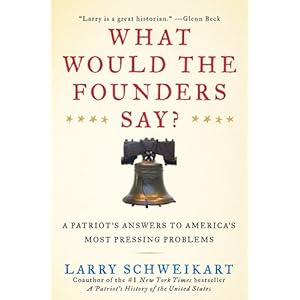
Folks can buy the book here or ask for it in your public library. We have two copies in our Long Island Library system.
Posted on 06/19/2011 7:06:50 AM PDT by SeekAndFind
There has been ample tongue-clucking about abysmal student scores on the civics and history portions of the National Assessment of Education Progress (NAEP), but the real scandal has gone unnoticed. It is certainly a shame that two-thirds of fourth-graders and nearly three-quarters of eighth-graders don’t know the purpose of the Declaration of Independence, and that over half of America’s high-school seniors score below the basic level on history. What’s worse, however, is that some of what students are expected to know about the principles of the American Founding is at odds with what the founders themselves believed.
Fourth-graders, for example, are given a summary of the introduction to the Declaration of Independence that says citizens “are given certain rights.” This passive construction elides mention of the Creator, and leaves students to assume that our rights come from some person or government. Worse still, when asked to identify an idea articulated in this summary, the “correct” answer students are expected to choose is that “people in the United States should have some control over the government.” Some.
The notion that people should have “some” control over the government would be news indeed to the authors of the Declaration, who insisted that “it is the Right of the People to alter or abolish” government when it “becomes destructive” of “Life, Liberty and the pursuit of Happiness.”
Fourth-graders are also taught that the best explanation of the Constitution is that it “gives us a plan for how our government is set up.” This is true as far as it goes, but it’s far better to say that the Constitution gives us a plan for governing ourselves while protecting our rights.
Other questions and answers characterize the U.S. as a democracy (rather than a constitutional republic), and imply in myriad ways that the American experiment is one of building a large national government to solve problems for people. One question even gives students a chart showing rising hydrocarbon levels in the atmosphere and asks them to summarize “what this means.” (Those in need of a hint can be referred to another NAEP question, in which citizens of a hypothetical town mobilize to stop businesses from building a road where trees ought to stand.)
It’s certainly difficult to agree on common knowledge standards (this explains, by the way, the miserable quality of modern civics textbooks, which manage simultaneously to agitate interest groups and bore schoolchildren senseless). This is no excuse, however, for misrepresenting the essential principles of the American Founding.
So what principles should schoolchildren learn? Here are a few:
Our government derives its powers from the people, not the other way around. In a national Harris Interactive survey conducted for the Bill of Rights Institute last year, 60 percent of Americans failed to recognize that a government whose powers derive from the people is something that makes this country exceptional. For more colorful context, consider how in recent years we’ve seen congressmen look incensed when grilled by constituents at town-hall meetings, and even characterize peacefully gathered tax protestors as Nazis.
Gridlock is good. This was the great challenge facing our Constitution’s framers: how to establish a system of self-governance that avoided the twin tyrannies of unaccountable monarchy and unbridled democracy. Far more dangerous than a slow-moving government is an overactive one. Yet a modern, thoughtless criticism of the federal government, proffered from both left and right, is that it’s not doing enough.
Uniformity is bad. While the federal government has expanded to impose national rules and standards on everything from how our children are taught to when they may drink a beer, the founders envisioned a republic in which citizens would have considerable authority to govern themselves at the local level. Federalism offers, as Supreme Court justice Louis Brandeis famously observed, “laboratories of democracy,” meaning that laws can be tested — and rejected — more easily by citizens.
Majorities are dangerous. Given our national obsession with polling, and recent calls for abolishing the Electoral College, students should understand that the simple fact that 51 percent of your classmates think it’s a good policy to take your lunch money does not make it legitimate for them to do so. The goal of the American experiment in liberty has never been to give majorities a route to collective self-actualization, but rather to carry out the essential business of self-governance while affording maximum opportunity for individuals to build their businesses, raise their children, worship God, and enjoy the fruits of their labors.
Be responsible for your own well-being. Contrary to the implicit NAEP message that the Bill of Rights exists to help people extract things from government, America was founded on the belief that man has been endowed by his Creator with the right — and responsibility — to support himself while pursuing what is good and just. A well-known American history professor recently told me that his students think of the Bill of Rights mostly as a document that affords them rights to self-expression. It largely escapes them that liberty depends on a citizenry imbued with a sense of responsibility.
If we are to be in the business of teaching America’s founding principles, then we ought, at a minimum, to be certain that the founders themselves would pass the test — and that the test is worthy of the founders.
— Tony Woodlief is president of the Bill of Rights Institute, a nonprofit organization dedicated to educating students about the words and ideas of the founders.
How about “There is no free lunch”
That should send them into a tizzy.
Baby steps. Let’s teach ‘em to read and write first.
Gee, think of it, today they teach those concepts as radical.
Well, you’d think he’d at least mention my book, “What Would The Founders Say?” in which I go over specifically what they DID say and teach on education.
It has done better pre-release than any of my books. We're not talking Palin or Ann Coulter range here, but #467 on Amazon at one time, two weeks out, ain't bad.
The Reader will be my last book for a looooong time. After that, it will be December 2012 before I release my magnum opus, "A Patriot's History of the Modern World." Everything I write of course isn't great. That is a great book. I love re-reading it myself.
“What Would the Founders Teach? (Are our schools teaching the principles of America’s founding?)”
********************
No, of course not, hardly the purpose of “our schools” today, and for a looong time now!
:(
*****
“What Would the Founders Teach? (Are our schools teaching the principles of America’s founding?)”
********************
No, of course not, hardly the purpose of “our schools” today, and for a looong time now!
:(
*****
I’ll be buying that one for sure! Getting ready to dig into PHUSA with my newly 7th grade homeschool son.
Thanks.
Disclaimer: Opinions posted on Free Republic are those of the individual posters and do not necessarily represent the opinion of Free Republic or its management. All materials posted herein are protected by copyright law and the exemption for fair use of copyrighted works.