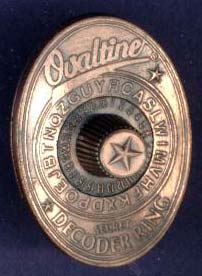
And here is the ring in question:
Ping
When an individual in the military decides he knows better, then there’s a real problem. Either way.
All of these individuals knew they were throwing away their careers and more. There’s no apparent financial gain and they are not working for the enemy. Perhaps Islamic terrorism in the US is a far greater threat than the government is acknowledging.
The point being made by Ford and his screenwriters, James Bellah and Willis Goldbeck, is that what’s needed for the establishment of civilization is, in the first instance anyway, not law but heroism. Someone has to risk his life to put an end to the threat of violence and disorder to the whole community. The problem, as in the parable of the mice, is that there is no incentive for any particular individual to be the one to bell the cat. And even if there were, there could be no question of due process about the exercise. The man who took on Liberty Valance would have to be as much outside the law as Liberty is—at least so long as his ability to intimidate witnesses makes the law powerless against him. But the filmmakers also seek to show us how this has become an unpalatable truth and one that people seek to disguise from themselves. Doniphon is induced to shoot Valance in what he himself describes as an act of “murder, pure and simple”—but in such a way that it looks like an act of self-defense by Stoddard, who is the representative of culture (he teaches the illiterates of the town to read), as well as law and civilization. When these desirable things all proceed, after the death of Valance, to thrive in Shinbone, the story of that death is then mythologized into a founding legend of the town and of the territory, shortly to become a state. Although he is told the truth years later, the local newspaper proprietor (Carleton Young) doesn’t want to know it. He responds with what has become the movie’s most famous line: “This is the West, Sir. When the legend becomes fact, print the legend.” In this, he is echoing the irony of Dutton Peabody (Edmond O’Brien), his predecessor as editor of The Shinbone Star, on that memorable occasion years before when Valance and his henchmen had been made to back down in a confrontation with Doniphon, occasioned by Valance’s deliberate tripping of Stoddard as he was carrying a tray of food..."...How did our culture get to the point where the heroism of some is thought to diminish others—where heroism in general has become an embarrassment, something not to be talked of in public for fear of giving offense to non-heroes? As it happens, the California conference I attended had devoted one of its sessions to a discussion of John Ford’s film The Man Who Shot Liberty Valance. Released in 1962, this classic Western tells the story of a frontier town called Shinbone that is terrorized by a murderer, thief, and gun-for-hire who bears the significant name of Liberty Valance (Lee Marvin). A lawyer called Ransom Stoddard (James Stewart) comes to town with the idea of setting up a practice there. But before he even arrives his stagecoach is waylaid by Liberty and his gang, and he is robbed and beaten. Symbolically, Liberty tears the pages out of one of Stoddard’s law books. On his arrival in Shinbone, the lawyer is nonplussed to find that there is no law enforcement there willing or able to bring Valance to justice. Tom Doniphan (John Wayne), the only man in town capable of standing up to him, is disposed to mind his own business. On the frontier, the law is otiose because (as Tom explains to the newcomer) there, “men take care of their own problems.”
URL is HERE.
Good intentions. I know a certain road paved with those.
What this Marine did is wrong, and a dangerous breach of security, but it’s not the same crime as deliberately providing information to our enemies, and I’m glad he’s not being punished as severely as he would be for that crime.
My first reaction was that this plan wasn’t all that well thought out — you’re going to steal documents, and then take them to ... the cops?
Investigators tracked the missing goods to his apartment in Carlsbad and to storage units he rented in Carlsbad and Manassas, Va. They recovered items such as Iraqi swords, several types of assault weapons and digital cameras. Along with the war booty, the investigators found surveillance data on suspected terrorists, two locked briefcases, a government record book, government maps, ammunition and body armor. Based on such evidence, their case broadened to include accusations of spying."
Looks as if he's a just an opportunist thief to me.
OMG! ... guilty of not filing the proper paperwork? Better throw them in a deep, dark hole with Ramos and Compean!
brain cooties ???????
“Spy ring” is a bit of a misnomer here. Correct but inaccurate in its connotation.
First, what they did is definitely wrong, and a crime, and they should be thoroughly prosecuted for it. There is no excuse whatsoever for a Master Gunney, two colonels, and a Navy commander to not understand the exact and profound breach of security in which they were engaged.
One wonders whether any of these guys ever followed their chain of command and classified materials guidelines and approached G2 Pendleton or C2 NORTHCOM to explore the idea of sharing information with LAPD. Maybe, maybe not. No matter. Even if everytone agreed in principle that operationally it would be a good thing to do, it still would have been very difficult to move TS materials out of the military classification system and into the civilian world, because of the ***inherent procedural, mechanical, and organizational controls*** that are in place for the ***precise purpose*** of securing those materials.
If you read between the lines its likely that all of these guys held clearance at the TS level, and one can assume that they tried to keep the materials secure within their own circle (best of itentions). But then you see what happens when liberties are taken and security controls and classified material guidelines are “overlooked”. Whoops. Master Gunney apparently had one or more classified documents in his storage locker. And who knows where else? The trunk of his car? The outbox on his AOL account? Does he know that Junior is sharing his entire home office hard disk to the world with bitTorrent?
This is the inevitable consequence of “just this once”. Classified materials start showing up on public printers; graphs and charts clearly marked “Classified” appear in documents intended for the public; Cpt. Schmoe’s car is stolen, along with that laptop that had been connected to a classified system for 6 months (and those 900 profiles on domestic terrorists become fairly valuable).
Every day, every schmoe with a clearance sees a way to end-run the system with the best of intentions. “Hmmmm.... it sure would be easier to print this document from my home PC, why don’t I just copy it onto my [unsecured, unencrypted, unapproved, unclassified] memory stick?” And later Maj. Schmoe leaves that memory stick and dozens of classified documents on his table at Applebees. “Just this one time”. Yeah, sure.
Classification controls are ultimately social controls. No matter what technical measures one applies, the classification system really depends upon the integrity of the users, and note that this is the reason for intensive background checks and clearances. Clearance is not so much about what you did and when you did it, it’s about your honesty and integrity and your absolute fidelity to the classification system. When you cross the line “just this one time”, and just barely, you have broken your fidelity to the classification system forever. You are no longer trustworthy ***even to yourself*** as a handler of classified materials.
Prison time and demotion is the minimum these guys should get, despite their good intentions. The classification system may be unwieldy, inconvenient, a PITA and complicated. Good. That’s exactly what it’s supposed to be.
There was a clear route toward doing what they wanted to do (info sharing with LAPD), and that was through the chain of command. Not through violating security and classification procedures. If they’d already tried the proper route and been denied, so be it. Swallow your pride and do your duty. Follow orders. And if they hadn’t tried the proper route, they might have great service to their command and to the nation by so doing.
Bad choices. Stupid choices. I’m sorry to say that the system is 100 times - 10,000 times - more important than these officers. There’s no excuse for what they did. None.
...nasty things that tickle but they won't kill you.
Two words: Sandy Berger.
Then let’s look at equal protection clauses and statutes... while acknowledging the acts of these Marines were intentionally wrong yet the acts of Berger were intentionally heinous.
On one hand I understand the need for secrecy as well as the need for the control that a chain of command provides. On the other, I remember what mandated lack of sharing between government anti-terrorist efforts resulted in.
Now add to the mix that this story comes from the MSM...
Reminds me of a film “The Fourth Protocol” in which a British Minister in his zeal to fight the Communists gives TS material to South African Intelligence. The problem is that the guy was working for the KGB and all the info wound up at Dzerzhinsky Square.
However well they meant, they have to be punished.
The temptation to use the info for national security may have been great, but they may well have rendered more significant plans useless with their actions.
Imagine if in WW2, a British soldier became aware that the Brits were aware of German plans and were not forewarning their troops in danger? It would be natural fo him to warn them, but it would have let the Germans know that Enigma was cracked and thus cost many lives indirectly.
The government may well be ‘sitting’ on this information for good reasons.
ping
And here is the ring in question: