
The story of a side of the war from which the North never fully recovered.
Posted on 07/31/2007 8:05:29 PM PDT by stainlessbanner
At the beginning of the Civil War the United States had a merchant marine that was second only to Great Britain’s in size. By the end of the war the nation was no longer a maritime power, except in its Navy, which would be quickly and radically reduced in size. Although little noted by history, this profound change had been brought about by Confederate naval strategy.
It was perhaps the South’s greatest victory of the war, and the only one to affect the country permanently. Wolf of the Deep: Raphael Semmes and the Notorious Confederate Raider CSS Alabama, by Stephen Fox (Knopf, 336 pages, $25.95), is a splendid retelling of the most famous implementation of that strategy, the cruise of the CSS Alabama under Capt.Raphael Semmes.
An inferior naval power, unable to slug it out gun for gun with a stronger power, has little alternative but to adopt the strategy of the “guerre de course,” or war on the run. It means attacking the enemy’s commercial shipping with fast vessels that can strike quickly and then flee over the horizon and hide in the vastness of the ocean. This has a greater effect than merely capturing a few ships and cargoes, for it sends insurance rates soaring and forces the enemy to divert naval resources needed elsewhere.
The strategy can be devastatingly effective. Had Germany concentrated more on building submarines before World War II instead of diverting much of its shipbuilding capacity to a surface fleet that could not match the Royal Navy’s, it might well have won the Battle of the Atlantic and thus the war.
The United States Navy was relatively small at the outbreak of the Civil War, but it rapidly expanded, thanks to the North’s near-monopoly in shipyards and shipbuilding expertise. The Navy was thus able to play a major role in the government’s “Anaconda plan,” helping to strangle the South into submission by blockading the Southern ports. The South, with few vessels, could do nothing about the blockade except try to run it, which it did with ever decreasing success as the U.S. Navy relentlessly expanded.
But the South could conduct a guerre de course, and it did so with stunning success. A relative handful of Confederate ships, under bold and skilled captains, took about 200 U.S.-flagged vessels, and burned many of them. This drove insurance rates on other American vessels through the roof, and ship owners rushed to reflag their vessels as from other countries, principally Britain. Altogether, Confederate commerce raiding caused 1,600 American vessels to abandon the American flag. They never came back.
No one personifies the Southern war on Northern shipping more than Capt. Raphael Semmes. The cruise of the Alabama lasted almost two years, from August 1862, after she first slipped out of Liverpool, where she had been built, until June 1864, when she was caught by the USS Kearsarge off Cherbourg, France, and sunk in a battle that lasted 90 minutes, witnessed by thousands who lined the French shore. In between, she traveled a total of 75,000 miles—as far west as Galveston, Texas, and as far east as Borneo—capturing a total of 65 ships. The cruise of the Alabama is one of the great epics of sea and naval warfare, and anyone interested in naval history, Civil War history, or just really good sea stories will find the book a great read.
Raphael Semmes was born in 1809 in southern Maryland to a tobacco-growing, slaveholding family. Orphaned at 14 and raised by uncles, he joined the Navy as a midshipman at the age of 16. He would spend the next 34 years slowly gaining promotion in the Navy (and practicing law on the side when things were slack).
At the outbreak of the war, he resigned from the U.S. Navy and received a commission in the Confederate one. Lacking good shipyards, the new navy dispatched James Bulloch of Georgia to England to arrange to build ships there. (Bulloch, interestingly enough, was Theodore Roosevelt’s maternal uncle.) But until those ships could be built, the Confederates had to make do with what was available.
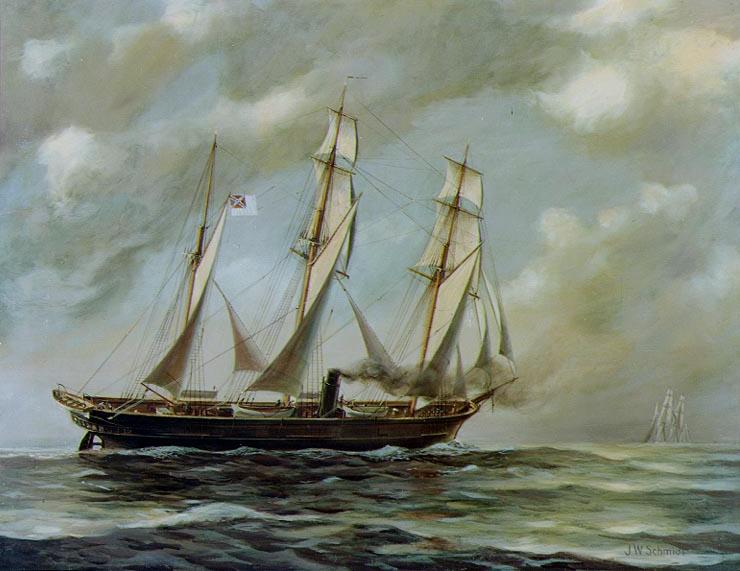
Semmes was soon assigned to command the CSS Sumter, a small three-masted steamer that had been used on the New Orleans–Havana run. He converted it into a commerce raider as best he could. (One officer said, “I could have kicked her bows in, she was so unseaworthy.”)
Semmes showed his talent for commerce raiding immediately, snapping up 18 prizes in the Caribbean. When the far larger and more capable USS Iroquois trapped him in the roads off St. Pierre, Martinique, he outfoxed the Yankee skipper and got away. But the Sumter was falling apart, especially after a December crossing of the Atlantic, a voyage for which she was not designed. When she reached Gibraltar, she was beyond repair.
The Alabama was a very different ship, newly built, designed as a warship, swift, gracile, and well armed. She and her captain soon entered into immortality. The rules of sea warfare were more gentlemanly in the mid-nineteenth century than they became in the twentieth. Semmes would take the crew of a captured ship on board the Alabama, offloading them onto a neutral vessel or at a neutral port. He would help himself to anything of use (he had dozens of chronometers on the walls of his cabin) and then torch the ship or occasionally sell it for bond. Whalers, sometimes loaded with hundreds of barrels of whale oil, made particularly spectacular bonfires. Semmes and his crew especially liked to read the latest newspapers they found on board their captures, in order to read about themselves, both in prose and in often terrible poetry. The title of this book, in fact, comes from one of those poems: “Semmes has been a wolf of the deep/ For many a day to harmless sheep;/ Ships he scuttled and robbed and burned,/ Watches pilfered and pockets turned.”
The trouble with the guerre de course is that it seldom wins in the end. The American frigates that won great glory early in the War of 1812 were all bottled up in port by the end of that war. The Alabama, unable to refit properly, was nearly worn out by the time she sailed out of Cherbourg to fight the Kearsarge. Semmes, after abandoning the sinking Alabama, made it onto an English yacht that had been watching the battle. He was taken to England, where he was lionized by British society and presented with a ceremonial sword.
He made it back to this country before the end of the war, but his glory days were over. Arrested after the war, he was freed early in 1866. His Memoirs of Service Afloat During the War Between the States is considered one of the best books by a major participant to come out the conflict (although I very much doubt Stephen Fox’s judgment that “considered simply as a piece of writing, the book is far deeper, wider, and better written than—for example—the much more famous memoir by Grant”).
Fox tells the story well. If I have a criticism of the book, it is that I wish he had devoted more than a page to the settlement of the “Alabama claims.” Raphael Semmes and the Alabama, however remarkable their exploits, and they were remarkable indeed, did not affect the outcome of the Civil War. But when Britain afterwards agreed to pay $15.5 million to the United States in settlement of damages claimed for violations of the rules of neutrality, it was the first time two major nations settled a serious dispute by arbitration. That is a lasting legacy of the Alabama and her gifted captain.
—John Steele Gordon writes “The Business of America” for American Heritage magazine. His most recent book is An Empire of Wealth: The Epic History of American Economic Power (HarperCollins).
The story of a side of the war from which the North never fully recovered.
MilHist ping
Whne Semmes was captured his rank was Admiral and General. He is the only such person in American history.
Had no idea - thanks for that info on Semmes.
Thanks indcons.
If I recall correctly, Semmes, after being made an Admiral, finished the war as a Brigadier General in the Confederate Army, commanding naval infantry. And he was the only man n the Civil War to hold flag rank in both the Army and navy of either side.
Bump for later read.
When the Alabama's Keel was Laid,
Roll Alabama, roll!
'Twas laid in the yard of Jonathan Laird,
Roll Alabama, roll!
'Twas Laid in the yard of Jonathan Laird, 'twas laid in the town of Birkenhead.
Roll Alabama, roll!
Down the Mersey way she rolled then, and Liverpool fitted her with guns and men.
Roll Alabama, roll!
From the western isle she sailed forth, to destroy the commerce of the north.
Roll Alabama, roll!
To Cherbourg port she sailed one day, for to take her count of prize money.
Roll Alabama, roll!
Many a sailor laddie saw his doom, when the Kearsarge it hove in view.
Roll Alabama, roll!
When a ball from the forward pivot that day, shot the Alabama's stern away.
Roll Alabama, roll!
Off the three-mile limit in '64, the Alabama was seen no more.
Roll Alabama, roll!
Semmes even wrote a note to be delivered to the Kearsarge indicating his desire for a battle. He didn’t want to disappoint them ;o)
ship owners rushed to reflag their vessels as from other countries, principally Britain.Good thing Britain was "neutral" during the Civil War.
Great Britain and the Confederate NavyHe follows the early Confederate exploits and provides exceptional accounts of the actions to keep secret the building of various ships in British ports. Exciting is the escape of the Alabama from port under the guise of an afternoon harbor tour and just ahead of the officials sent to impound the ship. No less intriguing are the behind-the-scenes efforts of Confederate ministers to fund and contract for vessels through unscrupulous businesses and less reputable persons. The building of ironclad rams, only to have them seized in the eleventh hour, proved particularly damning to the overall Confederate program... The Alabama and Florida were effective commerce raiders and significantly damaged Union shipping while drawing away Union vessels from blockade duty. However, even if the Confederacy had had a fleet of commerce raiders and chased every Union ship to port, the neutral shipping nations, including Great Britain, were more than willing to take the place of the Union merchant fleet, and very little overall reduction in shipping would have occurred. In regards to ironclad rams, Merli also believed these vessels would have limited impacts.
reviewed by Christian Lund
(Aground on the Rocks of Neutrality)

USS SEMMES (DD-189) while assigned to USCG (1932-34)
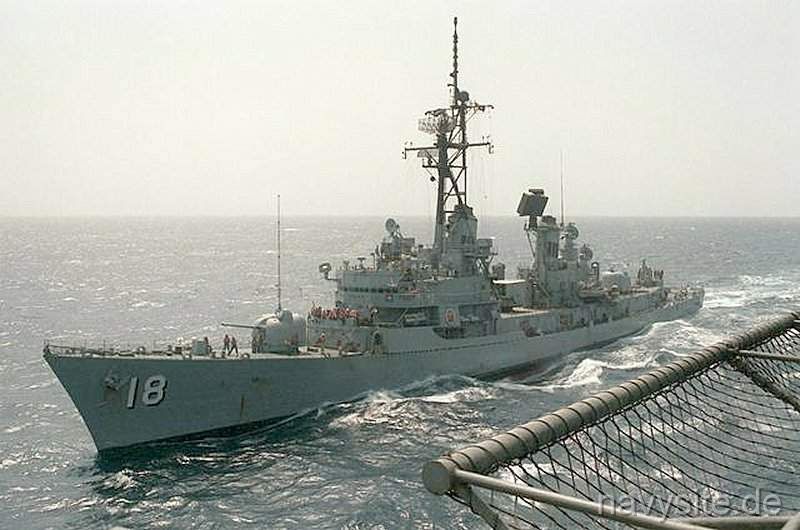
USS SEMMES (DDG-18)
Thanks for the pictures, GATOR NAVY
Disclaimer: Opinions posted on Free Republic are those of the individual posters and do not necessarily represent the opinion of Free Republic or its management. All materials posted herein are protected by copyright law and the exemption for fair use of copyrighted works.