Skip to comments.
Industry wants carbon fibre to be the new commodity on the trading block
The Times ^
| 7/16/2007
| Leo Lewis, Asia Business Correspondent
Posted on 07/16/2007 1:19:42 AM PDT by bruinbirdman
Ultra-light, rust-proof, ten times stronger than steel and hailed by some as the key to energy efficiency, carbon fibre may soon be traded as a commodity on global markets, according to some industry expectations. The view arises as carbon fibre is poised for potentially huge growth in the airline and motor industries.
Demand for the product is also soaring from manufacturers of everything from golf clubs and fishing rods to wind farms and bullet-proof vests.
Competition for high-quality carbon fibre is intensifying more quickly than its mostly Japanese producers ever predicted and an international market with liquidity and transparency could bring the supply and demand balance under better control, it is argued within the industry.
High-end carbon fibre is sold by producers direct to end-users, but both sides believe that the creation of a carbon-fibre spot market is vital. Rising demand has already pushed high-end carbon fibre prices up more than 65 per cent since 2004. Japan dominates the industry, with its top three textile companies producing 70 per cent of the world’s carbon fibre.
Investors have been eyeing the rising carbon fibre demand curve for some years, but when Boeing’s new 787 Dreamliner jet was rolled out last week it marked the start of a new era. Half the aircraft’s weight is represented by carbon fibre composites and the same ratio will be true of the A380, produced by Airbus.
The aircraft industry represents a fifth of the world’s carbon fibre demand of 28,000 tonnes a year and analysts estimate that aircraft-related demand could expand 500 times in coming years.
However, Toru Nagashima, president of Teijin, one of the world’s biggest producers of carbon fibre, said that other uses were being developed. As those demands pile up, he said, the complexity and capital intensity of making high-quality carbon fibre would be exposed.
Carbon fibre’s growth story relies heavily on prices being manageable at this stage, so that the technology is adopted. An international commodity trading system for carbon fibre might emerge as a result.
As well as its use in civil engineering – for strengthening bridges – carbon fibre is employed in making windmill sails. Takaaki Muramatsu, a UBS analyst, forecasts a doubling in carbon fibre demand by the windmill industry between now and 2010. Yet the greatest effect on carbon-fibre use, Mr Nagashima said, is expected in 2011, when the motor industry, for reasons of fuel-efficiency and safety, moves from aluminium to carbon composites for car bodies and parts. Toyota and Honda are among carmakers interested in greater use of carbon fibre.
TOPICS: Business/Economy; Miscellaneous; News/Current Events
KEYWORDS: carbonfiber; carbonfibre; trade
Navigation: use the links below to view more comments.
first 1-20, 21-22 next last
To: bruinbirdman
Ah-ha! As so many Freepers said re: GW: “Follow the money.”
2
posted on
07/16/2007 1:49:50 AM PDT
by
yankeedame
("Oh, I can take it but I'd much rather dish it out.")
To: bruinbirdman
Nice, I’d like to see carbon fiber re-bar on the market. As a general contractor in the Florida Keys, 95% + of my work is with reinforced concrete. We routinely use #6 up to # 8 steel rebar, which is heavy stuff. Carbon fiber would mike life easier...........especially as I get older!!
3
posted on
07/16/2007 1:50:23 AM PDT
by
jsh3180
To: bruinbirdman
Does America have the capacity to manufacture this product or has that been shipped to India along with thousands of jobs?
Seems like the elites and the globalists are trying to weaken America by moving it’s manufacur8ing ability to third world and American hating counties.
4
posted on
07/16/2007 2:23:24 AM PDT
by
OKIEDOC
(Kalifornia, a red state wannabe. I don't take Ex Lax I just read the New York Times.)
To: bruinbirdman
Carbon is one of the larger components of the Earth's crust, but still, with it being poised to replace steel and aluminum (iron and aluminum) for structural things, and poised to replace silicon (an element with which it is roughly equally abundant on Earth) in the electronics and computer industries, along with its 'traditional' role of being the primary element in almost all life, is carbon is danger of being limited?
This is probably a stupid question--there's probably plenty of carbon around for all those uses, yet there seems to be an increasingly reliance on one element where it was more spread out before.
It would be even bigger if some carbon substance replaced concrete.
5
posted on
07/16/2007 2:35:43 AM PDT
by
Jedi Master Pikachu
( What is your take on Acts 15:20 (abstaining from blood) about eating meat? Could you freepmail?)
To: OKIEDOC
As the article states, around 70% of carbon fiber is made by Japan's top three textile companies.
And it is largely service jobs (such as IT) that are out-sourced to India. India isn't as big a manufacturer as--type--China.
And the United States should start producing more carbon fiber (and manufacturing in general) indigenously.
6
posted on
07/16/2007 2:37:52 AM PDT
by
Jedi Master Pikachu
( What is your take on Acts 15:20 (abstaining from blood) about eating meat? Could you freepmail?)
To: jsh3180
I was in a concrete class a few years ago and we discussed replacing the rebar with fiberglass of an equivalent size. Is that still an option?
7
posted on
07/16/2007 3:18:44 AM PDT
by
Stegall Tx
(Again, thanks Danny for being an inspiration.)
To: Jedi Master Pikachu
And the United States should start producing more carbon fiber (and manufacturing in general) indigenously. We do manufacture it, but some years ago, one needed a security clearance to get inside the companies. The Military got it first.
I once saw some samples that for all the world looked exactly like the little cardboard core of a toilet paper roll, blackish grey in color, a carbon/carbon composite. You could stomp on it, jump up and down on it, and nothing would happen. Amazing stuff that appeared indestructible and weighed nearly nothing. Pyrolytic production of it is not exactly "Green" though.
8
posted on
07/16/2007 3:26:23 AM PDT
by
Gorzaloon
To: Gorzaloon
9
posted on
07/16/2007 3:55:06 AM PDT
by
Jedi Master Pikachu
( What is your take on Acts 15:20 (abstaining from blood) about eating meat? Could you freepmail?)
To: bruinbirdman
CF bump. Thanks for the post.
10
posted on
07/16/2007 4:11:42 AM PDT
by
the crow
(NO MORE BUSHES!)
To: Jedi Master Pikachu
This is probably a stupid question--there's probably plenty of carbon around for all those uses, yet there seems to be an increasingly reliance on one element where it was more spread out before. Well, all Life relies on carbon. It has a unique chemistry, and is the foundation of all organic compounds. There is nothing exactly like diamond for thermal diffusivity and heat conduction, yet its graphite allotrope is soft and slippery. If you pyrolize it just right, you make fibers of enormous strength.

"The illustration shows a descriptive picture how the molecular structure of a single thread of carbon fiber is being generated step by step under respective processing conditions of carbonization and graphitization procedures.
The picture gives you a clear idea in what manner carbon atoms become regularly lined up along the longitudinal direction of a filament by means of high temperature treatments and stretching."
To: Stegall Tx
Yes, It already exist and has been used for quite a while now.
12
posted on
07/16/2007 4:40:28 AM PDT
by
Frankss
To: Jedi Master Pikachu
Concrete is already carbon. Portland cement is dervied from Calcium carbonate. In many many places, the aggregate is limestone that is also calcium carbonate.
13
posted on
07/16/2007 4:45:01 AM PDT
by
bert
(K.E. N.P. +12 . Happiness is a down sleeping bag)
To: Gorzaloon
This sounds wonderful, how is it made? Could someone direct me to information on the web.
To: Rumplemeyer
How is it made?
http://pslc.ws/macrog//carfsyn.htm
15
posted on
07/16/2007 5:09:01 AM PDT
by
xeno
To: Gorzaloon
" You could stomp on it, jump up and down on it, and nothing would happen. Amazing stuff that appeared indestructible and weighed nearly nothing. "What's its melting point?
yitbos
16
posted on
07/16/2007 10:15:34 AM PDT
by
bruinbirdman
("Those who control language control minds." -- Ayn Rand)
To: bruinbirdman
" You could stomp on it, jump up and down on it, and nothing would happen. Amazing stuff that appeared indestructible and weighed nearly nothing. " What's its melting point? It does not melt, but will burn like coal if it reaches refractory temperatures. Well, so does Graphite...it did at Chernobyl.
To: Gorzaloon
"but will burn like coal "The question arises, especially as I see some propose a substitution for re-bar, will this stuff retain its strength at a temperature similar to steel or aluminum? I suppose we are talking strength to weight, cost, flexibility, and heat resistance.
The layman sees this stuff as plastic, as in Saturn automobile.
yitbos
18
posted on
07/16/2007 10:55:35 AM PDT
by
bruinbirdman
("Those who control language control minds." -- Ayn Rand)
To: bruinbirdman
The question arises, especially as I see some propose a substitution for re-bar, will this stuff retain its strength at a temperature similar to steel or aluminum? I suppose we are talking strength to weight, cost, flexibility, and heat resistance. It will probably never replaced rebar, because of cost, and more importantly, neither fiberglass/resin composites nor carbon/resin composites really bond well to concrete. The is a chemical bonding that happens between lightly rusted iorn and concrete, where the cement actually protects the rebar from further rust. The rust is a hydrated iron oxide and the cement is an amorphous polycrystaline hydrate, and they go together very well. No matter how strong a composite bar may be, if it slips like wet spaghetti, it will not add its strength to the concrete.
The layman sees this stuff as plastic, as in Saturn automobile.
Yes, but that is miles away from the military stuff, and is just fiberglass made with graphite fibers instead of the glass, and while very strong it is nothing compared to the aerospace stuff. Consider that the automakers bend over backwards to save a nickel at every opportunity, and it just has to be the bottom-of-the-barrel. Epoxy bonds to carbon better than to fiberglass, generally. Fiberglass fiber has to be treated with primers and coupling agents for it to work well.
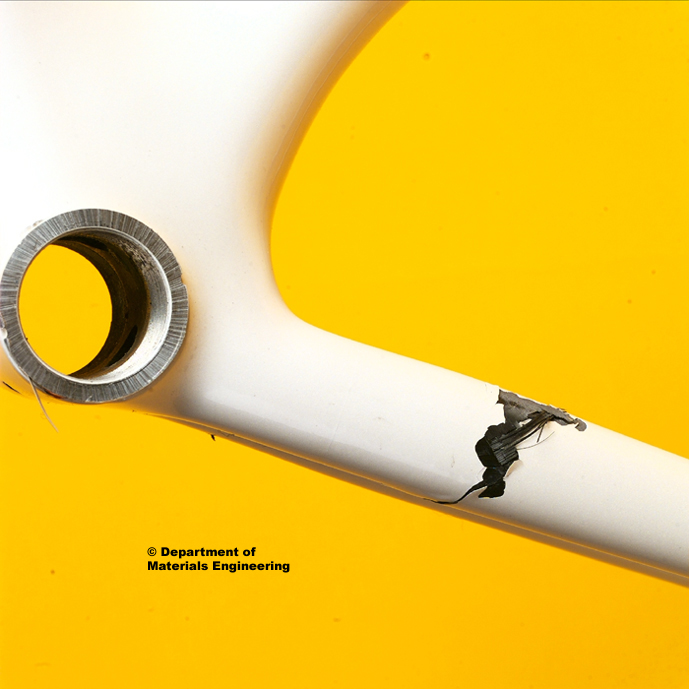
Carbon composite bicycle frames are becoming popular,despite the high price. Serious riders will pay anything to save a few ounces- but when it fails, it is a catastrophe.
http://video.google.com/videoplay?docid=-162891478515007486
Well, this guy may have been asking for it, but there have been too many reports of this..
To: bruinbirdman
If it isn’t a terribly labor-intensive material to produce, it might be a good candidate for production in America. Would probably make someone a lot of money — if that’s still permitted.
20
posted on
07/16/2007 11:15:53 AM PDT
by
BfloGuy
(It is not from the benevolence of the butcher, the brewer, or the baker, that we can expect . . .)
Navigation: use the links below to view more comments.
first 1-20, 21-22 next last
Disclaimer:
Opinions posted on Free Republic are those of the individual
posters and do not necessarily represent the opinion of Free Republic or its
management. All materials posted herein are protected by copyright law and the
exemption for fair use of copyrighted works.
FreeRepublic.com is powered by software copyright 2000-2008 John Robinson