Skip to comments.
New grand design for Europe is doomed to fail – again
The Times ^
| 4/18/2007
| Alan Milburn
Posted on 04/18/2007 5:10:08 AM PDT by mborman
Europhiles have been far too complacent and unquestioning.
Here we go again. Two years ago the French and Dutch public demolished Europe’s plans for a new constitution. Now the German presidency of Angela Merkel wants to resurrect it in the guise of a new treaty. Europe is on the verge of repeating history rather than learning from it.
As a pro-European I fear the consequences for the already strained relationship between Europe and its citizens.
It is true, of course, that Europe has grown topsy-turvy as successive countries have clamoured to share in its remarkable success. As the world’s biggest economic market, the European Union is a magnet for new entrants. The challenges of the modern world — global warming, global terror, mass migration, organised crime — require more cooperation between nation states, so if the EU didn’t exist we would have to invent it.
While modern Europe is geographically wide, however, its public support is shallow. People agree with the EU in principle but feel alienated from the practice. Turnouts at European elections are a joke.
The EU speaks a bureaucratic language that is foreign to the public.
Too often it seems as if an unaccountable elite takes decisions behind closed doors. Scepticism isn’t peculiar to Britain. Elsewhere in Europe public antipathy is common place. The results of the 2005 constitution referendums gave it voice.
Pro-Europeans usually point the finger of blame for such public ambivalence at external influences. The media are a favourite target — and of course sections of the press have waged an unrelentingly negative campaign against Europe. The blame game also fingers governments for failing to win over public opinion — and in the UK members of Tony Blair’s Government could have done more to make a consistent case for Europe. But these explanations are excuses: a soft comfort blanket that merely induces complacency.
It reminds me of how parts of the Labour Party, faced with successive election defeats in the 1980s, heaped blame on the public for voting the wrong way. The public was mistaken, not Labour. Eventually we cottoned on that since there were many more members of the public than there were of us, it was we who needed to change.
So it is with Europe. The EU needs to stop pointing and start examining its own part in the gulf that exists between public and Europe. There have been two principal failures: to demonstrate that both its relevance and its governance are in touch with the modern world.
With the best will in the world it is hard for people to see the EU as relevant when it is too concerned with changing its institutions and not enough with modernising its policies. The valiant efforts over recent years by the European Commission of President José Manuel Barroso to shift that focus are undermined by Chancellor Merkel’s decision to make a new treaty the centrepiece of the German presidency.
And yet the public mood across Europe is crying out for coordinated and effective action on security and terror, the environment and immigration. This is the territory that the EU should make its own and the priority for the new presidency.
Instead, Chancellor Merkel warns of “historic failure” without a new treaty, even though new accessions, new membership negotiations, a new budget and new peacekeeping operations have all proceeded happily without one. Of course some reform is needed but far better to make piecemeal change that is focused on securing greater external public participation than on grand internal institutional redesign.
It is not just what Europe does but how it does it that has failed to keep pace with the times. Europe's institutions were born out of postwar adversity. People expected little say and experienced precious little choice. Then deference was higher, expectations were lower. Now it is the other way round.
Unaccountable decision-making no longer works in an era when the public is far more informed and inquiring. The new democratic thirst that exists among citizens requires from the EU a more modern modus operandi.
So Tony Blair is right to demand a rethink about what Europe is for and to reorientate its spending and policy priorities accordingly. But that is just one side of the reform coin. The other side is to find ways of bringing the public into Europe's decision-making tent.
The European Parliament in particular needs to think about how the public’s voice can be better heard in its deliberations. For example, by better linking the results of consultation to decision-making, especially budget setting. Or by introducing a citizen’s right to initiate new laws, giving the people of Europe a direct say in place of the European Commission’s monopoly over initiating legislation. Or by revisiting the 2001 Laeken Declaration’s presumption towards subsidiarity by identifying powers that could be delegated to nation states, local government or even local communities.
None of this implies that Europe’s nations can or should go it alone. Quite the reverse. Europe can build a knowledge economy faster in concert. Europe can better defend itself against crime, terror and global warming by pooling sovereignty. Europe can more effectively shape the world order if it acts in unison on trade, defence and foreign policy. But cooperation between nations nowadays relies on the active cooperation of citizens.
Unless the EU is prepared to address the gulf between rulers and governed we risk a bureaucrats’ Europe, not a peoples’ Europe. It is time for Europe to face outwards not inwards, to empower the public not the politicians. Elitism is out. Engagement is in. Europe needs to learn the lesson.
TOPICS: Editorial; Foreign Affairs; Germany; News/Current Events; Politics/Elections; United Kingdom
KEYWORDS: eu; europe; europeanunion; federaleurope; use
Navigation: use the links below to view more comments.
first 1-20, 21-28 next last
The EU speaks a bureaucratic language that is foreign to the public.And that is why the majority of the European populace distrusts the EU and why many are discovering that they are truly nationalists.
1
posted on
04/18/2007 5:10:09 AM PDT
by
mborman
To: mborman; MoochPooch; Michael81Dus; Vicomte13; az_gila; Experiment 6-2-6; henkster; CT-Freeper; ...

|
pan-Europe pinglist.* This pinglist covers a broad range of topics relating to Europe: culture, current events, politics, science, history, arts, etc. Warning: This could be a high volume pinglist. Note: This pinglist covers--but not as much--Eastern Europe. There is already a moderate volume pinglist for that region. Ping if you see a pertinent thread. |
*To get on or off this list, freepmail with the subjects or .
No message is necessary. To get on or get off this pinglist, freepmail here, with the appropriate subject.
|
|
There is also a:
John 3:16 (New King James Version): "16 For God so loved the world that He gave His only begotten Son, that whoever believes in Him should not perish but have everlasting life." |
|
This pinglist can terminate at any time, without notice.
|
2
posted on
04/18/2007 5:17:35 AM PDT
by
Jedi Master Pikachu
( What is your take on Acts 15:20 (abstaining from blood) about eating meat? Could you freepmail?)
To: mborman
In other words, elitist leftist Alan Milburn doesn’t want to reform the substance of the EU. He wants the EU to gull the populace into “engaging with” the EU, with the EU elites doing a better PR job as part of the gulling.
3
posted on
04/18/2007 5:18:11 AM PDT
by
CivilWarguy
(CivilWarGuy)
To: mborman
This is classic.
Rumsfeld was right - Old Europe vs. New Europe.
Europe (most of it) WILL swing to the right with time.
It just takes time for reality to register.
To: mborman
Europe waited too long. It is now a Muslim country.
President Bush, call your office!
To: mborman
If the Germans, French, Belgae and Luxembourg are so hot for Pan-Europe, then why are they not forming a Federal State between the four of them?
6
posted on
04/18/2007 6:15:21 AM PDT
by
neb52
To: mborman; Jedi Master Pikachu
Thanks for posting this and thanks for the ping.
7
posted on
04/18/2007 6:15:23 AM PDT
by
syriacus
(Congress should debrief Pelosi as they would any US diplomat who met with a foreign leader.)
To: R.W.Ratikal
Mr. Ratikal,
When and where were you in Europe this year?
8
posted on
04/18/2007 6:17:30 AM PDT
by
Paulus
To: CivilWarguy
You nailed it!
Would you want a US where states have no rights and everything is run by committee from a central point in Washington? That’s what the Euro-socialist wants more or less!
Nearly every rational person rejects the vision of this European state if they know what it is they are being sold in its current form. In the words of Chirac, “then we simply have elections again and again, until it passes”.
This Constitution is a legally wordy document unintelligible by the common man. The power brokers in the EU seek massing of power and centralization with a powerful socialist undertone. Within Europe you have a “core” built with France, Germany and Belgium who see themselves running the EU (Germany through economics, France through security policy)....... Everything is wrong! Literally everything is not the way it should be! The Constitution needs to be simple and understandable, power needs decentralized and you can not have some more equal than others dictating the course and mandating that all are alike.
9
posted on
04/18/2007 6:26:05 AM PDT
by
Red6
(Come and take it.)
To: mborman
Unaccountable decision-making no longer works in an era when the public is far more informed and inquiring.What fundamental principles unite the union? How is the UNaccountable bureaucrat held in check?
10
posted on
04/18/2007 6:28:33 AM PDT
by
PGalt
To: PGalt
They don’t learn:
Shiny example of Communism - didn’t work even when held with terror.
Soviet - Union - gonsky!
EeeeeUnion? goin- going....
To: Jedi Master Pikachu
The whole EU project is going to eventually fail because it goes against human nature. No nations with different languages, history, cultures, are going to form a long lasting Union. Moreover the EU adopted the already failed socialist economic model versus the very successful free capitalist economic model of the United States.
12
posted on
04/18/2007 7:05:56 AM PDT
by
jveritas
(Support The Commander in Chief in Times of War)
To: PGalt
What fundamental principles unite the union? The draft for the constitutional treaty is availble online, just use Google or
Wikipedia.
To quote from it:
The Union is founded on the values of respect for human dignity, freedom, democracy, equality, the rule of law and respect for human rights, including the rights of persons belonging to minorities. These values are common to the Member States in a society in which pluralism, non-discrimination, tolerance, justice, solidarity and equality between women and men prevail.
The Union shall offer its citizens an area of freedom, security and justice without internal frontiers, and an internal market where competition is free and undistorted.
13
posted on
04/18/2007 7:10:46 AM PDT
by
wolf78
To: mborman
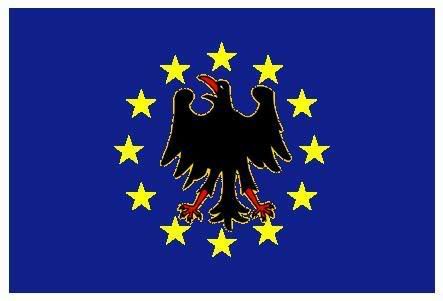
The new EU flag, integrating the "roadkill crow" emblem of the Holy Roman Empire, which for 1000 years was neither Holy, nor Roman, nor an Empire; accomplished nothing, achieved nothing, and remains a footnote in history after unceremoniously collapsing.
To: Red6
The problem Europe faces is more or less the same problem that the American states faced after the American Revolution, when they were trying to figure out how to have a federal government they could tolerate. Then, there were widely disparate economic bases of the different states. Looming large was the difference in labor organization, with heavy plantation slavery in the South and a moral aversion to slavery in New England and Pennsylvania.
How, then, to unite the different parts?
Specifically, how does one simultaneously satisfy the desire for representative government, where majority will chooses the legislators, and the desire of distinct regions not to be dominated by the majority? The answer to that conundrum, in US history, was the bicameral legislature, with the popularly elected House apportioned purely based on population, while the more aristocratic, state-selected Senate representing each state on the basis of equality.
Thus, the majority of the population could win in one house, while the majority of the states prevailed in the other, and if they two went in different directions a compromise would need to be reached. The default was to the status quo, with no law being passed.
Of course there was nothing in the American Constitution which allowed any state a veto of Congress if the majority of the people’s representatives AND a majority of the states’ representatives went along with an act that a particular state really detested. The Southern Senator John Calhoun proposed the concept of “Nullification”, whereby states could individually ignore, thereby nullifying, acts of Congress within their territory. There isn’t any constitutional basis for this. In Europe, each state still retains the veto over anything Brussels does, because each state can refuse to enact a directive in to law, ignore decisions of the ECJ, etc.
We should remember that the American Constitutional structure failed over the issue of slavery. An issue that was so big that it was reconcilable caused the dissolution of the American union and a calamitous Civil War during which the Union, in order to win, stretched federal powers and beyond anything envisioned in the Constitution. After the Civil War, it was clear that the federal government was supreme over the states, and whatever residual powers were reserved to the states could not stand in the way of any federal civil rights legislation.
The problem of the veto was never resolved legally in American history. It was resolved on the battlefield. Even if the Federal government oversteps its theoretical bounds in the Constitution, the states have to obey anyway, because if they don’t, federal military power will enter the state and impose the federal law upon the state’s governments and, to the extent necessary, citizens. Such was the outcome of the Civil War, followed by reconstruction, followed by intervention by federal forces in the civil rights disputes of the 1950s and 1960s.
Europe is not there yet. The problem is the veto. Does a single state, or a handful of states, have the power to VETO a European directive, or ignore an ECJ decision, if it finds it strongly against that states’ interests? Right now, the answer is YES. So, the EU is really a confederation, not a federation. To get the full benefits of uniform policies across an area as vast as Europe would require a European federation, but THAT would mean a definitive renunciation of the power of any state to veto. It would REDUCE the status of European countries to that of American states. The Europeans are not there yet, although in many areas they have, by long negotiation and mutual agreement, arrived at a uniform set of European policies.
So, there is SOME federalization of policies in Europe: trade, tarriffs, the duty to impose a VAT and many civil rights. But it’s a voluntary federalization. Everybody has adopted the norms, because the benefits to each negotiating party made it worth their while. So far, nobody has reneged and pulled out of these treaties. The problem, of course, remains that anybody COULD pull out, if he wanted to. A strength of Europe is that there is no issue like slavery, which is already within the EU and which puts different parts violently at odds with each other over fundamental matters of human rights. The European Charter of Human Rights isn’t voluntary. All of the member states have adopted it. It is enforced by the European human rights court, and any new member who wants the trade benefits of being in Europe has to agree to the totality of the European human rights project. There is no national exception for THAT, and human rights are an area that IS keenly watched in Europe. So, for example, when the British military continued their age old practice of barring homosexuals, the European human rights court ordered the UK to eliminate its policy and admit gays into the British military without discrimination. This is a fundamental matter of human rights in Europe, and there is no national opt out on any detail of human rights. England, of course, submitted, because human rights are the one area that will get Europeans in a hue and cry in a hurry.
So, in this most-emotional of all areas: human rights, the Europeans have ALREADY solved the problem that tore America apart in the 1860s. The US Constitution, as originally envisioned, failed because human rights (and labor/property rights) were so fundamental that people valued them over the government and over peace. When America was formed the issue of slavery was already front and center, and was a primary driver of the bicameral legislative outcome, with the equal representation of states in the Senate. The seed of discord had already forced a compromise which, in the end, proved unworkable.
Europe doesn’t have that problem. European fundamental rights are uniform. In that sense, Europe is federal. What Europe is about is economic integration, and although money can stir passions, it nearly always drives towards compromise and dealmaking in the end. EVERYBODY loses, financially, if Europe falls apart. That is why the English decided that the not having gays in their military was not nearly as important as not having unfettered trade with Europe, and caved on the gay servicemen point.
The solution? More of the same. The European integration project has been slow and messy. It’s a confederation, not a federation, and that means that many things are not uniform. But it ALSO means that those things which ARE uniform are agreed upon by everybody. Coalitions cannot be put together that can ram a policy down some people’s throats. Right now, EVERY nation has a veto on EVERY policy. This drives policymakers mad, but actually, it has produced economic integration sufficient to make the largest economy in the world, and with new accessions, a rapidly growing one at that.
So, perhaps the answer is for politicians to be unhappy with their inability to swiftly enact new policies, and to allow the slow, almost vegetative, growth of policy cooperation on an ad hoc basis, as is done now. Europe works. It may be best to leave it as-is.
15
posted on
04/18/2007 7:19:53 AM PDT
by
Vicomte13
(Le chien aboie; la caravane passe.)
To: jveritas
Moreover the EU adopted the already failed socialist economic model versus the very successful free capitalist economic model of the United States.
Which is complete nonsense. About 35% of the American economy is run by the state (through taxes and social services). The numbers are about the same for Ireland, Latvia, Lithuania, Estonia and Spain, all EU members (well, it's 38% in Spain).
True, it's 54% in France, but that has little to do with the EU and a lot with the fact that the French are, well, french. If anything at all, the EU promotes free trade, the catch-22 being that the individual states are still free to tax their economies into submission.
16
posted on
04/18/2007 7:40:53 AM PDT
by
wolf78
To: wolf78; Vicomte13
Thanks wolf78.
The Union shall offer its citizens an area of freedom, security...
How?
Europe works. It may be best to leave it as-is.
A noble effort in the context of history.
17
posted on
04/18/2007 8:14:56 AM PDT
by
PGalt
To: PGalt
How?
Well, first of all, it's a statement of fact, because only democracies are allowed to participate. In addition to that the EU aims at maximizing freedom within its borders (EU citizens shall have the right to work, buy property and start businesses in every state of the Union), while strengthening the borders against illegal immigration (a coordinated effort by the respective border states).
18
posted on
04/18/2007 8:24:07 AM PDT
by
wolf78
To: wolf78
If you look at the French state PAYS FOR with that 55% of GDP, you will find all of the regular functions of government, PLUS universal health insurance, PLUS universal pensions, PLUS universal free college education.
Now, if you look at the US public and private expenditures for those same sectors: goverment plus health care plus pensions plus college, you will find that the Americans spend 67% of GDP to get the same things that the French spend 12% less of their GDP getting.
That’s a different perspective, which cuts quite in favor of the French model.
19
posted on
04/18/2007 8:26:26 AM PDT
by
Vicomte13
(Le chien aboie; la caravane passe.)
To: wolf78
20
posted on
04/18/2007 8:26:56 AM PDT
by
PGalt
Navigation: use the links below to view more comments.
first 1-20, 21-28 next last
Disclaimer:
Opinions posted on Free Republic are those of the individual
posters and do not necessarily represent the opinion of Free Republic or its
management. All materials posted herein are protected by copyright law and the
exemption for fair use of copyrighted works.
FreeRepublic.com is powered by software copyright 2000-2008 John Robinson