 Saddam carried a copy of the Koran to his execution
|
Posted on 12/30/2006 9:08:35 AM PST by Ernest_at_the_Beach
The extraordinary, turbulent, hugely controversial life of Saddam Hussein was brought to an end at dawn this morning, between 0530 and 0545 local time, just as the call to prayer was sounding across Baghdad.
Saddam carried a copy of the Koran to his execution
A small group of Iraqis, including a representative of the Iraqi prime minister and a Sunni Muslim cleric, were brought to witness the execution.
It took place in an Iraqi compound known by the Americans as 'Camp Justice', a secure facility in the northern Baghdad suburb of Khadimeya, outside the Green Zone.
Several recent executions have taken place here.
Barzan al-Tikriti, Saddam's half brother, and the former chief judge Alwad al-Bandar, who were sentenced to death alongside Saddam, were not with him. They will be executed at a later date.

 The trap door was released and he was hanged - the entire business took just a few minutes
Saddam was brought in carrying a copy of the Koran, and the sentence was read out to him.
He was quiet, but handed the Koran to one of the people there and asked that it should be given to a friend, whom he named.
One of the four executioners told Saddam that he had ruined the country; Saddam responded firmly but quietly.
The noose was placed around his neck. He repeated the Muslim statement of faith.
When the chief executioner went to put the hood over his head, Saddam made it clear he wanted to die without it. It was his last action of defiance.
Then the trap door was released and he was hanged. The entire business took just a few minutes.
Sunni despair
There had been concerns that people might not believe that Saddam was really dead, so the execution was videoed.
This is the end of an important and terrible chapter in Iraq's history. How Iraqis respond to it depends on their politics and their religious and ethnic background.
His unusual name - Saddam - means 'the one who confronts', and that is what he has done for almost half a century
The Shia and Kurdish majority here will largely be overjoyed, and the government, which is itself mostly Shia, sees the execution as an important way of winning popular support.
To the Sunni minority, already embittered and in despair at losing political power, this is the final evidence that they are the major losers in the events of the past few years.
Like virtually everything in Saddam's long political life, reaching back to the early 1960s, his overthrow, trial and execution have divided opinion fiercely, both here and around the world.
His unusual name - Saddam - means "the one who confronts", and that is what he has done for almost half a century, invading first Iran and then Kuwait.
Clemency
His first trial for mass murder, beginning in 2005, was supposed to be the Nuremberg Trial of our time. Yet, as ever, it proved to be divisive, and certainly did not receive general international approval.
There were questions about the nature of the evidence, and the Iraqi government intervened to sack the leading judge for not being tough enough in dealing with Saddam.
After he was sentenced to death, the appeals for clemency from many international leaders have been ignored.
These things will certainly continue to affect the way the world will see Saddam's death.
But now he has finally been swept off the political chessboard, the Iraqi government hopes that 2007 will be a better year as a result.
The Left cannot even bring themselves to say "the end of one of the most brutal dictators in history of mankind:>
***************************************************
By Paul Reynolds
World affairs correspondent, BBC News website 
 Saddam Hussein in power: not mourned by many now
Some Iraqis will miss Saddam Hussein but many more will not mourn him.
He brought little but war and suffering to a people who should have been among the most prosperous in the Middle East, given the oil wealth the country sits on.
Two groups of Iraqis, the Kurds and the Shias, make up a majority of the population and since the US-led invasion of 2003, they have taken control of the government.
Before then, they were the oppressed as Saddam Hussein ruled with absolute ruthlessness through his Sunni-dominated military and intelligence services.
The Anfal
The plight of the Kurds became well known around the world in 1988 when the Kurdish town of Halabja in eastern Iraq was gassed.
The atrocity was but part of a wider campaign against the Kurds, which had its own name - the "Anfal". Saddam Hussein did not trust them. He accused them of wanting a separate state and of helping the Iranians with whom he was at war.
Reporters who penetrated the Kurdish region of northern Iraq after the defeat of Saddam Hussein in Kuwait in the first Gulf War of 1991 found a wasteland.
Village after village had been destroyed. Piles of rubble told where houses had been.
In the midst of the destruction there lay a splendid palace built by Saddam Hussein for himself.
Thousands of Kurds fled into the mountains of southern Turkey as Saddam Hussein fought to regain control. Tolerated but not welcomed by the Turks, they huddled in "safe havens" set up by British and American troops until they could return and try to rebuild.
Shias rise up
In the south, the Shias, encouraged by a call to arms by the then US President George Bush senior, rose up. But there was no help from outside and Iraqi helicopter gunships established the control by violence that was the hallmark of Saddam Hussein's rule.
It is no wonder therefore that the Kurds and the Shias will not shed tears for him.
 Kurdish refugees from Saddam in 1991
Some, many even, among the Sunni population will. Saddam had his power base among them and they powerfully support the insurgency. To them he was an Iraqi hero who had overthrown the old ways and had given them pride.
Others, especially the middle classes of all backgrounds - might look back to the days when they could walk the streets and drive around the country with no fear of being blown up.
But these families too had suffered.
During the eight-year war Saddam Hussein had launched against Iran in 1980, hundreds of thousands of Iraqis (and probably even more Iranians) died. Iraq used nerve and mustard gas against Iranian forces.
He was at the time supported by the Western powers, who were most concerned to contain revolutionary Iran, and the Soviet Union.
But the Kuwait invasion was followed by years of deprivation and isolation under UN sanctions.
Never a proper peace
Saddam Hussein never ruled over a land at peace and at ease with its neighbours and the world.
His execution marks the end of a chapter. But it does not mark the end of the chaos that Iraq faces.
His fate has become almost a sideshow in the great struggle now unfolding in Iraq. His dying wish, expressed in a letter written in jail, called for Iraqis to unite.
They are unlikely to listen.
The Bush administration, struggling to set a new course in Iraq, will try to make capital out of Saddam Hussein's removal.
But it was thought when he was captured in December 2003 ("We got him," declared the American administrator Paul Bremer) that it would demoralise the insurgency. It did not.
And nor will his death.
The future of Iraq and its place in the Middle East remains to be determined by players other than Saddam Hussein.
Paul.Reynolds-INTERNET@bbc.co.uk
Yepper! I guess he's bedding down with at least a few virgins right now! What a lucky guy! /sarc
The Left cannot even bring themselves to say "the end of one of the most brutal dictators in history of mankind."
No Arab euphoria at Saddam deathP>********************************************************
By Ian Pannell
BBC News, Cairo
Although the news of Saddam Hussein's execution was widely anticipated in the region, it has been greeted with a mixture of surprise and anger in some quarters - and notable silence in others.
 Some Palestinians are mourning Saddam Hussein's demise
For many ordinary people in the Arab world, Saddam Hussein was admired if not particularly loved.
He was an active and strident supporter of the Palestinian cause and many regarded him as a strong leader who dared to defy both America and Israel. Images of the former leader having the noose pulled around his neck will shock many.
Libya has declared three days of national mourning.
Lawmakers and members of the militant Palestinian group, Hamas, have condemned the execution, with one calling it "a political assassination" that "violated international laws".
There is little reason to think the execution will change much in a region that heads into 2007 in a precarious state.
Opposition to the US-led invasion of Iraq was almost unanimous in the region. So perhaps it was no surprise that his trial was also regarded as unfair, as an exercise in 'victor's justice'.
Many Arab governments and people saw the legal process as instigated and controlled by Washington.
Despite the insistence that the trial, verdict and now execution was a purely Iraqi affair, few in the Middle East will believe that.
'Victory for Iraqis'
But for those who crossed swords with Saddam, his execution is welcome news.
Iran fought a long and bloody war with Iraq that killed hundreds of thousands of people on both sides. The country's deputy foreign minister called it a "victory for Iraqis". Hamid Reza Asefi predicted it would lead to more violence in the short-term, but would ultimately benefit the country.
 Official reaction in Kuwait has been muted
But the response from Kuwait, a country Saddam invaded in 1990, was more muted. The state-owned news agency reported the only official reaction which was that this was "a matter for Iraqis".
Most other governments in the region have remained completely silent. To be fair, this is the first day of Eid al-Adha, the most important holiday in the Islamic calendar. Even so, it seems many have chosen not to step onto what is widely regarded as extremely delicate territory.
From Egypt, to Saudi Arabia and Jordan, there are real worries that the instability in Iraq will be made worse by Saddam's execution. Sectarian tensions across the Middle East have risen since the US-led occupation and the fear is that this news could make that even worse.
However, while it is possible that the troubles of the region could be affected by a single event - the execution of Saddam Hussein is unlikely to be it.
There is violence and instability in Iraq, continuing tension between Israelis and Palestinians, a peace process that (at best) is at a stand-still and an ongoing political crisis in Lebanon.
The optimism many felt this time last year that real political change may finally start to trickle through the Middle East has all but vanished.
While the execution of Saddam Hussein may prompt some reflection and probably plenty of analysis, there is little reason to think it will change much in a region that heads into 2007 in a precarious state.
The bleeding heart liberals sure are upset about his death
The Leftists use every event to further their cause.....
They might be afraid that President Bush might get some credit!
Extraordinary? Turbulent? Controversial? Um... that's how you'd describe ELVIS, people, not a dictator who tortured and murdered thousands.
You should read some of the comments on BBC have your say.The euros are some of the most idiotic naive anti-US fools on the planet. Either that or they just hate us. I think its a combination of both. Screw'em.
There had been concerns that people might not believe that Saddam was really dead, so the execution was videoed.
This is the end of an important and terrible chapter in Iraq's history. How Iraqis respond to it depends on their politics and their religious and ethnic background.
The Shia and Kurdish majority here will largely be overjoyed, and the government, which is itself mostly Shia, sees the execution as an important way of winning popular support.
To the Sunni minority, already embittered and in despair at losing political power, this is the final evidence that they are the major losers in the events of the past few years.
I wonder if this is true? The the Sunni's are in "Despair" over saddams death. I think we're getting spin.
Franz Liebkind: Hitler... there was a painter! He could paint an entire apartment in ONE afternoon! TWO coats!
There was NO controversy you freaking twits- Saddam was a murderous maggot who deserved to die for his CRIMES AGAINST HUMANITY- end of story- Now go cry us a river BBC you flippin terror colddling maggots! http://sacredscoop.com
for later
Yes, the left can say little evil against the dead. They are so polite. The best they coud do was say his name means he who confronts? ( Who...The Western capitalist Pigs.)
This is a perfect example of out of context reporting. Saddam and his sons were monsters of the first water.
And the photos are easily available to show it. I wonder why the BBC didn't remind everyone of why Saddam is a genocidal monster:
Thousands of Halapja Kurds gassed 1998: ( Thanks Bill Clinton)
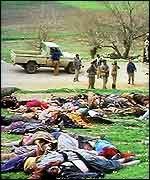
Thank G_D that Sadam has been terminated with prejudice, and other wanna be genocidal maniacs are shivering in their boots. The message: Who else wants some of this? Thank you President Bush. And Bushy is right, which infuriates the socialist liberal mavins of the BBC, AP , UPI and Reuters. So they propagandize it.
Disclaimer: Opinions posted on Free Republic are those of the individual posters and do not necessarily represent the opinion of Free Republic or its management. All materials posted herein are protected by copyright law and the exemption for fair use of copyrighted works.