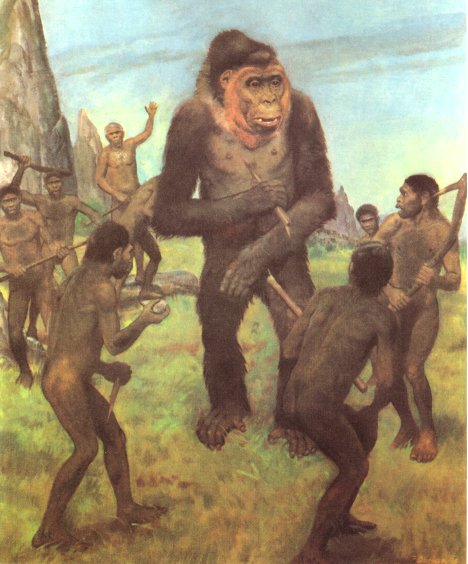
Gigantopithicus: More "Mighty Joe Young" than Kong?
Posted on 01/02/2006 1:25:28 PM PST by nickcarraway
"King Kong" may be a far-fetched creation of Hollywood, but scientists say the big ape has some basis in biological fact: Animals on islands often evolve into gigantic versions of their mainland kin.
"There is a whole body of research on islands which suggests gigantism occurs on them, but of course nothing on the scale of King Kong," said Sue Lieberman, an evolutionary biologist and director of the global species program for WWF International.
"There is evidence that this happens because of isolation and a lack of competition...The further an island is from the mainland, the more potential there is for the evolution of new species," she told Reuters by telephone from Rome.
"King Kong," which is reigning at the North American box office this holiday season, is a remake of the 1930s classic about a giant gorilla found on an uncharted island. Besides falling for the female lead, director Peter Jackson's ape battles predatory dinosaurs on an island that is also inhabited by titanic bats and bugs.
Jackson's monsters may be a stretch, but it is a fiction which mirrors some strange facts about island life.
"Islands are havens and breeding grounds for the unique and anomalous. They are natural laboratories of extravagant evolutionary experimentation," David Quammen writes in his book "The Song of the Dodo: Island Biogeography in an Age of Extinction."
There are many examples of what biologists term "gigantism" on islands.
These include the Komodo dragons, the world's largest lizards, which can be 10 feet long or more and weigh up to 500 pounds. Found on a few small Indonesian islands, the Komodo--a recorded man-eater--can be in some ways as chilling as anything from Jackson's fertile imagination.
Some of these quirks of evolution have occurred in a matter of decades--an astonishing speed.
On remote Gough Island in the South Atlantic, "monster mice" are eating 3-foot-high albatross chicks alive, threatening rare bird species on the world's most important seabird colony. The house mice--believed to have made their way to Gough decades ago on sealing and whaling ships--have evolved to about three times their normal size.
Their remarkable growth seems to have been given a boost by a vast reservoir of fresh meat and protein in the form of the endangered Tristan albatross chicks on which they are feeding.
The huge Indian Ocean island of Madagascar--the setting of another 2005 Hollywood blockbuster by the same name--has also given rise to plenty of natural oddities. These included massive elephant birds that stood over 10 feet in height, and lemurs that weighed 175 pounds or more.
Madagascar broke away from East Africa more than 100 million years ago, leaving it to evolve a rich ecosystem with 10,000 plant species, 316 reptiles and 109 bird species--many of which are found nowhere else.
Moving in the opposite direction, island species have also displayed a marked tendency to shrink in size--a process known as "dwarfism"--though "Mini-Kong" would probably be a flop as a sequel. This has been observed in island-dwelling hippos, elephant and deer, many of which have mutated into much smaller versions of their continental cousins.
Seemingly the last of his kind, King Kong also reflects another phenomenon of islands: their disturbingly high rate of extinction, especially when humans land on them.
Many island species have evolved in a predator-free environment--producing things like flightlessness in birds--which makes them easy prey for meat-eating intruders.
Such was the fate of Madagascar's elephant birds as well as the famed dodo of Mauritius.
According to the World Conservation Union, close to 800 species have become extinct since 1500, when accurate historical and scientific records began.
While the vast majority of extinctions since that time have occurred on islands, over the past 20 years continental extinctions have become as common. Scientists say this is partly because continental habitats are being diced up by human activities--a process that is creating what some biologists term "virtual islands."
King Kong's real-life relatives are marooned on one of these "islands" on East Africa's Virunga mountain range, home to the last of the world's roughly 700 mountain gorillas.
Conservationists say poaching, logging and disease will soon wipe out the last of the world's great apes unless new strategies are devised to save humankind's closest relatives.
From the Democratic Republic of Congo and Nigeria in Africa to the islands of Borneo and Sumatra in Asia, scientists fear populations of gorillas, chimpanzees and orangutans could disappear within a generation without urgent action.
Isn't Gerald Nadler (looks like an ape to me) from the Island of Manhattan?
Gigantopithicus: More "Mighty Joe Young" than Kong?


What is that?
I believe that's the Komodo Dragon (referenced in the text).
But enough about Ted Kennedy.
A great singer who died from obesity.
Well, that was a stupid thing to evolve into. Why don't they just evolve back into flightful birds?
2) Largish land animals cannot evolve much larger because of the fact that weight increases with the cube of one's size (volume is a cube of linear dimension) while limb strength increases with the square of one's size (cross section is a square of linear dimension). Necessarily, the elephant has much fatter legs, even proportionately, than the deer or even more so the ant, and yet it's the ant that can lift 10 times his own weight. A land animal much larger than the elephant is even more disproportionately made up of wide legs, and the limits on size are quite constrained (whereas that of sea creatures such as whales are relatively unconstrained, as they are held up by their buoyancy).
So King Kong, an ape of huge size but normal proportions, could only exist if he spent all his time in the water! On land he would be a helpless invalid.
"Some of these quirks of evolution have occurred in a matter of decades--an astonishing speed."
So which is it? Evolution takes "billions and billions of years" (imitating Carl Sagan) or only a "matter of decades"? Evolution is the theory that fills all gaps. For instance, if cockroaches are found among millions of years old fossils, why it means "they reached their evolutionary zenith then and haven't changed since". Everything else takes millions of years to reach it's potential ... except the examples in the article. Very curious and confusing.
They are amazing looking. I looked them up and saw they can be 10 feet long. That's a big lizard.
Talk about grasping at straws. Are evilutionists really that desperate?

Sounds like a theory I would have come up with when I was eight years old. Hollyweird iz fixshunell! It ain't syents!

A great singer who died from obesity.
Actually, Elvis died on the toilet on many forms of drugs. The end most pro drug libertarians would be most envious to try and duplicate for themselves no doubt.
Disclaimer: Opinions posted on Free Republic are those of the individual posters and do not necessarily represent the opinion of Free Republic or its management. All materials posted herein are protected by copyright law and the exemption for fair use of copyrighted works.