Skip to comments.
Extreme Geomagnetic Storm on Sun
World Net Daily ^
| 16th May, 2005 2:18 pm Eastern
| Staff Writer
Posted on 05/17/2005 5:17:25 AM PDT by Red Sea Swimmer
Event measures 9 on 0-9 scale, power system, satellite disruptions likely causing possible power outages and satellite disruption, an extreme geomagnetic storm occurred yesterday that registered at the highest level on measurements of such solar activity.
Extreme geomagnetic event recorded on sun on Sunday (NOAA photo)
Forecasters at the National Oceanic and Atmospheric Association Space Environment Center in Boulder, Colo., observed the event, which measured G-5 – the highest level – on the NOAA Space Weather Scales.
"This event registered a 9 on the K-Index, which measures the maximum deviation of the Earth's magnetic field in a given three-hour period," Gayle Nelson, lead operations specialist at NOAA Space Environment Center, said in a statement. "The scale ranges from 0 to 9, with 9 being the highest. This was a significant event."
The event was forecast by NOAA as the result of a solar flare that occurred on Friday, May 13.
Possible impacts from such a geomagnetic storm include widespread power system voltage control problems with some grid systems may experience complete collapse or blackouts. Transformers may experience damage. Spacecraft operations may experience extensive surface charging, including problems with orientation, and uplink/downlink and tracking satellites. Satellite navigation may be degraded for days, and low-frequency radio navigation can be out for hours. Reports received by the NOAA Space Environment Center indicate that such impacts have been observed in the U.S., the agency says.
"We usually have something of this magnitude only about four or six times a year, so this is kind of a big event," Mowry said Florida meteorologist Larry Mowry.
TOPICS: News/Current Events
KEYWORDS: buildaspaceark; callingartbell; callthek9unit; christianscatology; divineclock; hashem; repentyeastronomers; sandwichboardandbell; space; time; warnings
Navigation: use the links below to view more comments.
first 1-20, 21-39 next last
The myopic, distracted and drugged of the world fail to read the signs. When the world "leaders" are also failing to read the cosmic signs, trouble is not far off on the horizon.
Many of the world's "leaders" in business, politics, monarchy and religion think that they are masters of reading the zeitgeist and having a felling for what is going on. They often congratulate themselves and each other on their zeitgeist reading prowess. They have become smug in their conceit.
We will see whose plans prevail over the coming days and weeks.
To: Red Sea Swimmer
A 'geomagnetic' storm on the Sun? I don't think so. 'Heliomagnetic' would be the correct term.
To: Red Sea Swimmer
Could be "series". Better check on flashlight batteries.
3
posted on
05/17/2005 5:25:23 AM PDT
by
Russ7
To: Russ7
We're doomed, I say! Doomed! Doomed!
4
posted on
05/17/2005 5:29:34 AM PDT
by
Neville72
To: Red Sea Swimmer
Maybe Ed Dames was right.
5
posted on
05/17/2005 5:31:04 AM PDT
by
taxed2death
(A few billion here, a few trillion there...we're all friends right?)
To: Red Sea Swimmer
6
posted on
05/17/2005 5:34:14 AM PDT
by
Redleg Duke
(Don't let Terri's death be in vain!)
To: Red Sea Swimmer
This is obviously a result of Bush's failure to enforce the Kyoto protocols.
7
posted on
05/17/2005 6:01:39 AM PDT
by
Blood of Tyrants
(G-d is not a Republican. But Satan is definitely a Democrat.)
To: Neville72
I hope so ..I have some left over Y2K supplies I would like
to unload at better prices..
8
posted on
05/17/2005 6:02:23 AM PDT
by
joesnuffy
(The generation that survived the depression and won WW2 proved poverty does not cause crime)
To: bonfire; RadioAstronomer; bonesmccoy; Ernest_at_the_Beach; GeronL; glock rocks; Phil V.; djf; ...
9
posted on
05/17/2005 6:03:14 AM PDT
by
Howlin
(North Carolina, where beer kegs are registered and illegal aliens run free.)
To: Howlin
Ahhh! That's why my Dish was cutting in and out yesterday!
10
posted on
05/17/2005 6:04:25 AM PDT
by
bonfire
(dwindler)
To: Red Sea Swimmer
Bush's Fault....Quagmire!!!
11
posted on
05/17/2005 6:06:47 AM PDT
by
AngryJawa
(Will Work For Ammo)
To: Russ7
And duct tape....just in case civilization breaks down.
12
posted on
05/17/2005 6:25:02 AM PDT
by
DannyTN
To: DannyTN
To: Red Sea Swimmer
They have become smug in their conceit. We will see whose plans prevail over the coming days and weeks.
During the rectification of the Vuldronaii, the Traveller came as a large and moving Torb. Then, during the third reconciliation of the last of the Meketrex Supplicants, they chose a new form for him--that of a Giant Sloar! Many Shubs and Zuuls knew what it was to be roasted in the depths of the Sloar that day, I can tell you!
To: snarks_when_bored
It is a misnomer. One would think earth's mag field would be storming. It wobbles, the north mag pole moving over an area 500 miles across with the instantaneous pole moving 100 miles per second due to who knows what, but what a geomagnetic storm might be who knows.
15
posted on
05/17/2005 9:35:32 AM PDT
by
RightWhale
(These problems would not exist if we had had a moon base all along)
To: Howlin
From:
Stay Tuned for a STEREO View of Stormy Space Weather
05.03.05
*******************************************************
 |
 |
|
|
Stay Tuned for a STEREO View of Stormy Space Weather
|
05.03.05
|
The thrills! The chills! Soon you'll be able to see for the first time ever, in dazzling three dimensions … the Sun. Imagine solar prominences looping out into space for thousands of miles. Now picture a billion megaton blast of solar plasma flying toward Earth and the effect it would have on astronauts, satellites in orbit, airplanes, and power grids, which are vulnerable to such a burst. Now you're starting to see why we need a better understanding of that powerful and dynamic star.
 The upcoming Solar TErrestrial RElations Observatory () mission will help provide the big picture by using two nearly identical spacecraft to image the Sun and track its activity in high definition 3-D. Particularly crucial will be its observations of coronal mass ejections, or CMEs, the most powerful explosions in the solar system. Related to solar flares (scientists still don't really know which comes first), CMEs can pack the force of a billion megaton nuclear bombs. The upcoming Solar TErrestrial RElations Observatory () mission will help provide the big picture by using two nearly identical spacecraft to image the Sun and track its activity in high definition 3-D. Particularly crucial will be its observations of coronal mass ejections, or CMEs, the most powerful explosions in the solar system. Related to solar flares (scientists still don't really know which comes first), CMEs can pack the force of a billion megaton nuclear bombs.
Image Right: Animation showing STEREO spacecraft observing a CME in 3-D. Click on image for animation or download stills and movies. Credit: NASA/Walt Feimer.
"In terms of space weather forecasting, we're where weather forecasters were in the 1950s. They didn't see hurricanes until the rain clouds were right above them; in our case, we can see storms leaving the Sun but we have to make guesses and use models to figure out if and when it will impact Earth," said Dr. Michael Kaiser, Project Scientist for STEREO at NASA Goddard Space Flight Center.
 Image Left: A view of the Sun Earth Connection Coronal and Heliospheric Investigation (SECCHI) instrument being built at the in Washington, DC. Credit: NRL/NASA/Chris Gunn. Image Left: A view of the Sun Earth Connection Coronal and Heliospheric Investigation (SECCHI) instrument being built at the in Washington, DC. Credit: NRL/NASA/Chris Gunn.
There's a strong fleet of satellites observing the Sun right now, but even with missions like , which images the Sun every 10 to 15 minutes, scientists still can't definitively say if a CME is coming toward Earth or traveling away from it -- for that we need to see the third dimension.
"When you're trying to figure out what really makes a CME go, knowing where it is in space is crucial. At this point we don't quite know where it is, how fast it's traveling, or how one structure interacts with another," said Dr. Terry Kucera, Deputy Project Scientist for the mission.
 Image Right: A 3-D rendering of the Sun's corona, the wispy outer atmosphere where solar flares thrive. Click on image for animation or download stills and movies. Credit: NASA/Tom Bridgman Image Right: A 3-D rendering of the Sun's corona, the wispy outer atmosphere where solar flares thrive. Click on image for animation or download stills and movies. Credit: NASA/Tom Bridgman
"If you only saw stuff with one eye you lose the ability to judge perspective and depth," said Dr. Alex Young, a NASA scientist. "Basically we're looking at the Sun with one eye. With STEREO, we're finally going to have the ability to gain this extra dimension, or this depth perception we didn't have before."
STEREO's spacecraft are just as unique and groundbreaking as its mission. It marks the first time that two spacecraft will launch on the same rocket, and then swing around the Moon to get into separate orbits. Once there, STEREO 'A' will fly ahead of the Earth and STEREO 'B' will fly behind it. When the solar arrays are deployed, the spacecraft will be about the length of a large school bus.
 Image Left: Animated preview of STEREO spacecraft. The two spacecraft will be launched on the same spacecraft in Spring 2006. Click on image for animation or download stills and movies. Credit: NASA/Chris Meaney Image Left: Animated preview of STEREO spacecraft. The two spacecraft will be launched on the same spacecraft in Spring 2006. Click on image for animation or download stills and movies. Credit: NASA/Chris Meaney
Building two spacecraft at the same time "requires twice the amount of knowledge, but isn't that much harder with the right team," said Jim Adams, the Deputy Project Manager.
Each STEREO observatory has a total of 16 instruments, all of which are still being assembled in labs throughout the world. In the summer they will all be brought to The Johns Hopkins Applied Physics Lab for assembly and initial testing, and then to NASA Goddard Space Flight Center for final testing. STEREO launches in February 2006 from the Cape Canaveral Air Force Station in Florida.
Besides improving space weather forecasting and understanding for Earth systems, STEREO is also an important key to understanding the Sun's influence throughout the solar system.
 Image Left: This artist's concept shows a CME leaving the Sun and being buffeted by Earth's magnetic fields until it finally results in a spectacular aurora at the poles. Scientists still don't fully understand the origins and evolution of these massive storms. Credit: NASA/Walt Feimer. Image Left: This artist's concept shows a CME leaving the Sun and being buffeted by Earth's magnetic fields until it finally results in a spectacular aurora at the poles. Scientists still don't fully understand the origins and evolution of these massive storms. Credit: NASA/Walt Feimer.
Here on Earth we're protected by the atmosphere and magnetic fields from the Sun's radiation. But as NASA gears up to send astronauts to the Moon and beyond, we're going to need a better understanding of the dangerous solar particles accelerated by shock waves from CMEs. One of the biggest mysteries confronting scientists: why does one CME produce a major storm and another one does not?
"To some degree, we're getting knocked around and seeing bits and pieces. With STEREO, we'll get a chance to step back and see a CME from the outside in all its glory… We're not just going to see CMEs coming toward us, but we'll see how they move through the solar system," said Young.
And it's going to be one amazing show.
Rachel A. Weintraub
NASA Goddard Space Flight Center
|
|
|
|
***************************************************** 


|
16
posted on
05/17/2005 11:12:16 AM PDT
by
Ernest_at_the_Beach
(This tagline no longer operative....floated away in the flood of 2005 ,)
Another try at images...

17
posted on
05/17/2005 11:18:33 AM PDT
by
Ernest_at_the_Beach
(This tagline no longer operative....floated away in the flood of 2005 ,)
To: Ernest_at_the_Beach
18
posted on
05/17/2005 11:25:27 AM PDT
by
Ernest_at_the_Beach
(This tagline no longer operative....floated away in the flood of 2005 ,)
To: Red Sea Swimmer; Howlin; RadioAstronomer; snarks_when_bored; Neville72; Blood of Tyrants; ...
I don't see any alarm on the offical sites that monitor the SUN!!!!!
Why are you hyping this like it is the END OF THE WORLD????
19
posted on
05/17/2005 11:31:22 AM PDT
by
Ernest_at_the_Beach
(This tagline no longer operative....floated away in the flood of 2005 ,)
To: Ernest_at_the_Beach
STEREO (Solar TErrestrial RElations Observatory) is the third mission in NASA’s Solar Terrestrial Probes********************************************
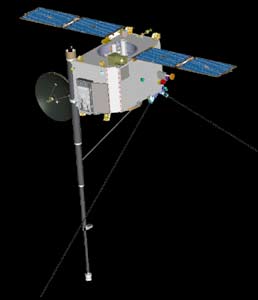 STEREO [JHU/APL] |
STEREO (Solar TErrestrial RElations Observatory) is the third mission in NASA’s Solar Terrestrial Probes program, scheduled to launch in November 2005 aboard a single Delta-7925-10L launch vehicle. This two-year mission will employ two nearly identical space-based observatories to provide the first-ever, 3-D stereoscopic images to study the nature of coronal mass ejections, or CMEs.
The STEREO mission will provide a totally new perspective on solar eruptions by imaging CMEs and background events from two observatories simultaneously. To obtain unique views of the sun, the twin observatories must be placed into a rather challenging orbit where they will be offset from one another. One observatory will be placed “ahead” of the Earth in its orbit and the other, “behind” using a series of lunar swingbys. Just as the slight offset between your eyes provides you with depth perception, this placement will allow the STEREO observatories to obtain 3-D images of the sun.
APL mission designers determined that the most efficient and cost-effective method to place the twin observatories, launched aboard a single rocket, into their respective orbits is to use lunar swingbys. This is the first time this technique has been used to manipulate orbits of more than one spacecraft. Mission designers will use the moon’s gravity to redirect the observatories to their appropriate orbits – something the launch vehicle alone can’t do.
For the first three months after launch, the observatories will fly in an orbit from a point close to Earth to one that extends just beyond the moon. STEREO Mission Operations personnel at The Johns Hopkins University Applied Physics Laboratory, in Laurel, Md., will synchronize spacecraft orbits so that about two months after launch they encounter the moon, at which time one of them is close enough to use the moon’s gravity to redirect it to a position “behind” the Earth. Approximately one month later, the second observatory will encounter the moon again and be redirected to its orbit “ahead” of Earth. When combined with data from observatories on the ground or in low-Earth orbit, STEREO’s data will allow scientists to track the buildup and lift-off of magnetic energy from the sun and the trajectory of Earth-bound CMEs in 3-D.
The two STEREO observatories will be nearly identical with selective redundancy. The spacecraft bus will be built by The Johns Hopkins University Applied Physics Laboratory (APL), in Laurel, Md., with NASA Goddard Space Flight Center procuring the instruments. Each observatory and its instruments will be integrated at APL.
The STEREO mission consists of two solar-powered, 3-axis-stabilized spacecraft, each with a launch mass – including propellant – of approximately 620 kg. The spacecraft will communicate with the APL-based Mission Operations Center via NASA’s Deep Space Network.
The significant challenge in spacecraft design is the large number and extent of the instrument fields-of-view, coupled with the various instruments’ competing design requirements to ensure successful science observations.
The major design drivers to support the science instrument performance are a conductive outer surface for the energetic particle experiments, stringent electromagnetic compatibility and interference requirements for the radio burst tracker, and contamination control of both volatiles and particulates for the imager experiment.
The spacecraft bus consists of six operational subsystems supporting two instruments and two instrument suites. This combination provides a total of 16 instruments per observatory. The subsystems include: command and data handling; radio frequency communications; guidance and control; propulsion; power; and thermal.
Following Instruments are on board of each of the two probes:
- The Sun-Earth Connection Coronal and Heliospheric Investigation (SECCHI) is a suite of remote-sensing instruments consisting of an extreme ultraviolet imager, two white-light coronagraphs, and a heliospheric imager. These instruments will study the 3-D evolution of coronal mass ejections—the most energetic eruptions on the sun and primary cause of major geomagnetic storms—from their origin at the sun’s surface through the corona and interplanetary medium to their eventual impact at Earth.
- The In situ Measurements of PArticles and CME Transients (IMPACT) investigation provides measurements of the solar wind electrons, interplanetary magnetic fields, and solar energetic particles. IMPACT comprises seven instruments including a solar wind electron analyzer, a magnetometer, and an array of particle detectors measuring the energetic ions and electrons accelerated in coronal mass ejection (CME) shocks and in solar flares.
- The PLAsma and SupraThermal Ion Composition (PLASTIC) instrument is slated to study coronal-solar wind and solar wind-heliospheric processes. PLASTIC will provide in situ plasma characteristics of protons, alpha particles and heavy ions. It will supply key diagnostic measurements of mass and charge state composition of heavy ions and will characterize the coronal mass ejection plasma from ambient solar wind plasma.
- STEREO/WAVES (S/WAVES) is an interplanetary radio burst tracker that will trace the generation and evolution of traveling radio disturbances from the sun to Earth's orbit. A radio and plasma wave receiver, S/WAVES is both a remote-sensing and an in-situ instrument.
| Nation: |
USA |
| Type / Application: |
Science, Solar |
| Operator: |
NASA |
| Contractors: |
Johns Hopkins University Applied Physics Laboratory (APL) |
| Equipment: |
SECCHI, IMPACT, PLASTIC, S/WAVES |
| Configuration: |
|
| Propulsion: |
|
| Lifetime: |
|
| Mass: |
620 kg |
| Orbit: |
Earth leading (#A) or trailing (#B) solar orbit |
| Further STP (Solar Terrestrial Program) missions:
|
Source: STEREO (JHU/APL) Website
Last update: 04.01.2005
Contact: gunter.krebs@skyrocket.de
© Gunter Dirk Krebs
20
posted on
05/17/2005 11:41:25 AM PDT
by
Ernest_at_the_Beach
(This tagline no longer operative....floated away in the flood of 2005 ,)
Navigation: use the links below to view more comments.
first 1-20, 21-39 next last
Disclaimer:
Opinions posted on Free Republic are those of the individual
posters and do not necessarily represent the opinion of Free Republic or its
management. All materials posted herein are protected by copyright law and the
exemption for fair use of copyrighted works.
FreeRepublic.com is powered by software copyright 2000-2008 John Robinson
