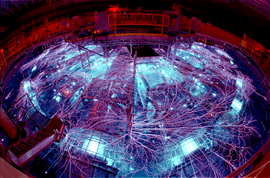
The full sized photo is excellent at the source link above.
Posted on 10/23/2004 1:19:03 PM PDT by tricky_k_1972
Concept for rapid-fire thermonuclear explosions proposed by Sandia scientists
ALBUQUERQUE, NM -- A simple theoretical concept to solve the staggeringly difficult problem of maintaining intact electrical transmission lines to produce rapidly repeated thermonuclear explosions for peacetime purposes has been proposed by researchers at the Department of Energy's Sandia National Laboratories.
The method is meant to advance the day of relatively cheap, clean, fusion-produced energy through machines like Sandia's Z accelerator.
The concept was presented informally by Sandia researcher Mark Derzon in late July to researchers in Snowmass, Colo., at the first extended meeting of fusion researchers both inertial and magnetic.
There, scientists interested by the concept placed Z pinches on the list for recommended scientific exploration as an energy source.
The Z-pinch accelerator at Sandia, known simply as Z, is far and away the world's most powerful laboratory X-ray source. However, funding to date for Z has been related to its weapons-program usefulness.
"Getting Z listed as a potential source of energy is a major leap forward for the Z fusion program," says Tom Hunter, Sandia Senior VP for the nuclear weapons program. "This may be an opportunity to make a significant contribution to our nation's energy security."
While weapons research requires only a single explosion to produce data, fusion meant to create virtually unlimited electrical power requires the high-yield implosion of a pea-sized deuterium-tritium pellet every few seconds, says Craig Olson, who organized the inertial fusion section of the Snowmass meeting.
The proposed power generation process for inertial fusion resembles the rapid series of explosions that drive a gasoline engine. Instead of gasoline and air interacting chemically, isotopes of hydrogen fuse. The problem has been that the power of a high-yield thermonuclear explosion would damage not only the pellet-target, which could be rapidly replaced, but also the last five feet of power lines connected to the target. This has been a stumbling block in envisioning Z as a source of real-world power, since a near-continuous stream of rapid-fire explosions is necessary to continuously create steam to turn turbines, says Derzon, who with principal collaborators Gary Rochau, Greg Rochau and Steve Slutz came up with the new concept. Antonio Zamora, manufacturing liaison, provided the cost estimate for the recyclable transmission lines that suggests the concept is feasible.
"The problem has always been how to separate power supply from the physical target," says Derzon. "We propose to get around the problem by using recyclable transmission lines, perhaps of lithium or flibe [fluorine, lithium, and beryllium]." Hollow spheres -- "Christmas tree" ornaments -- of lithium or flibe surrounding the lines would serve as the heat exchange medium and moderators of neutron flux.
Transmission lines would cycle on a large horizontal carousel. After the firing, or shot, the then-liquefied lithium or flibe would be pushed out of the chamber and its heat used to drive electrical generators. Tritium, an isotope of hydrogen essential for the fusion process, would be harvested from the liquefied metal. Finally, the spent metal would be put in a mold to form new transmission lines and new "Christmas tree" ornaments.
Rather than trying to create a vacuum in the entire chamber after each shot, Derzon's group, consulting with Olson and Rick Spielman , proposes to pump only the space between recyclable transmission lines -- a much quicker, cheaper, and easier procedure than emptying the whole chamber.
"Now it's just a concept. At Snowmass, they were very receptive and we hope to get resources to do a design study," says Derzon.
Nuclear fusion could be a way to produce energy not only on Earth but also in spacecraft or in space colonies, since its power source -- isotopes of hydrogen -- for the most part is readily available.
Consider the new idea proposed for using microwaves to push space craft and cut down transit times to 90 days for round trip to Mars, well here is your power source.
Space ping!
thanks.
the hunt for controllable small scale fusion has so far been a bust, but I still hope.
A microwave vehicle with a rectenna powered by a gigawatt satellite was proposed by Leik Myrabo of Rensselaer Tech.
I heckled from the audience. Since rectennas leak, the occupants are in dire danger. I asked if they would all hold up hot-dogs during liftoff, and if (unpopped) popcorn would be distributed on the deck as a warning measure.
At one point in his presentation he stated that passengers would be "equipped with exoskeletal armor." My response: "Are they equipped with Pampers?"
--Boris
Sorry, I got it wrong. It was not microwaves; the new project uses magnetized ions that would interact with a magnetic sail on a spacecraft. Hope this is better for our astronauts.
Here is a link to the original article: http://www.spacedaily.com/news/rocketscience-04zh.html
The full sized photo is excellent at the source link above.
However, I must give him his due. Everyone (including me) told him he was crazy with his "lightcraft" idea...until he made it work...


I don't understand why they convert the energy into steam and then to electricity rather than use it directly to seperate hydrogen and oxygen in water.
except if answer to the next question -- ie-- which is cheaper to transport (value-cost) electricity or hydrogen+oxygen--turns out to be electricity.
Wow, that'd make a cool skin for the desktop!

Fusion is a distraction, don't fall for it.
The only significant advantage for fusion over fission is that fusion produces less radioactive waste.
...But radioactive waste is a political problem, not a technical one.
Simply put, we can get all of the energy that we need from fission with today's existing industrial technology, rather than having to depend upon exotic technical advancements in the future (or depend upon making lab experiments practical).
Fission is the answer.
bump
Not quite true. The source fuel for fusion, hydrogen isotopes, are far more plentiful than is Uranium. Also, fusion is an inherently more efficient energy source, meaning you get far more energy from a given mass of fuel from fusion than you do from fission.
It's well worth exploring. My worry is that there will be the same protests over fusion when it comes on stream as there are today over fission. It'll be the same thing all over again and we'll get nowhere.
Yes, that's why fusion is a distraction. We can already get what we want from fission; it's politics that are in the way. Fusion doesn't change the politics.
And don't forget, fission reactors can be breeders. We can *make* as much fuel as we need already. We don't have to depend upon Nature.
Breeder reactors can't make fuel from nothing. They have to have Uranium to start with.
OK, so that's the end of it. Did GWB rescind this order, or is it still in place? Looks like your argument is moot because this process is illegal and will probably stay that way, or am I wrong?
Besides, you keep mentioning politics. Tell me about the politics of building new nuclear power facilities, whether they are breeder or conventional reactors. I don't think it's very realistic. They're shutting plants down, not building new ones.
We're building the only new one in the U.S., outside of those on military ships, here in Alabama...scheduled for 2014.
Politics is a beast. We need far more nuclear power than one new plant in Alabama.
Let's face it. No one wants one of these things in their back yard. I know I don't, even though in principle I support nuclear power. Even Einstein didn't like them.
Disclaimer: Opinions posted on Free Republic are those of the individual posters and do not necessarily represent the opinion of Free Republic or its management. All materials posted herein are protected by copyright law and the exemption for fair use of copyrighted works.