Posted on 11/20/2026 6:25:28 AM PST by MtnClimber
In the prior post, I noted that the existing big federal entitlement programs (Social Security, Medicare, and Medicaid) consistently grow faster, year after year, than the overall rate of economic growth. In any given year, the growth of entitlement spending as a percent of GDP may seem small. But I concluded that:
[T]he United States . . . needs to figure out a way to get the entitlement spending into line with the size of the economy before the entitlements swallow the whole thing and completely impoverish the people.
This is a very slowly-growing problem, but very real. Again, understanding it is an exercise in math that is not very complicated.
Here’s how it plays out. Current spending on Social Security in just-ended fiscal year 2026 was about $1.5 trillion; spending on Medicare for the same period was about $1.3 trillion; and spending on Medicaid (federal share) was about $0.7 trillion. That’s a total of about $3.5 trillion for the three of them. The GDP for the entire economy was about $33 trillion. So the three entitlements consumed (via federal spending only) about 10.6% of the economy.
But every year each of the entitlements grows faster than the economy by about 1% to 3%. Considering the last 25 years since 2001, the compound annual growth rate of Social Security has been about 5.6%; the compound annual growth rate of Medicare has been about 7.6%; and the compound annual growth rate of federal Medicaid spending as been just under 7%. Meanwhile, the overall rate of economic growth of GDP has averaged about 4.6% over the same period (non-inflation adjusted). The rates of growth of the entitlements, and of GDP, obviously vary somewhat year by year. But the phenomenon that the entitlements grow on average by a couple of percent faster than GDP year after year is remarkably consistent.
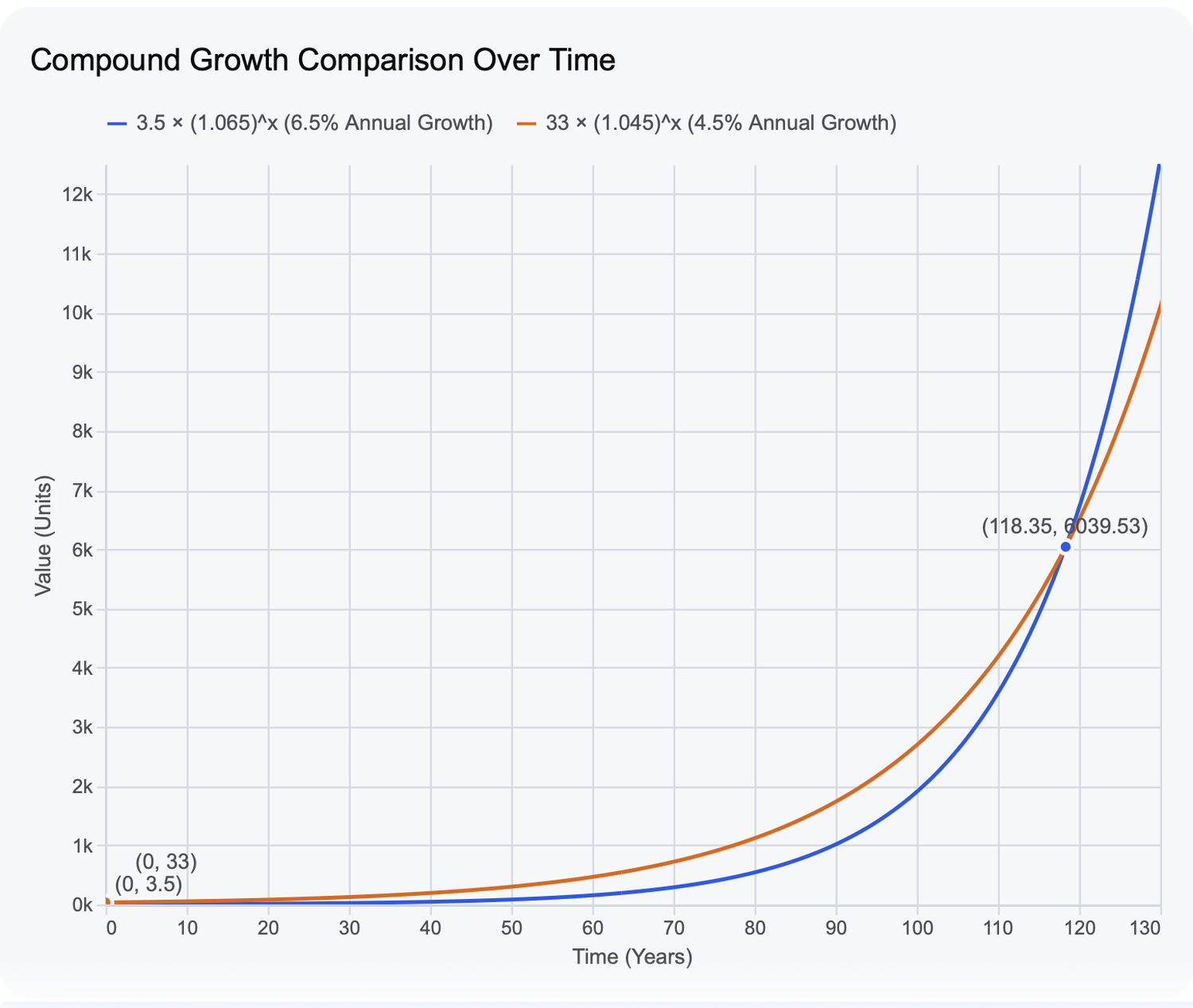
With the magic of today’s AI, you can get yourself a graph of what happens if this just continues for decades without anyone trying to get the spending under control. Here is a graph produced for me by Google’s Gemini AI. The instructions were to plot two lines, one of which starts at 3.5 (current federal entitlement spending in trillions of dollars) and grows by 6.5% per annum, and the other of which starts at 33 (current GDP in trillions of dollars) and grows by 4.5% per annum.
In the version of this generated on the Gemini website, you can hover your cursor over any point on the graph to get the values at that point. (You can also do the same calculation very easily with a basic calculator.) You find that 20 years out the economy has grown to about $80 trillion, while the entitlements have gone to about $13 trillion. So from today’s 10.6% of the economy, the entitlements have grown to about 16%. Forty years out, it’s $192 trillion for the economy, and $45 trillion for the entitlements — about 23.5%. At 60 years it’s $465 trillion for the economy, and $154 trillion for the entitlements — about 33%. And so forth. As the graph shows, the two lines meet at 118.35 years out, at which point the entitlements have swallowed the entire economy.
One conclusion from this is that there is really no prospect of being able to finance this kind of ongoing growth by imposing increasing taxes on a small slice of “billionaires,” or millionaires, or even a larger slice of upper middle income earners. That strategy might seem to cover the problem for the first few years or even a decade, but as you get into the second and third decade, the spending needs of the entitlements comes to exceed all the earnings of the upper income people, even if taxed at 100%.
Someone might push back against the assumptions behind this chart by contending that the rate of growth of the entitlements won’t continue past patterns, and will inevitably slow down. But why? Particularly in the area of the medical entitlements, the ongoing growth is driven by the combination of an aging population and the creativity of the people and the bureaucracy in adding covered items to the programs. Nursing home care, hospice, “adult day care,” non-emergency medical transportation (getting grandma to her doctors’ appointments), in-home aides (often family members) to do cooking and housecleaning, autism counseling, etc., etc., etc. How about vision and dental? (AOC wants to add those to Medicare coverage.). Medicaid for people with income below the poverty rate? How about double the poverty rate? How about four times? Why stop there? Pharmaceutical companies continually come up with new and creative drugs, always priced at high levels when they first come to market. Who is going to say no to paying for these things, and the many others like them coming down the pike?
And then of course we have Medicare for All. Its characteristerics are not yet known, but we will soon be learning as the new Democratic Congress puts its proposals in writing.
A very slowly-unfolding train wreck is coming for us all.

|
Click here: to donate by Credit Card Or here: to donate by PayPal Or by mail to: Free Republic, LLC - PO Box 9771 - Fresno, CA 93794 Thank you very much and God bless you. |
Manhattan Contrarian ping
Ok. So what they are saying is that there is no money for Americans but plenty of money for Ukraine, Israel and for unnecessary and useless wars. Got it.
There is no money for any of it though foreign aid is a rather small portion of the budget , eliminating it wouldn’t really do much
What the graph illustrates is annual gvrowth and not the increase in depletion. It is growing but so are the payouts.
The trustee’s reports current this year from social ecurity and other funds is:
The Old-Age and Survivors Insurance (OASI) Trust Fund will be able to pay 100 percent of total scheduled benefits until the fourth quarter of 2032, one quarter earlier than projected last year. At that time, the fund’s reserves will become depleted and continuing program income will be sufficient to pay 78 percent of total scheduled benefits.
The Disability Insurance (DI) Trust Fund is projected to be able to pay 100 percent of total scheduled benefits through at least 2100, the last year of this report’s projection period. Last year’s report projected that the DI Trust Fund would be able to pay scheduled benefits through at least 2099, the last year of that report’s projection period.
If the OASI Trust Fund and the DI Trust Fund projections were combined, the resulting projected fund (designated OASDI) would be able to pay 100 percent of total scheduled benefits until the third quarter of 2034, unchanged from last year’s report. At that time, the projected fund’s reserves would become depleted and continuing combined fund income would be sufficient to pay 83 percent of scheduled benefits. (The two funds could not actually be combined unless there were a change in the law, but the combined projection of the two funds is frequently used to indicate the overall status of the Social Security program.)
The Hospital Insurance (HI) Trust Fund will be able to pay 100 percent of total scheduled benefits until the second quarter of 2033, one quarter earlier than projected last year. At that point, that fund’s reserves will become depleted and continuing program income will be sufficient to pay 89 percent of total scheduled benefits.
The Supplementary Medical Insurance (SMI) Trust Fund is adequately financed into the indefinite future because, unlike the other trust funds, its main financing sources—enrolled beneficiary premiums and the associated federal contributions from the Treasury—are automatically adjusted each year to cover costs for the upcoming year. Although the financing is assured, rapidly rising SMI expenditures have been placing steadily increasing demands on beneficiaries and general taxpayers.
This report is the accumulation of estimated growth and depletion of the funds. And it shows a shelf life and gives the reasons why.
The reasons for that are here:
https://www.ssa.gov/oact/trsum/
wy69
A well written article. Thanks for posting it.
I very much look forward to Francis Menton’s posts.
However, Social Security is not an “entitlement” as the word is used here.
It is, however, the only item listed that may actually fit the dictionary definition of an entitlement.
Yes it’s all coming apart soon. Europe will go down first, but things will only be marginally be better here. The debt has approached the point where current spending is unsustainable.
“Entitlements”
Between the worthless non-productive pukes, welfare queens, cash stipends for illegals, the uniparty Congress (spending) over the years has put us in near default any year now.
Might be way too late for this kind of spending and to pull back these actions anyway. We are looking at a worse and worser scenario.
.
Fear Not: The DemonicRats are going to add Everybody to Medicare. That will fix it.
For health care, bring on market force:
1. Break most hospitals into two highly competitive entities.
2. Convert other hospitals into real estate leasing entities with competing surgical suites and nursing wings.
3. Separate out drug coverage so hospital systems can run care coverage systems and cut out insurance company overhead and meddlers.
4. Create interstate drug plans that don’t have to pay what the drugmaker wants for every drug. To qualify for exchange listing and federal subsidies, they would have to most (~80% or more) in all important types (large volume recombinant, small volume recombinant, breakthroughs under patent, etc.). Group and exchange plans to offer time-limited vouchers at plan set amounts for out-of-formulary drugs. Voucher plans would have variable premiums. Plans without minimums (or vouchers) could be vended directly to individuals and families.
5. These plans would be all the doctors (and computer algorithms) prescribe for formulary drugs with co-pays equal to manufacturing cost.
6. Reform medical education, breaking down medicine and dentistry into simpler chunks and start it in the first year of college.
7. Replace most primary care doctoring with algorithmic computer-based care.
(Insurers would pay human doctors to confirm computer diagnosis, orders for expensive tests[MRI, genetic], prescribe radiation imaging[CT, PET, X-ray]/treatment, and voucher/government co-pay drugs. Other human doctor care would be private pay.)
8. Place radioisotope-related care at international airport centers.
******************************
Multi-State Drug Coverage Inc.
TIME-LIMITED VOUCHER
Void if the Drug is not given to the Patient by June 30, 2028
or the VOUCHER is not sent by registered mail to MSDC for payment within 30 days thereafter
Patient: John Q. Needy
Drug: Fab-Mab
Drug Vendor: Fab-Mab Maker Inc.
Covered Dosage: 100 units
Eligible Dispensing Period: 18-day period starting June 12, 2028
MSDC Payment Amount: $3,500
Multi-State Drug Coverage Inc. agrees to pay the listed Drug Vendor the MSDC Payment Amount if the Covered Dosage is administered to the listed Patient during the Eligible Dispensing Period by a MSDC authorized provider and that provider and the listed Patient so certify administration as per contract on this VOUCHER.
Any word about New Jersey or Illinois government pension cuts?
Did you mail in your ballot, Mrs. Democrat?
I forget where I put it, Miss Ward Heeler.
I’ve been on SS for 18 years. My “benefits” have grown much faster than inflation, much faster than my wages as I concurrently worked til I was 81. (now unemployed)
This has been obvious to all of us.
The same way with Medicaid. Medicaid now often pays for food for those already on SNAP and WIC. Why? Complex reasons. But an oversimplified explanation is that Health Insurance Companies can get much more government money by providing a little more mone to recipients.
Disclaimer: Opinions posted on Free Republic are those of the individual posters and do not necessarily represent the opinion of Free Republic or its management. All materials posted herein are protected by copyright law and the exemption for fair use of copyrighted works.