Skip to comments.
Same Learjet received warning from air traffic control months before Florida crash: Report
toronto sun ^
| November 4, 2026
| Denette Wilford
Posted on 11/06/2026 10:00:15 AM PST by xxqqzz
Audio between an air traffic controller and a female pilot flying the Learjet 60 during a flight in May has resurfaced following Sunday’s tragic incident in Palm Beach County.
A man and woman in the cockpit were scolded by air traffic controllers after they appeared to make unapproved altitude adjustments during turbulent conditions, according to audio obtained by the Daily Mail and the U.K. Sun.
What happened with the Learjet 60 in May? The plane was flying near Newark, N.J., at the time when an air traffic controller asked the crew, “Why are you climbing?”
The female pilot answered: “We’re just about to call you, we are experiencing moderate chop and unable to hold altitude.”
The controller responded sternly: “That is not moderate, descend to 4,000 [feet] immediately. If you can’t maintain altitude, that is not moderate, that is severe turbulence. Are you experiencing severe turbulence?”
(Excerpt) Read more at torontosun.com ...
TOPICS:
KEYWORDS: aviation; florida; floridacrash; learjet; palmbech; planecrash
It was the same plane and a female copilot who seems to have the same voice as the one in the accident. Controller was strong with them. They were flying in a thunderstorm in NJ in March.
20-year-old girl was handling communications in both cases. The 55-year-old pilot was responsible, because he was the pilot flying and also the pilot in command. She was mostly responsible for the radar though.
1
posted on
11/06/2026 10:00:15 AM PST
by
xxqqzz
To: xxqqzz
Distracted pilot can’t think Straight with a Woman in the cockpit.
2
posted on
11/06/2026 10:03:16 AM PST
by
bunkerhill7
(Don't shoot until you see the whites of their lies)
To: xxqqzz
I’m no pilot, but I do have a little knowledge in science. If they were experiencing icing on the wings, why would they have ascended? Wouldn’t they have descended because they would’ve hit warmer air which could’ve melted the weight of ice off their wings?
3
posted on
11/06/2026 10:07:55 AM PST
by
Phoenix8
To: Phoenix8
They were trying to rise above turbulence and precipitation. Ice melts rather slowly,in ambient conditions, but the blast air system on board was evidently managing it well enough. (-47 Celsius)
4
posted on
11/06/2026 10:19:19 AM PST
by
gundog
(The ends justify the mean tweets.)
To: Phoenix8
If they were experiencing icing on the wings, why would they have ascended? They had storms below them. Descending to lower altitude would put them into the storms. Icing is normally limited to conditions at a specific altitude, so either ascending or descending by several thousand feet is a standard procedure to clear the problem.
Unfortunately, the thunderstorm rose up to meet them. They were right on top of the rising core. There was no good choice available to them.
The key question is "why did they not avoid the storm entirely?". The Learjet has good weather radar and was capable of diverting around the storm.
They turned right into the top of the thunderstorm a few moments before they reported the icing problem. They were already doomed by the time they saw the icing.
5
posted on
11/06/2026 10:27:48 AM PST
by
flamberge
(Democrats can win honest elections, just not very many of them,)
To: flamberge
Kinda reminds me of Southern Airways Flight 242
April 4, 1977
Had to look up the flight number and date
6
posted on
11/06/2026 11:04:25 AM PST
by
SaveFerris
(Luke 17:28 ... as it was in the Days of Lot; They Did Eat, They Drank, They Bought, They Sold ......)
To: xxqqzz
Production of the original Learjet 60 ended in 2007.
An upgraded version, the Learjet 60XR, entered production in 2007 and was later suspended in 2013. Overall Learjet manufacturing concluded entirely when the final Learjet was delivered in 2021.
Hours in the air takes a toll at some point.
7
posted on
11/06/2026 11:35:40 AM PST
by
Vaduz
(NEVER TRUST A DEMOCRAT)
To: Phoenix8
To: Phoenix8
We’re talking about two different events right?
The most recent one, where this aircraft crashed, was where they notified ATC about ice and wanted to descend.
This article is about an earlier incident where they experienced turbulence and were climbing.
I have a pilot’s license, but I’m a weekend warrior with a little Cessna and even then it’s been awhile since I’ve flown. So I am totally not nearly as savvy as a working commercial pilot on these things, but I do know the rules. Rules are, pilot is in command. If you feel like your safety or the safety of people on the ground are threatened, you do what you need to do and tell ATC about it later. That’s all to say that if they felt threatened by turbulence and thought that climbing would get them out of it, go for it. Can’t really fault them for that.
9
posted on
11/06/2026 12:19:55 PM PST
by
jcmccorm
To: Phoenix8
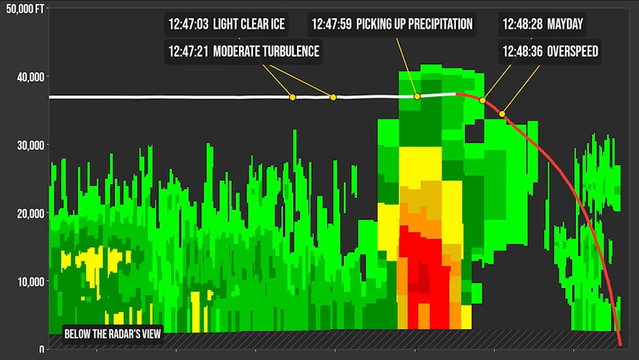
"...If they were experiencing icing on the wings, why would they have ascended? Wouldn’t they have descended because they would’ve hit warmer air which could’ve melted the weight of ice off their wings?" As gundog noted, the OAT was -47°C, -52.6°F. There shouldn't be any liquid water in the air at that temperature, and the only reason there could have been was that the convective cell beneath them was rising so fast that the water it was bringing up from lower altitudes didn't have time to freeze (radar showed the cell was climbing at 1000 fpm).
Descending would have exposed them to even more liquid water and more ice accumulation. Climbing might have got them to an altitude where the liquid water finally had frozen and would no longer add ice to their wings.
Understand too, that flying over a cell with that much power, circumstances change in the blink of an eye. You literally could go from clear wings to significant ice accumulation in a split second.
And they're still trying to turn this into pilot error because they've got "celebrity pilots" who said they'd never do such a thing. In the fullness of time, the FAA might well find the pilots were at fault, but at the present, no one living knows whether the icing was the cause of the structural failure or its result. Until that information becomes public, I think the crew deserves the benefit of the doubt.
It bears mention that the SPECIFIC reason they put anti-icing equipment on airplanes is so they CAN BE flown into known icing conditions. It's done all day, every day. But there are limits to how much ice the equipment on any particular airframe can shed. And it's up to a cooperative effort between the the airplane manufacturer, the pilots, the weather service and the FAA to keep the freight running in crummy weather while minimizing the risk to the flying public.
But the baseless speculation gets these websites lots of clicks, and that's all they're concerned with.
To: flamberge
The key question is "why did they not avoid the storm entirely?". The Learjet has good weather radar and was capable of diverting around the storm.Probably because they wanted to get to the Bahamas as quickly as possible.
The crew had an approved vector from ATC to fly north (or left) and avoid the storm altogether, but it would have added about six minutes of flight time.
The Learjet's radar showed they were flying over the storm (red in graph below), not into the storm, and they thought they were safe.
The lesson here for pilots is not to mess with storms.
To: Right_Wing_Madman
The Learjet's radar showed they were flying over the storm... Pilots tell me there is no safe way to fly over a thunderstorm.
12
posted on
11/06/2026 7:57:16 PM PST
by
flamberge
(It seemed like a good idea at the time.)
13
posted on
11/07/2026 8:05:53 AM PST
by
Phoenix8
Disclaimer:
Opinions posted on Free Republic are those of the individual
posters and do not necessarily represent the opinion of Free Republic or its
management. All materials posted herein are protected by copyright law and the
exemption for fair use of copyrighted works.
FreeRepublic.com is powered by software copyright 2000-2008 John Robinson