Posted on 10/19/2026 10:10:33 AM PDT by Red Badger
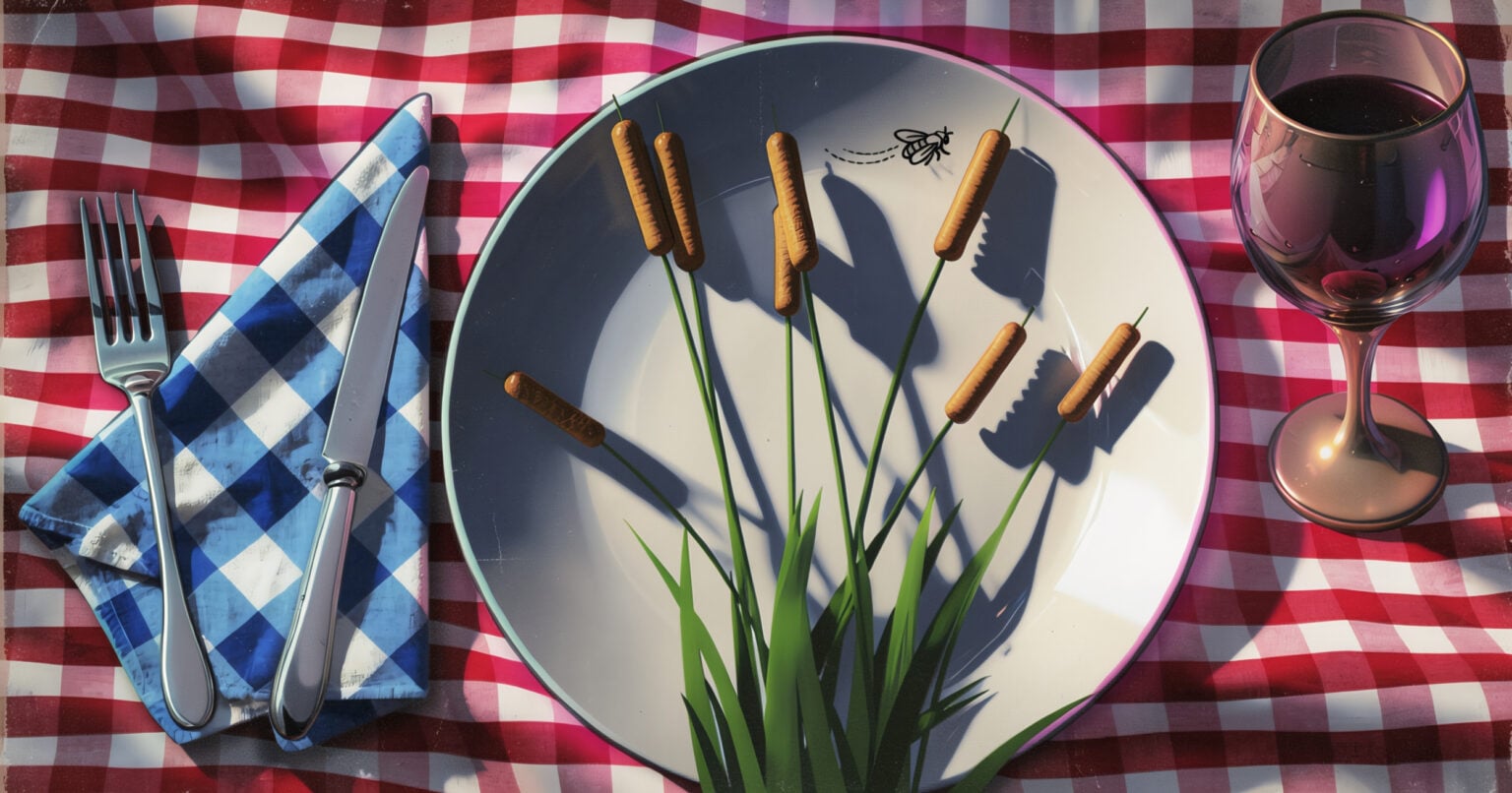
You know those weird brown corndog-lookin’ things growing in ditches, ponds, and marshes all over America? The ones you’ve probably driven past a million times without giving them a second thought?
Those are called cattails, and apparently, we’ve been ignoring one of nature’s most interesting food sources while spending billions of dollars growing, harvesting, and processing the foods we actually eat.
Yes, I went down another rabbit hole, and found something that blew my mind… ready for this one:
An acre of cattails has the potential to produce around 6,400 pounds of flour. By comparison, an acre of American wheat might yield somewhere around 3,000 pounds of grain before milling.
Now, before you start planting a cattail farm, hold on. Those aren’t perfectly equivalent measurements, and the cattail figure comes from estimates of wild plants rather than proven commercial farming. But still, even with that distinction, the possibilities are pretty amazing.
And what’s even better is that cattails grow effortlessly, like weeds on steroids, and, thrive in places where usual crops wouldn’t stand a chance. They also don’t need somebody planting them every spring. And get this, folks… we’ve known they were edible for thousands of years. Yes, our prehistoric ancestors were apparently grinding these things into food long before any of us were wandering around the grocery store with a loaf of Wonder Bread.
So what the heck happened?
How did we end up with an entire agricultural industry dedicated to producing flour from wheat while ignoring a plant that’s frantically waving at us from every damp ditch in America?

Sorry, that GIF might’ve been a tad inappropriate…
But seriously, guys, I’m not suggesting y’all grab a shovel, wade into the nearest swamp, and start digging up dinner. That sounds like a pretty miserable way to spend a Saturday afternoon, and personally, I’d rather just grab a bag of flour at Kroger and call it a day.
But my beef here is why, with all our incredible modern technology and food manufacturing capabilities, we haven’t figured out how to turn cattails into something people can actually buy and eat.
Because the more you learn about these bizarre little swamp plants, the better they sound.
THE GREAT CATTAIL MYSTERY
Like I said earlier, cattails aren’t some undiscovered food source waiting for a brilliant entrepreneur to stumble upon it.
People have been eating cattails for an astonishingly long time, and researchers have even explored their potential as a commercial crop.
But there’s a fascinating reason why wheat became the undisputed king of flour while cattails were left growing in freeway sludge.
This video digs into that history, the surprising amount of food cattails can potentially produce, and the frustrating obstacles that’ve kept them out of America’s grocery stores.
And trust me, there’s a lot more going on beneath those goofy-looking brown stalks than you’d ever imagine.
VIDEO AT LINK...............................
WE WERE EATING THESE THINGS 30,000 YEARS AGO!
Our ancestors figured out the cattail craze before civilization had even gotten around to inventing agriculture.
In 2010, archaeologist Anna Revedin and her team examined ancient grinding stones discovered at Stone Age sites in Italy, Russia, and the Czech Republic. Some were around 30,000 years old, and microscopic starch residues revealed that prehistoric humans had been processing plants, including cattails.
Some guy wearing animal skins was apparently willing to dig around in a freezing swamp to make something resembling flour, and here we are thousands of years later, surrounded by food-processing factories, wondering whether it’s even worth the trouble.
Cattails are still edible, it’s just that we developed an agricultural system that favored foods that were easier to grow, harvest, transport, and process.
Which makes sense from a business standpoint. But I still find it remarkable that something our ancestors considered worth the effort has become little more than an ornamental weed to Americans.
And the really crazy part is that cattails aren’t just good for flour.
You can eat practically the entire damn plant!
THE SWAMP HAS AN ENTIRE GROCERY STORE GROWING IN IT
Before we start dreaming about cattail bakeries popping up across America, we should probably answer a more immediate question.
What the heck do these things actually taste like?
Because if we’re talking about turning cattails into a legitimate food source, they’d better taste like something people would willingly put in their mouths.
Well, the answer depends on which part you’re eating.
Those tender young shoots that pop up in spring apparently have a fresh, mild flavor similar to cucumbers. Cook them, and they take on something closer to cabbage, making them suitable for all sorts of vegetable dishes.
Then there are the immature green flower spikes, which can be steamed or boiled and eaten somewhat like corn on the cob.
And yes, this is the same plant that eventually develops those fluffy brown corndog-lookin’-things.
And if you harvest the flower spikes while they’re still young and green, the flavor is mildly sweet, nutty, and somewhat similar to corn.
Slap a little butter and salt on one, and you’ve basically got a bizarre little swamp cob.
But my favorite discovery is the pollen.
Before those distinctive brown corndog heads develop, the male flowers produce bright yellow pollen that can be collected and used in cooking.
People have mixed it into pancakes and other baked goods, and there’s even a traditional street sweet from southern Iraq called kiriat, made using cattail pollen and sugar.
Imagine explaining that to somebody at a dinner party…”Oh, that delicious little treat you’re eating right now? They’re made from the fuzzy shit growing in the swamp behind the gas station.”
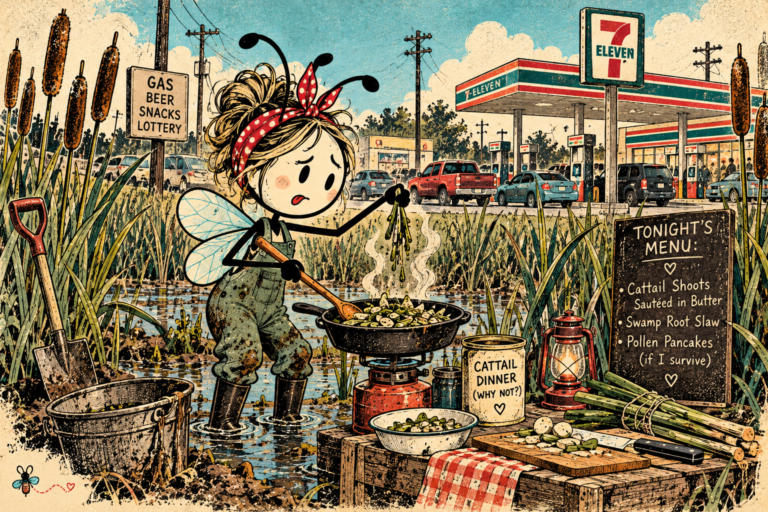
Tonight’s dinner pairs beautifully with unleaded.
And then there’s the underground portion of the plant, which is where the flour potential really heats up.
Cattails spread through thick underground stems called rhizomes. They’re loaded with starch that can be separated from the surrounding fibers and dried into a flour-like ingredient. The tender portions can have a mild, starchy flavor like potatoes, and some of the young rhizome sections have been described as tasting like water chestnuts or cucumbers.
Uh, that doesn’t sound terrible at all.
In fact, back in the early 1900s, a professor named P.W. Clausen experimented with cattail flour, making biscuits that supposedly turned out quite similar to conventional versions. He even tested the starch in puddings with some pretty encouraging results.
So the basic idea of making edible flour from cattails isn’t far-fetched.
People have already done it.
The question is why we’ve never made it practical enough for the average person to enjoy.
SOMEBODY ACTUALLY KNOWS HOW TO COOK THIS STUFF
Now, I know what you’re probably thinking.
This all sounds fascinating, but what does preparing an actual cattail look like?
Well, it turns out there are people who know exactly how to turn these strange swamp plants into legit meals.
This next video features an experienced wild-food cook demonstrating which portions of cattails are edible, how they’re prepared, and some very creative ways to serve them.
There are tender shoots, flower spikes, edible underground stems, and even a sweet treat made from pollen.
And while the food looks interesting, pay special attention to how much work goes into getting those tasty little pieces ready for the kitchen.
Because that brings us to the biggest problem with making cattails a mainstream food…
VIDEO AT LINK.................
WELL, THAT LOOKS LIKE AN ENORMOUS PAIN IN THE A$$
Okay, I have to admit, some of those dishes look pretty darn good.
But seriously, watching somebody actually prepare these things reveals a rather inconvenient detail.
I can absolutely imagine ordering a fancy little cattail salad at some trendy restaurant where the chef charges $28 because the ingredients were personally gathered from a marsh next door to 7-11. Locally “sourced” of course. But the issue is that you can start with this big, beautiful cattail shoot and spend the hour peeling away tough outer layers until you’re left holding a the smallest little edible piece on earth.
And that’s not even considering all the work we’ll be doing to extract starch from those underground rhizomes.
Unlike wheat, which very conveniently produces grain aboveground where harvesting machinery can reach it, cattails hide their starch inside tangled underground stems buried in wet, muddy soil. Getting them out means digging through muck, separating the usable material from the roots and fibers, washing everything thoroughly, and then extracting the starch.
The traditional process involves crushing the cleaned roots in water, separating the starch from all the muck and fiber, and then drying it out. That’s a helluva lotta work for something you can grab in a five-pound bag at the grocery store.
And for an individual person trying to make enough cattail flour to bake bread regularly?
Forget about it.
Unless your lifelong dream is to spend your weekends standing knee-deep in swamp water, wrestling with muddy roots, and making friends with a few leeches, this probably won’t be an attractive alternative to buying Walmart flour.
But here’s where I think the conversation gets more interesting.
We shouldn’t judge the potential of cattails based on how difficult they are for one person to harvest by hand. Nobody expects the average American to grow an acre of wheat, harvest it with a sickle, and grind the grain between two rocks just to make a loaf of bread.
We’ve invented enormous machines to do that work for us.
So why couldn’t we do something similar with cattails?
WHY HASN’T SOMEBODY INVENTED A GIANT CATTAIL-HARVESTING MACHINE?
This is the question I am currently obsessed with.
We’ve developed agricultural machinery capable of harvesting enormous fields of crops with very little human labor.
Our food-processing facilities can separate, wash, grind, filter, dry, package, and distribute ingredients on an industrial scale at warp speed.
And yet, when it comes to cattails, we’re still talking about pulling muddy roots out of a swamp like some prehistoric hunter-gatherer.
What’s going on here, folks?
Well, as the first video explains, the problem is considerably more complicated than simply inventing a machine with a giant shovel attached to it.
Like I mentioned earlier, wheat has this tremendous advantage because thousands of years of cultivation have produced a crop that works beautifully with modern farming equipment. Its grain grows aboveground, can be separated mechanically, and stores remarkably well once it’s dried.
Cattails are a completely different animal.
Harvesting them basically means somehow separating that underground mass of tangled hell from the mud without destroying the equipment or bringing half the swamp into the processing facility.
Even after harvesting, there’s the challenge of extracting usable starch from all that fibrous material.
Researchers in Minnesota explored cattails as a potential energy crop back in the late 1970s, and harvesting those stubborn underground rhizomes was already red flagged as a major obstacle.
And here’s something else worth considering…
Growing enormous quantities of something isn’t particularly useful if harvesting and processing it costs more than the finished product is worth.
Which brings us back to those impressive flour-yield estimates.
The roughly 6,400 pounds per acre figure is intriguing, but it isn’t proof that a commercially operated cattail farm could consistently outperform a modern wheat operation. There’s also that pesky distinction between measuring finished cattail flour and measuring harvested wheat grain.
And some of the more spectacular cattail production claims floating around the internet are considerably more ambitious than the estimates discussed in the video. We’re talking about stories suggesting a single acre could produce more than 30 tons of flour.
Okay, now THAT would get somebody’s attention.
Unfortunately, extraordinary claims about wild plants aren’t the same thing as demonstrating that a commercial farm can actually produce those quantities at a competitive price.
And until somebody figures out the economics, cattails remain an interesting possibility rather than a serious challenger to wheat.
But harvesting isn’t even the strangest obstacle.
THE SAME PLANT THAT COULD FEED YOU MIGHT ALSO POISON YOU
Here’s where our adorable little swamp corndogs take a slightly macabre turn.
Cattails are exceptionally good at absorbing substances from the water and soil around them.
In fact, they’re so good at it that engineers deliberately use them in constructed wetlands designed to help filter contaminated water.
They can take up excess nutrients and heavy metals, including lead, cadmium, and zinc.
Which is wonderful if you’re trying to clean polluted runoff. However, it’s not so wonderful if you’re planning to grind the plant’s underground stems into flour and feed them to your family.
And where do we typically see cattails growing?
Along highways, beside drainage ditches, near farm fields, and around retention ponds collecting runoff from all sorts of places.
Suddenly, those conveniently located cattails don’t look quite so tasty.
The plant’s ability to absorb contaminants creates a serious problem because some of those unwanted substances can accumulate underground, exactly where the valuable starch is located.
So even if you discovered an enormous patch of cattails growing behind your neighborhood Walmart, that doesn’t mean you’ve stumbled upon a free flour factory. You might’ve discovered a very effective natural water-filtration system that nobody in their right mind should be eating.
And for anyone tempted to experiment with wild cattails, there’s another concern.
Young cattail shoots can resemble yellow flag iris, a toxic plant that grows in similar wet conditions. Some people also report becoming really sick after eating raw cattails, which makes proper identification and preparation a must. Please, don’t finish reading this and wander into the nearest drainage ditch with a grocery bag and a burst of culinary inspiration.
But that still leaves us with one important question.
Why couldn’t we grow cattails specifically for food in clean, controlled conditions?
WHAT IF WE STOPPED TREATING CATTAILS LIKE WEEDS?
This is where I think the real opportunity might be hiding.
Instead of harvesting random cattails from questionable roadside ditches, why can’t we cultivate them in wetlands specifically designed for agricultural production?
The water and growing conditions could be monitored, the plants could be managed for food production, and the harvesting process could become the focus of actual agricultural engineering.
After all, we’ve spent centuries improving other crops to make them more productive and easier to harvest.
Cattails never received that same level of attention.
For the most part, they’ve been left to do what they’ve always done, growing wherever conditions happen to suit them.
And they’re really, really good at it.
In fact, some hybrid cattails have become such aggressive growers in parts of North America that wildlife managers are working to control them.
They can spread through wetlands so densely that they crowd out other plants and cut into the diversity of the marsh.
Which creates an almost comical situation.
We’re spending money trying to get rid of a plant that might have considerable potential as a food crop.
This has really got me wondering about whether a carefully managed agricultural version of this plant could eventually become commercially useful.
And maybe the opportunity isn’t even about replacing wheat…
Think about all the specialty ingredients people buy today. Alternative flours, unusual starches, specialty baking ingredients, and foods that would’ve seemed downright bizarre to previous generations have managed to find customers.
Good lord, the gluten-free crowd might have a field day with this stuff. Imagine an entirely new flour alternative that’s naturally gluten-free, grows like a weed, and doesn’t require a farmer to plant it every spring. Somebody get the folks at Whole Foods on the phone!
Why not at least explore the possibility?
Of course, somebody would have to develop an efficient harvesting system, figure out how to process the starch economically, establish consistent food-safety standards, and demonstrate that growing cattails for food could actually make money.
Those are obstacles, and nothing in the research we’ve chatted about proves they can all be overcome. But that’s also a different question from whether cattails are worth eating.
We already know people can eat them.
What we haven’t established is whether modern agriculture could turn that edible plant into a commercially competitive food product.
And personally, I think that’s a much more interesting challenge than teaching somebody how to make three tablespoons of flour after spending six hours in a swamp behind Taco Bell.
MAYBE OUR ANCESTORS WERE ONTO SOMETHING
There’s something wonderfully strange about realizing that a plant we’ve been ignoring for generations was once a perfectly legit food source.
I’m down to see what would happen if somebody approached cattails as a serious agricultural engineering challenge instead of another strange ingredient for wilderness survival enthusiasts.
Because the potential is intriguing.
And who knows? Maybe someday we’ll see a bag of cattail “swamp” flour sitting beside the almond flour and coconut flour at the grocery store.
Although I suspect the marketing department might want to reconsider calling it swamp flour.
It definitely has an impressive history as a food source, several edible parts, and the potential to produce substantial quantities of starch.
The trouble is that nature designed cattails to thrive in swamps, not to cooperate with industrial farming equipment.
And until someone can bridge that gap economically and safely, we’re probably going to keep driving past them on our way to the grocery store.
Still, I can’t help thinking we’re ignoring something that deserves a second chance.
Dear FRiends,
We need your continuing support to keep FR funded. Your donations are our sole source of funding. No sugar daddies, no advertisers, no paid memberships, no commercial sales, no gimmicks, no tax subsidies. No spam, no pop-ups, no ad trackers.
If you enjoy using FR and agree it's a worthwhile endeavor, please consider making a contribution today:
Click here: to donate by Credit Card
Or here: to donate by PayPal
Or by mail to: Free Republic, LLC - PO Box 9771 - Fresno, CA 93794
Thank you very much and God bless you,
Jim
SHTF Ping!..................
Tried them once. They gave me a stomach ache.

You’re supposed to cook them first.............😜
So what’s the glycemic index for cattail flour?
Yeah ... like potatoes. Or rice. Or sorghum. Or tapioca. Or ...
One problem ... good bread CANNOT be made with these materials. They lack gluten; they will not because they cannot develop the chemical structure necessary to make risen bread.
I so remember that!
The answer for Cattails: 800,000 to 1,000,000 gallons of water. Like rice, cattails must be continuously submerged in water, which severely limits where they can be grown.
Wheat: 325,000 to 500,000 gallons per acre, and no requirement to maintain standing water.
GOOGLE AI:
AI Overview
There is no official, lab-tested glycemic index (GI) specifically measured or published for cattail flour.
What We Know About Cattail Nutrition
• Carbohydrate and Starch Content: Cattail rhizome (root) flour and pollen are very high in starchy carbohydrates—generally around 67% to 80% carbohydrates and rich in starch granules.
• Estimated Glycemic Impact: AI and nutritional estimators generally classify cattail shoots and native starchy wild foods as having a medium glycemic index range, though exact values depend heavily on whether you are using root-starch flour, pollen, or whole-plant parts, as well as how it is cooked or processed.
• Fiber Content: Cattail rhizome flour can contain notable dietary fiber (roughly 17g per 100g in some studies on Typha angustifolia), which helps moderate how quickly sugars are absorbed compared to refined white flour, though it remains a starchy carbohydrate source.
No mention on that site for “Gainesville Green”. ;)
IOW ... there are good reasons why we mass-farm certain crops and don’t mass-farm others.
“Cattail flour has a low glycemic index, making it a suitable option for those monitoring their blood sugar levels. However, specific glycemic index values for cattail flour are not widely documented.”
...or Quinoa................
I got tired of reading reading reading waiting for the line that explained how do they taste.
As a yout I would harvest them and let them dry out. If you light the tip it will burn slowly like a cigar which makes them handy for lighting 4th of July fireworks.
“Like rice, cattails must be continuously submerged in water, which severely limits where they can be grown.”
Well, they grow great in brackish (salty) water, as I’ve seen going off shore in Louisiana. In fact, I wouldn’t be surprised if they could be grow in sea water with a little selective breeding.
It’s the kind of thing that could make the coast of the Sinai or whatnot into cultivated land.
People claimed the smoke would keep bugs away but my observation is inconclusive.
Disclaimer: Opinions posted on Free Republic are those of the individual posters and do not necessarily represent the opinion of Free Republic or its management. All materials posted herein are protected by copyright law and the exemption for fair use of copyrighted works.