Free Republic
Browse · Search
General/Chat
Topics · Post Article

Skip to comments.

Grassley Report Concludes Secret Service Failure to Share Threat Information Allowed for Preventable Tragedy in Butler, Identifies Path Forward for Agency Improvements [links to Grassley's GAO report and DHS IG Report, w/ GROK summary of GAO]
Judiciary.senate.gov ^ | September 12, 2026 | US Senate on the Judiciary

Posted on 09/16/2026 2:26:53 PM PDT by ransomnote

07.12.2025

Grassley Report Concludes Secret Service Failure to Share Threat Information Allowed for Preventable Tragedy in Butler, Identifies Path Forward for Agency Improvements

Secret Service received threat intel 10 days before Butler rally; Major gaps in internal policies and procedures contributed to massive security breakdown

BUTLER COUNTY, IOWA – U.S. Sen. Chuck Grassley (R-Iowa), Chairman of the Senate Judiciary Committee, today released a Government Accountability Office (GAO) report compiled at his request in the wake of the attempted assassination of President Donald Trump in Butler, Pennsylvania on July 13, 2024.

The Grassley-requested report states senior-level U.S. Secret Service (USSS) officials received classified intelligence regarding a threat to President Trump’s life ten days before the rally in Butler, but failed to relay the information to federal and local law enforcement personnel responsible for securing and staffing the event.

Per the GAO, “the Secret Service had no process to share classified threat information with partners when the information was not considered an imminent threat to life.” GAO offered eight recommendations to improve USSS functionality; chief among them is a recommendation for USSS to proactively share threat information among USSS personnel and its law enforcement partners.

The report further exposes a litany of USSS procedural and planning errors, including misallocation of resources, lack of training and pervasive communication failures, all of which contributed to an unsecure environment and ultimately allowed for Thomas Matthew Crooks to fire a near-fatal shot at President Trump and take the life of a spectator.

The GAO is the U.S. government’s primary auditor and is a nonpartisan, wholly independent legislative branch agency. GAO’s audit, conducted over the course of nearly a year – from August 2024 to July 2025 – is the longest review of the attempted assassination in Butler that has been completed to date.

Grassley said the following regarding the report’s release:

“One year ago, a series of bad decisions and bureaucratic handicaps led to one of the most shocking moments in political history. The Secret Service’s failure on July 13th was the culmination of years of mismanagement and came after the Biden administration denied requests for enhanced security to protect President Trump. Americans should be grateful that President Trump survived that day and was ultimately reelected to restore common sense to our country.

“Naturally, the American people wanted answers and accountability in the aftermath of this tragedy, and so I worked hard to provide that. The information I’m releasing today is a comprehensive overview of the failures that occurred prior to and on July 13th. More importantly, this report offers a clear path forward for the Secret Service to improve, so it can prevent another Butler from ever happening again. This information would not have been possible without congressional oversight, and my work will continue.

“As Chairman of the Judiciary Committee, which has jurisdictional oversight over the Secret Service, I’m committed to working closely with the agency to ensure they’re properly equipped to repair what’s broken. As an important step, I allocated $1.17 billion in the One Big Beautiful Bill to provide the Secret Service with additional funding. I’m hopeful this significant injection of resources will go a long way in bringing the agency up to speed.”

Grassley is additionally making public a letter from Department of Homeland Security (DHS) Inspector General (IG) Joseph Cuffari to then-DHS Secretary Alejandro Mayorkas discussing credible whistleblower accounts that USSS personnel frequently rely on their personal cell phones for official communication, which creates serious security and legal risks. According to these allegations, USSS in 2021 instituted “functional limitations on government phones” that prevent USSS personnel from participating in groups texts or sending or receiving photos via text.

Read the DHS IG letter HERE.
Read the GAO report HERE.

KEY FINDINGS OF THE GAO REPORT

Threat Information Sharing 
On July 3, 2024, one day after the USSS Pittsburgh field office was notified of the scheduled Butler rally, high-level USSS officials were briefed on a classified threat to President Trump. Per GAO, “once those officials reviewed the intelligence, they could have then requested that personnel within their chain of command be briefed on the specific information.” USSS had multiple opportunities to share this information over the course of the following ten days, but repeatedly failed to do so.

As a result of USSS’s siloed information-sharing, federal and local law enforcement entities planning and staffing the event were unaware of the active threat, including members of the Donald Trump Protective Division. Local law enforcement interviewed by GAO attested that, if they had received threat information, they “would have requested additional assets” for the Butler rally.

Timeline of when Secret Service Personnel Obtained but did not Appropriately Share Threat Information
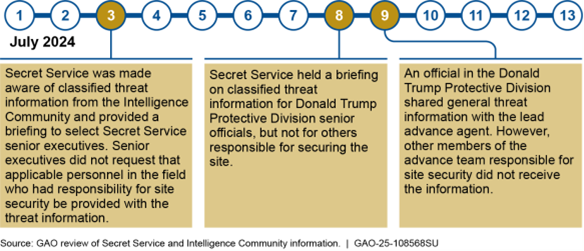
GAO USSS Timeline

Roles and Responsibilities
The USSS’s Office of Protective Operations (OPO), which is responsible for issuing documents outlining USSS personnel’s respective roles, prescribed overly-broad policies that failed to clearly communicate USSS personnel’s responsibilities. As a result, five of the 14 USSS agents GAO interviewed, who “performed key roles on July 13th,” stated they relied on their own varying-levels of protective experience in executing this event.  

At the time of the Butler rally, OPO did not require the USSS advance team to review local law enforcement partners’ operational plans or participate in USSS’s central command center at the event.

Further, the assigned site agent on July 13th, who was responsible for “identif[ying] site vulnerabilities,” was new to her role. The Butler event was “her first time planning and securing a large outdoor event as the site agent.”

On-Site Decision-Making
At the time of the Butler event, USSS also lacked a formal policy for communicating protectee staff’s requested changes to on-site security plans.

Ahead of July 13th, a Trump campaign staffer asked the USSS advance team, who was unaware of the active threat to Trump, “not to use large farm equipment to address line-of-sight concerns near one of the buildings – the AGR building” so as not to interfere with campaign press photos. In response to the request and without consulting senior-level USSS officials who could have changed the decision, the USSS advance team independently made the decision to use a “jumbotron and a large flag to address the line-of-sight vulnerability,” rather than the large farm equipment.

Per the GAO, “not using the farm equipment possibly created an opportunity for the gunman to use the AGR’s elevated rooftop to fire several shots at then former President Trump and kill and injure other rally participants.”

Assets
The USSS’s “War Room” is responsible for allocating resources for protectees and protectees’ events. The War Room makes these decisions “primarily based on availability and efficiency assessments” without knowledge or input of current risk assessments.

Due to limited resources, the War Room denied the Donald Trump Protective Division’s request for enhanced counter Unmanned Aerial Surveillance (cUAS) equipment at the Butler event, as “these resources had already been allocated for the Republican and Democratic National Conventions.”

However, senior OPO officials with knowledge of the threat against Trump stepped in to approve counter sniper assets for the Butler rally, a decision which was described as “inconsistent with and separate from War Room practices for making resource decisions.” Per GAO, “[a]bsent OPO senior executives’” action, President Trump “would likely not have received the counter sniper assets that ultimately took out [Crooks].”

Technology
The USSS’s limited cUAS technology used on July 13th malfunctioned, and while repairs were being made, Crooks flew a drone – undetected – over over the event site hours before the rally. The USSS agent assigned to operate the cUAS was severely inexperienced; this agent reported receiving just one hour of training on cUAS capabilities and noted, “in retrospect, [he] did not have enough training to confidently operate the equipment.”

Additionally, many USSS agents and local law enforcement who relied on cell phones to communicate the day of the event encountered limited service, hampering their ability to share information in real-time. Despite knowing the event would garner significant attendance, the USSS had no policy in place to proactively troubleshoot “potential audio and data communication challenges.” The agency has yet to require agents to perform such an assessment.

Background: 
Grassley’s oversight provided the “most detailed picture” of USSS security failures in the immediate aftermath of the Butler assassination attempt. Grassley contacted the USSS, DHS, DHS IG, Department of Justice and Federal Bureau of Investigation within days of the rally to begin investigating. He was the first to release bodycam footage and text messages from local law enforcement who responded to Crooks at the event.

As Chairman of the Judiciary Committee this Congress, Grassley allocated $1.17 billion in funding for USSS as part of the One Big Beautiful Bill Act (Sec. 100057).


TOPICS: Miscellaneous
KEYWORDS: 2021; 202407; 20240702; 20240703; 20240713; 202408; 202507; butler; campaignstaffer; communications; crooks; cuas; cybersecurity; dncconvention; dollypartoneatskids; drone; farmequipment; fthonascrooks; hacking; inexperience; lineofsight; mayorcas; opo; pennsylvania; personalphones; phonerecords; rncconvention; secretservice; secretservicephones; thewarroom; usss; usssopo; ussswarroom; warroom
Message from Jim Robinson:

Dear FRiends,

We need your continuing support to keep FR funded. Your donations are our sole source of funding. No sugar daddies, no advertisers, no paid memberships, no commercial sales, no gimmicks, no tax subsidies. No spam, no pop-ups, no ad trackers.

If you enjoy using FR and agree it's a worthwhile endeavor, please consider making a contribution today:

Click here: to donate by Credit Card

Or here: to donate by PayPal

Or by mail to: Free Republic, LLC - PO Box 9771 - Fresno, CA 93794

Thank you very much and God bless you,

Jim

GROK SUmmary of Grassley's GOA report:

**Summary of the GAO report released by Sen. Chuck Grassley on the U.S. Secret Service (USSS) failures related to the July 13, 2024, Butler, Pennsylvania, assassination attempt on then-candidate Donald Trump:**

The nonpartisan Government Accountability Office (GAO) conducted a nearly year-long review (August 2024–July 2025) at Grassley’s request. It concluded that USSS “failed to implement security measures that could have prevented” the attack by Thomas Matthew Crooks, which wounded Trump, killed one spectator (Corey Comperatore), and injured others. The failures stemmed from siloed information-sharing, unclear policies, planning/communication breakdowns, resource issues, and training gaps.

**Core finding on threat information:**
On July 3, 2024 (one day after the Pittsburgh field office learned of the Butler rally and 10 days before the event), senior USSS officials received classified intelligence about a threat to Trump’s life. The threat was not specific to the Butler rally or to Crooks and was not classified as an “imminent threat to life.” USSS had no process to share such classified information with partners or broadly within the agency. As a result, the Trump Protective Division, advance team, and local law enforcement (who planned and staffed the site) remained unaware. Local officials told GAO they would have requested additional assets (e.g., more ballistic protection, drone mitigation, fuller counter-sniper coverage) if informed. Multiple opportunities to share the information over the following days were missed due to siloed practices.

**Other major procedural and operational failures identified:**
- **Roles and responsibilities** — Office of Protective Operations policies were overly broad. Five of 14 key agents interviewed relied on personal experience rather than clear guidance. The advance team was not required to review local law enforcement operational plans or fully participate in the central command center. The site agent (responsible for identifying vulnerabilities) was new to the role and it was her first large outdoor event in that capacity.
- **On-site decision-making** — No formal policy existed for handling protectee staff requests for security changes. A Trump campaign request not to use large farm equipment (to avoid interfering with press photos) for line-of-sight issues near the AGR building led the advance team (unaware of the threat) to independently substitute a jumbotron and large flag. GAO noted this “possibly created an opportunity” for the gunman to use the elevated AGR rooftop.
- **Resource allocation** — The “War Room” allocated assets primarily based on availability/efficiency rather than current risk assessments. It denied enhanced counter-unmanned aerial systems (cUAS) for Butler because resources were prioritized for the national conventions. Senior officials (aware of the threat) separately approved counter-sniper assets, which ultimately neutralized Crooks; without that intervention, those assets likely would not have been present.
- **Technology and training** — The limited cUAS system malfunctioned; while it was being repaired, Crooks flew a drone undetected over the site hours earlier. The assigned operator had only about one hour of training and later said he lacked confidence in operating the equipment.
- **Communications** — Many agents and local partners relied on cell phones amid poor service, limiting real-time information sharing. USSS had no policy requiring proactive assessment of potential audio/data challenges for large/complex events. (A related DHS Inspector General letter, also released by Grassley, noted whistleblower concerns about over-reliance on personal cell phones due to limitations on government devices.)

**Recommendations and context:**
GAO issued eight recommendations focused on proactive internal and external threat-information sharing, clearer role-specific guidance for agents, better integration of risk into resource decisions, improved training (especially for technology), formal processes for on-site security changes, and pre-event communication capability assessments. Grassley emphasized that the failures reflected longer-term mismanagement and highlighted his allocation of $1.17 billion in additional USSS funding. He framed the report as providing both accountability for the preventable security breakdown and a path for agency improvements.

The full GAO report (referenced as involving sensitive/classified elements) expands on these points with timelines, interviews, and detailed analysis of policies and decisions. Secondary coverage aligns closely with the Grassley press release’s key findings.


1 posted on 09/16/2026 2:26:53 PM PDT by ransomnote
[ Post Reply | Private Reply | View Replies]

To: ransomnote

If still bothers me that Curran was one of the SS top dogs that day. Now he’s THE Top Dog. It makes no sense.


2 posted on 09/16/2026 2:30:57 PM PDT by MayflowerMadam (In the end, we will remember not the words of our enemies, but the silence of our friends.)
[ Post Reply | Private Reply | To 1 | View Replies]

To: ransomnote

The CIA gives the Secret Service an A- for their work that day.


3 posted on 09/16/2026 2:44:22 PM PDT by Arkady
[ Post Reply | Private Reply | To 1 | View Replies]

To: MayflowerMadam

i still don’t think any of this was accidental incompetence; at BEST it was deliberate incompetence by deliberately assigning a gaggle of incompetent, inexperienced, DEI agents, with the hope that something bad would happen, perhaps even KNOWING something bad was likely to happened based on advanced intel held only by deep state operatives ...


4 posted on 09/16/2026 2:56:55 PM PDT by catnipman ((A Vote For The Lesser Of Two Evils Still Counts As A Vote For Evil))
[ Post Reply | Private Reply | To 2 | View Replies]

To: catnipman

100%
100%


5 posted on 09/16/2026 3:27:17 PM PDT by MayflowerMadam (In the end, we will remember not the words of our enemies, but the silence of our friends.)
[ Post Reply | Private Reply | To 4 | View Replies]

To: MayflowerMadam
General George S. Patton's opinion of The Secret Service: “Cheap detectives smelling of booze!''. Yalta Conference, February, 1943.
6 posted on 09/16/2026 3:31:41 PM PDT by jmacusa ( Liberals. Too stupid to be idiots.)
[ Post Reply | Private Reply | To 2 | View Replies]

2021 : ( ) A whistleblower credibly alleges that in 2021, the Secret Service imposed functional limitations on government phones issued to Secret Service personnel that eliminated the ability of a user to:
(i) Initiate or participate in a group text limited to users of Secret Service
phones; and
(ii) send or receive a photo attached to a text message.

The whistleblower further alleges that in most instances the only way to communicate with foreign law enforcement partners when working on protective missions overseas is to use a messaging application such as [redacted] which cannot be installed on a Secret Service phone.3 [3 A user of a Secret Service-issued phone lacks the capability to download an application from a public site. Instead, according to the whistleblower, the only applications that can be installed on a Secret Service phone are found in a
“library” of approved applications made available by the Secret Service, and the library does not include {redacted}.]

The whistleblower alleges that as a result of these functional limitations and prohibitions, Secret Service personnel on protective missions routinely resort to using their personal cell phones to communicate with other Secret Service personnel, as well as with law enforcement partners, during protective missions.

In addition, the whistleblower alleges that Secret Service personnel sometimes incur charges on their monthly personal cell phone bills amounting to several hundred dollars or more resulting from using their personal cell phones overseas, and that such charges are not always reimbursed by the Secret Service.


7 posted on 09/16/2026 8:39:40 PM PDT by piasa (Attitude adjustments offered here free of charge)
[ Post Reply | Private Reply | To 1 | View Replies]

To: catnipman

There does seem to be a total disregard in 2021 for the whistleblower’s complaint about the phones provided being so inadequate that agents were having to rely on personal phones which left many avenues for breaches in security. And it wasn’t just one person complaining to the leadership and being ignored.


8 posted on 09/16/2026 9:19:12 PM PDT by piasa (Attitude adjustments offered here free of charge)
[ Post Reply | Private Reply | To 4 | View Replies]

To: catnipman

There does seem to be a total disregard in 2021 for the whistleblower’s complaint about the phones provided being so inadequate that agents were having to rely on personal phones which left many avenues for breaches in security. And it wasn’t just one person complaining to the leadership and being ignored.

Why ignore it instead of addressing it - unless someone at the top was profiting from the accessibility of information about agents and their activities and locations that could be gathered from breached phones and preferred things that way.


9 posted on 09/16/2026 9:23:24 PM PDT by piasa (Attitude adjustments offered here free of charge)
[ Post Reply | Private Reply | To 4 | View Replies]

To: ransomnote

“Secret Service Failure to Share”

Intentional. The Secret Service cleared a path for the FBI’s stooge. Nothing since that day has changed my mind.


10 posted on 09/17/2026 1:17:40 AM PDT by ArcadeQuarters (You can't remove RINOs by voting for them!)
[ Post Reply | Private Reply | To 1 | View Replies]

To: catnipman

There is no level of incompetence that explains the Butler shooting. From letting him get on the roof with a rifle, to the snipers allowing him (in full view on the roof) to get shots off before killing him.


11 posted on 09/17/2026 3:22:37 AM PDT by Brooklyn Attitude (The DemocRATic party is a treasonous America hating cult.)
[ Post Reply | Private Reply | To 4 | View Replies]

Disclaimer: Opinions posted on Free Republic are those of the individual posters and do not necessarily represent the opinion of Free Republic or its management. All materials posted herein are protected by copyright law and the exemption for fair use of copyrighted works.

Free Republic
Browse · Search
General/Chat
Topics · Post Article

FreeRepublic, LLC, PO BOX 9771, FRESNO, CA 93794
FreeRepublic.com is powered by software copyright 2000-2008 John Robinson