Posted on 08/10/2026 6:20:35 PM PDT by Red Badger
2026's El Niño is on course to be the most severe on record, even hotter than the 1997/98 event that caused trillions in damage and thousands of deaths.
An El Niño event like nothing we’ve ever seen before is cooking in the Pacific. Its mounting strength is so unprecedented that climate scientists aren't even sure what impact it will have when it hits full tilt, but they say this “uncharted territory” should be a cause for concern.
What is El Niño? And why is 2026 so weird?
El Niño is a climate phenomenon characterized by warmer ocean temperatures across the central and eastern tropical Pacific Ocean, triggering a domino effect that has a broad influence on the weather across the world.
It's part of a cycle that wavers through three distinct phases every few years: El Niño (the warm phase), La Niña (the cool phase), and ENSO-Neutral.
Scientists officially declare the emergence of El Niño when sea surface temperatures in this part of the Pacific rise to at least 0.5°C above the long-term average. The US National Oceanic and Atmospheric Administration (NOAA) announced we had passed this threshold back in early June, just as models predicted.
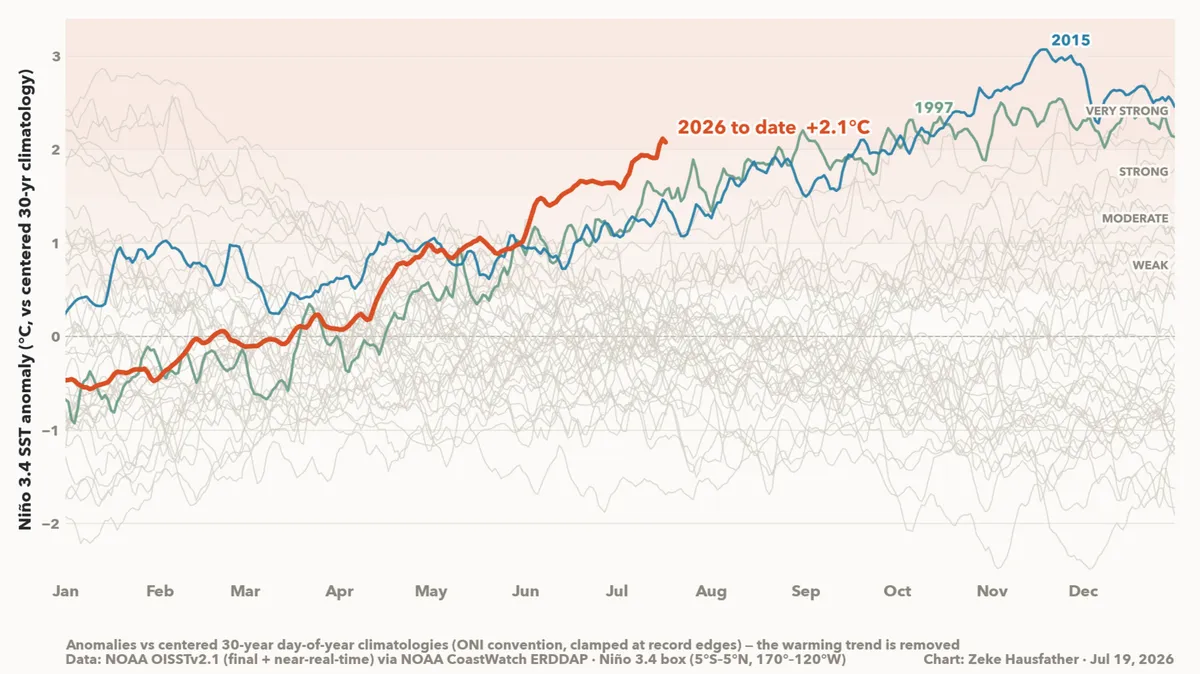
However, this El Niño has continued to muster strength at a remarkable pace despite still being relatively young. In the first week of August, temperatures in the eastern Pacific were 2.6°C above normal.
If temperatures continue to rise on this trajectory, we're in for one of the hottest El Niño phases on record.
“To put it in perspective, anything above 2°C is considered a 'super El Niño.' So we're already, at least for daily temperatures, well within a very strong or ‘super El Niño’ territory,” Zeke Hausfather, a climate scientist at Berkeley Earth, told IFLScience.
“It’s nuts how quickly the event is developing and how strong it is to date,” he added.
Satellite-derived daily temperature changes in the Central Pacific Niño 3.4 region, showing how powerful 2026 is compared with other "very strong" ones in 1997 and 2015. Image courtesy of Zeke Hausfather / Berkeley Earth
The best comparison we have is the record-breaking El Niño of 1997/98, the strongest event in recent memory, which cost the global economy trillions and killed thousands. However, as the graph above shows, this year's El Niño is currently charging ahead even of that year's trajectory.
“We haven't had El Niño anywhere near as strong as this before at this time of year. We're in uncharted territory as far as that goes,” explained Hausfather.
Will the skyrocketing temperature line taper off early in a slightly different trajectory from previous years? It's a possibility, but most models suggest the current El Niño will go on to become the strongest on record, peaking late in 2026.
The global impact
All of this is set to have a profound impact on climate and weather across the globe. The most significant effect of El Niño is an increase in global temperatures, leading to more frequent heatwaves, disrupted rainfall patterns, and an elevated risk of drought in some regions alongside severe flooding in others.
However, the phenomenon affects different parts of the world in many other, subtler ways. In the US, El Niño typically pushes the jet stream south, bringing wetter conditions to the Gulf Coast and Southern California, milder and drier winters to the Pacific Northwest and northern states, and reduced Atlantic hurricane activity due to increased wind shear.
Elsewhere in the world, these changes can be more severe.
“In the tropical Pacific, we tend to get drier conditions. Indonesia, Southeast Asia, Eastern Australia, Southern Africa, the Northern Amazon, and India tend to be drier and have a weaker monsoon. Those are probably, of all the effects of El Niño, the ones I'd be most concerned about because they have a big impact on agricultural yields,” noted Hausfather.
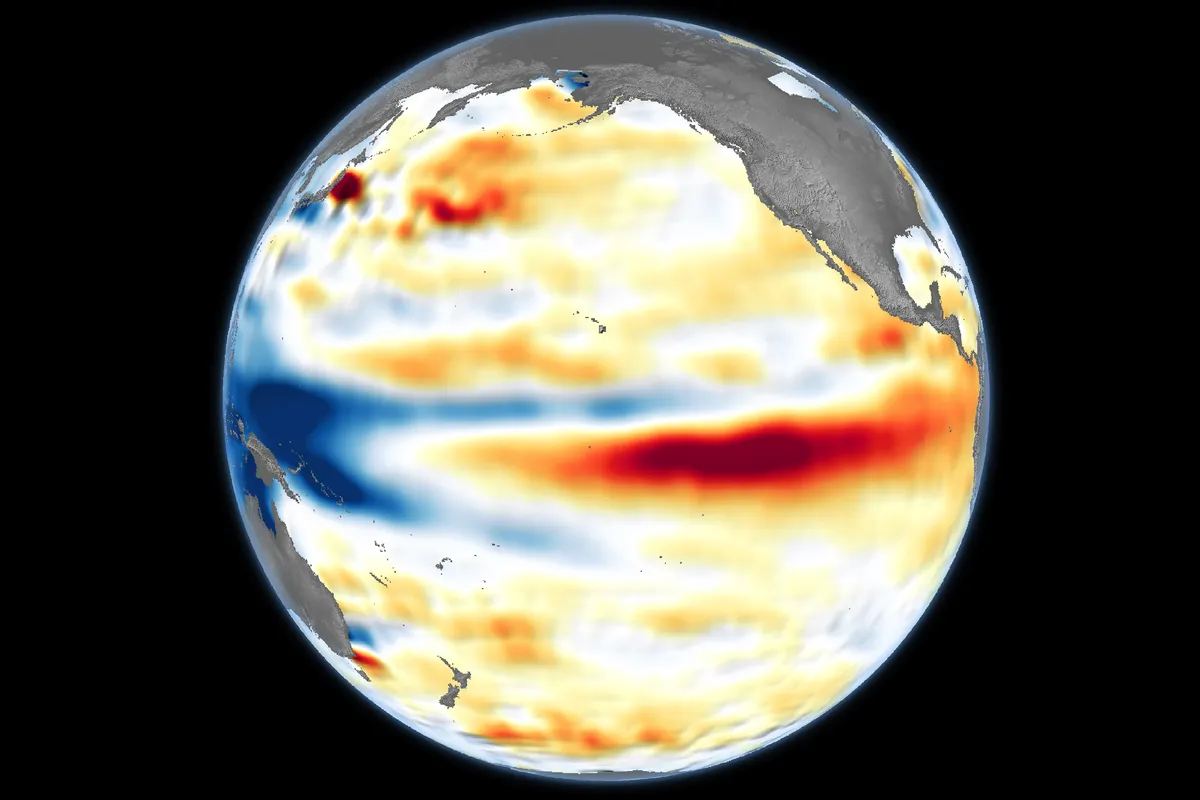 El Niño is characterized by warmer ocean temperatures across the central and eastern tropical Pacific Ocean. Image credit: NASA Earth Observatory image by Lauren Dauphin, using modified Copernicus Sentinel data (2023) processed by the European Space Agency and further processed by Josh Willis, Severin Fournier, and Kevin Marlis/NASA/JPL-Caltech
These impacts were made starkly clear in the 1997/1998 El Niño event, where thousands of people died across the world from flooding, drought, famine, fires, extreme heat, and disease outbreaks.
It's also likely to spark record-breaking coral bleaching around the world, dealing a devastating blow to the planet's already struggling reefs.
The first globally synchronous coral bleaching event occurred in 1998, coinciding with the strong El Niño. Since then, nearly every strong El Niño event has triggered a new wave of global coral bleaching.
Known unknowns
There’s no telling yet whether 2026 will be anywhere near as catastrophic as 1997/1998, partially because scientists have little idea of how the rest of the story might pan out.
“I don't want to be overly alarmist about it, but I think we should be preparing right now for something that we have never seen before,” said Hausfather.
“I hope countries, particularly in the tropics, are already starting to prepare for reduced harvests and the impacts that'll bring. I don't think we can be complacent, particularly because this event is so far outside of anything we've experienced before,” he added.
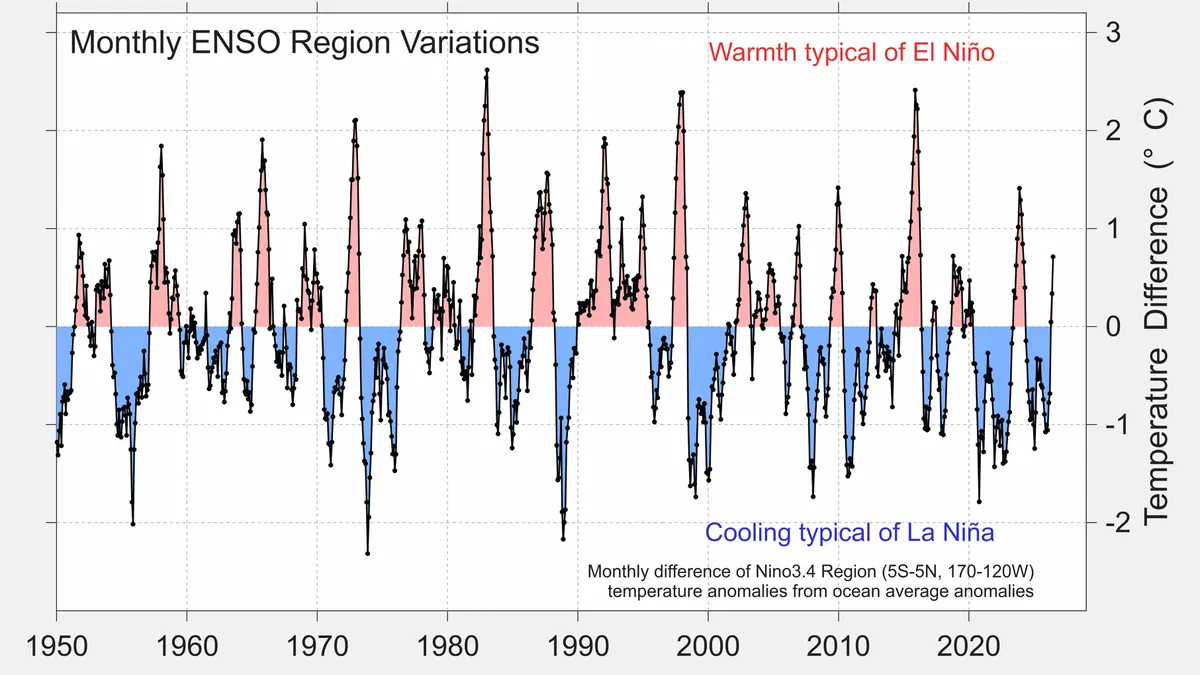
Monthly temperature differences in the Niño 3.4 region from 1950 to 2026. Image courtesy of Zeke Hausfather / Berkeley Earth
Another reason it's difficult to draw direct comparisons with El Niño of 1997/1998 is that Earth was a very different place just 28 years ago. In 2026, the planet is considerably warmer than it was in previous decades as a result of climate change, adding an additional sting to El Niño phases.
“1998 was a record-shattering year at the time for temperatures. If it occurred today, it would be exceptionally cold. That puts in perspective how much human contribution has changed things in addition to things like El Niño,” continued Hausfather.
“The last time we had a year as cold as 1998 was 2011. Every year since 2011 has been hotter than 1998,” he added.
This rapidly changing baseline is precisely what fuels the misconception that any extreme weather can be shooed away as "just El Niño" and swept under the rug. Hausfather pushes back firmly against that framing and, instead, believes that these events only further highlight the perils of climate change.
“There's a certain class of very online climate sceptics who are like ‘oh, it's all El Niño, you're just blowing natural variability out of proportion.’ But no, El Niño just gives us a sneak peek at what the new normal is going to be a decade from now,” he warned.
Dear FRiends,
We need your continuing support to keep FR funded. Your donations are our sole source of funding. No sugar daddies, no advertisers, no paid memberships, no commercial sales, no gimmicks, no tax subsidies. No spam, no pop-ups, no ad trackers.
If you enjoy using FR and agree it's a worthwhile endeavor, please consider making a contribution today:
Click here: to donate by Credit Card
Or here: to donate by PayPal
Or by mail to: Free Republic, LLC - PO Box 9771 - Fresno, CA 93794
Thank you very much and God bless you,
Jim
Do you know “El Nino” means in Spanish?
He caught Oprah? What did he use for bait? A pack of Dunkin Donuts?.................oh, wait a sec..................
Super-duper El Niño
We are cooked
The current Gulf of America water temperature in Destin is 84.9°F (29.4°C). This reading is slightly below the late July average of 84.8°F but remains comfortably warm for swimming. The water is expected to rise to 85.5°F over the next 10 days.
Sharknado!
I just about two weeks Hoover Dam will be shut down to the low head pressure turbines. There are 5, but one is down for repairs.
Thats a power loss of about 80%
The guys tell me Glen Canyon has shut down 2 or three of its turbines.
And just now the news is starting to break about this. It will effect around 40 million people.
This will also draw power from outside the region to fill the void.
Last i looked. The level was at 1040.15. At about 1038 cavitation starts. At that time, they will shut down 12 turbines. The official low power pool is 1035. But with over 100 feet of silt behind that dam the low pressure level should be higher.
Every single one of those turbines have cavitation damage and need attention. If left to run while cavitating those things will self destruct..
Expect blackouts in the evening hours soon..
You and all here would enjoy the Saturday Summary done every Saturday after 3 pm EST- a free to watch video on the Weatherbell.com site. Have heard Meteorologist Scientist Joe Bastardi for many years. Weatherbell.com
He explains El Nino /La Nina etc in direct easy to unde rstand manner. He is no climate change globull warming— finds these people to be hard headed and very un-informed of basic weather facts. He has predicted correctly the many past hurricane seasons and uses the historical record and tracks of past hurricanes within his forecast. Weather Bell is a commercial weather forecasting service for industry (oil and gas, trucking,tourism etc— many clients.
Learning about Madden-Julian oscillation of the Arctic pole and storm forecasting, Pacific and Atlantic ridge ocean temp oscillation and many other tools of the real experts (ie. not tv personalities/political agenda types) is refreshing. Have to pay attention to the details. Old school scientific.
Most recent was last Saturday, two days ago.
Only 4.47 years left.
Us Idahoans would be happy to give you some of our summer.
Notice they started to name tropical storms that aren’t hurricanes and now refer to the number of named storms. Little counting trick.
Pretty mild summer.

“Blackouts”
The region used to have strong coal power. I’ll bet it wishes it had not made stupid decisions:
Navajo Generating Station, near Page, Arizona, 2,250 MW. Shut down permanently in November 2019; the smokestacks were demolished in 2020. It was one of the largest coal plants in the West.
San Juan Generating Station, Farmington, New Mexico. Originally four units built in the 1970s totaling around 1,600–1,800 MW combined. Two units were retired in 2017, leaving roughly 847 MW of capacity from the remaining two units, which then shut down in 2022 (enough at that point to power around 150,000 homes).
Coronado Generating Station near St. Johns, Arizona, in Apache County in eastern Arizona (790 MW). It’s still burning coal today, but Salt River Project got approval in March 2026 to convert it to natural gas. The switch expected to be finished by 2030.
Four Corners Power Plant, near Fruitland, New Mexico is the only coal plant still running. It currently runs two units (4 and 5), each 770 MW, for a combined 1,540 MW. It originally had five units totaling about 2,040 MW, but units 1–3 were retired in 2013. The remaining units retirement was planned for 2031, but Arizona Public Service pushed that back to no later than 2038. There’s active discussion about carbon capture or a switch to natural gas to keep it going even longer. Talks are in progress with the Navajo Nation to potentially take it over.
Gee.
Looks cyclical.
Go figure.
/s
Key words:”strongest event in recent memory”
Their “recent memory” conveniently doesn’t go back very far in time.
It means hot, boiling water out in the equatorial Pacific.
The Cholla plant at Joseph City is also down.
The muzzies will get us before climate change does.
I just want to know if it is safe to eat eggs.
Disclaimer: Opinions posted on Free Republic are those of the individual posters and do not necessarily represent the opinion of Free Republic or its management. All materials posted herein are protected by copyright law and the exemption for fair use of copyrighted works.