Posted on 06/29/2026 5:57:24 AM PDT by MtnClimber
Among our “climate leader” jurisdictions, Britain is a serious contender for the top spot. Sure Germany got started earlier than Britain, with the so-called “Energiewende” going back to the 1990s; and upstart American states like California and New York each think that their own hair shirt energy restrictions should qualify them for the number one position.
But Britain’s suite of policies in the aggregate is hard to top: mandatory Net Zero goals set by statute; madcap buildout of wind and solar electricity generation; shuttering of generation from coal and natural gas; refusal to permit drilling in the North Sea; complete ban on fracking. The Energy Minister of the current Labour government — Ed Milliband — is as crazed a climate zealot as you can find anywhere. The British have even dynamited coal-fired power stations to be sure that nobody could ever change their minds about this Net Zero thing and try to re-start the plants.
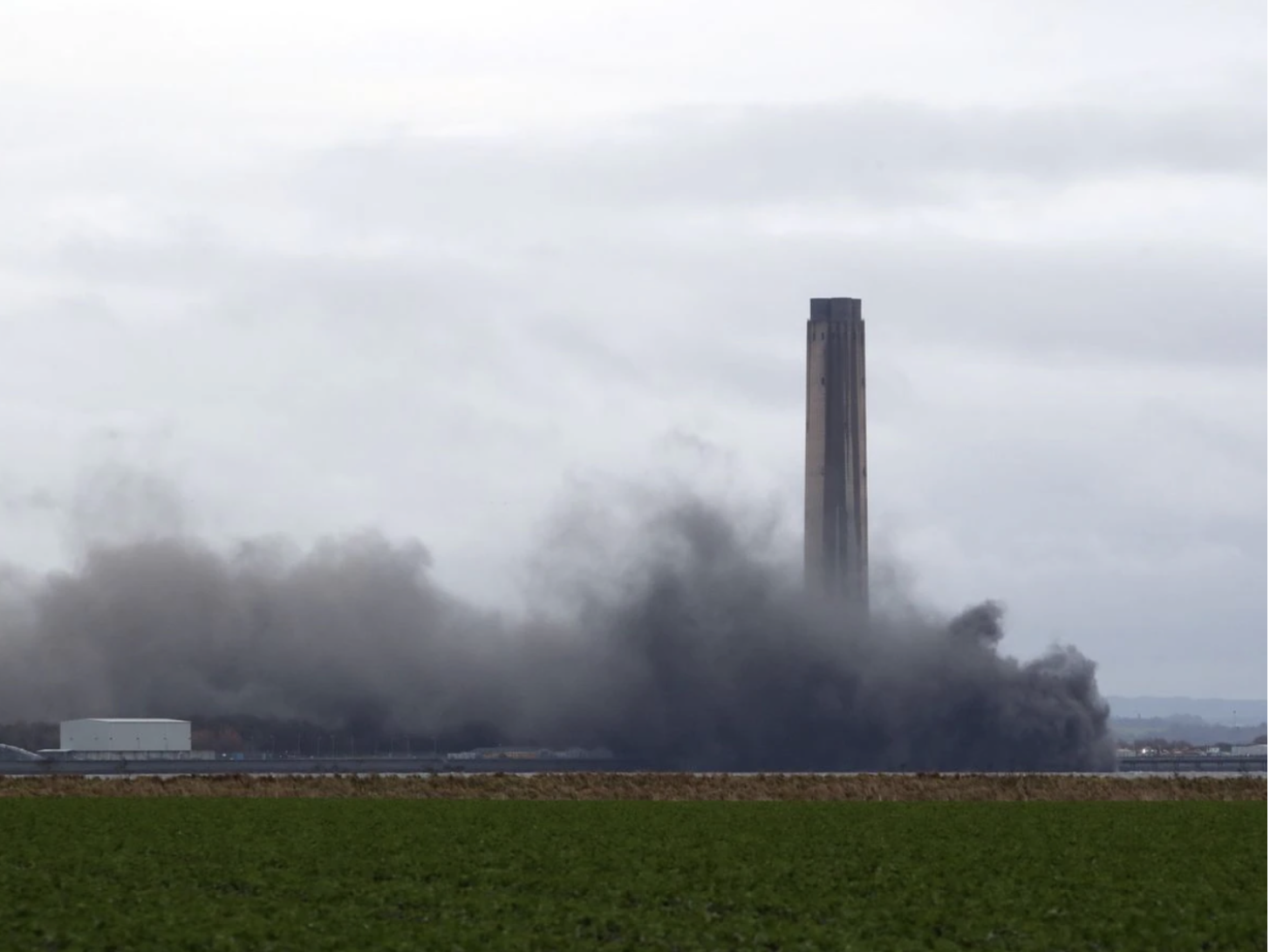
Here from a post I did back in 2022, is a picture of the former Longannet coal plant in Fife, Scotland, getting dynamited to smithereens in 2021.
The last coal-fired electricity generation station in the UK closed in 2024. Today, the UK claims to get about 45-47% of its electricity from “renewables,” although that includes about 5-7% “biomass,” plus a small amount of hydro. The wind/solar contribution is around 35-40%. Milliband thinks he can further increase that percentage by just building more and more wind turbines and solar farms.
But unfortunately for the British, their wind and solar generation facilities seem to be subject to all going quiet at the same time, often inconveniently at the very hottest or coldest times of the year. Building more and yet more of them does not solve the problem. Some call this Britain’s “looming firm generation capacity crisis.”
So what’s the answer? How about doing the unthinkable — bring back coal!
On June 9, Andrew Montford, Director of Net Zero Watch, addressed this issue with his new Report “Thinking the Unthinkable: Coal Power and National Security.” (Full disclosure: I serve on the Board of the American affiliate of Net Zero Watch.). Here is the basic assumption underlying Andrew’s paper:
[T]he deteriorating state of the UK economy – unsustainably high electricity prices, low growth, deindustrialisation and a declining tax base – means that Net Zero and, along with it, carbon pricing, will be abandoned, no matter which party is in power.
I think that is clearly right. Reality has caught up with them. It is only a question of time until they are forced to abandon the Net Zero fantasy.
Andrew’s Report also focuses on the national security implications of unreliable electricity, with its inherent need for insecure backup from imports:
[I]mports and offshore production are both vulnerable to the actions of hostile powers, as the sabotage of the Nordstream pipeline in 2022 made clear. In this regard, the UK is horribly exposed. Nearly half of our gas supply comes from Norway. Sabotage of the Langeled pipeline, which alone brings around 20%, would be catastrophic for the UK, and would quickly lead to a civil emergency.
Is it even possible to raise the subject of coal power generation today in the UK, where that fuel has been subject to a decades-long campaign of vilification? Montford:
While such a step [i.e., reviving coal generation] was unthinkable just 12 months ago, the political landscape is moving quickly. Polling by More in Common has found that that ever-rising energy bills are causing political volatility and fragmentation. Italy and Germany have both recently announced the extension of the lives of their coal-fired power stations. As a result, new voices are being listened to. As a hint of just how far the Overton window has already moved, the Reform party’s manifesto for the Scottish elections featured a pledge to allow coal mining once again. It clear that the looming geopolitical threats to the country now mean that the time is ripe to reconsider the consensus against coal that has taken hold in the last two decades.
So all that is needed is a sufficiently imminent crisis to force the issue of coal generation back into the public conversation. The two short weeks since issuance of Andrew’s Report have brought to Britain some indicators of the dire corner it has backed itself into. Readers here probably know about the recent record-setting heat wave that has covered much of Europe, including Britain. Paul Homewood, of the Not a Lot of People Know That website, has a post on June 25, titled “No Wind? No Sun? What Could Possibly Go Wrong?” Homewood’s post includes extensive excerpts from a piece in the Telegraph from June 24 (behind paywall). The gist is that on June 23 the UK’s National Energy System Operator (NESO) had issued an emergency power supply warning, which was then withdrawn after NESO secured emergency supplies from the continent. However, obtaining the emergency imported supplies required getting a special waiver of EU export restrictions. From the Telegraph piece:
The National Energy System Operator (Neso), which manages the grid, issued a rare emergency power supply warning on Tuesday after soaring temperatures triggered a slump in solar energy, with panels struggling to work in the hot conditions. It was subsequently withdrawn after Neso secured emergency supplies from the Continent on Wednesday. Kathryn Porter, an industry consultant, said Neso had “begged the EU” to lift import trading limits which would have capped the amount of energy Britain could import. Ms Porter said the sudden easing of restrictions had allowed the UK to obtain 2.3 gigawatts (GW) of imports versus a 1.5 GW limit introduced in May, helping Britain avoid power shortages.
OK, crisis averted, for now. But Homewood reports on a few other aspects of this solution to Britain’s crunch. First, they had to buy the power from the Netherlands on a day-ahead market that was already at a high level due to the heat wave and lack of dispatchable capacity. Homewood links a Tweet from a firm called Montel Analytics as to the price: “[T]hey are paying up to €1600 per MWh for it.” €1600/MWh is equivalent to more than $2000/MWh, or more than $2.00/kWh. That will translate to a retail price of around $2.50/kWh, compared to average U.S. retail electricity prices of under $0.20/kWh.
Oh, and almost all of the imported power was generated from either natural gas or coal.
In other words, the only effect of the wind/solar generation obsession has been to drive up the cost of electricity to consumers and businesses to ridiculous levels. And, next time around, when the next wind/sun drought comes along on a hot evening, the imported power may not be available at all, and widespread blackouts could follow.
Thank you, Andrew, for getting the subject of coal-fired electricity generation back into the conversation. It’s only a question of time before this will happen.
Manhattan Contrarian ping
Guess where they’ll get it from.
Again.
Russia.
The Stupid is strong with Net Zero
When the power goes out even the commies are going to die. Sucks to be them.
The newest generation of nuclear energy is now available, and has had several highly successful installations in a number of locations already.
There has been a revolution in the production of electric energy from nuclear sources. These new small modular nuclear reactors are so compact, they may be manufactured almost on an assembly line in a factory, loaded on freight cars or eighteen-wheel semi trailers, transported to site, and installed up and running in days. Vastly cheaper and much safer than the older light-water atomic pile behemoths, which were obsolete in the 1960’s.
https://www.nuclearbusiness-platform.com/media/insights/top-5-smr-tech
An additional alternative also exists for the generation of electrical power by environmentally sound measures, taking advantage of eliminating one problem, that of waste disposal in landfills, while reclaiming a maximum amount of truly renewable energy source.
There is an environmentally sound and virtually self-sustaining process known as plasma arc trash reduction, which takes in virtually every kind of waste except radioactive material, organic AND inorganic. Essentially, the system consists of a plasma arc which does not incinerate, as in an oxygen-fired flame, but actually strips ALL elements to ions, at an operating temperature of 3,000°C (10,000°F), the organic compounds reduced to hydrogen and carbon monoxide, known as syngas, and the other elements all falling to the bottom of the retort as a glass-like slag, in molten form. Almost all the other elements are captured in this slag, which in molten form may be formed into bricks, or allowed to cool and be crushed into aggregate suitable for concrete to be used as a construction material, or as a mix with asphalt to make road surfacing.
The process uses HUGE amounts of energy at startup, and the construction of the processing unit is perhaps a quarter to a half BILLION dollars. But once up and operating, this technology can generate more net energy than it consumes, so long as the process is continuous, like where it could mine a landfill trash dump. The material fed into the arc has to be rather finely shredded, and the gases formed may include more than just hydrogen and carbon monoxide, like sulfur compounds or certain nitrogenous compounds. But with scrubbing technology, the environmental problems that may present are much diminished or even eliminated altogether.
Coal or oil. And yes they have plenty of both of those, they just refuse to use it.
The UK doesn’t have large mineable coal reserves only a few dozen million tonnes and those are the economic reachable ones....
That do have massive deep coal resources and even more massive resources under the North sea that no conventional mining can reach. They need to use UGC that’s underground coal gasification. You drill directional wells identical to shale oil/gas well tech two of them one is an injection well for suoerheated steam, H2 gas or O2 never ever air you can but no just no the nitrogen Fs up the whole equation of syngas production.
You then pipe said syngas just like town gas of the 18&1900s to the cities and also gas turbines.
I’ll lay this out there as a Sedimentologist by trade, and pedigrees plural in the geosciences.
Based on current UK energy consumption, UK coal resources would last between 180 and 4,100+ years, completely replacing all current electricity generation and natural gas heating grid demand.
From a purely geological and engineering standpoint, removing all environmental, planning, and political restrictions completely alters the definition of “recoverable reserves.”
By shifting the criteria to what is technically achievable through Underground Coal Gasification (UCG)—leveraging horizontal directional drilling, controlled retracting injection points (CRIP), and the ability to process thin, steeply dipping, or otherwise unminable seams—the volumes scale from standard mining estimates into a massive resource base. [1, 2, 3, 4, 5]
The estimated volume of UK and North Sea coal technically accessible via UCG spans several tiers, depending on how far out into the continental shelf the data is projected:
## 1. Onshore Deep Seam UCG Resources
If looking strictly at the British mainland at depths too deep for conventional mining (typically between 600 and 1,200 meters), the numbers are highly detailed: [6, 7]
* The Official Baseline: Estimates previously established by the UK Department of Trade and Industry (DTI) and the [British Geological Survey (BGS)](https://www.bgs.ac.uk/) put the “good” onshore deep-seam resource highly suitable for UCG at 17 billion tonnes. [8, 9]
* Strict Parameter Fit: If applying restrictive criteria (such as focusing strictly on single, thick 2-meter seams in major basins like eastern England or the Midland Valley of Scotland), a conservative 7 billion tonnes is considered directly gasifiable. [10]
* Expanded Criteria: If expanding the parameters to include thin (1-meter) seams and steeply dipping structures, the onshore resource scales closer to 35 to 50 billion tonnes. [11]
## 2. Near-Shore and Estuary Deposits
Moving just off the coast into tidal estuaries and near-shore waters where the UK granted initial exploratory UCG licenses in the 2010s:
* The DTI historically mapped an immediate 50 billion tonnes of offshore coal considered highly accessible using shore-to-sea directional drilling. [8]
* Localized assessments proved high density in single areas. For instance, exploratory work in just a 37-square-kilometer block of the Firth of Forth estuary mapped up to 335 million tonnes of stranded coal deemed accessible via UCG. [12]
## 3. The Deep North Sea Basin (The Trillion-Tonne Resource)
The largest volumes exist further out under the North Sea, where massive Carboniferous coal measures extend from the UK mainland across to Europe. Because conventional mining could never reach these deep, undersea strata, they were historically ignored in reserve tallies. [13, 14, 15, 16]
* Geological estimates from energy researchers at Newcastle University track the total indigenous North Sea coal resource at between 3,000 billion and 23,000 billion tonnes (3 to 23 trillion tonnes). [13, 14]
* Even if UCG infrastructure could only practically target a modest 5% to 10% of these multi-trillion-tonne deposits due to depth or geological faulting, the technically accessible volume still amounts to 150 billion to 1,150 billion tonnes of coal. [17]
## Why UCG Alters the Equation for These Seamsthe technical reasons why these numbers scale up so drastically under a UCG-only framework:
* No Structural Minimums: Conventional mining requires strict structural integrity to prevent roof collapse. UCG relies on high-pressure gasification cavities where structural collapse of a thin or dipping seam during the burn does not halt the extraction of the synthesis gas. [6]
* Depth Advantage: Deep-sea pressure acts as a natural asset. At depths exceeding 600 to 1,000 meters, the high hydrostatic and lithostatic ambient pressure increases the gasification reaction rates, optimizing the thermal efficiency of the burn and yielding a higher-quality syngas. [6]
Without political or environmental constraints, the UK’s total UCG-accessible asset is safely measured in the hundreds of billions of tonnes, with the broader theoretical North Sea basin holding trillions of tonnes. [8, 14]
[1] [https://www.sciencedirect.com](https://www.sciencedirect.com/science/article/abs/pii/S0016236112002980)
[2] [https://www.sciencedirect.com](https://www.sciencedirect.com/science/article/abs/pii/S0360128512000573)
[3] [https://en.wikipedia.org](https://en.wikipedia.org/wiki/Underground_coal_gasification)
[4] [https://www.researchgate.net](https://www.researchgate.net/figure/Location-of-the-UCG-site-Jamalganj-coal-field-the-CO-2-transport-pipeline-and-the_fig1_272380845)
[5] [https://www.businessinsider.com](https://www.businessinsider.com/the-future-of-cheap-energy-underground-coal-gasification-2011-8)
[6] [https://assets.publishing.service.gov.uk](https://assets.publishing.service.gov.uk/media/5a807db040f0b62302693d1c/Underground_Coal_Gasification___Evidence_Statement_of_Global_Warming_Potential.pdf)
[7] [https://www.ingenia.org.uk](https://www.ingenia.org.uk/articles/underground-coal-gasification/)
[8] [https://democracy.durham.gov.uk](https://democracy.durham.gov.uk/documents/s45757/Underground%20Coal%20Gasification%20UCG%2010%20November%20final.pdf)
[9] [https://assets.publishing.service.gov.uk](https://assets.publishing.service.gov.uk/media/5a807db040f0b62302693d1c/Underground_Coal_Gasification___Evidence_Statement_of_Global_Warming_Potential.pdf)
[10] [https://nora.nerc.ac.uk](https://nora.nerc.ac.uk/id/eprint/517472/1/ECSSR%20Stephenson.pdf)
[11] [https://www.offshore-technology.com](https://www.offshore-technology.com/features/featureunlocking-the-uks-offshore-coal-4378702/)
[12] [https://www.bbc.com](https://www.bbc.com/news/uk-scotland-scotland-business-29987033)
[13] [https://www.researchgate.net](https://www.researchgate.net/publication/305789451_Direct_underground_gasification_of_North_Sea_coal_for_future_UK_energy_prosperity)
[14] [https://deepresource.wordpress.com](https://deepresource.wordpress.com/2018/12/18/north-sea-ucg/)
[15] [https://www.thetimes.com](https://www.thetimes.com/uk/environment/article/coal-is-new-black-gold-under-the-north-sea-32spzhtkz5m)
[16] [https://web.lmd.jussieu.fr](https://web.lmd.jussieu.fr/~fcodron/COURS/papiers/Beyond%20Fracking.pdf)
[17] [https://papers.ssrn.com](https://papers.ssrn.com/sol3/Delivery.cfm/c1538720-af60-4734-922c-f0eb04d1183b-MECA.pdf?abstractid=5317459&mirid=1)
Bkmk
“These new small modular nuclear reactors are so compact, they may be manufactured almost on an assembly line in a factory,”
There are numerous uses for small nuclear power generators, but the cost per kwh is certainly greater than that of the large nuclear plants.
So, I’d think the large plants will still be used for most of a country’s electricity needs.
Looks like the World Cup couldn’t have come at a better time with lots of Brits coming over here in hot weather and enjoying our air conditioning that’s fueled by low cost fossil fuel power and nukes. Now they can go back to their sweat box and maybe do something about the insane politicians who’ve turned Britain into a hopeless sweat box and basket case.
Right now, According to the article, Britain relies for emergency power on various continental sources. Using the Mental Way Back Machine, I recall a couple of European gentlemen named Napoleon and Hitler who would have dearly loved to have Great Britain over this kind of a barrel. The Brits never could have fought the heroic wars that they fought against those two monsters without energy independence.
The UK should invest in nuclear plants. The French get some 80% of their electricity from nuclear plants.
“The newest generation of nuclear energy is now available, and has had several highly successful installations in a number of locations already.”
There are zero commercial SMR installations operating anywhere. They’re in design and planning stage, still years away from operation.
“3,000°C (10,000°F)”
No, 3000 degrees C is 5432 degrees F.
Meanwhile, guess where the UK is getting its LNG...
Russia.
Not to mention its jet fuel and diesel...
https://www.bbc.com/news/articles/ceqdl8xre7qo
Really scared of them Rooskies, ain’t they....
And all the while the UK’s government is doing this, per AI, source is the UK government...
“The UK has committed over £12.8 billion in direct military support to Ukraine since 2022, with a pledge of £3 billion annually until at least 2030. This includes supplying over 120,000 drones, air defense systems, and training over 63,000 personnel through Operation INTERFLEX.”
The citizenry pays through the nose for Russian energy while being taxed to death to support Ukraine...
Get a clue, UK voters.
The call is coming from INSIDE the house...
The design and planning of small modular nuclear power plants has already been done. The barrier here is overcoming cumbersome permitting and bureaucratic procedures, and misplaced regulations, so the units may be installed, up and running within WEEKS, not the years that the large old plants took in construction and assembling all the components onsite.
These new AI computing centers, which are supposed to be such huge consumers of electrical energy, should have as part of their construction a nuclear power source, supported by natural-gas fired plants, which can spool up and be online very rapidly, and abandon altogether these plans to use “renewable” wind and solar installations, which are so unreliable as to become a very bad prank on the businesses that try to depend on them.
Disclaimer: Opinions posted on Free Republic are those of the individual posters and do not necessarily represent the opinion of Free Republic or its management. All materials posted herein are protected by copyright law and the exemption for fair use of copyrighted works.