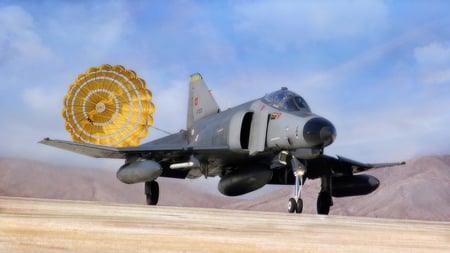
It is absolutely emblematic of an era.
When my father was deployed to Yokosuka in 1967, we landed at Yokota AFB, and I remember taxiing past long rows of these, painted up in just that camo scheme, though in my memory, I recall more black in the camouflage scheme where this one doesn’t appear to have much, if any.
I can tell, you, in my nine year old mind, I thought that long row of Phantoms on the flight line was the baddest-ass thing I had ever seen and I had my face pressed to the window.
When I lived in Subic Bay, I would spend hours at Cubi Point (where the beaches were) watching them take off and land, and I would walk around where the tarmac where they were all parked, peering into the intakes, looking in the tailpipes, sticking my head up in the wheel wells and marveling at all the piping.
As a 12 year old boy, I would follow the pilots as they did their pre-flight walk-arounds, but never got invited to sit in the cockpit like I did by one F-8 Crusader pilot did, and even let me put on his helmet. As I climbed out of the cockpit to let him climb in, he grinned down and said something like "I'll do a special takeoff you, kid!" When he took off, he climbed out at about a 75 degree angle, and did a series of four or five sequential aileron rolls for my entertainment!
How things have changed. Now, I am certain they would never let me wander around the flight line, but back then, nobody seemed to care a bit. (I did get captured once by two guys in a jeep with a checkered flag on it when I walked across the runway...I looked both ways, didn't see any aircraft in the pattern, and walked across. Heh, they drove out in that jeep, both guys grabbed me the arms and tossed me in the back. They interrogated me an tried to call my parents, but I gave them a fake number!)
When I was aboard the USS JFK, I saw USMC Phantoms (and an occasional Navy Phantom) make a trap now and again, and when they shot it back off, they had to break out the catapult cables where were rarely used in the mid-Seventies.
I thought the Phantom was the most incredible, masculine, and deadly looking flying machine ever built as a kid, and I drew it incessantly in school when I should have been paying attention to my subjects!
Ping!
Those big muthas would come in as low and slow and as close as they dared. More than once have I felt the heat from their napalm.
Yes, these things are incredible wicked looking.
I used to watch them do bombing runs. You could see them streak down from the clouds in a steep dive, then the smoke from the ordinance, then hear the F14 in the dive, then hear the ordinance explode. The sound was delayed because it travels slower than light.
The F-4 is the rudest, loudest and crudest war plane ever. Which is why it is loved.
Duke Cunningham's story where he became a fighter ace in the F4 is a classic. Too bad his career in the Housee ended in discrace.
Marines had a lot of them at the Air Station I was stationed Stateside. The Navy was beginning to transition to F-15s, but you are right. The F-4 was awesome. I saw two crash at the Naval Air Station I posted at while having lunch on the tarmac hanger. Someone had shoved the intake cover into the front intake and when he went afterburner, it blew up. Pilot bailed though and was OK. The other crash involved a Pilot who bailed and crashed his plane in a small lake just south of the runway. All exciting stuff, but we have advanced since then.
Sierra Hotel!
F-4 nicknames:
Double Ugly
Rhino
Lead Sled
Old Smokey
The Spook
Eisenschwein / Eisensau: Meaning “Iron Pig” or “Iron Sow”
Fliegender Ziegelstein: Meaning “Flying Brick”
Do you know the story behind the reason the Collings Foundation F-4D did not fly for seven years?
I, obviously, have not been keeping up because I thought it had been flying all this time.
Thanks for the post...
In the late 60s, as a young Airman-then-sergeant, I worked on RF-4s electronic warfare systems.
We didn't know that there were aerodynamic reasons for much of the cool/angry appearance of the aircraft. It turns out that the wings tilt up at the hinge point in order to increase the overall dihedral, thus for needed stability. And, the horizontal stab droops down into the thrust field in order to provide nose down recovery ability when SS in a muscle climb.
Great AC, thunderously noisy on TO (love it), and you should see the shock diamonds in the long thrust flames at night on full throttle.
Thank you for sharing.
— Old Phantom Phixer (libertylover)
Re walking around on the flightline: When I worked on F-4s a special badge was required to get on the flightline and once in a while, the SP would arrest someone trying to get on and would take them to jail. It was always some kind of paperwork screw up that would get resolved by the end of the day.
Getting into the alert area with planes loaded with nukes required a 2nd special badge.
Alabama Air National Guard flew them out of Birmingham back in the late 70s and early 80s. My dentist was one of the pilots.
I was flying a 172 from Birmingham to Columbus Georgia one day at 1500 and two crossed a couple hundred feet BELOW me! Guess they were using me for targeting practice.
https://www.collingsfoundation.org/aircrafts/?tab=tab-one
Collings Foundation aircraft:
Curtiss TP-40N Warhawk (dual control/dual cockpit)
Consolidated B-24J Liberator
Messerschmitt ME-262 (dual control/dual cockpit)
North American B-25 Mitchell
Douglas A-1E Skyraider
McDonnell TA-4J Skyhawk (trainer version)
F-4D Phantom
North American F-100F Super Sabre
Bell UH-1E Iroquois
Boeing B-17G Flying Fortress (under restoration)
TA-4J Skyhawk Flight Training – Student must have at least a current, valid FAA Private Pilot Certificate with a current and valid FAA Class 3 Medical Certificate. Student Pilot, Recreational Pilot, and Sport Pilot Certificates are not permitted.
Program Cost: $8,000 for Ground Training and 45 Minute Flight – 50% deposit required for scheduling
Me-262 Dual Control Flight Training – Student must have at least a current, valid FAA Private Pilot Certificate with a Multi-Engine Rating with a current and valid FAA Class 3 Medical Certificate. Student Pilot, Recreational Pilot, and Sport Pilot Certificates are not permitted.
Program Cost: $5,500 for Ground Training and 45 Minute Flight – 50% deposit required for scheduling
F-4D Phantom Flight Training – Student must have at least a current, valid FAA Private Pilot Certificate with a Multi-Engine Rating with a current and valid FAA Class 3 Medical Certificate. Student Pilot, Recreational Pilot, and Sport Pilot Certificates are not permitted.
Program Cost: $18,000 for Ground Training and 45 Minute Flight – 50% deposit required for scheduling
Walked around a lot of these at MacDill AFB, FL, in the 1970’s. (1st Tactical Fighter Wing and 4501st training, 56th Combat Support group)
wy69
Good old F-4 Phantom. Totally outclassed by modern designs but still the king of cool.
F4C. Worked them 72-73, Luke.
When an F4 made a low pass over you with the burners lit you Know you have been Airplaned. Thunderbirds, Luke, 72 I think.
The first time I could reach out and touch an F-4 I was stunned at its size. It pretty much ended the days of those cute little fighters. The F-4 is a remarkable aircraft in so many ways! On top of being beautiful, it could deliver a serious multi-role punch.
I think they were flown during Desert Storm.
Aviano italy, saw and heard them all day long:-)