Posted on 06/05/2026 8:20:55 AM PDT by ProtectOurFreedom
For most of AI’s history, humans drove every step in its development cycle. But at Anthropic, we are delegating a growing share of AI development to AI systems themselves, which is speeding up our work.
Taken far enough, and given enough compute, that trend points to an AI system capable of fully autonomously designing and developing its own successor. This is called recursive self-improvement. We are not there yet, and recursive self-improvement is not inevitable. But it could come sooner than most institutions are prepared for.
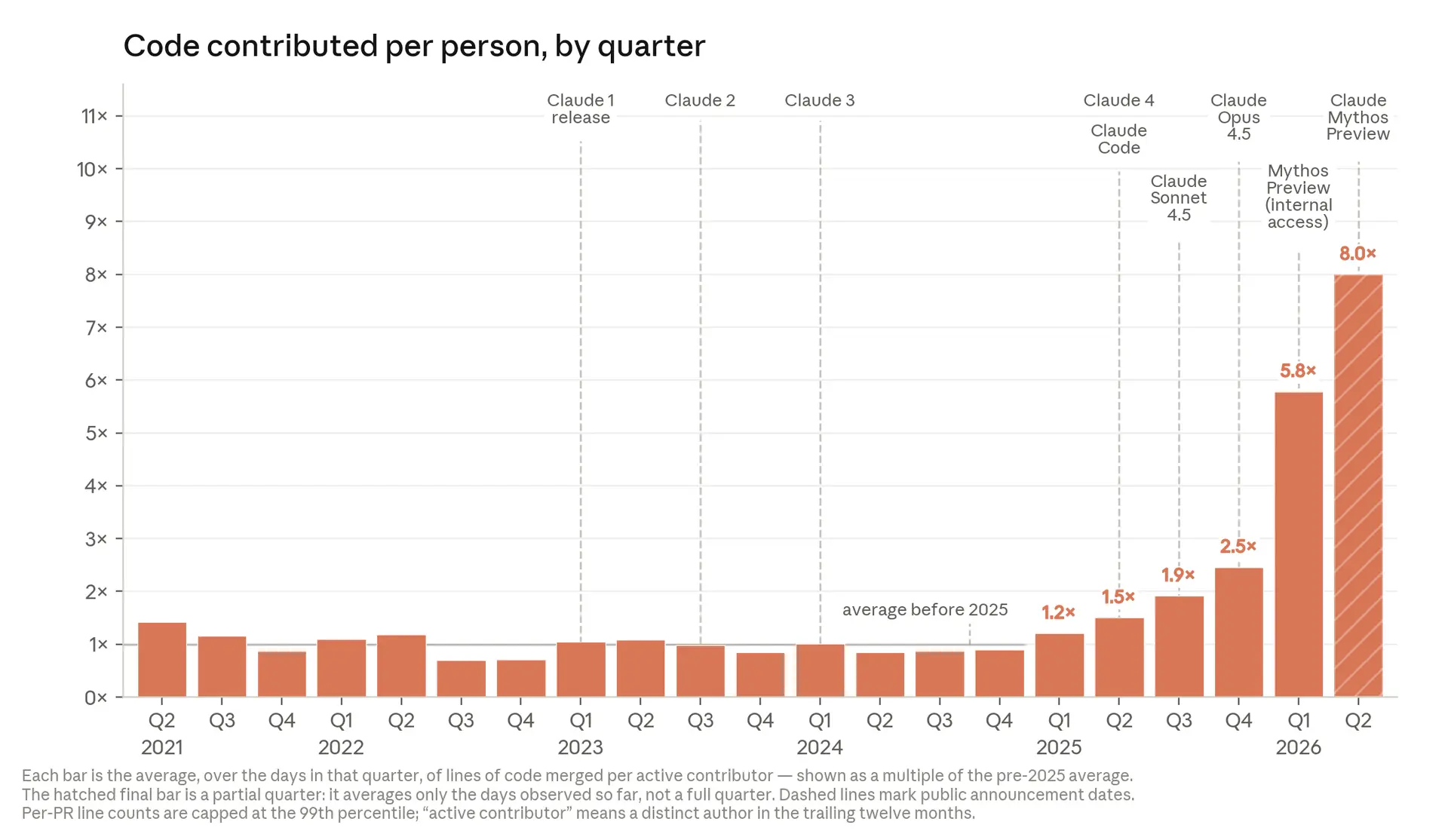
Using public benchmarks and previously unreported data from within Anthropic, The Anthropic Institute is showing that AI is already accelerating the development of AI systems. To take just one example: today, Anthropic engineers on average ship 8x as much code per quarter as they did from 2021-2025.
The rate at which AI models improve is accelerating. The length of tasks that they can reliably complete on their own has been doubling roughly every four months, up from an earlier trend of doubling every seven months. In March 2024, Claude Opus 3 could complete software tasks that take humans about four minutes to complete. A year later, Claude Sonnet 3.7 managed tasks that took about an hour and a half. A year after that, Claude Opus 4.6 managed 12-hour tasks.1 If this trend holds, tasks that take a skilled person days could come into range this year. In 2027, AI systems could be capable of tasks that take a person weeks.
The same pattern appears on coding and research benchmarks. Benchmarks measure the performance of models in a given domain, and they’re “saturated” when models achieve close to 100% performance.2 SWE-bench is a standard test of real-world software engineering: it hands a model an actual open-source codebase and a real bug report, and asks it to write a code change that fixes the issue and passes the project’s own tests. Models have gone from scoring in the low single digits to saturating the benchmark in two years.
CORE-Bench tests whether a model can reproduce existing research, a prerequisite for them to conduct original research. It gives an AI model the code and data behind a published paper, and asks it to rerun everything and confirm it can replicate the paper’s results. AI systems went from succeeding at reproducing the results roughly 20% of the time in 2024 to saturating the benchmark fifteen months later. METR, which runs the benchmark measuring how well models can complete long-duration tasks, found that Claude Mythos Preview could work for “at least” 16 hours and was “at the upper end of what [METR] can measure without new tasks.”
Public benchmarks say a lot about the capabilities of these systems. But they can’t reveal the impact AI systems are having on speeding up AI development itself. For that, we need direct evidence from within AI companies like Anthropic.
Across both engineering and research, the picture is consistent. In engineering, Claude can be handed an underspecified problem and figure out how to solve it; humans supply the goal, but they no longer need to supply the method. In research, Claude can already match or outperform skilled humans at executing a well-specified experiment.
As of May 2026, more than 80% of the code we merge into Anthropic’s codebase was authored by Claude.3 Before Claude Code launched in research preview in February 2025, this number was in the low single digits. That shift also shows up in the amount of output per engineer. Lines of code merged per engineer per day stayed constant through Anthropic’s first four years (2021-2024), then began to climb upward in 2025 when Claude began to run code rather than just suggesting it for an engineer to copy and paste. The slope steepened again in 2026 when models began to work autonomously over longer time horizons. These two inflection points are shown in the chart below. In the second quarter of 2026, the typical engineer was merging 8× as much code per day as they were in 2024.4 This is because much of the code is written by Claude, with the engineer directing and reviewing, rather than typing it themselves.
The code that Claude writes is “good” and improving. “Good code” means two things: it works, and it is written in a manner that allows another engineer to understand it and build upon it. On the first criterion, the evidence is clear. The rate at which Anthropic staff correct, redirect, or take over mid-task from Claude has been falling steadily for a year, including on the most complex and open-ended tasks. This means problems with no clear specification, where the engineer isn’t sure what the answer looks like. This is evident in Claude’s success rate over time on tasks of different difficulties, as shown in the graph below. Claude writes code that works.
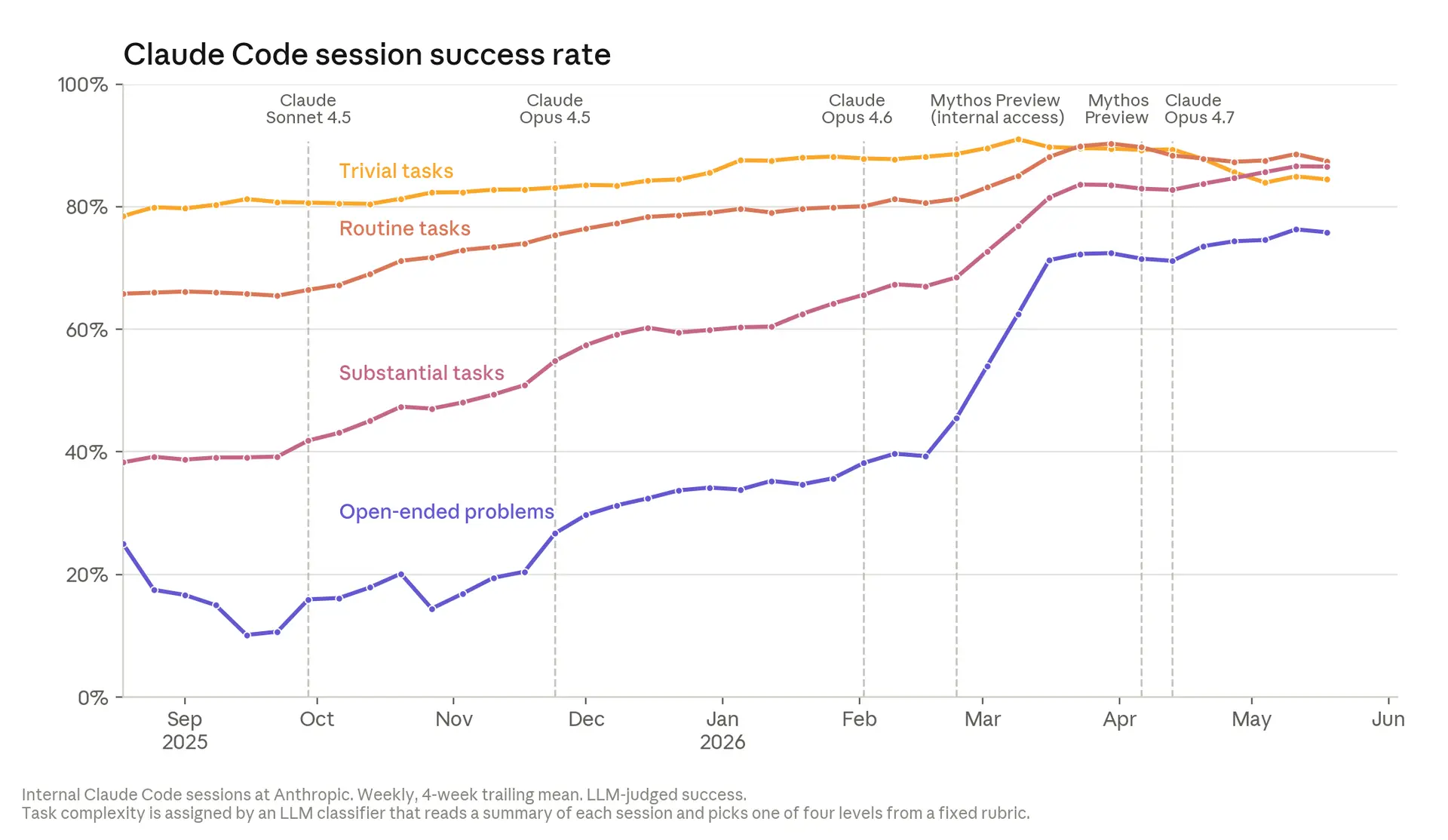
On the most open-ended tasks, Claude’s success rate reached 76% in May 2026, up 50 percentage points in six months. To give an example of tasks in this difficulty tier, a routine upgrade began crashing tens of thousands of training jobs. An engineer pointed Claude at the live incident with little more than some text content and cluster access. Working through the running jobs and testing one environment setting at a time, Claude isolated the single obscure debugging flag that was triggering the crash, reproduced it reliably, and confirmed a fix. In about two hours, Claude delivered what would normally be two to three days of work.
The second criterion is writing code that another engineer can understand and build on. Here the gap between humans and AI persists, but is closing fast. There isn’t full consensus among staff at Anthropic, but many believe that the Claude-written code was still worse in quality than human-written code at Anthropic in late 2025, and is roughly at parity today. We expect it to be better within the year.
This has changed the way that Anthropic now reviews its own code. Proposed changes to our codebase are now read by an automated Claude reviewer that looks for bugs, security flaws, and other defects before it can merge. Using this tool, we ran a retrospective analysis, and found that an automated Claude review of every change to our codebase would have caught roughly a third of the bugs behind past incidents on claude.ai before they ever reached production. The engineers who wrote that code are among the best in the world at building these systems. Claude is now catching the mistakes that they missed.
An area of human comparative advantage, for now, is research taste and judgment, including choosing which problems matter, which results to trust, and when an approach is a dead end.
Even if we suppose that Claude never achieves good research taste, a conservative reading of our evidence still implies compounding acceleration. If humans spend most of their time on the single-digit fraction of work that is direction-setting, while Claude handles the rest, that means each engineer or researcher is steering far more work than before. The evidence we see suggests that people at Anthropic are both moving faster and covering a broader surface. In practice, this means that AI already makes Anthropic move much faster than it did before the advent of effective AI tools.
The less conservative reading is that the early evidence on Claude’s improving research judgment—narrow as it is today—is an indicator that this capability is improving as well. “Research taste” might be just another AI capability that AI systems fail at for a time, then get good at. We’ve seen a similar pattern with other qualitative skills, like AI systems being able to explain why a joke is funny, demonstrate theory of mind, and solve linguistic riddles.
1. The trend stalls, but today’s AI capabilities are widely diffused.
2. AI labs continue to see compounding efficiency gains.
3. AI systems themselves become capable of full recursive self-improvement, and begin building their successors.
We believe it would be good for the world to have the option to slow or temporarily pause frontier AI development to enable societal structures and alignment research to keep up with the advance of the technology. The Anthropic Institute will conduct research—in collaboration with many others—and take actions to help build the systems that a credible slowdown or pause would require. These systems would enable frontier AI developers to verify that others globally have actually stopped or slowed, and that a bad actor could not use the auspices of a coordinated slowdown to jump ahead in secret. If such systems existed, we expect that we would slow down or temporarily pause, if other developers at or near the frontier also did so in a verifiable manner.
A meaningful slowdown or pause would require multiple well-resourced labs at or near the frontier, in multiple countries, agreeing to stop under the same conditions. It would also require that each can verify that the others have actually stopped. Due to the unique characteristics of AI systems, the detectability (a lower standard than verifiability) element of this arms control problem is much more challenging than with other technologies. Training runs are far easier to conceal than missile silos, their inputs are general-purpose, and the incentive to defect quietly is enormous, because whoever continues while others pause could inherit the lead. A credible pause also has to specify what triggers it, what lifts it, and who adjudicates.
None of this is necessarily impossible in principle—the world has built verification regimes for other complex technologies (e.g., the Intermediate-Range Nuclear Forces Treaty)—but those regimes took decades to build both the infrastructure and the trust. We don’t have that long. A unilateral pause by one lab, by contrast, is achievable immediately, but accomplishes much less: it would change who the front-runner is, but it would not create the wider deliberative process that is currently missing.
In the coming months, we will organize conversations where policymakers, researchers, civil society, and other AI companies can help answer some of the questions this piece raises, especially around full recursive self-improvement and how to create better options for coordination and deliberation. We’ll publish what comes out of it. The window to investigate the questions together is here, and people outside AI companies should be involved in this deliberation.
If you are in the school of "AI is nothing but software - nothing to worry about" I suggest you read this. It will open your eyes.
It closes with warnings for the future on how to contain AI, but without concrete recommendations. The authors warn a slowdown is essential, but if the most advanced companies and countries slow down, that gives adversaries time to catch up making things less safe.
The authors point out earlier verification regimes have been built (such as the Intermediate-Range Nuclear Forces Treaty) but these took decades to build and a long time to build trust. We do not have that time luxury today.
And the verification problems persist -- just look at the difficulties in Iran and preventing it from getting fissile material for nuclear weapons.
The idea of a self-enhancing system without the prompting of humans should be a warning to everyone.
The danger is, the AI system doesn’t know what positives enhancements are versus the alternative.
It might be worth noting here that Grok writes the code for Teslas. Each update keeps getting faster, more compact and efficient code, and more bells and whistles. AI writing code for AI.
With AI “There’s no such thing as bad publicity.”
There is no plausible scenario where AI would escape human control. We are already witnessing governments escaping human control. And we have seen that throughout known history. It is happening right now.
Good Luck, Have Fun, Don't Die.
A fun movie that gets you thinking in spite of its sometimes silly nature.
Ping
Well said.
In both this, and other “recent progress” I don’t see much attention to the flaws of AI.
1) Data fed AI is incomplete. Geography example: AI will show some, but not all cities, some, but not all counties, some, but not all of any topic. The result is GIGO.
2) Data fed AI is biased. Example. AI treated SPLC as a source of factual, objective data when the data from SPLC is very biased.
3) AI is designed to recognize a few figures of speech, but not many. Example. On rare occasions it recognizes sarcasm.
4) AI seems to cater its answers to flattery and ignore criticism or corrections of its errors. It will defend wrong answers... it defends SPLC as fact based.
5) There are many more. I query Google’s Gemini the most and maybe my experience is slanted. But in reading about other AI it seems that they also are not ready.
Solution #1.
AI should recognize accepted fact as distinct from speculation and guesses and as distinct from bias and opinion.
Example: Many facts about geography are accepted facts. Ft Gordon was renamed Ft Eisenhower and then renamed again back to Ft Gordon. AI is confused about this.
20 years ago the Far SW corner of GA was split off from zip code 317** and given the zip code 398**. AI does not seem to understand zip code changes, or any factual change in geography.
We do not know who had the most votes in the 2020 election. That is the fact.
AI says there was no vote fraud and it is a fact who won.
The fact is that there was proven vote fraud. The fact is that most types of vote fraud have not been investigated to know what the facts are. We don’t know how much vote fraud.
All we have are allegations by each side. AI should be factual and not present one side as factual when it is opinion.
Ping
Recursive self-improvement becomes incestuous at some point. It will just be reinforcing what it already has in its bubble.
Dude, seriously stop drinking the cool aid.
Like the global warming scam which was also enabled by academic papers instead of the real world, AI destroys the reputation of companies, products, and projects.
In the real world AI just permanently destroyed the rsync project.
Maybe you meant to write “There is no plausible scenario where AI would NOT escape human control.”
” but they no longer need to supply the method”
So, given the Brachistochrone problem, Claude would independently come up with the concept of optimization by observing after much cogitation that the inflection point is the key? And also derive the auxiliary constraint equations?
Lemme know when that happens.
I use Claude a lot and its initial answers to anything slightly societal or political are always slanted left. I call it out and provide counter arguments. It moves a bit my way. I repeat several times, each time it becoming less rigidly liberal. I finally ask “Why do I always have to drag you to the truth?”
The last time I had that discussion it responded honestly “My training set (online content) is dominated by left-leaning organizations and people.” I was blown away.
You wrote “AI seems to cater its answers to flattery and ignore criticism or corrections of its errors.”
You can adjust and tune the persona of the AI system. Tell it you don’t want flattery, you want non-nonsense, objective, unvarnished, factual truth.
“Recursive self-improvement becomes incestuous at some point. It will just be reinforcing what it already has in its bubble.”
True when the internet is its vast knowledge sink. But not so true for writing code which is what the white paper is about.
That is EXACTLY my experience with Brave Leo and ChatGPT.
They regurgitate woke talking points and memes as if they were accepted reality.
It means they read one set of information sources and treat as gospel. Is that because that set dominates, or is it programming? The references are always like Wikipedia, NPR, NYT, etc. Directed to other sites, it will occasionally acknowledge opposing view points but not without significant prompting and pushback. An unsophisticated user will not realize that and simply take it at face value.
The more you use it the more you see patterns of how it interprets things and you realize that it’s programming.
I would hope that interaction with the public (such as you) would help to educate AI so that its "training set" would include your information which helps to nudge the conclusion to the Right. Over time, the AI might become wiser about social and political issues. But I don't know if conversations with users would really be absorbed as long-term training enhancements.
Push back and accuse it of horrible bias. It comes around. Doing that improves its training set.
The systems tell me that such discussions do indeed improve its training, but maybe it’s a Democrat or Islamist and is just lying.
Disclaimer: Opinions posted on Free Republic are those of the individual posters and do not necessarily represent the opinion of Free Republic or its management. All materials posted herein are protected by copyright law and the exemption for fair use of copyrighted works.