Skip to comments.
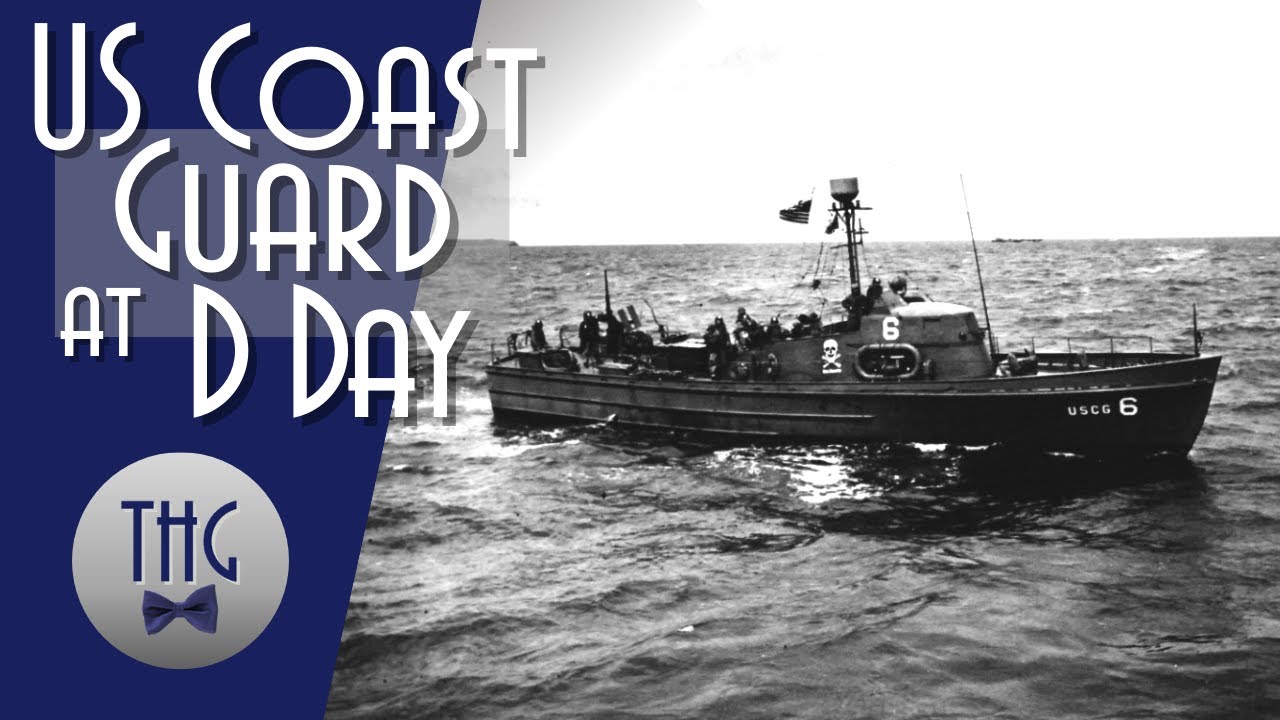
How Rescue Flotilla One saved more than 400 men on D-Day [10:20]
YouTube ^
| June 2, 2018
| The History Guy: History Deserves to Be Remembered
Posted on 06/01/2026 9:23:23 PM PDT by SunkenCiv
The History Guy remembers the heroic service of Rescue Flotilla 1 of the United States Coast Guard during D-Day. It is history that deserves to be remembered.
[1st vid in THG's D-Day Playlist] How Rescue Flotilla One saved more than 400 men on D-Day | 10:20
The History Guy: History Deserves to Be Remembered | 1.64M subscribers | 177,873 views | June 2, 2018
THG D-Day search results.
(Excerpt) Read more at youtube.com ...
TOPICS: History; Science; Travel
KEYWORDS: 19440606; coastguard; dday; godsgravesglyphs; pearlharbor; wwii
1
posted on
06/01/2026 9:23:23 PM PDT
by
SunkenCiv
To: StayAt HomeMother; Ernest_at_the_Beach; 1ofmanyfree; 21twelve; 24Karet; 2ndDivisionVet; 31R1O; ...
2
posted on
06/01/2026 9:24:13 PM PDT
by
SunkenCiv
(Do not trust all men, but trust men of worth. -- Democritus)
Transcript
Hi, I'm the History Guy. I love history, and if you love history too, this is the channel for you.
Two hundred and thirty-one thousand men and ten thousand women served with the United States Coast Guard during the Second World War; one thousand nine hundred and eighteen of them would die in that service. The Coast Guard took its first casualty the day after Pearl Harbor when the Coast Guard-manned transport Leonard Wood was bombed by the Japanese Navy in Singapore, and while the Coast Guard served many roles throughout the war, they never forgot their central role of search and rescue. Fifteen hundred survivors of torpedo attacks were rescued by Coast Guard cutters, boats, and planes off the coast of America during the war; a thousand more were rescued by Coast Guardsmen who were performing their duty as convoy escort, but about fourteen hundred more were saved by Coast Guardsmen in a little-known flotilla that played a notable role in the largest amphibious invasion in history. The story of Rescue Flotilla One, the Matchbox Fleet, is a story that deserves to be remembered.
After the Axis powers invaded the Soviet Union in Operation Barbarossa in June of 1941, Soviet leader Joseph Stalin started pressing for the Western Allies to open a second front in Western Europe. That would require the largest amphibious assault in world history, and it would take time to gather the strength to make such an attack. Two invasion plans for 1942, code-named Operation Roundup and Operation Sledgehammer, were both deemed impractical and unlikely to succeed, and the disastrous Operation Rudder, better known as the Raid of Dieppe, demonstrated the high cost and impracticality of trying to take a well-defended port. The Allies instead opted to invade what they perceived to be a more vulnerable French North Africa in 1942. Winston Churchill and Franklin Roosevelt met in Washington, DC, in May of 1943 and agreed that the invasion of Western Europe would occur in a year's time; the leaders discussed the initial plans for that invasion when they met again in Quebec City, Canada, in August of that year. While they briefly considered an invasion through Norway, tentatively called Operation Jupiter, they settled on an invasion of France, calling the plan Operation Overlord.
Operation Overlord was the code name for the overall Allied plan to establish a large-scale lodgement on the continent of Europe. Invading German-occupied Western Europe and establishing a second front would distract Hitler's armies, who were fighting the Soviets in the east, and offer a path for the liberation of Paris and the invasion of Germany itself. It was a massive operation, eventually including 39 divisions and more than a million troops. Overlord was a multi-faceted plan that included major operations like Operation Point-Blank, a portion of the Allied bomber offensive intended to set the stage for the invasion, and Operation Bodyguard, the complex deception plan designed to mislead the German High Command as to the timing and place of the invasion. But by far the most complex and challenging part of the plan was code-named Operation Neptune: the Allied landings on the beaches of Normandy, France, that today are better known as D-Day.
The scope of Operation Neptune was staggering; nearly 7,000 vessels were involved. By comparison, the great Spanish Armada of 1588 included a hundred and thirty ships. Only some 850 ships had been used in the invasion of North Africa the year before. One hundred sixty thousand Allied troops were landed by sea and parachute along those fifty miles of coastline on June 6, and they were supported by one hundred ninety-five thousand sailors manning the massive invasion fleet. Winston Churchill realized that some of those men were going to wind up in the water. Purportedly, some weeks before the invasion, he lamented to President Roosevelt that the invasion fleet had no rescue flotilla, but with all of the resources already committed, how could they put together such a flotilla in such a short period of time? FDR responded, "We already have such a group, the United States Coast Guard."
The Coast Guard already had a significant role in Operation Neptune, showing their skill at small boat handling by operating many of the landing craft that ferried the landing force under fire to the beaches. But of course, the Coast Guard had traditionally played the role of rescuing people at sea. Vice Admiral Russell R. Waesche, the Commandant of the Coast Guard, suggested that the coastal patrol boats being used for anti-submarine service along the U.S. East Coast were the best fit for the proposed flotilla. Sixty eighty-three-foot cutters, or what was called the Matchbox Fleet, were selected and transported piggyback on freighters to the UK, where they were formed into Rescue Flotilla One based at Poole, England, and modified for service as rescue craft.
The eighty-three-foot cutter had been designed in 1940, contracted to the Wheeler Shipyard in Brooklyn, New York. The first order of 40 cutters entered service in 1941, and by the end of 1944, a total of 230 were produced for the Coast Guard. They were designed for coastal convoy escort, anti-submarine duty, and search and rescue. The eighty-three-foot, two-inch-long vessels were wooden hulled, and their two screws were powered by two inline eight-cylinder Stirling Viking 2 gasoline engines, each of which produced 600 horsepower along with a top speed of 20 knots. They were commonly called matchboxes because of the dangerous combination of gasoline and wood. They had a displacement of 76 tons, a beam of 16 feet 2 inches, and a draft of 5 feet 4 inches. In normal World War II configuration, they mounted a 20-millimeter gun aft and depth charge racks, although the racks were removed for the role in Operation Neptune. The normal crew complement was 13.
The 60 cutters of Rescue Flotilla One had their Coast Guard call signs removed and, for the sake of communication simplicity, were renamed CGC 1 through 60. Thirty were assigned to the American sector, Omaha and Utah beaches, and thirty to the British sector, Gold, Juno, and Sword beaches. Although the Coast Guard operated several vessels on D-Day, Rescue Flotilla One represented nearly two-thirds of those. Their job was straightforward, as flotilla veteran Jack Hamlin explained, "Be nothing but just be a lifeguard," he said. "We were not there to destroy anybody, to kill anybody; we were there to just do rescue operations, and that's what we did."
At Poole, the crews had received special training, including extensive first-aid training; it would prove critical on June 6th. Their task was dangerous; they were accompanying the assault boats and would have to brave enemy fire and obstacles many times on the rough runs. The seas were rough, and the tiny boats had to maneuver around the larger craft. CGC 16, nicknamed the Homing Pigeon, got to work early, picking up survivors from a landing craft disabled by the choppy seas in the assembly area before the landing even began. As the crew neared Omaha Beach, they rushed to the rescue of the crew of an anti-aircraft ship that had been destroyed by German fire. No sooner had they pulled those survivors on board when a German shell destroyed a nearby patrol boat. Rushing to their rescue, the tiny cutter, intended to carry no more than 20 wounded, was crammed with ninety rescued men. They returned them to the hospital ship and went back to the beach. One of the CGC 16's crew climbed aboard a burning transport loaded with ammunition to rescue a sailor whose legs had been severed by a shell; he rescued the man, and the craft sank less than two minutes later. Many of the men were seriously injured, and the first aid was left up to CGC 16's cook, who applied tourniquets and administered morphine from the ship's medical locker. By the end of the day, the crew of CGC 16 had pulled 126 men from the English Channel, the largest number saved by any of the Coast Guard Matchbox Fleet that day. For their heroism, the crew of CGC 16 was awarded the Bronze Star.
CGC 1 came upon a sunken British landing craft two miles offshore; they pulled 24 soldiers and four Royal Navy sailors from the channel. The Coast Guardsmen had to jump overboard and tie lines to the freezing survivors because they were too cold to help themselves aboard. Later, CGC 1 rescued 19 survivors from another second landing craft, 14 of whom were fellow Coast Guardsmen. CGC 34 rescued another 32 British soldiers and seamen in the British sector. The process could be slow; many of the men being rescued were injured, and the soldiers were weighed down with heavy packs. It took time and all the crew's strength to carefully lift them on board while under fire. The boats had to carry survivors back to hospital ships 10 miles offshore in the choppy waters; loaded with casualties, the cutters could barely make 15 knots, and the cutters saw their share of fire that day. CGC 29 was in the British sector when a marauding German torpedo boat attacked a group of landing craft. Other escorts chased the torpedo boat as the crew of the cutter saved 14 men from the craft that had been torpedoed. A group of four cutters was nearly fired upon by the British, who had mistaken them for German torpedo boats. CGC 53 came under fire from a shore battery as they pulled men from a swamped landing craft; the battleship HMS Rodney opened fire, silencing the German guns. The crew of CGC 35 received the British Distinguished Service Cross for steering their wooden cutter through a sea of burning petrol to rescue the crew of a landing craft that had been blown up by a direct hit, and yet they did their jobs.
By the end of the day, the Matchbox Fleet had saved over 400 soldiers and sailors along the Normandy beachhead. Despite often being in the line of fire, with many of the cutters taking damage, Rescue Flotilla One did not lose a single boat, nor a single Coast Guardsman. The Coast Guard played a vital role in Operation Neptune, operating many naval ships, from large landing craft to the small Higgins boats that were dropping the soldiers at the shore. Four landing craft ships operated by the Coast Guard were sunk in Operation Neptune, and several other Coast Guard vessels were damaged; it was the largest loss of Coast Guard vessels in the history of the service. Fifteen Coast Guardsmen died in the Normandy landings. Coast Guard commander Quinton R. Walsh both helped to design the Mulberry Harbors that transformed the Normandy beaches into giant ports and also played a central role in capturing the French port of Cherbourg and returning it to service. He received the U.S. Distinguished Service Cross.
Rescue Flotilla One continued to be in service off the coast of France until the unit was finally disbanded in February of 1945. Some of the cutters had been in the assault zones for more than 89 days and had made the round trip between the Normandy beaches and Great Britain more than 30 times. In their period of operation, they were credited with rescuing 1,437 people. They were continuing the Coast Guard's long tradition of saving lives, albeit on a beach, under fire, thousands of miles from home. But that is the nature of the men and women who serve in the United States' oldest continuing seagoing service, whose motto is, Semper Paratus, always ready.
I'm the History Guy. I hope you enjoyed this edition of my series of short snippets of forgotten history, about ten minutes long. If you did enjoy, please go ahead and click that thumbs up button which is there on your left.
If you have any questions or comments, feel free to write those in the comment section. I will be happy to personally respond, and if you'd like more snippets of forgotten history, all you need to do is subscribe.
3
posted on
06/01/2026 9:45:32 PM PDT
by
SunkenCiv
(Do not trust all men, but trust men of worth. -- Democritus)
To: SunkenCiv
4
posted on
06/01/2026 10:25:14 PM PDT
by
Repeal The 17th
( I am obsessed with not being obsessed with anything.)
To: Repeal The 17th
5
posted on
06/01/2026 10:49:08 PM PDT
by
SunkenCiv
(Do not trust all men, but trust men of worth. -- Democritus)
To: SunkenCiv
Another great post and a moving story. Thank you for your work finding and posting not only the gist of it but the transcript as well.
I guess it qualifies as minor serendipity that two days ago one brother-in-law was visiting Normandy, and sent the other b-i-l, a CG vet, pics of a plaque memorializing the role and losses of the Coast Guardsmen on D-Day.
To: Chewbarkah
Glad you enjoyed it, and thanks for sharing the serendipitous.
7
posted on
06/02/2026 9:01:59 AM PDT
by
SunkenCiv
(Do not trust all men, but trust men of worth. -- Democritus)
from the FRchives, in honor of those who sacrificed so much, the 2025-2026 D-Day keyword topics, sorted:
8
posted on
06/02/2026 9:02:09 AM PDT
by
SunkenCiv
(Do not trust all men, but trust men of worth. -- Democritus)
To: AdmSmith; AnonymousConservative; Arthur Wildfire! March; Berosus; Bockscar; BraveMan; cardinal4; ...
9
posted on
06/06/2026 3:15:55 AM PDT
by
SunkenCiv
(TDS -- it's not just for DNC shills anymore -- oh, wait, yeah it is.)
10
posted on
06/06/2026 8:07:04 AM PDT
by
SunkenCiv
(TDS -- it's not just for DNC shills anymore -- oh, wait, yeah it is.)
Disclaimer:
Opinions posted on Free Republic are those of the individual
posters and do not necessarily represent the opinion of Free Republic or its
management. All materials posted herein are protected by copyright law and the
exemption for fair use of copyrighted works.
FreeRepublic.com is powered by software copyright 2000-2008 John Robinson

