
People think a red devil with horns and a pitchfork is a Christian concept. It's just an artistic representation meant to convey the horror or fear.
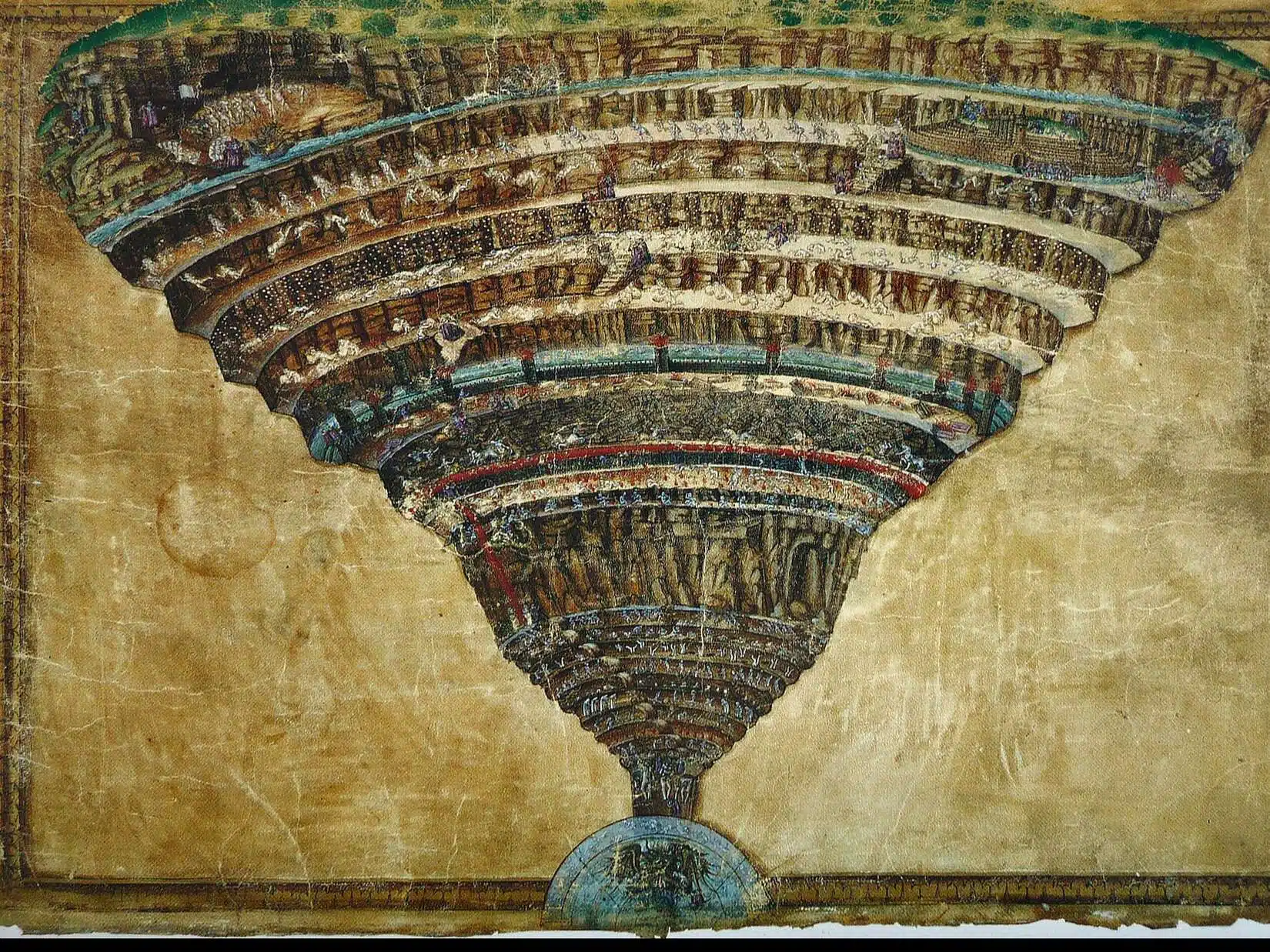
Sandro Botticelli


Eugène Delacroix
Posted on 05/22/2026 3:50:58 PM PDT by nickcarraway
Long before the fiery pits and pitchforks of Christian Hell haunted the religious imagination, the afterlife in ancient Hebrew thought was a muted, shadowy place known as Sheol.
The Hebrew Sheol and the Greek Hades
In early Hebrew belief Sheol was not a realm of torture or glory but a land of forgetfulness—where all the dead, both righteous and wicked, shared a common fate. In many ways, Sheol resembled the Greek Hades—not in its geography or grandeur but in its indifferent stillness for humans. It was a silent cavern of shadows, where even the most luminous of biblical figures—Adam, Moses, David—drifted as insubstantial shades, unseeing and unfeeling.
This early view of the afterlife was stark in its impartiality. There was no moral calculus at work. Like Hades, which offered only a few exceptions like the Elysian Fields for heroic souls and Tartarus for divine rebels, Sheol was not a realm of judgment. Tartarus in Greek cosmology was the abyss reserved for beings and demigods which had disrupted cosmic order—Cronus and the Titans, Sisyphus, Tantalus, etc. Similarly, in early Jewish thought, the concept of eternal punishment was not for humans but reserved for cosmic transgressors. The fallen angels, Watchers, and eventually, Satan himself were among these transgressors. Human beings would end up into Sheol, regardless of virtue.
Babylonian exile and the seeds of change
Everything began to shift during the Second Temple era, especially after the Babylonian exile. Exposure to Persian and Babylonian cosmologies brought with it a dualistic lens—light versus darkness, reward versus punishment, and a more layered concept of the soul’s journey after death. The once-shadowy Sheol began to split.
By the time we reach texts like the Book of Enoch and later 2 Maccabees, we find something new: consciousness after death. Some souls now appear to experience joy and closeness to the righteous forefathers—in the “bosom of Abraham“—while others suffer for their moral failings. The idea of resurrection, known as the time when the dead rise, are judged, and receive either eternal reward or damnation also enters the scene. Sheol was no longer neutral ground; it had become a moral landscape.
Jesus and the harrowing of Hell
Into this evolving spiritual world steps Jesus of Nazareth, whose teachings reflect and further shape these Second Temple ideas. In the Gospels, Gehenna becomes the word most commonly translated as “Hell.” However, Gehenna was not a metaphysical realm. It was a real valley outside Jerusalem, once a site of child sacrifice and later a cursed landfill.
Jesus used it to describe the fate of the eternally damned who never repented after resurrection. He evoked Hell to stir moral urgency, often in parables, and talked about the rich man and Lazarus and how he was punished in the outer darkness. He spoke of the weeping and gnashing of teeth—images heavy with consequence. The rich man is punished and wants to warn his own people about the reality of eternal damnation.
The apocalyptic dimension deepens in the Harrowing of Hell, the moment between Christ’s death and resurrection. Though not described in the canonical Gospels, it is elaborated on in early Christian tradition and Byzantine hymnography, wherein Jesus descends into Sheol (or Hades), breaks open its gates, and raises Adam and the righteous dead. In iconography, Christ pulls Adam and Eve from their tombs, crushing the gates of Hell underfoot. This is a triumphant, cosmic jailbreak.
St. John Chrysostom, one of the most influential Church Fathers, offers vivid and unequivocal teachings on the reality and nature of Hell. He emphasizes that Hell is not a metaphor but a tangible, eternal punishment for the unrepentant.
Chrysostom describes Hell as:
“A sea of fire—not a sea of the kind or dimensions we know here, but much larger and fiercer, with waves made of fire, fire of a strange and fearsome kind.”
He further elaborates on the eternal nature of this punishment:
“For that it has no end Christ indeed declared when he said, ‘Their fire shall not be quenched, and their worm shall not die.'”
Chrysostom’s vivid imagery and firm stance underscore the seriousness with which early Christian theology regarded the concept of Hell.
Chrysostom even acknowledged that the idea of posthumous justice was not exclusive to Christian doctrine but resonated across human thought and culture. “Even poets, philosophers, and writers,” he writes, “have contemplated future retribution and spoken of the punishments that exist in Hades.”
While their accounts lacked precision and were shaped by distorted echoes of Christian truths, they nonetheless glimpsed the concept of divine judgment. He references vivid imagery from Greek mythology and speaks of rivers such as Cocytus and fiery Phlegethon, the water of Styx, and Tartarus buried deep beneath the earth. Chrysostom saw these as symbolic reflections of a real and terrible judgment.
Yet for all this theological richness, the modern Western conception of Hell owes just as much to poetry as to scripture. Dante Alighieri’s Inferno crystalized an image of Hell that has lingered for centuries. This image is an elaborate, layered abyss tailored to specific sins, complete with vivid geography and moral symbolism.
Dante, steeped in classical education, weaves Greek myth into Christian theology. He borrows Virgil as his guide. Virgil, who had described Aeneas’ descent into the Underworld, now leads Dante through the nine circles of Hell. Within these circles, Minos judges the damned while Charon ferries souls across the river of Acheron. Pluto, no longer merely the Greek god of the dead, becomes a guardian of infernal secrets. The punishments of Tartarus, Cerberus, the Furies, and Titanic all reappear—except they now serve a Christian vision of justice.
Dante’s hell is deeply literary, but it codified an emotional and visual grammar of damnation. This shaped sermons, paintings, and imaginations ever since.
From shadows to fire: A legacy of transformation
The Christian concept of Hell did not begin as fire and brimstone. It began as a quiet, cold shadow—a Sheol where even the best of humanity slumbered without voice or vision. Over time, with the influence of foreign cosmologies and inner theological evolution, Sheol gained color, sound, and flame. It split into places of rest and punishment, opened to the possibility of resurrection, and finally became a moral arena with eternal consequences.
The Christian story made Hell dynamic rather than a mere destination. It was a battleground, where Jesus defeated death itself. And yet, its form continued to evolve, shaped not just by theologians and saints, but by poets and painters, preachers and philosophers.
Sandro Botticelli
Eugène Delacroix
The Devil is supposed to be the ruler of Hell, forever.
The Devil is supposed to be destroyed forever.
Both can’t be right.
God is a just judge, punishing and torturing forever is not just, it’s not even the principal of indemnity. It’s more like a killer who delights in this, like the devil. It has the ring of a myth. To attribute this to God suggests they don’t know Him, imho.
“ The Devil is supposed to be the ruler of Hell, forever.”
—————-
Where do you get that idea from? Certainly not the Holy Bible.
Satan is Inmate of the Month of Hell.
He will be a ruler of no one in his prison.
“God is a just judge, punishing and torturing forever is not just, it’s not even the principal of indemnity. It’s more like a killer who delights in this, like the devil. It has the ring of a myth. To attribute this to God suggests they don’t know Him, imho.”
That’s going to upset a lot of folks here who seem to get their rocks off on the idea of eternal roasting of others.
Confusing use of “Hell” when Christ went there after His Resurrection:
When the Apostles’ Creed states that Jesus “descended into hell,” Catholics teach that He did not go to the place of the damned. Instead, He descended into a realm of the dead often referred to as the Limbo of the Fathers or Abraham’s Bosom.
“This specific realm differed completely from the eternal Hell of punishment in several ways:
Before Jesus opened the gates of Heaven through His death and resurrection, no human soul could enter into the direct presence of God.
The righteous souls from the Old Testament (like Adam, Eve, Moses, David, and the prophets) were held in this peaceful waiting place, free from torment but separated from the Beatific Vision.
Jesus did not go there to suffer or be punished. According to Catholic tradition (detailed in the Catechism of the Catholic Church), His descent was a triumphant victory. He brought the Good News of salvation to the righteous dead and broke the bonds of death.”
—Catholic.com
Note: I am not a Catholic myself.
Cartoons....the accordion....
There used to be a bumper sticker with an accordion on it:
I Support Accordion Music—
And I Vote.
Right from the Bible.
There are some who went there and came back to describe its horror.
Again, Christ is the answer.
There shouldn’t be an eternal burning in hell fires for indulging in the pleasures of life. The 10 Commandments do not speak against them. Love God and honor his commandments.
Great article. I have stared in the Gates of Hell, which turns our to be Caesarea Phillipi, whic is a Temple built to the God Pan. This is located at the flood Waters at Panias, which is where the snowmelt creates a mighty river. The Temple has been excavated, but when the NT quotes the “Gates of Hell”, this is where they were standing. This site is about 50 miles north of Caperneum, whis is from the Hebrew e Kefar Nahum, or City of Nahum. he Hinom Valley wraps around the Temple Mount in Jerusalem, all the way to the west of the Old City, and is where a millenia of trash was thrown over the edge into. So the trash was constantly burning, so this is the Fires of Hell people were thrown into that Fante referred to. In essence, I have stood on the edge of the burning pit, and stared into the gates of hell.
That’s the myth.
Jesus was very clear that Hell is a place of torment. And sin He is God, He would know.
I know.
The devil isn’t in hell. His time is coming, though.
The people that go to hell chose to go to hell. That’s not God’s doing. He isn’t going to welcome someone who doesn’t want to be there. Listen to Jesus. Word is not a place that’s going to be very fun. It’s where the worm never dies.
This is my understanding as well. Jesus descended into the underworld, not Hell as we think of it.
I'm not sure why the Apostle's Creed says "Hell", except that it is shorter and easier to say than "underworld".
I understand your point, and you're not the first person to suggest this. I seem to remember an article in First Things that discussed this same point.
and again in Mark 9:47-48, "And if your eye causes you to sin, pluck it out. It is better for you to enter the kingdom of God with one eye than to have two eyes and be thrown into hell, where ‘their worm never dies, and the fire is never quenched."
In truth, the New Testament does not go into any great detail, because that's not really the point now is it?
Disclaimer: Opinions posted on Free Republic are those of the individual posters and do not necessarily represent the opinion of Free Republic or its management. All materials posted herein are protected by copyright law and the exemption for fair use of copyrighted works.