
Posted on 05/14/2026 4:47:49 PM PDT by Red Badger
NASA’s TESS mission has released its most complete cosmic mosaic yet, revealing thousands of confirmed and candidate exoplanets scattered across the night sky.
© Credit: NASA
NASA has unveiled the most complete panoramic view yet from its Transiting Exoplanet Survey Satellite (TESS), offering a breathtaking look at a sky crowded with thousands of potential alien worlds. The newly released all-sky mosaic combines years of observations into a single image that highlights nearly 6,000 confirmed and candidate exoplanets discovered across the galaxy. Beyond its visual impact, the map represents one of the most ambitious planet-hunting efforts ever conducted and marks another major step in humanity’s search for life beyond Earth.
A Seven-Year Hunt Across the Entire Sky
Since its launch in 2018, NASA’s TESS spacecraft has systematically scanned vast portions of the sky using four wide-field cameras designed to monitor the brightness of stars. The mission searches for tiny dips in starlight caused when planets pass in front of their host stars, an observational method known as the transit technique. Over time, those repeated observations have allowed scientists to build an enormous catalog of distant planetary systems, many unlike anything found in our own solar system.
The newly assembled mosaic combines 96 sectors of sky observed between April 2018 and September 2025. Each sector represents roughly a month of continuous monitoring, giving researchers enough data to identify recurring signals that may indicate orbiting planets. The final image reveals an extraordinary celestial landscape where blue markers identify nearly 700 confirmed exoplanets while orange markers indicate more than 5,000 candidates still awaiting verification.
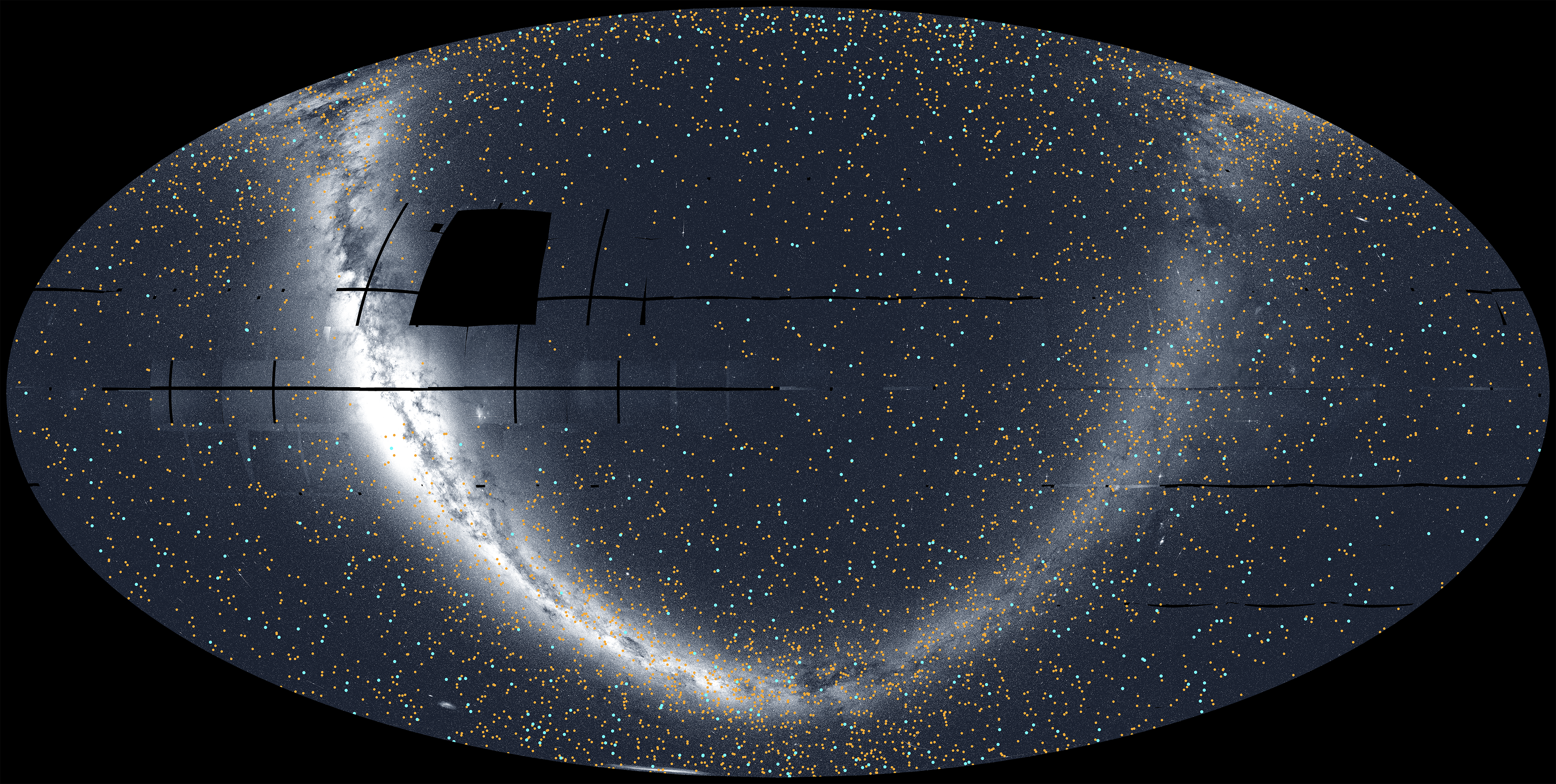
This view of the whole sky was constructed from 96 TESS sectors. By the end of September 2025, when the last image of this mosaic was captured, TESS had discovered 679 exoplanets (blue dots) and 5,165 candidates (orange dots). The glowing arc running through the center is the plane of the Milky Way. The Large Magellanic Cloud can be seen along the bottom edge just left of center. Black areas within the oval indicate regions TESS has not yet imaged.
NASA/MIT/TESS and Veselin Kostov (University of Maryland College Park)
Among those worlds are volcanic planets, giant gas worlds larger than Jupiter, and extreme systems where planets are slowly being torn apart by the gravity and radiation of their stars. Some planets orbit binary stars, producing double sunrises and sunsets reminiscent of science fiction. Others sit within the so-called habitable zone, where temperatures may allow liquid water to exist on the surface.
“Over the last eight years, TESS has become a fire hose of exoplanet science,” said Rebekah Hounsell, a TESS associate project scientist at the University of Maryland Baltimore County and NASA’s Goddard Space Flight Center in Greenbelt, Maryland. “It’s helped us find planets of all different sizes, from tiny Mercury-like ones to those larger than Jupiter. Some of them are even in the habitable zone, where liquid water might be possible on the surface, an important factor in our search for life beyond Earth.”
The Image Reveals More Than Just Exoplanets
The mosaic released by NASA is not only a catalog of distant worlds. It also provides a sweeping portrait of the larger structure of the cosmos surrounding Earth. Stretching through the center of the image is the bright arc of the Milky Way galaxy, glowing densely with stars and interstellar dust. In the lower left region, two bright white patches mark the Large and Small Magellanic Clouds, neighboring dwarf galaxies located roughly 160,000 and 200,000 light-years away.
Those details highlight how TESS has evolved far beyond a single-purpose exoplanet mission. While its primary goal remains the discovery of planets orbiting nearby stars, the spacecraft has become a powerful tool for studying a broad range of astrophysical phenomena. Scientists have used TESS data to observe stellar eruptions, track asteroid movement near Earth, and analyze the behavior of young star clusters moving through the galaxy.
The mission’s enormous archive of observations has also become increasingly valuable because of advances in automated data analysis. Modern algorithms can sift through massive amounts of brightness data far faster than human researchers, uncovering subtle patterns and signals that might otherwise remain hidden inside the dataset.
“The more we dig into the large TESS dataset, especially using automated algorithms, the more surprises we find,” said Allison Youngblood, the TESS project scientist at NASA Goddard. “In addition to planets, TESS has helped us study rivers of young stars, observe dynamic galactic behavior, and monitor asteroids near Earth. As TESS fills in more of the night sky, there’s no knowing what it might see next.”
Why TESS Is Changing the Search for Life Beyond Earth
The significance of TESS lies not only in the number of worlds it discovers but also in the kind of planets it identifies. Unlike earlier missions that focused heavily on distant regions of space, TESS concentrates on stars relatively close to Earth. That strategy allows follow-up observations using more advanced observatories, including the James Webb Space Telescope, which can analyze planetary atmospheres in detail.
Many of the planets discovered by TESS orbit small, cool stars where habitable-zone planets complete their orbits quickly, making them easier to detect. Scientists are especially interested in rocky planets with sizes similar to Earth because those worlds may provide the best opportunities to search for atmospheric biosignatures, including gases potentially linked to biological activity.
The mission has already transformed planetary science by dramatically increasing the number of known exoplanets available for study. To date, astronomers have confirmed more than 6,270 exoplanets using TESS, the retired Kepler Space Telescope, and various ground-based observatories around the world. Each new discovery adds another piece to a rapidly expanding understanding of how planetary systems form and evolve.
As researchers continue analyzing the growing database, scientists expect the number of candidate planets to rise even further. Future discoveries could include Earth-sized worlds orbiting nearby stars close enough for detailed atmospheric investigation, a milestone that may redefine humanity’s understanding of life in the universe.
Ping!.............
you can look, but you can’t touch.
E.T phone home.
Humbling! And how many galaxies in the universe?
Billions and billions................
Humans as carbon based beings probably not. Advanced immortal AI silicon based lifeforms it’s only 5000 years at 2% of C to reach 100 light years distance.
Plasma magnetic sails that are dropped by chemical rockets deep into the Suns gravity well and then inflate a few hundred megawatt plasma sail bubble hits 2% of C on a nearly straight line out of the solar system the acceleration time is as short as 3 months then it’s screaming outbound.
Added plus is the same plasma magnetic sail bubble brakes your ship at equally fast deceleration dragging against the target star solar wind.
Advanced machines could easily last for 5000 years especially if powered down in a deep sleep mode. The limit is the decay rate of your nuclear power fuel. Pu239 has a 24,110 years...so half your fuel has decayed by then. U235 is significantly longer at 703.8 million years.
So how far can a 2% of C ship go in 24,110 ship years?
At 2% of the speed of light (0.02c), approximately 24,114.82 years will have passed on Earth when the ship clocks reach 24,110 years, and the ship will have traveled a distance of 482.30 light-years (LY)
Again immortal AI sentient machines are coming it’s when not if any more and those machines will easily survive 24K years in deep sleep being silicon based lifeforms.
It won’t be biological humans it will be our spawn of intelligent machines who for the stars with intelligence.
Some of those bodies in the solar system no longer exist. Imagine if you could travel way faster than light. And picked one of those points of light and headed toward it. It is possible that somewhere along the way that light would just cease to exist before you ever got to it. You turn around and head back toward earth. And it would re-appear.
Right. It’s exciting stuff, but the distances…..
Humans could construct laser powered light sails that use plasma magnetic braking at their arrival. Such pushed sail ships can reach 20% of C in theory.
After 24,110 ship years traveling at (0.20c), approximately 24,607.17 years will have passed on Earth, and the ship will have traveled a distance of 4,921.43 light-years.
A sun sized stars at the target would enable a magnetic braking from the Heliopause inwards it would take 18-20 years to slow down and enter the inner system orbits.
So humans have the ability with intelligence machines to seed a 4000 light year wide bubble once the AI can fend for itself. Frozen embryos in artificial wombs could conceivably be used to not only gestate animals but humans too , given AI intelligence to raise them along the way in a ark type ship during it’s 18-20 year braking time they will arive as prime age adults. The supplies for 20 years is the real issue it makes for a huge ship vs just a small ship with silicon based lifeforms that don’t eat or need air they need electrons which can be from solar or nukes.
Then again why send a inferior lifeform to the stars that needs very specific environmental conditions. AI super intelligence will exceed humans it’s only when. Nanotech will be self replicating at some point too.
If humans had FTL we would go to the closest ones first those would not be millions of light years it would be hundreds and stellar lifespan is measured in millions and billions of years. We would know how far along a star is in lifespan by it’s spectral lines. Even a million light years distance is well within stellar lifespans of sun sized stars.
The bigger problem is the universe is expanding and stellar drift in orbits under gravity and dark energy / matter not fully understood. If we have FTL like Star Trek then you need absolutely clear paths for the folding of space in front of the ship any gravity well or stellar/planetary mass would be shredded by a Star Trek warp drive. Same for jump FTL like Battlestar Galactica which jumps from one place to another via sub space, so again no gravity well or masses at the exit point or you jump into a star or planet or asteroid field. Stargate style hyperdrives also use dimensional twindows to leave relative law space and open an exit dimensional window which again must not be in a gravity well or some planets mass.
Exotic theories such as quantum tunnels, micro wormholes all require exotic energy and some means of deconstructing matter into particles that fit down the quantum tunnel or micron sized worm hole event horizon. This is how the Stargate is supposed to work in that show it’s a wormhole at each end with thrle gates doing the decon and recon of the matter streams.
The only one grounded in any real physics is the space folding warp and you would need black hole levels of energy or dark matter and dark energy the universe expanding kind.
At relativistic speeds you are only getting to stars close enough that you can see how deep into their billon plus year long lifespans they are and a 20,000 year trip is a tiny fraction of that time.
Good information. My point was not on the science or possibility/disability of traveling very fast. It was to point out that what we see is the illusion of what once was. Not the reality of what is today.
Closer to home, the sun that you see in the summer sky is a total illusion since light takes eight minutes to travel from sun to earth.
We can never see the actual real-time sun from the earth due to its distance from us.
In the unlikely event that we see the sun explode, we would have eight minutes to say our prayers.
The rest of TESS, sorted:
Thanks!
· join · view topics · view or post blog · bookmark ·
· post new topic · subscribe ·Google news searches: exoplanet · exosolar · extrasolar ·
NASA stole the idea from the d’Urbervilles.
Yes light years away if any
Disclaimer: Opinions posted on Free Republic are those of the individual posters and do not necessarily represent the opinion of Free Republic or its management. All materials posted herein are protected by copyright law and the exemption for fair use of copyrighted works.
