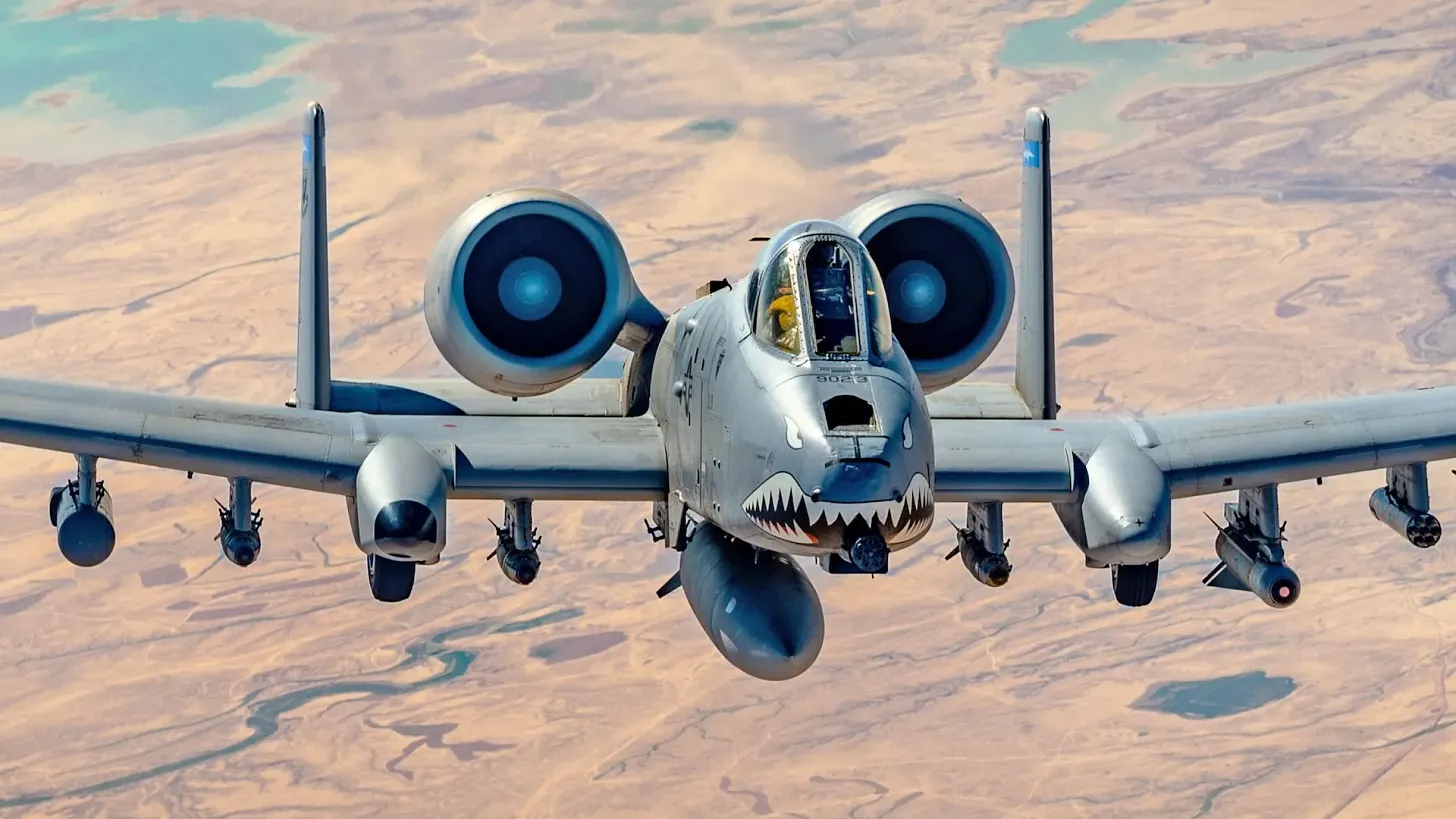
Posted on 03/28/2026 8:40:39 AM PDT by MtnClimber
There is a particular species of institutional error that only becomes visible in hindsight, and only then at considerable cost. It is not the error of building the wrong weapon. It is the error of discarding the right one because it does not fit the threat you expect to fight. The US Air Force spent the better part of a decade trying to retire the A-10 Thunderbolt II, requesting $57M in its fiscal year 2026 budget submission to decommission the remaining 162 aircraft, two years ahead of its own previously stated schedule. Congress blocked the effort, mandating a minimum fleet of 103 aircraft through September 2026. And then Operation Epic Fury began, the Strait of Hormuz closed, and the aircraft the Air Force wanted to scrap became the one the joint force needed most. The irony is not that the Warthog proved useful. The irony is that the environment where it proved essential was one American planners should have anticipated for decades.
American carrier aviation and Aegis destroyer capabilities were engineered for the open ocean, for blue-water engagements against sophisticated adversaries operating capital ships, cruise missiles, and ballistic anti-ship weapons. That engineering represents the correct solution to the problem it was designed to solve. The Strait of Hormuz presented a categorically different problem. Iranian tactics relied on swarm attacks using fast, low-signature boats, often armed with rockets, mines, and short-range anti-ship missiles. These are targets that are difficult to detect and track using conventional high-altitude strike profiles. The IRGC operated more than 1,500 such craft, composite and fiberglass hulls mostly under 15 tons, running between 50 and 70 knots, each carrying a Naser-1 anti-ship missile with a 35-kilometer range and a terminal speed of Mach 0.9, sufficient to mission-kill a frigate. Their doctrine was swarm, overwhelm, and saturate, forcing the defender to choose which threat to engage while knowing that every defensive weapon fired costs more than every offensive boat it destroys.
That cost asymmetry is where conventional naval doctrine collapses inside a confined channel. An SM-6 interceptor costs $5.3M. A Harpoon costs $1.5M and was engineered for cruiser-sized targets, not composite skiffs. The Phalanx CIWS empties its magazine in 20 seconds and requires 4 minutes to reload. An Aegis destroyer carries between 90 and 96 vertical launch cells, many of which are already committed to Tomahawks, SM-2 interceptors, and ESSM quad packs. Using those cells against a sustained swarm of $50K to $500K speedboats is not a doctrine. It is a bankruptcy proceeding conducted at sea. Consider the analogy of a master locksmith hired to fix a screen door. His tools are genuine, his skills are real, and his credentials are impeccable. None of that matters if he arrived with the wrong kit for the job in front of him. The Navy arrived at Hormuz with blue-water tools and found a brown-water problem, and the screen door stayed broken regardless of how impressive the locksmith’s reputation happened to be.
The A-10 exists at the opposite end of that cost spectrum, and this is precisely what makes the match between aircraft and environment so analytically precise. The Warthog is built around its GAU-8/A Avenger cannon, a seven-barrel Gatling system that fires 30-millimeter depleted uranium rounds at 3,900 per minute, or 65 rounds per second. The aircraft carries 1,150 rounds in a drum roughly the volume of a Volkswagen Beetle. A standard 2-second combat burst puts approximately 130 rounds downrange against a target. A fiberglass fast boat has no armor. The engagement math against that target runs to under $10,000, compared to $5.3M for an SM-6 intercept of the same threat. That is a 500-to-1 cost advantage, and it is not a marginal improvement within a shared category of performance. It restructures the entire economics of the engagement from the ground up. For medium-range targets, the Maverick air-to-surface missile runs between $150K and $170K per shot, still 30 times cheaper than the SM-6. For fast boats mixed with drone threats, APKWS laser-guided rockets cost approximately $35K per engagement. Across every distance inside the corridor, the A-10’s cost per kill runs between 30 and 500 times lower than the Navy’s available alternatives.
But cost alone does not explain why this aircraft specifically, and it is worth slowing down here because this is where the argument becomes most interesting. Any platform can theoretically deliver cheap munitions. What makes the A-10 the correct instrument at Hormuz is the simultaneous combination of characteristics that the environment demands and that no other aircraft in the current inventory provides together. The Warthog operates at low altitude with extended loiter time, allowing pilots to visually identify, pursue, and engage threats in real time, even in congested maritime environments where civilian and military vessels are intermingled. That visual identification capacity is not a secondary convenience. It is the primary capability the mission requires. When 3,200 civilian vessels anchor in the Gulf and IRGC boats disperse among them, no radar signature, no electronic profile, and no algorithmic targeting solution substitutes reliably for a trained pilot at low altitude with a clear line of sight to the water below. An F/A-18E Super Hornet crossing the corridor at over 500 knots leaves every surface target in the pilot’s visual field for under 2 seconds. At the A-10’s patrol speed, the identification window extends two to three times longer. The pilot sees the rocket launchers bolted to the gunnel, sees the military configuration, confirms the target, and fires. That sequence is not physically possible at supersonic approach speeds, and no amount of sensor sophistication fully compensates for that constraint.
Loiter time is the decisive metric in a sustained patrol mission, and here the A-10’s characteristics align precisely with what Hormuz demands. The aircraft can remain on station for approximately 1 hour and 50 minutes on internal fuel, extended to 2.5 hours with external tanks, flying racetrack patterns over the corridor, scanning, waiting, selecting. It does not consume its endurance transiting hundreds of miles from a carrier and back. It arrives at the 6-mile slot and stays. Its straight-wing configuration, often cited in retirement arguments as an aerodynamic limitation compared to swept-wing designs, produces more efficient lift at low speeds, burns less fuel per hour in the patrol regime, and enables a turn radius tight enough that the aircraft can reverse its patrol loop without ever departing the engagement zone. What looks like a design constraint in a comparison with the F-35 becomes a structural advantage inside a narrow maritime chokepoint. The aircraft was optimized for an environment that, as it turns out, looks considerably like Hormuz.
Survivability completes the argument. The A-10 pilot sits inside roughly 1,200 pounds of titanium armor, a cockpit enclosure engineered to withstand 23-millimeter armor-piercing rounds and 57-millimeter fragmentation. The aircraft’s redundant hydraulic and control systems can sustain catastrophic battle damage and continue flying. The IRGC’s coastal installations fire 12.7-millimeter and 14.5-millimeter machine guns at low-flying aircraft. A fast-moving strike jet avoids that threat by climbing out of range, surrendering the visual identification capability in the process. The A-10 absorbs the fire and continues the engagement, because absorbing that category of fire at low altitude while remaining operationally functional is precisely the engineering tradeoff its designers prioritized. The aircraft’s combat history across Desert Storm, the Balkans, Afghanistan, and Iraq demonstrated this survivability under live fire conditions repeatedly. At Hormuz, that history stopped being historical and started being operational.
What elevates Operation Epic Fury from a platform story to a strategic lesson is the joint architecture surrounding the A-10’s contribution. US Army AH-64 Apache attack helicopters are now operating alongside the Warthogs over Iran’s southern flank and the strait, staging from expeditionary sea bases, forward-deployed Navy platforms adapted to support Army aviation. Each Apache carries up to 16 Hellfire missiles at between $70K and $200K each and a 30-millimeter chain gun, the same caliber as the Warthog’s cannon. The Apaches operate at a lower altitude than the A-10’s patrol layer, engaging threats that pass through the upper layer’s coverage. Meanwhile, the Aegis destroyers preserve their vertical launch inventory for threats that genuinely justify the cost: anti-ship ballistic missiles, Mach-3 cruise missiles, capabilities that nothing else in the joint force can stop. US Central Command also employed multiple 5,000-pound deep penetrator munitions against hardened underground storage facilities along Iran’s southern coastline, collapsing the supply infrastructure feeding the coastal defense systems threatening the corridor from shore. The layered result is a system where the most capable and expensive weapons are reserved for the threats they were actually designed to defeat, while the cheaper persistent tools handle the volume threats that would otherwise drain the expensive inventory dry.
No other military in the world could assemble this architecture, and that is not rhetorical patriotism. It is a structural observation about institutional prerequisites. Integrating three separate service branches, each operating under distinct doctrine, distinct equipment, and distinct command culture, into a coherent simultaneous layered defense over a single 6-mile maritime corridor requires decades of joint training infrastructure, interoperable communications systems, shared logistics networks, and a practiced culture of inter-service coordination that most militaries never develop because their organizational incentives never demand it. Single-service dominance, which characterizes most of the world’s capable militaries, produces precisely the Navy-alone scenario that Iran’s swarm doctrine was designed to exploit. The IRGC studied the 2002 Millennium Challenge war game, in which a retired Marine lieutenant general used unconventional swarming tactics to sink 16 American warships in the exercise’s opening phase, forcing the Pentagon to restart the simulation with adjusted parameters. Iran built an entire naval strategy around that exercise, engineering 1,500 fast attack craft to overwhelm 96 vertical launch cells on an Aegis destroyer. The arithmetic was deliberate. The strategy was designed for a scenario where the American Navy answers the call without the Army and without the Air Force. The joint architecture that materialized above the strait exploits none of the vulnerabilities Iran’s planners built their strategy around, because Iran solved for the wrong equation.
The harder question is what comes next. The A-10 will eventually retire. Titanium armor and seven-barrel Gatling cannons do not operate indefinitely, and the sustainment cost of an aging airframe rises as flight hours accumulate. Operation Epic Fury has not resolved the retirement debate. It has made the debate considerably more expensive to resolve incorrectly. The capability gap the Warthog fills does not disappear when the airframe does. Fifth-generation strike aircraft have performed effectively against Iran’s air defenses and hardened infrastructure during Epic Fury, but experts have noted that their continued use against cheap, one-way attack drones and fast boats is economically unsustainable at scale. The F-35 is a remarkable aircraft optimized for a specific threat environment. That environment does not include hunting composite speedboats at low altitude over a congested 6-mile shipping lane, and no software upgrade changes the physics of its speed, fuel consumption, and minimum effective altitude. The question Congress and the Air Force must answer is not whether to keep the Warthog forever. The question is whether a successor capability exists that fills the same operational niche at comparable cost and comparable effectiveness. If the answer is no, and at this writing the answer appears to be no, then retiring the platform before that successor is fielded is not a budget decision. It is a capability decision, and the consequences of that decision will become visible the next time American forces confront a congested, narrow, contested maritime corridor where the correct answer is slow, cheap, and persistent rather than fast, expensive, and precise.
The Strait of Hormuz will not be the last such corridor. Analysts have identified the Taiwan Strait, the Bab el-Mandeb, and the contested island approaches of the South China Sea as environments with structural similarities to Hormuz: confined spaces, asymmetric threats, swarm tactics, and civilian vessel density that makes high-speed precision strike operationally difficult. The lesson available from Operation Epic Fury is not specific to Iran. It is a lesson about what kinds of capability matter in what kinds of environments, and about the institutional cost of failing to match tools to problems before the problem arrives. Dan Grazier, a senior fellow at the Stimson Center and director of its national security reform program, captured the underlying principle precisely when he observed that when you design a weapon system where every decision was made for matters of military effectiveness rather than procurement convenience, you get a genuinely effective aircraft. The Warthog is the proof case for that principle, and the Strait of Hormuz is where the proof was filed under live fire.
The A-10 was almost retired because it did not fit a doctrine built around the wars that planners expected to fight. The Strait of Hormuz was the war that actually arrived. The aircraft the Pentagon wanted to discard for $57M is the one currently holding open one of the world’s most critical energy chokepoints, destroying fast boats for under $10K per engagement while $5.3M interceptors stay in their cells for threats that justify the price. The equation is on the public record. It deserves to inform every procurement and retirement decision that follows
“Just build more A-10s. Why is that not the solution?”
Fairchild-Republic who built the A-10 is no longer in business. I doubt the tooling still exist. Recreating that tooling would take time and lots of money. It would be like designing AA completely new aircraft.
I agree. I’ve talked about the A-10 before. It is a beauty.
The A10 was originally designed as a tank killer, and the depleted uranium rounds were for that purpose. I don’t know if the Gatling gun would work right with FMJ rounds.
Heard more less exactly that from a WWII P51 pilot- his favorite target were trains because you got the big "kaboom" of steam when you got to the engine.
But he also said that on the long flight back to base you though about the guys on the train and you didn't feel so good.
He ferried some fighters back to the US in 1945 and never flew an airplane again.
“We’d be dead”. I had the same thought.
I was working at a small airport where two A-10’s would leave every morning and come back later. I was on a taxi-way and at the other end was an A-10 parked. A guy drove out to tell me to get off the taxiway when the A-10 was there. “He’s aiming his gun, and it’s loaded. We’ve never had an accident, but...”
I guess they would take off and do their training runs. One day I was standing on top of the cargo van taking photos of the site, parked in the grassy infield. One A-10 landed, and the other one flew right over my head. Low. I just laughed and thought “I’m dead!”
The A-10 has one flaw. It does not have United States Army painted on it.
Eventually, the operator can be made less and less important.
“””””I know this sounds terrible but straffing has to be a real blast.”””””
Talk to helicopter door gunners during Vietnam, I’ve never met one or heard of one who didn’t like it (not strafing but lot’s of auto fire from high up).
If I recall correctly; the argument to end the A-10 started with Obama (not him specifically). I also recall 0bama appointed admirals to kill the littoral ship program. Something that plays a significant role in dealing with Barbary Pirates around the world (plus defense of Taiwan).
Forbes https://www.forbes.com › sites › sebastienroblin › 2022 › 12 › 11 › to-stop-killer-drones-ukraine-upgrades-ancient-flak-guns-with-consumer-cameras-and-tablets To Stop Killer Drones, Ukraine Upgrades Ancient Flak Guns With ... - Forbes Dec 11, 2022Photos of an air defense training exercise of Ukraine's Territorial Defense Force show a 20-millimeter anti-aircraft gun fitted with consumer CCTV cameras to serve as thermal and daylight sights ...
Aviation Week Network https://aviationweek.com › defense-space › budget-policy-operations › drone-threat-puts-flak-back-demand Drone Threat Puts Flak Back In Demand | Aviation Week Network Jun 24, 2024The Gepard anti-aircraft guns that Germany donated to Ukraine were once considered obsolete, but they have proven highly effective against drones and cruise missiles.
Yet,
As with most things that are perceived to do harm, the instinct of many defence agencies has been to fight fire with fire—hurt it before it hurts us. Hard-kill capabilities are at the forefront, and there’s a rising appetite to use bullets and lasers to down drones that come too close.
Unfortunately, hard-killing drones is rarely effective. The German Flakpanzer Gepard anti-aircraft gun has been successful against the Iranian HESA Shahed 136, but it remains an exception, not the norm. And despite its usefulness in the instance of the Shahed, it still suffers ammunition resupply issues, uses ‘dumb’ bullets and, ultimately, will face new challenges as foes get smarter.
The reality is that the old-hat method of shooting at anything that poses a threat is extremely difficult when the target is a small object moving at 100 kilometres an hour in often unpredictable patterns. Many militaries have tried using small arms, but it almost never works unless the drones are extremely close and there are only a few of them.
A centrepiece of Ukraine’s defence against Russia is the use of soft-kill capabilities to defeat drones. Soft kill—or smart jamming—uses radio frequency instead of bullets and lasers. It can actively monitor for drones, unlike yesteryear’s sensors, and take them down using handheld devices without explosions.
Soft kill is also free of the restrictions of ammunition. Fragmenting rounds from large turreted weapons—typically of the 25- to 35-millimetre calibre variety—can down a few drones, but large amounts of ammunition are required to deal with just a few targets. Then there’s the issue of setting up and moving the turret, alongside the logistics of resupply. - https://www.aspistrategist.org.au/why-a-hard-kill-strategy-doesnt-work-against-combat-drones/
Why a hard-kill strategy doesn’t work against combat drones 13 Sep 2023|Oleg Vornik
“I am glad that they did not retire the A-10.”
They did retire several squadrons of them. I met at the Oshkosh airshow last year one of squadron and they were headed to the boneyard that next Monday.
“I don’t know if the Gatling gun would work right with FMJ rounds.”
Wiki
The standard ammunition mixture for antiarmor use is a five-to-one mix of PGU-14/B armor-piercing incendiary, with a projectile weight around 14.0 oz (395 g or 6,096 gr) and PGU-13/B high-explosive incendiary] rounds, with a projectile weight around 13.3 oz (378 g or 5,833 gr).[10] The PGU-14/B’s projectile incorporates a lightweight aluminum body, cast around a smaller caliber depleted uranium penetrating core.[11] In 1979, the Avenger was tested against M47 Patton tanks and caused “severe damage”.[12]
An innovation in the design of the GAU-8/A ammunition is the use of aluminum alloy cases in place of the traditional steel or brass.[13] This alone adds 30% to ammunition capacity for a given weight. The projectiles incorporate a plastic driving band to improve barrel life. The cartridges measure 11.4 in (290 mm) in length and weigh 1.53 lb (0.69 kg) or more.
The most Destructive Gun ever Devised..... just add wings.
That is the correct answer. Build a drone around a gun instead of a missile platform, and you'll have a winner. The gun doesn't even necessarily need to be something as huge as the GAU-8. The M61 Vulcan will do just fine.
The AF has been trying to kill off the Warthog for years. Very glad they have not succeeded. This aircraft is unique, has a distinct role, and is super in support of ground ops.
There is nothing quite the same in the US arsenal.
“The A-10 was almost retired because it did not fit a doctrine built around the wars that planners expected to fight. The Strait of Hormuz was the war that actually arrived. “
The A-10 is a fantastic aircraft for what was designed to do.
I did Depot level maintenance on A-10s while I was in the military in the early 70s. Even though I was an Avionics Technican, I had to learn sheet metal repair and other mechanical skills. In a Depot they literally strip the air craft to the frame and rebuild it.
The only thing that saved the A-10 was Congress fixation on
tank wars which the Pentagon knew was outdated. See how the Russians with massive tank forces are basically stalled after a very short period in Ukraine, by a far smaller military.
Nobody ever considered a “Tank” like war scenario being fought in narrow marine environments. Masses of small
cheap mobile targets engaging a larger massive not quite as nimble force.
An American Marine general in war games demonstrated it,
the Iranians saw it and copied it.
We are blessed that stodgy old stubborn men that refuse to
easily change are in the congress.
Progressives would have killed us.
Bingo.
I gotta say, rumors of this planes demise have been largely exaggerated.
Ammunition for the GAU-8 cannon:
PGU-14/B API Armor Piercing Incendiary (DU)
PGU-13/B HEI High explosive incendiary
PGU-15/B TP Target Practice
Your wish was fulfilled many years ago ...
The practice rounds would probably do for ripping up speedboats ...
One might place drones on rafts and keep them charged using solar power.
Once a speedboat comes near a raft, its drone can sent after the speedboat which can be taken out like a Russian tank is by Ukraine.
I do not know beans about the specifics but do believe it is obvious that certain weapons systems are pushed primarily to enrich military contractors and to satisfy the egos of our military politicians, all of which would be scared shitless if they had to actually strap in a Warthog or any other aircraft. Or man any Navy or Army vehicle other than a base transportation Jeep.
Disclaimer: Opinions posted on Free Republic are those of the individual posters and do not necessarily represent the opinion of Free Republic or its management. All materials posted herein are protected by copyright law and the exemption for fair use of copyrighted works.