Posted on 03/27/2026 11:41:49 AM PDT by MtnClimber
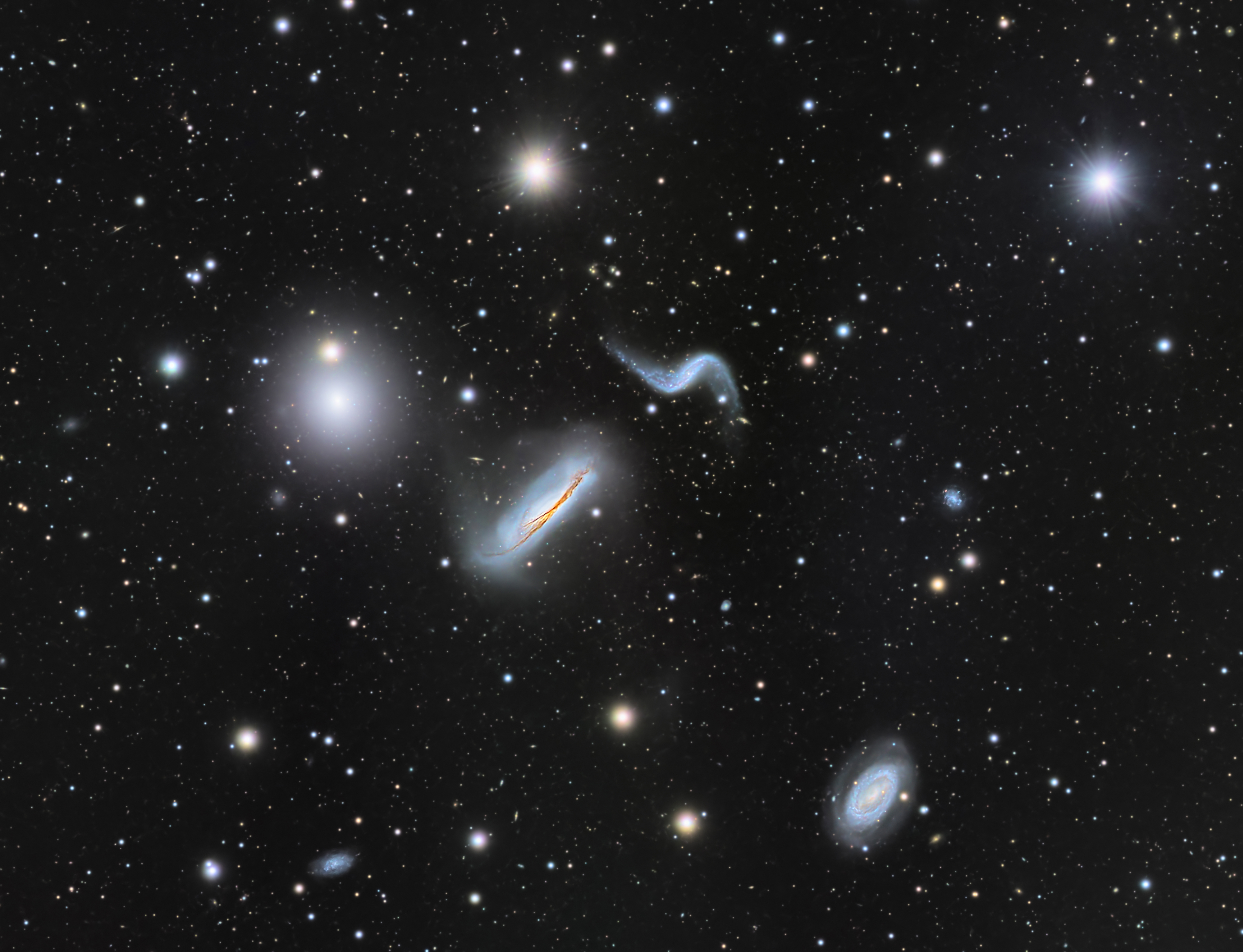
Explanation: Scanning the skies for galaxies, Canadian astronomer Paul Hickson and colleagues identified some 100 compact groups of galaxies, now appropriately called Hickson Compact Groups. The four prominent galaxies seen in this intriguing telescopic skyscape are one such group, Hickson 44. The Hickson 44 galaxy group is about 100 million light-years distant, far beyond the foreground Milky Way stars, toward the northern springtime constellation Leo. The two spiral galaxies in the center of the image are edge-on NGC 3190 with distinctive, warped dust lanes, and S-shaped NGC 3187. Along with the bright elliptical, NGC 3193 (left) they are also known as Arp 316. The spiral toward the lower right corner is NGC 3185, the 4th member of the Hickson group. Like other galaxies in Hickson groups, these show signs of distortion and enhanced star formation, evidence of a gravitational tug of war that will eventually result in galaxy mergers on a cosmic timescale. The merger process is now understood to be a normal part of the evolution of galaxies, including our own Milky Way. For scale, NGC 3190 is about 75,000 light-years across at the estimated distance of Hickson 44.
For more detail go to the link and click on the image for a high definition image. You can then move the magnifying glass cursor then click to zoom in and click again to zoom out. When zoomed in you can scan by moving the side bars on the bottom and right side of the image.
🪐 🌟 🌌 🍔
That S-shaped galaxy looks like a fun ride.
We’re looking at trillions and trillions of miles.
We’re looking at trillions and trillions of miles.
You are upping the ante on Carl Sagan
Ping.
Sirius, the brightest star in the sky after the sun, is one of the closest, and it is trillions of miles away. Seriously. These galaxies are something like 600 quintillion miles away. Once you get past trillions the numbers are hard to visualize.
Wow.
Any idea what lens was used?
An engineer friend of mine (and a pretty good amateur astronomer) tried to explain parsecs to me, but my puny brain had trouble comprehending.
New Mexico Cosmos Observatory, Edgewood (NM), US Edgewood, NM, Edgewood (NM), US Bortle 4 N
Leo 10h 18m 6s · +21° 49′ 57″ 0.69° × 0.46° 0.21″/px 12.60°N Broadband
· High resolution Integration UV/IR Cut 110×300″ 9h 10′ 3 days in Mar 2026 46% R 40×300″ 3h 20′ Mar 5 96% G 40×300″ 3h 20′ Mar 6 90% B 34×300″ 2h 50′ Mar 12 40% Totals 18h 40′
6 days in Mar 2026 61% Imaging equipment Telescope Celestron EdgeHD 11" Camera ToupTek ATR2600M Mount iOptron CEM120EC2
Filters Baader Blue (CMOS-Optimized) 36 mm Baader Green (CMOS-Optimized) 36 mm Baader Red (CMOS-Optimized) 36 mm Baader UV/IR CUT Luminance (CMOS Optimized) 36 mm
Accessories Celestron 0.7X Reducer EdgeHD1100 (94241) Celestron Off-Axis Guider MoonLite LiteCrawler ZWO EFW 7 x 36mm Software KDEdu KStars Pleiades Astrophoto PixInsight Guiding equipment Guiding camera Starlight Xpress Lodestar X2
Not only excellent equipment, but the photographer knows his stuff.
Thanks for the info and link. Amazing shots from an 11 inch scope.
I was thinking Webb or Hubble!
Disclaimer: Opinions posted on Free Republic are those of the individual posters and do not necessarily represent the opinion of Free Republic or its management. All materials posted herein are protected by copyright law and the exemption for fair use of copyrighted works.