Posted on 03/09/2026 10:30:30 AM PDT by ProtectOurFreedom
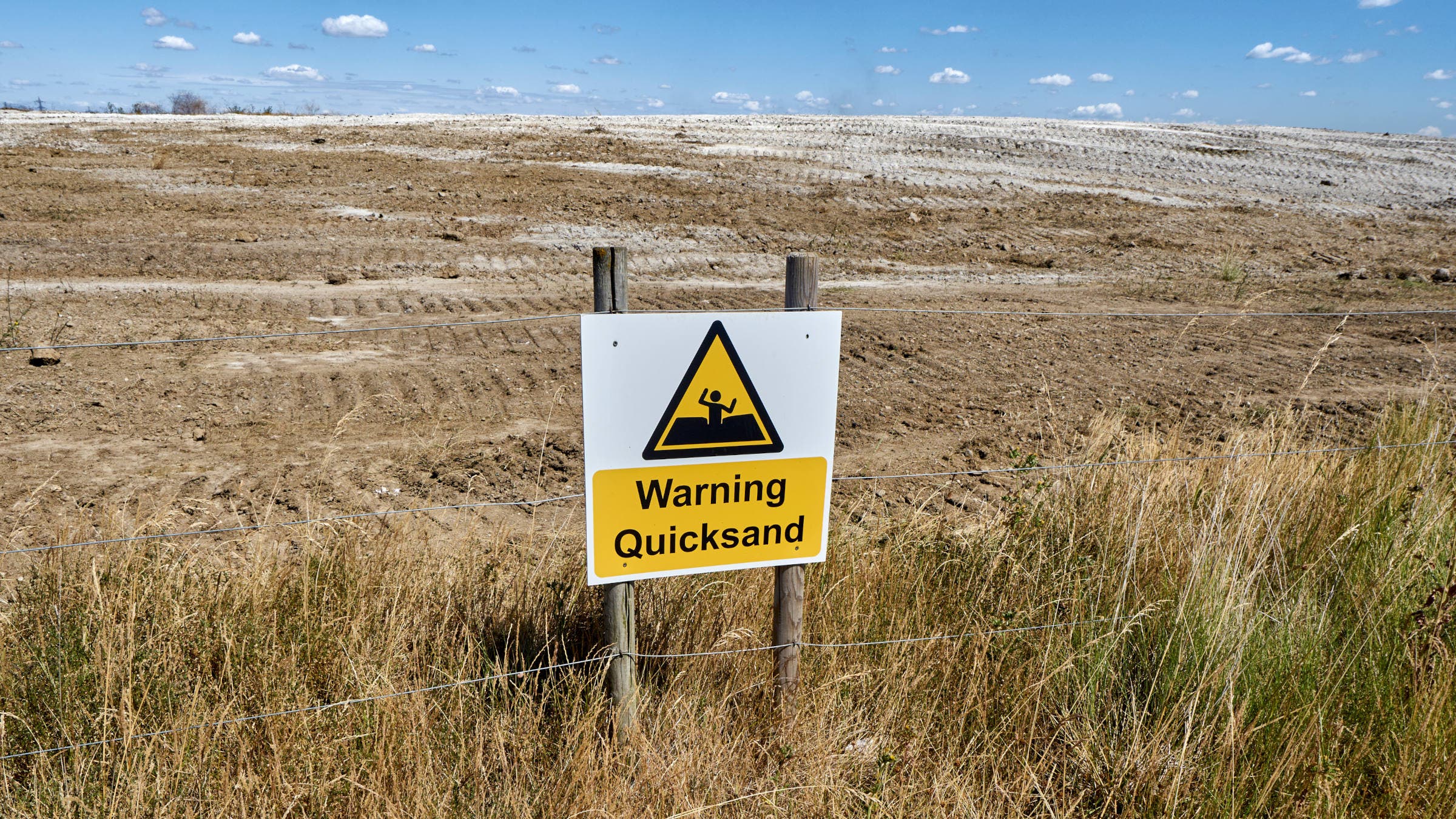
It may not be the human-swallowing horror of Golden Age Hollywood films, but quicksand is a real-life hazard for hikers. It pays to know what it is and how to escape.
Like many people who have survived being trapped in quicksand, Dirks noted that there was nothing unusual about the sand to suggest danger. As he told writer Mary Beth “Mouse” Skylis: “I’ve hiked in conditions almost identical to that…There were no immediate red flags that stuck out.”
Quicksand, as it turns out, is very real, and more than a little dangerous. No, it may not be “the third biggest thing you have to worry about in adult life, behind real sticks of dynamite and giant anvils falling on you from the sky,” as John Mulaney famously said, and despite what cartoons and Golden Age Hollywood movies suggest, it can’t swallow you whole, leaving just your pith helmet floating on top. But getting stuck in quicksand can pose genuine risks from hypothermia and lack of circulation, and can even endanger lives in rare occasions, such as in 2023, when a 20-year-old man drowned after becoming trapped in quicksand-like mud flats near Hope, Alaska. As our colleagues at Outside wrote last week, the National Park Service warned visitors that it had received reports of the hazard in parts of Glen Canyon National Recreation Area in Utah and Arizona.
If you need a primer on quicksand, this overview on it is a good place to start. The substance forms when just the right amount of water mixes with fine sand, reducing the friction that individual grains of sand exert on each other and reducing its ability to bear weight. Danger zones for it include the inside curves of rivers and dry washes. Flooding—and, oddly enough, salt—can exacerbate the problem.
Quicksand is “something to be aware of when you’re hiking, but maybe not something that should be outright feared,” Zion National Park Chief Ranger Daniel Fagergren told us when we talked to him in 2022. While Hollywood may depict quicksand pits as a danger you’d mostly find in the jungle, in the US, the desert southwest is ground zero for it, though it can occur in other places as well. Fagergren explained what hikers should watch out for and how they can avoid getting stuck in it.
As we’ve written, quicksand isn’t usually dangerous on its own. But add in cold temperatures and precipitation, and trapped, sodden hikers can be at real risk of hypothermia. That was Ryan Osmun’s biggest concern when he became stuck in quicksand during a hike in Zion National Park. As he related to Backpacker‘s Out Alive podcast, he would end up spending 10 hours unable to move while his girlfriend, with whom he had been hiking, went looking for cell reception to call for help.
Dirks’s story, which he originally related on Reddit before speaking with Backpacker, is important reading for any solo hikers headed to the desert as well. While he was able to get in touch with rescuers through a satellite communicator, he would ultimately spend two hours waiting for help to arrive, his knee bent at a painful angle that entire time. “I worried about the knee more than the cold,” he wrote. “I did not know how long it could stay bent like that before something tore or dislocated.”
I got stuck in mud when I was about 12 years old. It was in the fields near a new shopping center construction site. I had on my tall "pack boots" and got completely stuck. Fortunately, I was with a friend and he went for help. A construction worker from the site came to my rescue and pulled me out. Scared me to death at the time! It was getting dark and was a very chilly spring or fall day.
My son got stuck when he was about seven or eight. We were mountain biking at Joseph Grant County Park above San Jose, CA in the springtime. He dismounted and promptly got stuck. I pulled him out, but I think his shoe is still buried in the mud.

I got my dirt bike caught in quick sand once. It was a a heck of a mess and I was lucky to get both the bike and myself out.
How deep does it go? China?

Beat me to it!
I got stuck in a mud puddle in our back alley when I was 6-ish. I think my boots are still there.
I have learned that many of the things I thought were going to be big problems for me when I was a kid just didn’t pan out.
The Bermuda Triangle, quicksand, alien abduction, none of them have presented me near the difficulties I expected
Today i learned that Gilligan’s Island is a documentary.
I’ll bet you figured your bike was a goner. Lucky to get out, indeed!
LOL...”none of them have presented me near the difficulties I expected”
Then along came Hussein

Martha and the Vandellas
I’ve stepped into quicksand a couple of times in the Manitou Islands in Lake Michigan. The first time I was climbing a gully amid some bluffs. I stepped over a rock and planted my foot and it... just kept going. It was only calf deep, but the coolness of the water under the sand on a warm summer day was jarring. Like I’d suddenly stuck my foot through a gateway into the Void or something. Took a moment to register what was going on, but I was able to pull my foot out without difficulty. The sand on top was dry and just like the surrounding area.
Was covered in mud and my hands were bleeding like crazy.
I delivered papers for 2 years to buy that bike, and frankly it was my ride home so I didn't have much of a choice in the matter.
I’ve been worrying about quicksand and molten lava since I was 4 years old.
I sank up to my chest once. Where I grew up I went fishing all the time along the rovers. It was common for springs to wander and later in the season silt would settle over them and you couldn’t see there was a spring underneath. The top looked dry. Stepped in and right down I went. The number one thing to do is NOT panic. I just sort of laid down in it and slowly ‘floated to the top and moved where I could grab some roots and drag myself up the bank. I was too dumb to be scared at the time but probably could have ended a lot worse than just being wet and muddy.

Disclaimer: Opinions posted on Free Republic are those of the individual posters and do not necessarily represent the opinion of Free Republic or its management. All materials posted herein are protected by copyright law and the exemption for fair use of copyrighted works.