Posted on 03/04/2026 10:22:28 AM PST by MtnClimber
If hostile states believe Britain can be deterred by the threat of domestic unrest, they will exploit that perception, utilising communities which have failed to fully integrate into British society.
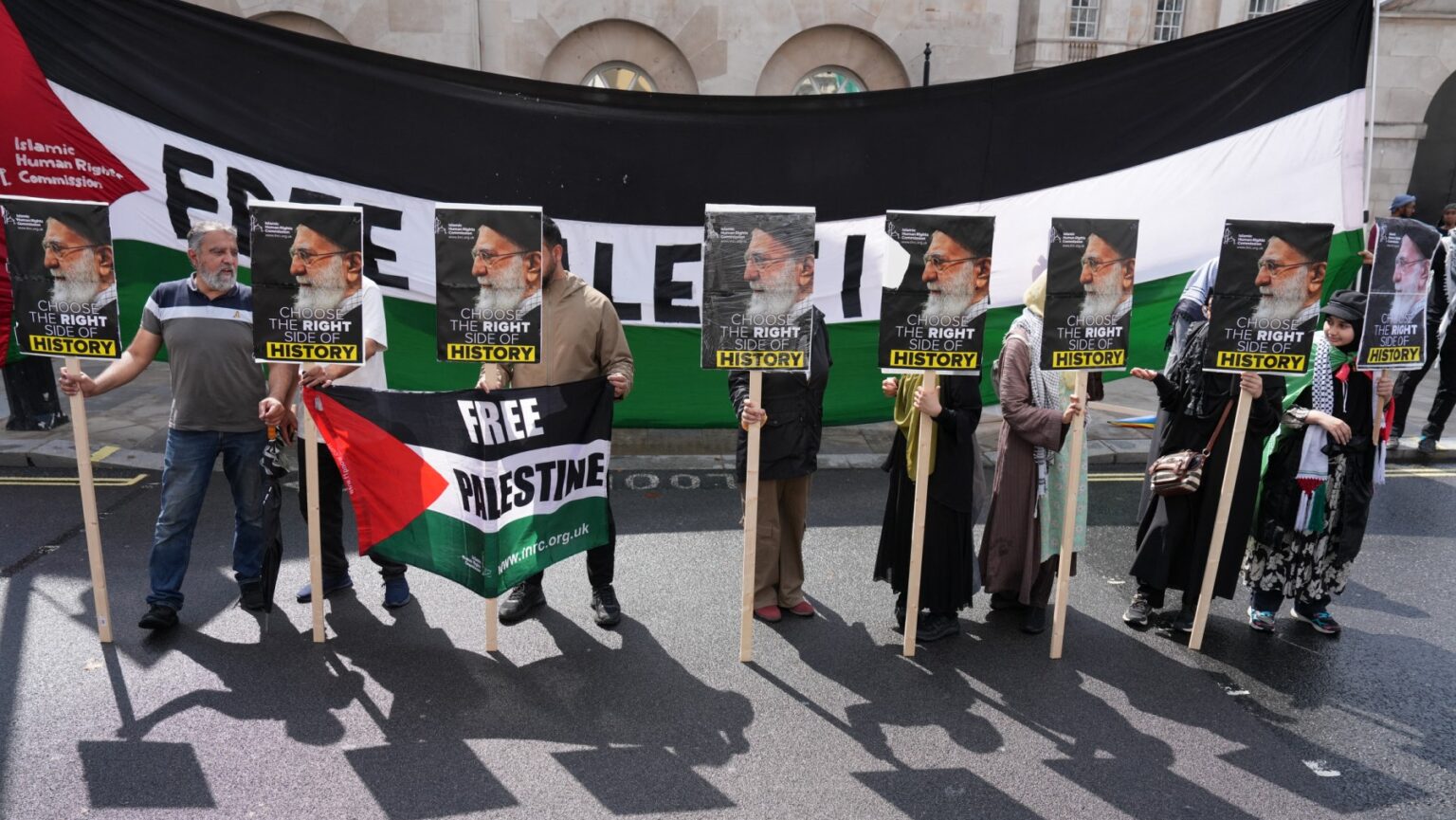
Activists from the Islamic Human Rights Commission hold a banner and placards showing the face of Iranian Supreme Leader Ayatollah Ali Khamenei on Downing Street in central London, on July 19, 2025, as they join a ‘National March for Palestine’ organised by the Palestine Solidarity Campaign. CARLOS JASSO / AFP.
Whatever one’s view of the so-called ‘special relationship’ between the United Kingdom and the United States (and I, for one, think it’s non-existent and embarrassing), the UK’s refusal to support American action against Iran marks a troubling moment in British foreign policy. The decision to prevent the United States from using joint UK-U.S. bases while simultaneously (and endlessly) stressing Britain’s non-involvement signals a government more concerned with internal community relations than strategic reality.
Close Commonwealth allies such as Australia and Canada, not natural bedfellows of the Trump administration, recognised the necessity of confronting Iran’s aggression. Britain and its Labour government, yet again, chose hesitation. The government has suggested that legal constraints made participation impossible. That claim does not withstand scrutiny.
Lord Wolfson, the shadow attorney general, has outlined a clear legal basis for action. He stated that the right of self-defence exists against an imminent threat from a hostile state with a consistent record of aggression. Also, there have been Iran’s sustained campaigns against British interests, including assassination plots, cyber-attacks, and threats to UK forces—not least the six-year insurgency against the British military in southern Iraq by Iran-backed Shia militias. There is also the moral obligation to assist allies acting in self-defence, particularly where Iran’s nuclear ambitions pose an existential threat to Israel.
On any reasonable interpretation, Britain could have supported its allies within the framework of international law. Instead, the government chose inaction. This was an explicitly political decision; one rooted in caution and risk aversion rather than national interest.
The graver concern is that Britain’s foreign policy is increasingly shaped by domestic vulnerability. Successive governments have allowed hostile regimes and extremist networks to establish influence inside the United Kingdom. Organisations which proclaim to be NGOs standing for such noble ideals as justice and human rights turn out to have links with nefarious international players. The Islamic Human Rights Commission, for example, has explicit associations with the Iranian regime. The result is a country that must now calculate foreign policy decisions in light of potential reprisals at home.
Iranian state activity on British soil has become a persistent reality. Plots targeting dissidents, journalists and political figures have been repeatedly uncovered. Islamist extremism remains the single largest terrorism threat facing the country by some way, yet the UK still refuses to designate Iran’s Islamic Revolutionary Guard Corps as a terrorist organisation—despite its direct involvement in hostile operations against British interests. This reluctance signals yet further weakness to adversaries who already view the West as lacking resolve.
Britain’s Muslim population has grown to around 6-7% of the total, and in some areas forms a decisive voting bloc. This was seen only last week, in the Gorton and Denton parliamentary by-election being won by the Green Party, which unashamedly leveraged sectarian prejudice in order to do so.
This emergence of sectarian political campaigning in certain British constituencies is a worrying development. Recent campaigns have appealed explicitly to religious and ethnic identity, urging voters to ‘punish Labour for Gaza’ and portraying political opponents as enemies of Muslim communities. This kind of politics fragments the electorate and undermines the principle of national citizenship. It risks importing the conflicts of the Middle East directly into British democracy, and this Labour government (always running scared of its politically infantile backbenchers) is looking at UK foreign policy through this prism, rather than confronting it.
Electoral fraud scandals in Birmingham and east London exposed serious weaknesses in Britain’s voting system, particularly around postal ballots and community pressure. More recent reports of coercive family voting and organised turnout in heavily Muslim constituencies suggest these vulnerabilities have not been addressed. These issues need to be confronted head-on. Public confidence in elections depends on the perception, as well as the reality, of integrity. That confidence is being rapidly eroded.
Mass demonstrations across Britain since 2023 have revealed a disturbing shift in public culture. Large-scale protests have celebrated organisations openly hostile to the West while condemning democratic allies such as Israel. Marches in London have featured open displays of support for the Iranian regime and its proxies. Political figures have attended such demonstrations without apparent concern for the message being sent. At the same time, communities opposed to authoritarian regimes in the Middle East have found themselves overshadowed by louder and more organised pro-regime activism. The scale and intensity of these demonstrations suggest a country increasingly uncertain of its own values.
The government’s refusal to support action against Iran reflects a broader failure of political leadership. Britain once understood that strength deters aggression. Today it too often signals hesitation instead. By dishonestly emphasising legal technicalities and fears of escalation, ministers risk creating the impression that Britain lacks the confidence to defend its own interests. Strategic caution has become strategic paralysis. If hostile states believe Britain can be deterred by the threat of domestic unrest, they will exploit that perception, utilising communities (covertly or otherwise) which have failed to fully integrate into British society—due to institutional disdain for the country or just plain cowardice.
Britain faces a clear choice. It can continue down a path where international law is treated as an end in itself, where domestic sensitivities constrain national policy and where hostile regimes operate with increasing confidence. Or it can reassert the principle that law exists to defend nations, not to weaken them. International law should serve the security and sovereignty of democratic states. When it fails to do so, it must be reinterpreted or reformed—not blindly obeyed.
A country unwilling to defend its interests will eventually lose the ability to do so. Britain must decide whether it still intends to act like a serious nation or whether it will remain trapped by a legal framework designed for a world that no longer exists and by fear of challenging bellicose domestic Islamism.
I think that UK, Canada and Australia have been conquered in the jihad. They are lost. They think their citizens are the enemy and that the jihadi enemies are their friends. Normal leftist upside-down thinking.
The UK is becoming the new Lebanon
It will be torn to shreds by sectarian conflict.
Terror works.
It isn’t over yet. America is quite skilled at carrying out revolutions and regime changes and there is no reason we cannot turn those tools angainst our Islamic enemies if they do capture those European countries.
The gist of the article - it is, of course, a principal objective of the internationalist migration jihad to bring potential enemies under control from within. Being assimilable within the host culture actually acts against this purpose.
Immune systems tend to be messy, ugly things, and the UK's immune system is being ruthlessly suppressed by its own government. In the United States the Democrats have gone a long way to effect that suppression here - that is, after all, what "inclusion" really means.
UK, Canada and Australia brought in 100,000s of muslims and they never thought they were DANGEROUS , stupid politicians
mark
The biggest Cuckolded nation in the entire history of the world has got to be present day United Kingdom.
They really are at a point where they don’t even deserve a country anymore
More like evil politicians. At least Australia imported millions of Chinese so they can fight with the muzzies over who gets to kill whitey.
They have been watching and living with it for decades, and now they need to confront the reality of their inaction and forcefully react. Will they screw up the courage to do so?
BTW, the same thing is happening in the United States.
I bet half the UK’s administrative state is staffed by people named Mohamed.
The U.S. has been at war with Iran for 47 years. Trump is finishing this war.
Muslims don’t even make up 10% of the UK’s population and they already wield influence completely out of proportion to their numbers. They’re reproducing faster than any other demographic in Britain - what happens when they get to 10%? 20%?
It’s like a frog in a pot.
Or worse, if one believes in the myth.
There are no laboratory records of healthy frogs in cool water boiling to death when the heat is increased. But one can easily imagine the frog is thoroughly pissed when it does jump out.
(That screen name was selected during Clinton's presidency, and I had two pages of single-spaced sentences describing scam events by the Clintons. Did indeed feel like a frog in a pot.)
They need a Pres.Trump clone
The U.S., contrary to what the Founders established, is no longer a Christian nation...
Disclaimer: Opinions posted on Free Republic are those of the individual posters and do not necessarily represent the opinion of Free Republic or its management. All materials posted herein are protected by copyright law and the exemption for fair use of copyrighted works.