
Posted on 01/18/2026 11:18:55 AM PST by MtnClimber
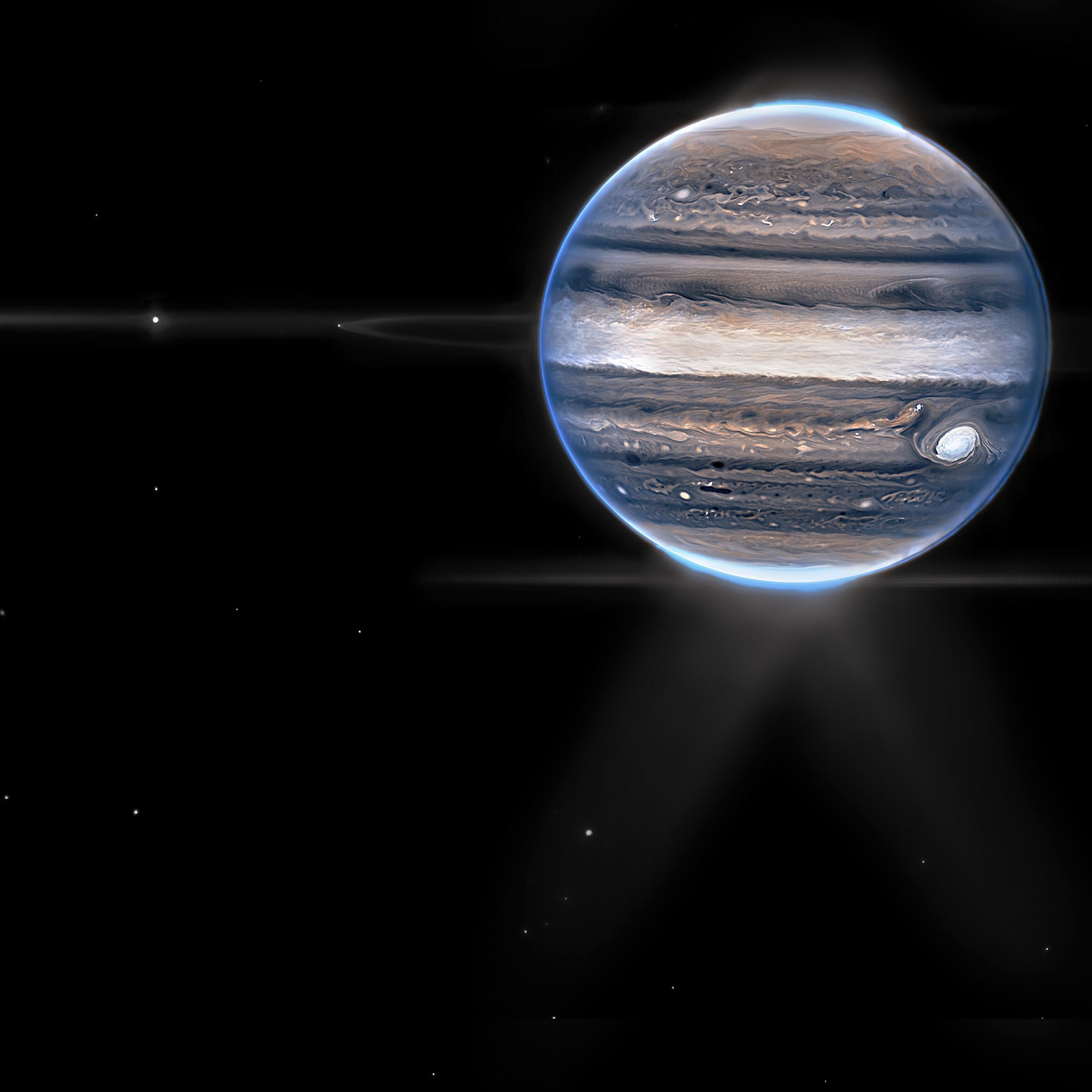
Explanation: This infrared view of Jupiter by Webb is illuminating. High-resolution infrared images of Jupiter from the James Webb Space Telescope (Webb) reveal, for example, differences between high-floating bright clouds -- including the Great Red Spot -- and low-lying dark clouds. Also clearly visible in the featured Webb image are Jupiter's dust ring, bright auroras at the poles, and Jupiter's moons Amalthea and Adrastea. The footprint of large volcanic moon Io's magnetic funneling of charged particles onto Jupiter is also visible in the southern aurora. Some objects are so bright that light noticeably diffracts around Webb's optics creating streaks. Webb, which orbits the Sun near the Earth, has a mirror over six meters across making it the largest astronomical telescope ever launched -- with over six times more light-collecting area than Hubble.
For more detail go to the link and click on the image for a high definition image. You can then move the magnifying glass cursor then click to zoom in and click again to zoom out. When zoomed in you can scan by moving the side bars on the bottom and right side of the image.
Pinging the APOD list
🪐 🌟 🌌 🍔
Incredible.
These moons are very small!
Edward Emerson Barnard discovered the moon Amalthea on 9 September 1892 and named it after Amalthea of Greek mythology. It was the last natural satellite to be discovered by direct visual observation; all later moons (like Adrastea) were discovered by photographic or digital imaging.
Do you know which IR bands were used to form this image?
Great info! So he used the 36” Lick refractor (I just looked it up) I wonder if it’s been seen at Yerkes? I’m an hour from there. That would be cool to see, if they would ever allow it.
No, I don’t know what bands were used in this photo.
Finally found a something
https://svs.gsfc.nasa.gov/31191 states that the image is from NIRCam
https://science.nasa.gov/mission/webb/nircam/
NIRCam is sensitive between .6 and 5 microns
All of which give clues, but nothing definitive.
< sigh >
Come on, NASA ... we’re not ALL technically illiterate!
Wow.
A Great Pic
Disclaimer: Opinions posted on Free Republic are those of the individual posters and do not necessarily represent the opinion of Free Republic or its management. All materials posted herein are protected by copyright law and the exemption for fair use of copyrighted works.
