Free Republic
Browse · Search
General/Chat
Topics · Post Article

Skip to comments.

An Archaeological Tour of Olympia [10:13]
YouTube ^ | January 9, 2026 | Scenic Routes to the Past (Garrett Ryan, Ph.D)

Posted on 01/11/2026 5:06:39 AM PST by SunkenCiv

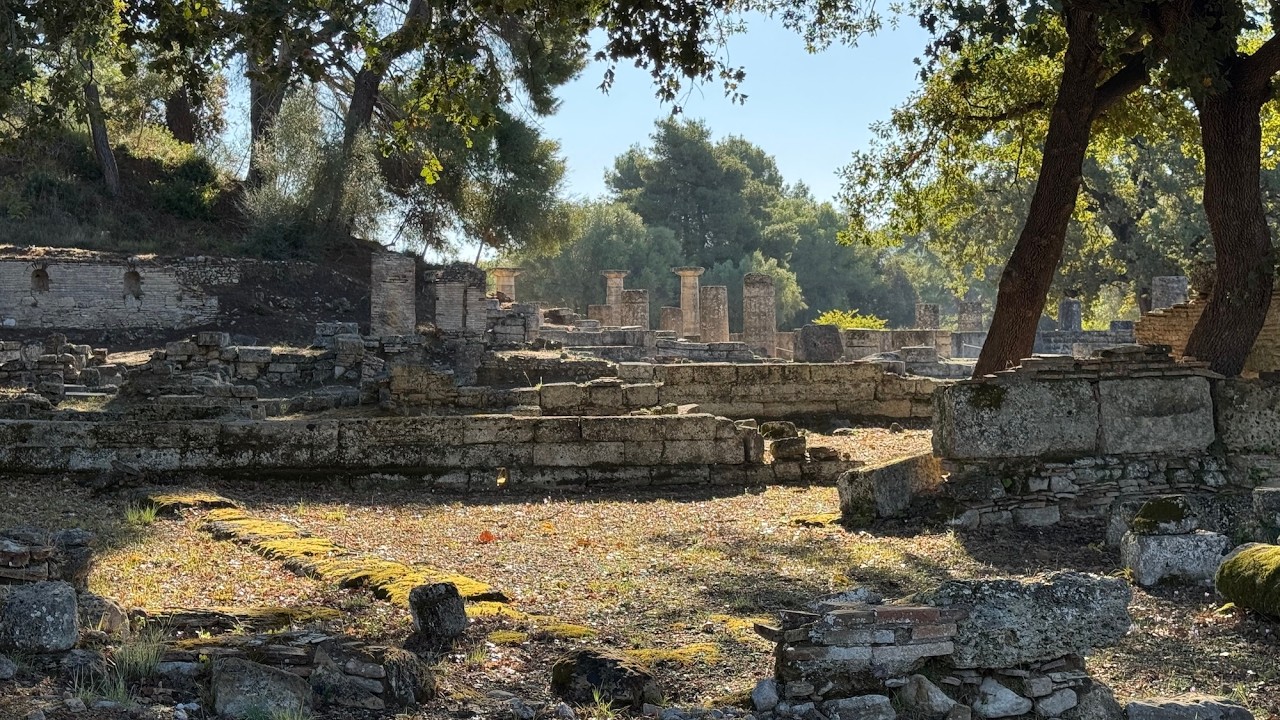
A short of tour of the archaeological site of Olympia, home of the Olympic Games for more than a millennium. 
An Archaeological Tour of Olympia | 10:13 
Scenic Routes to the Past | 54.2K subscribers | 7,791 views | January 9, 2026
An Archaeological Tour of Olympia | 10:13 | Scenic Routes to the Past | 54.2K subscribers | 7,791 views | January 9, 2026 
0:00 Introduction 
0:55 Gymnasium and Palaestra 
1:39 Philippeion 
2:09 Temple of Hera 
2:35 Temple of Zeus 
4:52 Workshop of Phidias 
5:37 Leonidaion 
6:12 East side structures 
6:56 Treasuries and Metroon 
7:42 Nymphaeum of Herodes Atticus 
8:24 Stadium

(Excerpt) Read more at youtube.com ...


TOPICS: History; Science; Travel
KEYWORDS: garrettryan; godsgravesglyphs; greece; theolympics
YouTube transcript reformatted at textformatter.ai follows.

1 posted on 01/11/2026 5:06:39 AM PST by SunkenCiv
[ Post Reply | Private Reply | View Replies]

The other GGG topics added since the previous digest ping, alpha:

2 posted on 01/11/2026 5:07:46 AM PST by SunkenCiv (NeverTrumpin' -- it's not just for DNC shills anymore -- oh, wait, yeah it is.)
[ Post Reply | Private Reply | View Replies]

To: 240B; 75thOVI; Adder; albertp; asgardshill; At the Window; bitt; blu; BradyLS; cajungirl; ...
The weekly digest list of topics is up top.

3 posted on 01/11/2026 5:08:21 AM PST by SunkenCiv (NeverTrumpin' -- it's not just for DNC shills anymore -- oh, wait, yeah it is.)
[ Post Reply | Private Reply | View Replies]

Most of the rest of The Olympics keyword, sorted:

4 posted on 01/11/2026 5:09:25 AM PST by SunkenCiv (NeverTrumpin' -- it's not just for DNC shills anymore -- oh, wait, yeah it is.)
[ Post Reply | Private Reply | View Replies]

Transcript

Introduction

Most of the time, Olympia was a quiet place. It was far from the major cities and trade routes of Greece, far from anything except its own ancient sanctuary of Zeus, where the Olympic Games were held every fourth summer. During the five days of the festival, and for months before, this sleepy backwater became the beating heart of the Greek world. Travel to and from the games was facilitated by a sacred truce that was usually, if not always, observed. Athletes came from every corner of the Mediterranean, trailing trainers and hangers-on. Tens of thousands of spectators came to watch them train and compete despite an almost complete lack of tourist amenities to service the various needs of the visitors. Hundreds of vendors and courtesans followed along with authors, philosophers, and crackpots of every description.

Gymnasium and Palaestra

The first building one encounters when entering the site at Olympia appropriately is a gymnasium where athletes trained before competing in the games. It dates to the Hellenistic period. It was centered on a large court ringed by colonnades under which athletes could run in bad weather.

Another training facility, a palaestra, stood beside the gymnasium, likely built like the stoa of Vatalis in the Athenian Agora by some Hellenistic king trying to burnish his cultural credentials. The peristyle around its central courtyard opened onto rooms with various functions, including dining halls and a library.

Philippeion

On the other side of the path is the Philippeion, a temple-like monument built by Philip II after his victory at Chyona. Inside were crystalline statues of Philip, his wife Olympias, and their son Alexander, soon to be great, along with Philip’s parents. The building presented the Macedonian royal family as equal to the gods, a none too subtle message about Philip’s political ambitions.

Temple of Hera

Beside the Philippeion are the remains of the Temple of Hera. This was the oldest temple at Olympia. So old, according to Balsenius, that its columns were made of wood and only gradually upgraded to stone, each wooden post being replaced by a column as it rotted away. The differences in the column styles can still be seen, though the standing ones were re-erected in the 20th century.

Temple of Zeus

The most important structure at Olympia was always the Temple of Zeus, built by the city of Elis in the mid-5th century BC. This temple, the largest in the Peloponnese, was in the Doric order and built of local limestone finished with stucco. As in most Greek temples, its cella had three chambers front to back: the antichamber, the naos or cella proper, and the epistyle behind, where reportedly Herodotus read excerpts from his histories. Remains of the pediment sculpture groups, which showed the battle of Lapiths and Centaurs and the chariot race of Pelops and Oenomaus, can be seen at the site museum.

In the museum, the race of Pelops and Oenomaus showed the labors of Hercules. And on this side, the truly magnificent centauromachy with the majestic statue of Apollo at the center.

The highlight of the temple, of course, was the great statue of Zeus, a wonder of the world. Phidias, the sculptor, had become something of a specialist in chryselephantine, golden ivory statues. This was his masterpiece. It showed Zeus in majesty, seven times lifesize, seated on his throne with a scepter in one hand and a figure of victory poised on the other. The ivory flesh of the god, moistened with olive oil, shimmered in the dimness of the room. Visitors admired the statue from balconies above the aisles of the naos. The statue was reportedly taken away to Constantinople at the end of the 4th century.

The Temple of Zeus collapsed in late antique earthquakes, leaving the pile of ruins we see today. The single standing column off to our right was re-erected in 2003.

Workshop of Phidias

This structure, currently under restoration, is the so-called workshop of Phidias. It was here, according to Palscanius, that the great sculptor fashioned the most famous of all Greek statues, the chryselephantine Zeus that stood in the sanctuary’s main temple. The fragments of ivory and terracotta molds found inside seem to confirm this.

The building resembled a temple implant, apparently to allow the great statue to be assembled in its entirety before being transferred to its permanent home. An altar of all the gods was installed here later in antiquity. Later still, the building became a church with its apse at the former entrance.

Leonidaion

The largest building in Olympia, the Leonidaion, was built by a wealthy benefactor in the 4th century BC. It appears to have served as a hostel for eminent visitors to the games. After a fire, it was reconstructed for the use of visiting Roman officials. The elaborate pools in the central courtyard date to that rebuilding.

On the south side of the sanctuary was the Bouleuterion, where the Olympic council met. It was here the competitors swore at the altar of Zeus Horchios, Zeus of Oaths, that they would abide by the rules.

East Side Structures

This elaborate Roman-era mansion may have been built for Nero’s visit to Olympia in the year 67. There are a number of Roman-era buildings on the east side of the sanctuary, most notably a substantial bath complex. This side was bounded by the so-called Echo Stoa. Any words spoken here reportedly would echo back seven times. In front of the stoa was a huge victory monument set up by Tommy II and his sister-wife Arsenui, another product of Hellenistic power politics.

A closer look at Talami in our Cineoese monument with the remains of the Echo Stoa.

Treasuries and Metroon

On this terrace were 11 treasuries. Like their better-preserved counterparts at Delphi, they were built by individual cities to store the offerings that were dedicated here. Both the offerings and the treasuries themselves were opportunities for competitive display. It’s striking how many of these were built by Greek colonies in Sicily. Like the monuments of the Hellenistic Kings, this was a way of proclaiming that they had arrived on the political scene.

Originally, the Metroon was dedicated to Rhea, the mother of Zeus. It was renovated in the Roman era and rededicated to Augustus, becoming a sanctuary of the imperial cult. Eight imperial statues were discovered inside.

Nymphaeum of Herodes Atticus

This huge nymphaeum was built by Herodes Atticus in the mid-second century. It had two basins. The upper basin was framed by a monumental facade which displayed two dozen statues of Herodes, his relatives, and the imperial family. Fed by an aqueduct a mile and a half long, it was a useful amenity, bringing clean water to a site that had long relied on notoriously foul wells. Some austere souls, however, complained about its ostentatiousness.

On these bases were the Zanes, Zeus statues set up with the fines from athletes found to have cheated.

Stadium

And now at last, the stadium. This tunnel was used exclusively by athletes and judges in antiquity. And there it is in all of its glory. In its current form, the stadium dates to the fifth century BC. There was room for up to 40,000 spectators where we sat directly on the grass.

With the exception of a single priestess, married women were not allowed to attend. On the right side of the screen is the stand on which umpires at the games stood. Lines of stones now visible off to our left mark the start line. The finish line on the other side, bear with me please, is about 200 yards, one stadion away.

Though they were only awarded a simple olive garland, victors here were immortalized in the breath of the Greek world and the depth of classical history for their feats at Olympia.

5 posted on 01/11/2026 5:10:06 AM PST by SunkenCiv (NeverTrumpin' -- it's not just for DNC shills anymore -- oh, wait, yeah it is.)
[ Post Reply | Private Reply | View Replies]

To: SunkenCiv
I have visited Olympia three times. It's well worth the trip.

One of my most delightful experiences was reading Thucydides' The History of the Peloponnesian War while riding across the Peloponnesian Peninsula from Corinth to Olympia, with stops along the way, including one at the site of Sparta.

Greece is one of the most beautiful places on earth.

6 posted on 01/11/2026 6:57:33 AM PST by Savage Beast (When the student is ready, the teacher appears. When the people are ready, the hero appears.)
[ Post Reply | Private Reply | To 5 | View Replies]

To: Savage Beast

Nice!


7 posted on 01/16/2026 8:19:05 PM PST by SunkenCiv (NeverTrumpin' -- it's not just for DNC shills anymore -- oh, wait, yeah it is.)
[ Post Reply | Private Reply | To 6 | View Replies]

A tour of the ancient theater and sanctuary of Asclepius at Epidaurus
Epidaurus: the best-preserved Greek theater | 6:38 
Scenic Routes to the Past | 48.6K subscribers | 4,257 views | December 5, 2025
Epidaurus: the best-preserved Greek theater | 6:38 | Scenic Routes to the Past | 48.6K subscribers | 4,257 views | December 5, 2025 
0:00 Introduction 
1:29 Sanctuary 
5:33 Theater
Introduction
Great sanctuaries of Eskeipius, the Greek god of medicine, were simultaneously pilgrimage sites and healing centers. No distinction was made between mysticism and practical cures. Both were under the god's care. Like the spas of 19th century Europe, sanctuaries of Eskeipius attracted wealthy hypochondriacs and convalescents from far and wide who joined locals in the shrines and porticos of the god. It wasn't quite a full-service hospital, however. In the interests of ritual purity, death and childbirth were forbidden within the sanctuary.

The sanctuary at Epidaris claimed to be the place where Eskeipius was first worshiped. The god probably didn't arrive, however, until around 500 BC. The original focus of worship was the hero Maliatus, later assimilated to Apollo. Apollo Maliatus had his own sanctuary up the hill from the later Eskeipion.

The sanctuary of Eskeipius developed over the course of the classical period. Most of the buildings now visible were constructed in the 4th century BC. Despite being sacked by Cella and shortly afterward by marauding pirates, there was a second golden age in the early imperial era when wealthy Romans, including a prominent senator, subsidized construction.
Sanctuary
With the exception of the theater, few of the sanctuary's buildings are well preserved. Little more than the foundations survive of the Kadogion, a hostel whose mudbrick walls melted away millennia ago. It was organized around four courtyards, each with 18 rooms around it. Since there were two stories, there were 160 rooms, all almost certainly reserved for high-status visitors.

I've acquired a mascot. The stadium was used for athletic contests during festivals and especially during the quadrennial Eskeleipia. Like most of the other buildings in the sanctuary, it dates to the 4th century BC. The stone starting posts on this end are still preserved, as are many of the stone seats around the center.

This partially reconstructed propylon was the entrance to a large banquet hall. In the dining rooms arranged around its central courtyard, visitors probably shared the ritual meal that followed sacrifices. In its courtyard is a small odon built in the Roman period. By that point, the rest of the building was half a millennium old.

We now come to the heart of the complex, which consisted from left to right of the tholos, the temple of Eskeipius, and the Abaton. The temple of Eskeipius, yet another product of the 4th century BC, isn't very impressive now, but frankly, it was never all that impressive.

It was, in fact, one of the smallest Doric temples anywhere in Greece. To cut costs, marble was used primarily for the sculptures of the pediment which showed the fall of Troy and the Amazon. The temple was at least built quickly according to a preserved inscription in less than 5 years. The cult statue showed the god seated stroking one of the sanctuary's sacred serpents. As usual, the altar stood in front of the temple's entrance.

The ancient Greeks assumed that most maladies were to some degree psychosomatic. If the harmony between body and soul could be restored, good health would follow. The god might intervene, but more often he simply showed the way. One place this was achieved was the Abaton.

The name means "place not to be stepped upon." This stoa was used for the practice known as enquisis or incubation. Those in search of healing slept inside the portico waiting for a cure or dream that offered guidance. Incubation took place in the lower story of the Abaton, the patients lying on stone benches like these.

The Tholos, currently undergoing restoration, is yet another building of the 4th century BC. It appears to have also been dedicated to Eskeipius but in disguise as a chthonic hero, not an Olympian god as in the temple next door. The outer colonnade was Doric. The inner colonnade used the new Corinthian order. Inside, accessed via a shaft, was an elaborate crypt with three rings of corridors. It was designed to be a labyrinth. No doors were aligned. Anyone trying to reach the center had to make a full circuit of each corridor.

The ritual purpose of all this is unknown, but almost certainly tied to the healing that took place in the neighboring Abaton. Next to the temple and Abaton was a Roman bath complex dating to the 2nd century AD. Besides being places to wash and socialize, the pools of the baths were used in some of the sanctuary's cures. The main hall, as usual, was a frigidarium. The warm rooms were beside it.
Theater
We'll conclude with the famous theater built in the late 4th century BC. Like most Greek theaters, it was built into the slope of a hill. Its 55 rows of well-preserved stone seats would have fit an estimated 14,000 spectators, about two-thirds the capacity of the theater of Dionysus at Athens or one-quarter of that of the Coliseum.

Almost all that's missing is the stage building, which would in any case have been much simpler than that in a Roman theater. The theater has remarkable acoustic properties, as anyone who stands here for more than a few minutes will hear a tour guide demonstrate. Even spectators in the top rows could have heard the musical and dramatic contests of the Eskeipia looking out over the valley that held the sanctuary of Eskeipius at Epidarus.
reformatted at textformatter.ai

8 posted on 01/16/2026 8:20:44 PM PST by SunkenCiv (NeverTrumpin' -- it's not just for DNC shills anymore -- oh, wait, yeah it is.)
[ Post Reply | Private Reply | View Replies]

The island of Ikaria in Greece is a blue zone, an area where people on average live longer and also lead happier lives. Anna Katsas, a young local resident who recently moved in with her grandmother, takes us on a tour of the island. 
The Greek island holding the secret to a long life | 4:07 
BBC Global | 717K subscribers | 149,872 views | November 7,2025
The Greek island holding the secret to a long life | BBC Global | 4:07 | BBC Global | 717K subscribers | 149,872 views | November 7,2025
I was 17 years old. I came here for just two weeks and I saw this place and I was like, "Oh my god, I'm from here. So recently I had the opportunity to get my Greek citizenship and I'm currently living with my Yaya Anna, my grandmother. Ever since I found out that Ikaria was a blue zone, I haven't been able to stop talking about it. So I'm glad you're here."

So a blue zone is a place in the world where research has shown that people live exceptionally longer and ultimately happier lives.

People move slower here. There's a saying called "siga siga" which means to take it slowly, to not rush things. Being present, you might go by a plate of cafes and you'll see people sitting and talking for hours with the same people, new cups of coffee. There's almost an art in doing nothing. As you're traveling through the island, you notice the rugged beauty of the mountains, the beautiful blue of the Aegean Sea. You almost feel time stops.

So, we are at the rock of Icaros. It's a bit tricky to find it, but if you stay on the road, you'll find your way. Icarus was trapped by King Minos in Crete. In order to escape, Icarus's father created wings out of wax.

He was having an amazing time flying in the sky. He flies too close to the sun and then his wings melt and he falls into the sea. And that rock is supposedly where he fell and why Ikaria has its name.

I'm not sure if many tourists know about the anti-pirate houses. You'll see houses and churches built into boulders because people wanted to camouflage as much as possible and look invisible.

Ikaria was a very poor island. So they were eating what they could find in their gardens. They were utilizing herbs and vegetables that they had. When we go to Karim Mali's restaurant, you'll see they still focus on the traditional diet. All of their recipes are plant-based throughout the week. Sunday is the only day of the week they cook meat.

So why do people make it to 90 here in Ikaria? The lifestyle, the diet, how much sleep people get, the low stress levels, the exercise. The healthiest lifestyle practices have been ingrained in daily life here for centuries.
YouTube transcript reformatted at textformatter.ai

9 posted on 01/16/2026 8:20:55 PM PST by SunkenCiv (NeverTrumpin' -- it's not just for DNC shills anymore -- oh, wait, yeah it is.)
[ Post Reply | Private Reply | View Replies]

Disclaimer: Opinions posted on Free Republic are those of the individual posters and do not necessarily represent the opinion of Free Republic or its management. All materials posted herein are protected by copyright law and the exemption for fair use of copyrighted works.

Free Republic
Browse · Search
General/Chat
Topics · Post Article

FreeRepublic, LLC, PO BOX 9771, FRESNO, CA 93794
FreeRepublic.com is powered by software copyright 2000-2008 John Robinson