
Posted on 01/10/2026 11:40:34 AM PST by CharlesOConnell
Ikiru movie at the article link click; the movie loads with a hidden speaker icon in the top left, muted.
Akira Kurosawa's cinematic masterpiece, isn't some grand Samurai epic, it's a film about a boring government clerk who has long acclimated to the real job of government—stopping anything from getting done—but goes off on a spree and actually DOES SOMETHING.
Ikiru (1952) stars Kurosawa's leading actor, Takashi Shimur, who played Kambei, the leader of the samurai in Seven Samurai.
Ikiru is about a government bureaucrat, Watanabe. He's a department head in a municipal parks department. The film's basic action segments, are, workers sitting at desks with enormous stacks of paperwork, simply stamping single documents with "Received", moving them from the one enormous "unstamped" pile to the "unstamped" pile, all day long, endlessly, mindlessly, without ever doing anything else.
The protagonist, Watanabe, gets a terminal cancer diagnosis. His son and daughter-in-law live with him; he hears them talking downstairs, complaining about his dragging on continuing to live so long, and when are they going to get his inheritence? He's trudging down the street looking down the sidewalk about 15 feet ahead, looking at nothing, perpetually morose.
Watanabe runs into the one lively person among his staff of about 15 paper-stampers, a young girl who is perpetually irreverent, joking, laughing, generally causing a minor uproar, someone who won't last, because if she doesn't get herself fired, she's going to quit anyway, from such a furiously boring job.
Watanabe's job, his family and his cancer diagnosis are weighing him down. Through some accident, the young girl and the old man meet on the street and start talking. He takes her out to eat. She has to be sure he's not trying anything improper. (He's about a 70 year old man with a cancer diagnosis!)
After they part, Watanabe asks if he can see her again. She's scandalized, he's her supervisor, but she's mildly bemused. She sees him again numerous times, she lets him buy her things, but she gets bummed out by his perpetual depression, so they break it off. It was a kind of platonic affair.
Watanabe has never taken a vacation. He had gone off on an extended vacation, seeing the girl. His subordinates talk about his odd behavior. (The film is a story within a story; the external container is their funeral for him, they're drinking sake, getting "tight", starting to say things in a drunken state that they'd never say at the gray office.) His family are being scandalized because people who have seen him with the girl are talking about him.
Eventually, after someone in a cafe gets Watanabe drunk, he goes through an epiphany. He goes back from vaction to the office. Some petitioners, mothers of small children, want a park put in where there's just an open sewer. They had been routinely turned down, as de facto deparmental policy, the real business of the parks department.
(This issue of impeding anything from getting done, the real, unstated purpose of most government and business organizations, is extensively developed in Charles Dickens' "Little Dorrit" (trailer), about an inventor, Daniel Doyce, who has a promising invention and production business, but who is perpetually stymied trying to get permits by a government bureau called the Circumlocution Office, which is only in business to stop anything from happening—but in the case of England, for hundreds of years, the unspoken grammar is that you COULD get something approved, if you gave bribes. Eventually Doyce has to go offshore, presumably to France, to run his engineering business, where he is a fabulous success.)
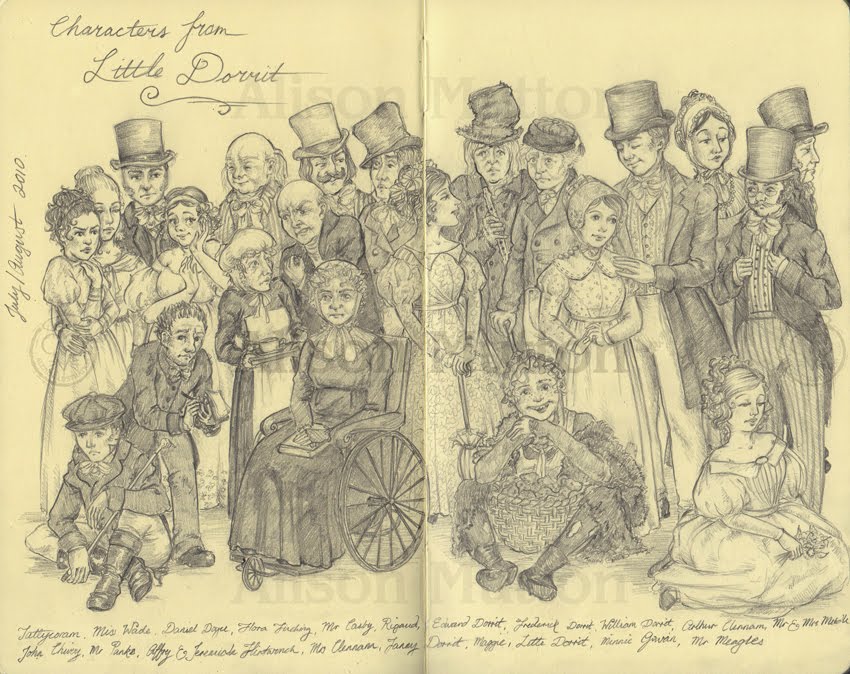
Daniel Doyce, top row, third from the left
This parks department supervisor, Watanabe, decides unilaterally to approve the parks construction plan. He immediately runs into a furious backlash, starting with his own subordinates. As supervisor he can savage through and pull it off. He runs into flak from the Vice-Mayor's office, but the enforcers there are the Yakuza who really run things in the municipality. This little mole of a man bravely stands up to the gangsters.
The beginning and end of the film, scene shifting between the funeral at which Watanabe's drunken subordinates end up shouting and whining about, "why can't we ever actually DO something, ANYTHING!", and the supervisor, Watanabe, sitting on a swing, dying, singing "The Gondola Song". (He is found dead in the swing, having frozen to death.)

"The Gondola Song", to the tune, "Mortality"
life is brief.
fall in love, maidens
before the crimson bloom
fades from your lips
before the tides of passion
cool within you,
for there is no such thing
as tomorrow, after all
https://youtu.be/Nx5M4AkIeTE?si=cHtiC_HrfTr3w5rJ
It took Akira Kurasawa to pose the issue in a meaningful form. It's our education system that is actually at the root. At the very beginning of compulsory, universal education, from 1880-1920, the explicit purpose as pushed by the university educationalism cartel at the behest of, then, the Titans of Industry, the oligarchs of the Robber Baron era, was to keep disruptive competition from penniless inventors and entrepreneurs stomped down, by strangling young people's initiative and self-acualization, stamping out uniformly repetitive human-resources "parts" for industry and commerce. (But no one works in factories anymore, after Ronnie Raygun shipped them all off to China; so why do we need this mis-"education" system?)
(For instance, the inventor of the t.v. tube, the "iconoscope", with a great Wizard of Oz type name, "Philo. T. Farnsworth", had his invention stolen by lawyers working for RCA/NBC monopoly head David Sarnoff, and eventually killed himself. And Nikola Tesla forked over his patents to George Westinghouse as long as he could get unlimited lab space and R.-&-D. funding, at a time when the competition for Tesla's alternating current was Thos. Edison's direct current, but J.P. Morgan told Westinghouse, "either, sign it over, or my lawyers will crush you"; Westinghouse signed, and G.E. was born.)
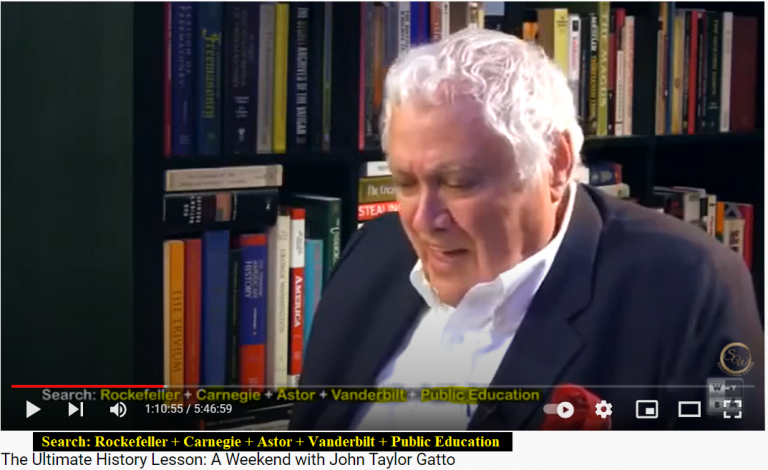
Teaching troublemaker John Taylor Gatto told all about it, how, by 1880, after the railroad facilitated carnage of the Civil War, Americans were being forcably moved off their own farms — where they did everything — and into millionaire owned factories, where they were just cogs in a machine. (Financial exploitation of indebted soldiers returning from the Civil Was is one common explanation for the forced exodus.) The titans of Wall St., Morgan, Carnegie, Astor, Vanderbilt and Rockefeller, regarded the Yankee tradition of auto-didactic, small farmers, mechanics/engineers, inventors and entrepreneurs, as a lethal competition threat to Financial Capitalists’ Wall St. accumulation of investment monies. The elites’ most efficient solution was to undermine this threat by strangling it in the cradle; the effort to control, at the dawn of the information age, the intellectual uprising of the common people coalesced in the very foundation of universal, compulsory/police-enforced public schooling. The compulsory, universal public school system as we understand it, was never without built-in institutional handicapping of the vast majority of students.
YouTube: The Ultimate History Lesson: A Weekend with John Taylor Gatto
"We want one class of persons to have a liberal education, and we want another class of persons, a very much larger class, of necessity, in every society, to forego the privileges of a liberal education and fit themselves to perform specific difficult manual tasks. … we are trying to make skillful servants of society along mechanical lines…" (Woodrow Wilson, High School Teachers Association of New York, Volume 3, 1908-1909)
The resulting product is legions of mindless consumers who will buy what they're told, and who won't cause trouble at work in giant corporations and other public workplaces.
In my government job–but it's not confined to government, far from it–it took me decades to learn this lesson. Generally the system will ferret out innovative troublemakers who actually want to DO something. (A new person comes into the job, having passed through human resources screening. The person's actual colleagues will be testing them to see that they'll buckle down and not rock the boat. If they are inveterate go-getters, the colleagues will rig their evaluations to show, not that they're good material, that they only need mentorship, and they can become successful organization members. Instead the colleagues will be sure the supervisors give them bad ratings, the equivalent of retaliation the whistleblowers undergo. They will be got rid of.)
I had the following experience, repeatedly. I worked in Information Technology back-office. Some poor little person would have a government related problem, at another agency that wasn't ours, we were City and they needed County. They probably didn't have internet, this in the 1980s or 1990s, we did, I would look up the phone number which they needed to call, and tell them.
My lead man told me, "don't do that". It seems wrong, but within the bureaucratic-organizational context he was actually correct. And it was proven. After about 5 incidents of this, helping someone find their way, I got a call back from a furious member of the public who had not been able to get a solution to the particular problem, yelling at me because of it, about an agency to which I was not related.
(I had been in Human Resources and bridged over to I.T. Some member of the public was repeatedly harassing the H.R. front desk workers, coming back again and again, actually terrorizing them. I heard about it in a different building other than H.R. I knew just the magic words to say to the irate person; I couldn't be identified as belonging to the H.R. office. I met the person on the stairs, told the irate person what would happen to them if the didn't desist. H.R. never saw the person again. Pulling strings is actually very easy, if you've got nothing to do but dream up BUREAUCRATIC troublemaking techniques, as I saw with a Vice-Dean's daughter who sat in a corner spider-like, spinning webs, saying about some randomly selected victim, "I'm going to ruin her career", and then she did, a malicious habit as a solution to meaninglessness and boredom.)
I finally learned my lesson, after seeing an I.T. guy coming to "fix your department's computers" sitting for hours playing computer soliaire while waiting for a computer process that took a long time to execute.
I stopped always trying to "DO something". I thought I could work out the chords to Jeopardy "Think!" (Merv Griffin's "Time for Tony", his 3 year old son, from 1963, that earned him millions in royalties, every time it is played on Jeopardy.) I didn't have any music manuscript, I made a Word file with sets of 5 lines, printed it out, worked out the better chords C-a_minor-d_minor-G7 that are played once just before Final Jeopardy. Eventually I worked it up into a video.
I'm sure if you admit it to yourself, you know all about this, the real "purpose" of most jobs, and don't need me to tell you.
I am happy now, after retirement, because I can work as hard as I want, about projects that might be considered worthy. No one can tell me not to try to do good. I stay up till 4 in the morning. I can do what I want on my own, without anyone interfering with me—no one can stop me now.
This will offend, and I apologize but I don’t see a nice way, but in my thinking:
Good grief. Find Jesus in his Catholic Church or live with these kinds of thoughts.
Ikiru - Japanese for “To Live”.
I’m all right, Jack.
Yes, “Find Jesus in his Catholic Church”.
Moreover, do everything you do for love of Him and for His glory.
bfl
Disclaimer: Opinions posted on Free Republic are those of the individual posters and do not necessarily represent the opinion of Free Republic or its management. All materials posted herein are protected by copyright law and the exemption for fair use of copyrighted works.