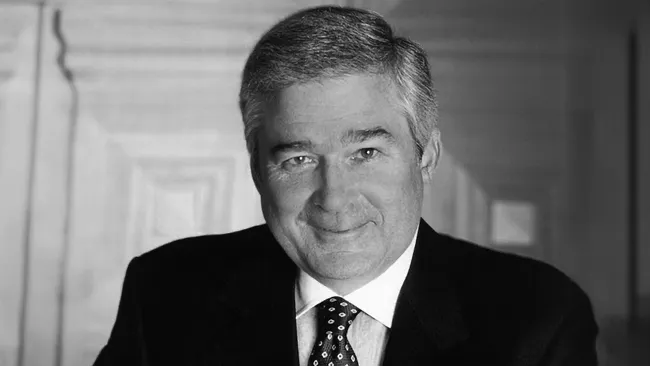
Lou Gerstner
Posted on 12/29/2025 8:43:25 PM PST by SeekAndFind
Louis Gerstner, the executive who engineered one of the most important corporate turnarounds in the history of the high-technology sector, died at the age of 83 on Saturday. Gerstner took control over IBM in 1993 when it was at the brink of breakup and bankruptcy, rebuilt the company into a services-led enterprise, and restored its strategic relevance by 2002. Multiple prominent high-tech leaders worked at IBM under Gertner's leadership, spreading his skills across the industry nowadays.
Lou Gerstner
The most important technical shift was a decisive move away from hardware-centric economics toward business services, systems integration, and enterprise software. Under his direction, IBM abandoned its long-standing practice of selling IBM PCs with the IBM's mainframe operating systems, and proprietary applications that its customers were slow to adopt in the 1980s, but which were quickly losing any relevance in the 1990s.
Moreover, product lines that failed to gain market traction were eliminated (e.g., IBM abandoned Token Ring LAN products), so only the fittest survived. After dropping OS/2, IBM became a neutral integrator that supported heterogeneous hardware and software environments and did not force customers into proprietary ecosystems. Furthermore, PCs ceased to be strategically important products, which set the stage for selling the PC unit to Lenovo in 2004. But while hardware was no longer the focus, IBM changed its approach to processes and supply chain discipline to make this business more flexible and stable.
As IBM was kept together, the company continued to offer complete IT solutions for various customers as it had unique pieces that others did not. At the core of IBM's complete solutions were its database software, transaction processing systems, and management tools that sat between hardware and applications, something that still encouraged customers to buy IBM hardware, but this time without unpopular products like OS/2. Furthermore, IBM also put emphasis on the Internet, enterprise networking, servers, and services; forerunners of cloud services in the 1990s.
IBM's strategic reset was paired with sweeping operational changes. Gerstner cut costs aggressively: he sold real estate and eliminated 35,000 positions from a workforce of roughly 300,000. Compensation was restructured to reflect overall corporate performance instead of divisional metrics, and management accountability shifted from annual reviews to continuous performance tracking, which dramatically affected corporate culture. Despite cuts and downsizing, IBM returned to growth in the 1990s, and in 2002 its workforce grew to 315,000 – 320,000, which is more than the company employed when Gerstner assumed leadership.
Over Gerstner's nine-year tenure, IBM's market capitalization expanded from approximately $29 billion to around $168 billion (that is after the dot com crash in 2000 and September 11, 2001). By the time he stepped down in 2002 and passed the baton to Sam Palmisano, IBM had been transformed into a unified, services-driven technology company.
Gerstner later chaired Carlyle Group, but his most important legacy remains the reinvention of IBM as an integrated enterprise built around future needs of its customers, a culture later inherited by many successful high-tech companies.
During the Gerstner era, IBM quietly produced a significant share of today's top-tier U.S. tech leadership, particularly in semiconductors, enterprise, software, and supply chain spaces, something that very few companies in the industry can brag about. To that end, many former IBM employees mourn the death of Louis Gerstner.
"I am saddened to share that Lou Gerstner, IBM's chairman and CEO from 1993 to 2002, passed away yesterday," wrote Arvind Krishna, the current chairman and chief exec of IBM. "Lou arrived at IBM at a moment when the company's future was genuinely uncertain. The industry was changing rapidly, our business was under pressure, and there was serious debate about whether IBM should even remain whole. His leadership during that period reshaped the company. Not by looking backward, but by focusing relentlessly on what our clients would need next."
"I was privileged to learn and experience the leadership of Lou Gerstner early in my career at IBM," wrote Lisa Su, chairman and chief executive of AMD. "He was amazingly curious and insightful about technology. So honored to have had a chance to work with him. My condolences are with Lou's family and the extended IBM family."
"Yesterday, we lost Lou Gerstner, IBM's iconic and legendary CEO from 1993 to 2002," wrote Gina Rometty, the former CEO and chairman of IBM. "Lou was my very dear friend and mentor. Much will be written about Lou's immense contributions to IBM and his philanthropic efforts, but I would like to speak about Lou the person. I first met Lou in the 1990s, and admired him immediately. He was a brilliant, principled leader who led with intellect, not fear. Lou could cut through to the heart of any issue with penetrating questions. One of the most valuable things he taught me was the importance of preparation. Not long after we met, we were getting ready for a client meeting when Lou told me that he’d been reading a book, The Greatest Generation, because it included a chapter on the CEO we were going to visit. I couldn’t believe he was researching so diligently, and I thought, 'if the CEO takes time to prepare, so should I.' […]"
I made the video below in 1990 for IBM Research. John Cocke had just received his presidential medal from President Bush and had been quite ill. The head of research wanted to leave a record of how highly his peers thought of John. These were some of the most famous researchers and IBMers who had worked with him.
John never wrote his own papers. Researchers were always assigned to follow him around and write down what he said. Anyone who did became famous in their own right. My husband was asked but didn’t want to give up his own research for John’s topics. Sigh.
There were so many really special minds that worked at IBM.
Computer History - John Cocke: A Retrospective by Friends - 1990
https://youtu.be/eYwd30iWVvw
John Cocke, Fran Allen, Joel Birnbaum, Lewis Branscomb, Fred Brooks, Brad Dunham, Red Dunwell, Ed Fredkin, Ralph Gomory, Ian Gunn, Andy Heller, Harwood Kolsky, Abe Peled, Jack Schwartz and Ed Sussenguth
bump
He may have been good for IBM but he looks like a smarmy real estate/investment dude.
More precisely he reminds me of Costanzas boss “Rick” that he put a mickey in his drink...
But he or his underlings sold DOS (Direct Operating System) which is the heart of PCs to Bill Gates. If IBM saw the future as stand alone PCs they would be IBM plus Microsoft. IBM thought that Mega Computers Main Frams could only do the computing power. They were wrong and Bill Gates was right.
PS Bill Gates is still a threat to society despite his brilliance or perhaps because of his brilliance.
Thank you, Mairdie.
That’s not quite how it went down, IBM did not sell DOS to Microsoft, in fact Microsoft bought DOS from a company called Seattle Computer Systems, renamed the OS to MS-DOS and licensed it to IBM instead of selling it, changing the way software was bought and sold.
I believe Gerstner was still at IBM when they began a foolish adventure to develop their own OS for the PC called OS/2, they spent millions developing the product and it never really caught on and was eventually dropped.
DOS - Disk Operating System
The decision to license DOS from Gates/Microsoft and the decision to develop OS/2 in an attempt to make an alternative to DOS were both made long before Gerstner was on board at IBM.
Interesting. Thanks.
In what world? Place I work at now has about 100 Dell PCs. Last place had about 50 Dell PCs. Sounds more like IBM just couldn't compete with Dell. For many years, the IBM Thinkpad mobile work station was the king of lease programs for large corporations.
All my laptops were Thinkpads from ebay that came from recently ended lease programs. I still have a few IBM Thinkpads but am typing on a Lenovo Thinkpad.
I worked for him during my tenure at IBM. He was legit visionary. Then Sam Palmisano took over and it was downhill from there.
Lou knew folks by name.
Palmisano knew me as 819530, my employee # on a spreadsheet.
IIRC, I was watching CNBC the morning he took over. He was walking down the street before daybreak, heading to his office, toting a big briefcase.
The correspondent briefly chatted - I don’t recall who said what.
But you could tell he was a man on a mission, and he was not much of a showboat, at least that morning.
OS/2 was a great OS and was running ATM’s for a long time.
Lotus Notes was a horrible application.
I don’t miss it.
I’ve heard that os/2 and warp were very good and so was the OS for Amiga computers/pc’S 1992-96 before they stopped being sold.
With Micro-softbloat now becoming so meddlesome, I wonder if, especially with the speedy processors, memory and storage we have now, if some enterprising people could try bringing these older operating systems back to the market to see how they’d fare. Yes there is Linux and all its “flavors”, and maybe that’s where I will go next.
Yeah but OS/2 was a rock. I remember it crashed on me...once. One freakin time. We used it to run Microfocus COBOL for development.
It still died. They made mainframes more and more expensive and less capable. They lost all control of the personal computer space. They stopped innovating. They stopped hiring the best and brightest as an MBA move to pinch pennies.
“I’ve heard that os/2 and warp were very good”
OS2 has several Achilles heels. It wasn’t that great. It was also bloated and had a bloated budget.
MS Word still doesn’t have tabs.
Disclaimer: Opinions posted on Free Republic are those of the individual posters and do not necessarily represent the opinion of Free Republic or its management. All materials posted herein are protected by copyright law and the exemption for fair use of copyrighted works.