Posted on 12/29/2025 1:35:08 PM PST by delta7
They look like coins. They circulated like money. Yet the U.S. Mint never meant them to be coins at all.
In the mid-1940s, the United States Mint struck one of the most unusual forms of American gold ever produced: anonymous gold disks made not for collectors or commerce, but to pay oil royalties to Saudi Arabia. These pieces sit at the crossroads of geopolitics, bullion, and numismatic mystery, and remain among the most counterfeited U.S.-minted gold items today.
Saudi Arabia Oil Fields Unlike commemoratives or circulating coinage, these disks emerged from a quiet diplomatic crisis. Saudi Arabia demanded gold. The United States needed oil. The result became bullion disguised as money.
Gold for Oil: Why These Disks Exist at All
During World War II and its aftermath, the Arabian American Oil Company, better known as ARAMCO, owed the Saudi government millions of dollars each year in oil royalties. The contract required payment in gold, not paper currency.
That requirement collided with reality.
The United States still fixed gold at $35 per ounce, while open-market prices soared far higher overseas. ARAMCO could not legally buy gold at market rates, yet Saudi Arabia refused further payment in dollars. The standoff threatened oil supplies vital to the postwar world.
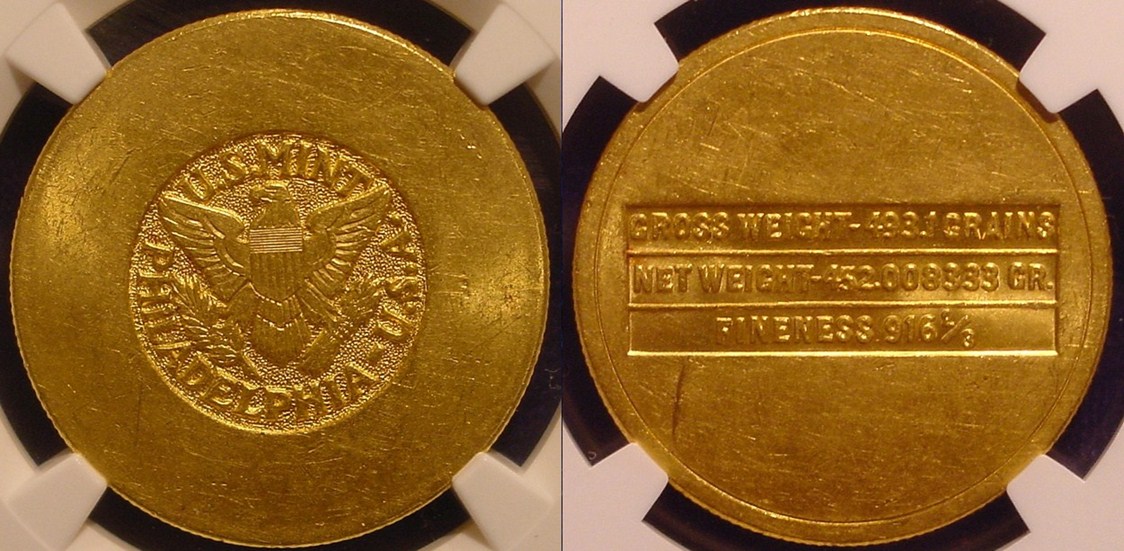
Washington chose an extraordinary solution. The Philadelphia Mint struck special gold disks, bullion pieces shaped like coins but never authorized as legal tender. These disks carried weight and fineness statements instead of denominations, allowing the U.S. government to satisfy both gold restrictions and Saudi demands.
Not Coins, Yet Made Like Coins
Collectors still debate how to classify these pieces. They feature an American eagle and official mint markings, yet no face value appears anywhere. The Mint treated them as bullion, not coinage.
Numismatists later dubbed them “the coins that weren’t.”
They circulated briefly in Saudi Arabia, traded alongside sovereigns, and passed hand to hand. That everyday use blurred the line between money and metal, and later fueled confusion, misattribution, and counterfeiting.
Two Issues, One Purpose
The Mint struck two primary formats to meet ARAMCO’s obligations:
Large Gold Disks (1945–1946)
These pieces equaled four British gold sovereigns in weight and fineness. Saudi Arabia favored British standards, so the Mint matched sterling gold instead of the U.S. 90% standard.
Small Gold Disks (1947)
The smaller version entered limited circulation in Saudi Arabia and traded for roughly $12, or 40 silver riyals. Public use ended quickly once counterfeits appeared.
Both versions shared the same minimalist design and bullion intent.
Specifications (Genuine Large Disk)
Gross Weight: 493.1 grains Net Gold Weight: 452.008333 grains Gold Fineness: .916⅔ (sterling standard) Actual Gold Weight: ~0.942 troy ounces Edge: Reeded Mint: Philadelphia Composition: Gold with copper alloy Why So Few Survive
Survival rates remain low despite mintages exceeding 90,000 pieces.
Most disks followed one of three paths:
Melted into bars and sold overseas, often in Bombay or Macao Redeemed and restruck into Saudi sovereigns after 1951 Melted following Saudi oil nationalization in the 1950s As a result, genuine examples today appear infrequently and command strong premiums—especially when certified.
A Counterfeiter’s Favorite Target
These gold disks attract counterfeiters for three reasons: high intrinsic value, simple design, and widespread unfamiliarity.
Historical Counterfeits
Swiss and Lebanese operations began striking imitations as early as the late 1940s. Those fakes pushed the smaller disks out of circulation in Saudi Arabia within just a few years.
Modern Bullion Fakes
Authorities in Saudi Arabia continue to shut down online sellers offering copper-plated “gold disks” at steep discounts. Many mimic ARAMCO-era pieces to appear historical.
Collector-Level Deception
Some modern counterfeits use transfer dies taken from genuine disks. These pieces often fool casual buyers and even experienced collectors at first glance.
How Experts Spot Fakes
Professional graders and counterfeit specialists focus on surface texture first. See and NGC Counterfeit here.
Genuine U.S.-minted disks show distinctive pebble-like fields, a subtle, uneven texture caused by original Mint preparation and striking pressure.
Red flags include:
Texture fading near lettering Smooth or glassy fields Weak detail around weight inscriptions Incorrect edge reeding depth Because these diagnostics require experience, experts strongly recommend that buyers ONLY purchase NGC or PCGS certified examples.
Why This Coinage Still Matters
These disks tell a story no other U.S. gold can tell.
They represent American foreign policy pressed into bullion, and show how far the government would go to secure oil supplies. This also challenges definitions of what a “coin” really is.
No other U.S. minted gold piece exists solely because a foreign government refused paper money.
That singular origin makes ARAMCO gold disks one of the strangest, and most compelling, chapters in American numismatic history....
When you hold and ounce of Silver ( or Gold) you are now holding barrels of oil, tons of mining equipment, much labor, and tons of ore that had to be crushed and processed....all in that one ounce of Silver.
Hi Ho Silver ( and Gold).
They don’t want our fiat money. They want something that is tangible.
should have drilled for our own oil. Just ignoring the screaming drag queens
Nature’s first green is gold,
Her hardest hue to hold.
Her early leaf’s a flower;
But only so an hour.
Then leaf subsides to leaf.
So Eden sank to grief,
So dawn goes down to day.
Nothing gold can stay.
(Robert Frost)
We should sent a battalion or two have wiped them out back then and taken their oilfields. They were powerless to stop us. The only reason we didn’t is because the idiot Brits installed the Saudi family into power in Arabia.
As I understand it, the gold held at Ft. Knox meets the Sterling purity standard mentioned in article. So my question is if the source of the gold for this mint run was the reserve or was it sourced another way? By my rough calculations, this would have required about 5800 pounds which means how many bars were withdrawn from Ft. Knox? How much did ARAMCO pay: the US set $35 value or the international market value? Good article about something I’d never read before but lots of questions left unanswered, IMO.
Good article about something I’d never read before but lots of questions left unanswered, IMO.
An equally excellent question, too. Consider it part of a growing list.
What a cosmic joke God put all that oil under the ground of 6th century tribal low IQ barbarians.
“ What a cosmic joke God put all that oil under the ground of 6th century tribal low IQ barbarians.”
Washington has been in the Saudi back pocket for years. Notice how all the Saudi involvement in 9/11 was basically ignored or covered up?
What a cosmic joke God put all that oil under the ground of 6th century tribal low IQ barbarians.
Not even close to comparable. The Saudi fields were very light, sweet crude. Some of it could be run in Diesels straight out or the ground, or near enough. The Venezuelan crude is heavy on tar and sulfur. Great for making shingles, needs lots of refining.
Yes indeed.
Strange historical fact, a Silver ounce is now worth much more than a barrel of oil!
Yep! Silver is finally getting some respect, but should be even higher to account for inflation.
Disclaimer: Opinions posted on Free Republic are those of the individual posters and do not necessarily represent the opinion of Free Republic or its management. All materials posted herein are protected by copyright law and the exemption for fair use of copyrighted works.