Posted on 12/24/2025 10:33:37 AM PST by MtnClimber
American cities did not stumble accidentally into mass surveillance. They chose it. Over the past decade, thousands of municipalities quietly installed automated license plate reader systems that record, store, and analyze the daily movements of ordinary people. They did so deliberately, with minimal public debate, and with striking indifference to the constitutional implications. This architecture was celebrated as modern, data driven, and compassionate. It was defended as the price of safety. Privacy objections were waved aside as abstract or paranoid. The public was assured that responsible officials would use the tools wisely. That confidence collapsed the moment enforcement priorities changed.
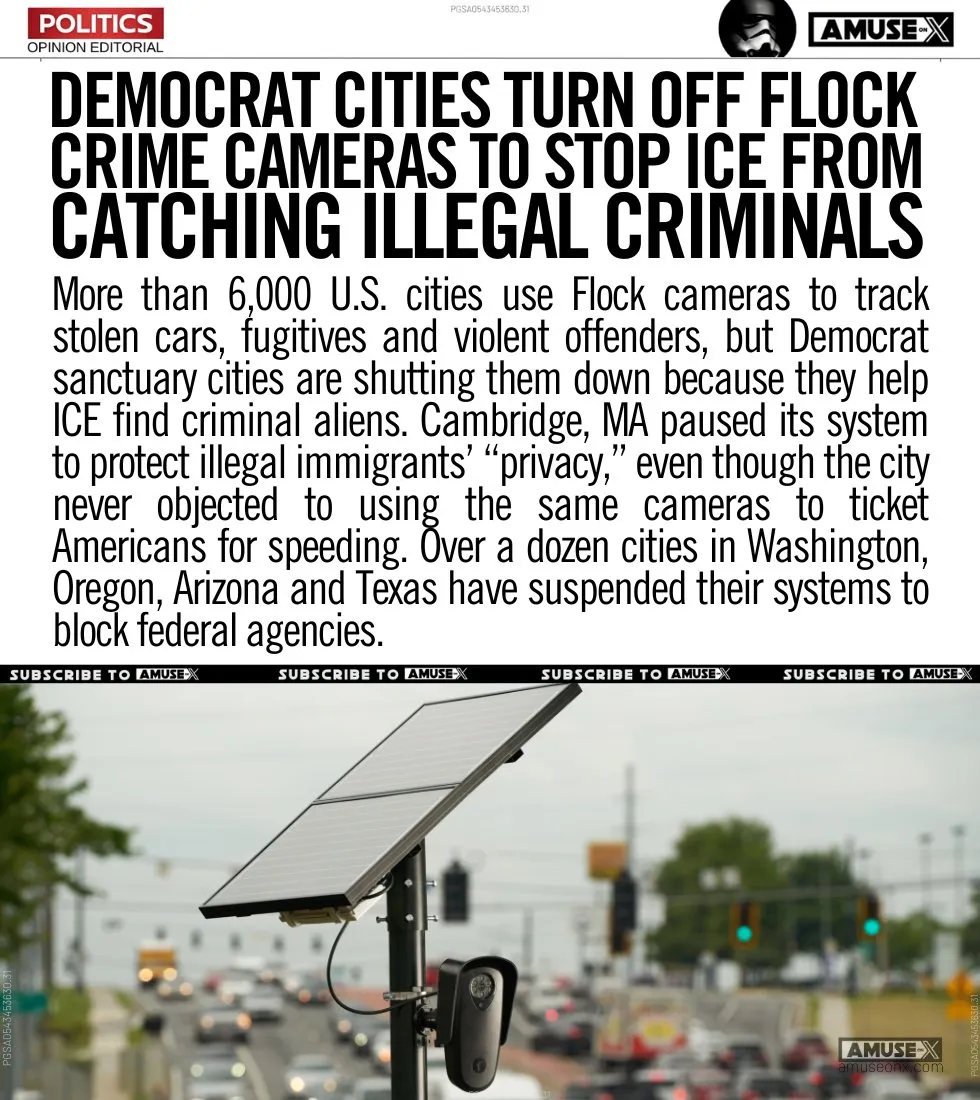
When President Trump returned to office and began enforcing federal immigration law, the same cities that had embraced ubiquitous tracking suddenly discovered that surveillance might be dangerous. Not dangerous to citizens, but dangerous to illegal aliens living in their jurisdictions. Cameras that had been praised as essential to public safety were now denounced as tools of oppression. Contracts were suspended. Cameras were covered. Systems were disabled. Sanctuary cities that had constructed a surveillance state recoiled when that state threatened to enforce the law.
To see the inconsistency clearly, one must first understand what these systems are and what they do. Flock Safety is not a traditional camera network. It is an automated license plate reader platform that continuously captures images of vehicles, extracts plate numbers, timestamps and locations, and stores that information in searchable databases. The system allows users to reconstruct where a vehicle has been, when it was there, and how often it appears in certain places. This is not targeted surveillance of suspects. It is ambient monitoring of everyone who drives.
Flock is now deployed in roughly 5,000 communities across the US. There are well over 100,000 Flock cameras installed nationwide. These cameras are typically mounted at neighborhood entrances, intersections, and arterial roads. They operate continuously. They do not distinguish between suspects and non suspects. Every driver is recorded. Every trip is logged.
For years, this fact generated remarkably little resistance in Democrat controlled jurisdictions. City councils approved contracts with little scrutiny. Police departments promoted the systems as force multipliers. Civil liberties concerns were treated as technicalities. The central moral assumption was clear. Surveillance was acceptable so long as it was framed as protecting communities from crime. Citizens were expected to accept that their movements would be recorded indefinitely, just in case the data might someday prove useful. What changed was not the technology. What changed was who might benefit from it.
In 2025, a report by the University of Washington’s Center for Human Rights documented that federal immigration agencies, including ICE, had accessed ALPR data from local networks without local police departments fully understanding or controlling that access. This revelation triggered panic in sanctuary jurisdictions. The problem was not that mass surveillance existed. The problem was that the wrong sovereign might use it.
[video at source]
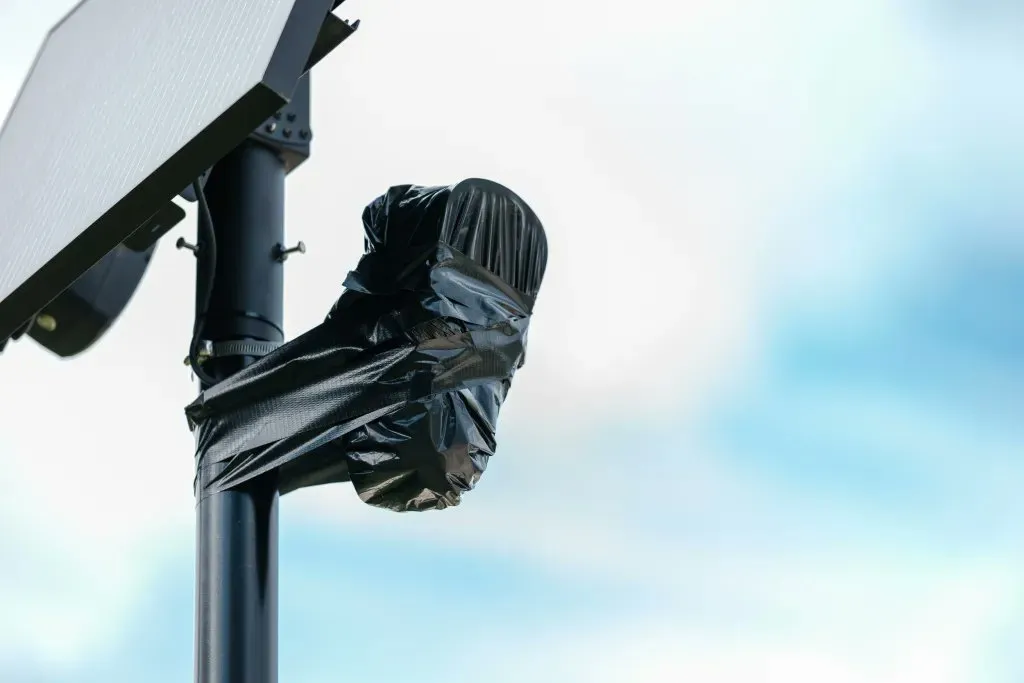
Consider the pattern. In Woodburn, Oregon, the city council suspended its Flock program after residents warned that the cameras could aid ICE enforcement. The concern was not generalized privacy. It was immigration. In Redmond, Washington, officials paused the camera network amid worries about federal immigration arrests near camera locations. In Olympia, Washington, the response was more theatrical. Officials physically covered Flock cameras with hoods while reviewing whether the system conflicted with the city’s sanctuary status. The image was unintentionally perfect. A surveillance state concealed, not dismantled.
Elsewhere, the same logic prevailed. Flagstaff, Arizona voted unanimously to terminate its Flock contract. Cambridge, Massachusetts paused its system. Hays County in Texas canceled its ALPR contract. Eugene, Oregon moved to terminate its agreement and deactivate cameras. In each case, the stated justification centered on fears that surveillance data could be used to enforce immigration law.
This sequence matters. These cities did not awaken to civil libertarian principles after deep reflection. They had already dismissed those principles when citizens raised them. They rediscovered privacy only when surveillance threatened to frustrate sanctuary policies.
There is a powerful case against Flock style surveillance when applied to law abiding citizens. That case was always available. It was ignored. Mass ALPR networks invert the traditional relationship between the citizen and the state. In a free society, investigation follows suspicion. With Flock, suspicion follows investigation. Governments build permanent databases of innocent people’s movements, hoping that future queries might retroactively justify the intrusion. This is not a marginal adjustment to policing. It is a structural reversal.
Location data is uniquely invasive. A long term record of where a person drives reveals patterns of life. It reveals where people worship, where they seek medical care, whom they visit, and how they associate. Courts have increasingly recognized that persistent location tracking is qualitatively different from ordinary observation. Cities that adopted ALPR systems brushed this aside.
Function creep is not speculative. Surveillance systems expand because they can. A tool justified for violent crime is soon used for property crime, then civil enforcement, then intelligence sharing. Oversight mechanisms are weak because they are internal. Audit logs do not prevent abuse. They document it, often long after harm has occurred.
The data itself is a permanent liability. Centralized location databases invite misuse by insiders and attacks by outsiders. They are discoverable in civil litigation. They persist long after officials who approved them have left office. None of this is hypothetical. It is routine.
Errors compound the harm. ALPR systems misread plates and propagate mistakes across jurisdictions. When false positives occur, citizens bear the cost through stops, searches, and detentions. The system bears none.
Most corrosive of all, mass surveillance chills lawful behavior. People who know they are tracked alter how they move, where they gather, and how they associate. This is not freedom with safeguards. It is freedom on probation. These arguments are serious. They deserved consideration. They were dismissed by the very officials who now invoke privacy as a shield for illegal aliens.
Here lies the hypocrisy. Sanctuary jurisdictions accepted the transformation of citizens into perpetual data points. They normalized a system that treats everyone as a suspect in waiting. They did so knowingly. When the same infrastructure threatened to expose illegal activity, they recoiled. Privacy, it turned out, was selective.
There is no principled reason to oppose the use of Flock data against criminals and illegal aliens while having supported its use against the general public. If the system is intolerable because it enables warrantless tracking, then it was intolerable from the start. If it is acceptable when used for public safety, then it cannot suddenly become immoral when it enforces democratically enacted law.
A city cannot claim to defend constitutional values while suspending them opportunistically. One cannot argue that citizens must live in a perpetual police lineup while insisting that illegal aliens deserve invisibility. That position is not civil libertarian. It is political.
The deeper lesson is sobering. Surveillance powers, once built, escape the intentions of their creators. They do not remain safely caged within preferred policy goals. They follow incentives, not rhetoric. Sanctuary cities learned this too late. If mass surveillance is wrong, it is wrong because free people should not be tracked absent probable cause. That principle applies first to citizens. It cannot be rediscovered only when enforcement becomes inconvenient.
Using surveillance to catch and deport illegal immigrants impacts leftist plans to implement the Cloward-Piven strategy to destroy Western Civilization and replace it with a marxist system.
The surveillance state was enacted to terrorize and punish the innocent, not arrest the criminal.
Seems like more Anarcho-Tyranny — surveillance systems are double-plus good if they help the government stomp on law-abiding taxpayers. But as soon as these systems start to make life uncomfortable for criminals, then the systems need to be taken down. Criminals need free reign so that the citizens have to live in fear.
Every day the left’s machinations are being more and more exposed.
An astute Providence-area radio host, Chas Calenda, bravely confronted Brown U officials and l/e.
Calenda had critical info about Brown intentionally disabling surveillance systems due to DEI concerns.
Brown University was under pressure from the far-left wrt the school’s security system
<><>the left whined security data would be used by the feds
<><>to (a) identify radical leftists expressing antisemitic sentiments,
<><>and (b) to identify the immigration status of persons on campus.
<><>this lefty atrocity is not just isolated to Brown University.
<><>Multiple muni govts, private and municipal agencies have received the same demand
<><>there’s an ongoing lefty effort to block ICE’s valiant operations
<><>The mass shooting at Brown is leading to public awareness of the left’s rank stupidity
<><>lefty stupidity has been spreading rapidly in the last several months.
<><>bleeding heart “civil rightists” and “humanitarian” whining made Brown disable surveillance.
<><>the issue appears via the Rhode Island ACLU making the same demand in Oct.
That’s a good point. I am predicting here that police body cameras and dashboard cameras will soon be outlawed in many jurisdictions where they were implemented years ago — because they do a great job of showing the world just how badly certain racial/ethnic groups routinely behave during police interactions.
If the Flock cameras were purchased with Federal money, and the understanding was that they were to be used, perhaps the feds should demand reimbursement for the system not being used. Make ‘em howl!
Correct.
I amazed at the information they do have on illegal immigrants that Trump is able to use in the deportation process.
Like the dems were good at the record keeping for their purposes.
In the 1980s or 1990s (or maybe both), there were multiple drunk driving checkpoints set up in cities in Southern California (and likely the rest of the state). However, some of these towns and cities were run by CONSERVATIVES, and while very few drunks were caught, Illegals were getting nailed in droves, and losing their cars in the process.
Needless to say, no more checkpoints.
Disclaimer: Opinions posted on Free Republic are those of the individual posters and do not necessarily represent the opinion of Free Republic or its management. All materials posted herein are protected by copyright law and the exemption for fair use of copyrighted works.