Posted on 12/20/2024 9:44:01 AM PST by Red Badger
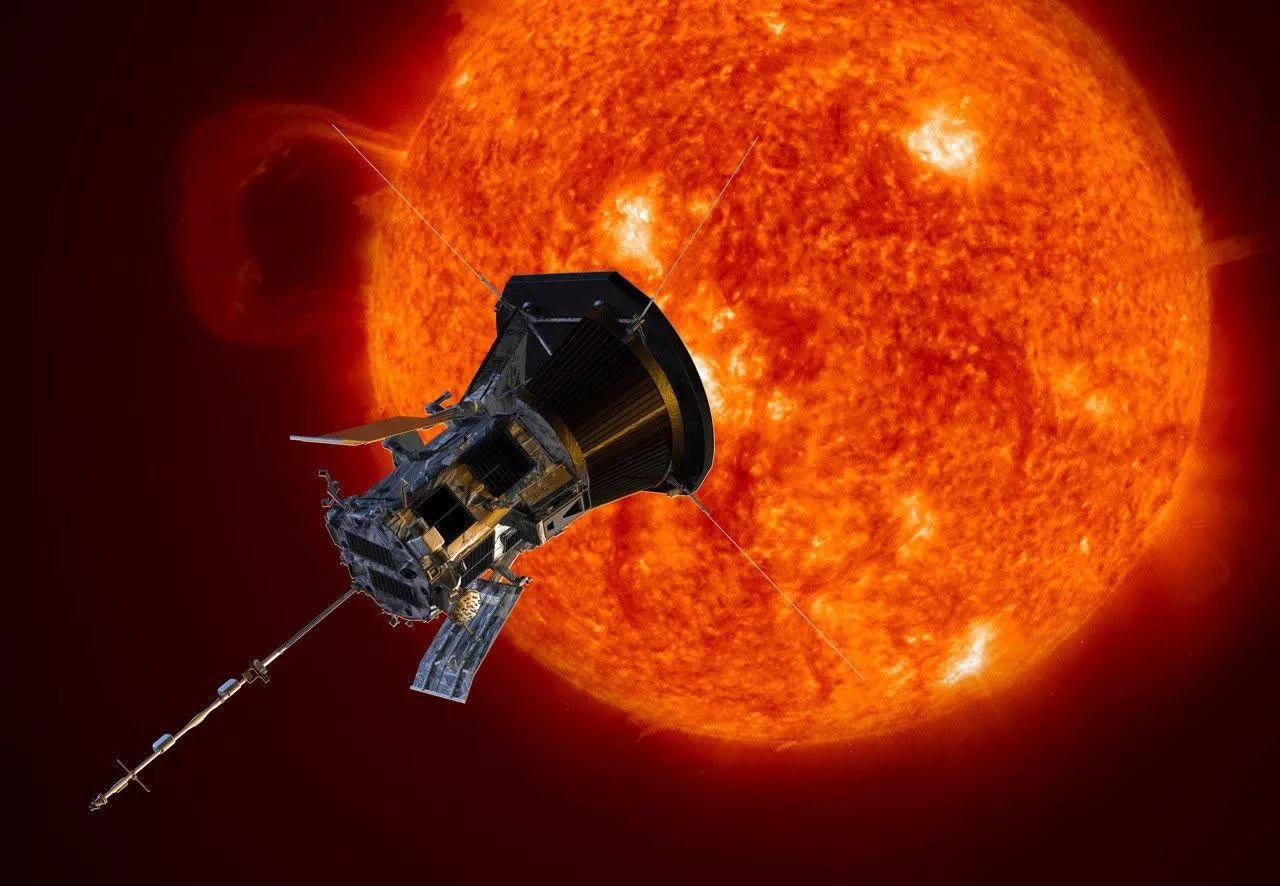
The Parker Solar Probe is on an ambitious mission to study the origins of the solar wind – the constant stream of charged particles flowing outward from the sun. Despite over half a century of scientific investigation since its discovery in the 1960s, the phenomenon's precise source within the corona remains unknown.
We're just days away from the Parker Solar Probe making its closest approach yet to the sun. The little spacecraft will barrel through the sun's outer atmosphere on Christmas Eve, passing within just 3.8 million miles of the surface below.
That may sound like a significant distance, but for a red-hot celestial ball with a diameter of 865,370 miles, this is the closest we'll have ever been. In fact, the probe will go right through the solar corona, which is the super-heated atmosphere extending millions of miles from the sun's visible surface. Because of this, the probe will endure extremes few things on Earth do, with NASA estimating its heat shield will experience temperatures exceeding 2,500°F.
Nicky Fox, who formerly served as the probe's project scientist before becoming NASA's Chief Scientist, explained to Ars Technica that the core objective is to pinpoint the birthplace of solar winds.
To unlock that mystery, there's no substitute for actually venturing into the sun's outer atmosphere to take measurements. But as Fox noted, that's an immense engineering challenge because the sun is, quite literally, on fire.
The probe had to be meticulously designed to endure the extreme heat and radiation of the corona, only to rapidly cycle back into the cold vacuum of space on its elliptical orbits around the sun. Fox elaborated that careful material selection was crucial, requiring lightweight yet durable components that could withstand drastic temperature shifts without becoming brittle or exhibiting changing properties.
Exotic metal alloys like titanium-zirconium-molybdenum with melting points over 4,200°F were used for sensors exposed to the sun's intensity. Even the wiring, which was built using niobium, needed special sapphire crystal insulation to prevent it from melting. It took years of planning and technological breakthroughs to build a spacecraft capable enough.
Appropriately, the probe honors the physicist Eugene Parker, who originally predicted the existence of the solar wind back in the 1950s. This theory initially met with widespread skepticism, that is until observations from 1962's Mariner 2 spacecraft confirmed it.
Now over six years into its mission, the Parker Solar Probe is gearing up to provide our most extreme glimpse yet into the sun's atmosphere and the origins of this fundamental solar phenomenon.
Despite incredible achievements like becoming the fastest human-made object at over 430,000 mph, the probe hasn't gotten much mainstream attention lately. But that may change after this record-close encounter and the new scientific insights it might bring.
Image credit: NASA
the fastest human-made object at over 430,000 mph
I have always wondered how stuff doesn’t get destroyed in space from other rocks and pebbles...
She’s dead, Jim......................
Space is pretty big. Getting hit by something is pretty rare, though tiny dust particles abound............But if you happen to see a NASA toolkit.................
Will they land near where the astronauts left the flag?
(A NASA space probe will fly into the sun on Christmas Eve)
Barely.
I was gonna say “I hope it lands at night” but now I won’t.
Oops 😬😬😬
From what I have read...
Sun core temp: 27 million degrees F
Sun surface: 10,000 degrees F
Sun corona: 1.8 -3.6 million degrees F
The writer states that the sun is “quite literally, on fire”.....fire is a chemical combination yielding heat, light and smoke..The writer would have been more correct to write”figuratively
on fire”
Beat writers nowadays read like AI, with a clueless “journalist” adding the human or grammatical touch......sigh....
Freegards
But Mama, that’s where the fun is.
Just. . . don’t hit the light switch.
Obviously:
yes, forgot about that.
And wasting it.
“”Exotic metal alloys like titanium-zirconium-molybdenum-niobium””
Rumor has it that on the followup mission, Parker Solar Probe II, researchers will attempt construct it using unobtainium, and probe even deeper into the mysteries of the Sun.
That didn’t work out too well for Icarus (son of Daedalus).
He flew too close to the sun. Next thing you know, his waxen wings had begun to melt!
Article Title:
“...will fly into the sun...”
-
Article Text:
“...passing within just 3.8 million miles of the surface...”
If the government shuts down, it’s gonna need to wait..
The movie Sunshine starring Cillian Murphy was a pretty cool flick.....at least the first two acts were..
https://www.imdb.com/title/tt0448134/?ref_=nm_flmg_job_1_cdt_t_36
:^)
I remember seeing the coming attraction trailer for this one at a drive-in back then (1965) and never saw it, apparently it’s on Tubi and will probably be tonight’s indoor attraction. :^) Nothing to do with blowin’ up the Sun though.
https://www.imdb.com/title/tt0059065/
He hates manure
Well, I watched it. What a steaming crap pile. :^)
https://tubitv.com/movies/639642/crack-in-the-world
Disclaimer: Opinions posted on Free Republic are those of the individual posters and do not necessarily represent the opinion of Free Republic or its management. All materials posted herein are protected by copyright law and the exemption for fair use of copyrighted works.