Skip to comments.
Kamala Harris may not be eligible to be President because her parents were in the USA on student visas (one expired!) when she was born, according to legal scholar Dr. John Eastman.
X twitter ^
| Jul 22, 2024
| Dr. John Eastman.
Posted on 07/23/2024 9:07:55 AM PDT by george76
Kamala Harris may not be eligible to be President because her parents were in the USA on student visas (one expired!) when she was born, according to legal scholar Dr. John Eastman.
TOPICS:
KEYWORDS: citizen; domesticterrorist; foreignagent; giveitupwontwork; giveyourmamauprino; harris; ineligible; kamala; kamalabirther; kamalaharris; naturalborn; naturalborncitizen; nbc; ntsa; president; replacingjoe; rinos4kamala
Navigation: use the links below to view more comments.
first previous 1-20 ... 41-60, 61-80, 81-100, 101-112 last
To: frogjerk
In Minor v. Happersett (1875), the Supreme Court defined two classes of persons. The first class consists of children born in the United States, of U.S.-citizen parents. The second class consists of all other U.S.-born children, regardless of their parents’ citizenship. The Court used the term “natural born citizen” only in reference to members of the first class. Regarding members of the second class, the Court doubted they were even citizens, let alone natural born citizens. In the Court’s opinion, natural born citizens are “distinguished from” aliens or foreigners, suggesting that a natural born citizen is someone who is not a “foreigner” (foreign citizen) at birth
101
posted on
07/23/2024 10:15:28 PM PDT
by
South Dakota
(Patriotism is the new terrorism .)
To: george76
Won’t matter. Democrats can do what ever they want.
102
posted on
07/23/2024 10:58:53 PM PDT
by
jmacusa
(Liberals. Too stupid to be idiots.)
To: South Dakota
In the court opinion is thus for your review emphasis is mine
1 The question is presented in this case, whether, since the adoption of the fourteenth amendment, a woman, who is a citizen of the United States and of the State of Missouri, is a voter in that State, notwithstanding the provision of the constitution and laws of the State, which confine the right of suffrage to men alone. We might, perhaps, decide the case upon other grounds, but this question is fairly made. From the opinion we find that it was the only one decided in the court below, and it is the only one which has been argued here. The case was undoubtedly brought to this court for the sole purpose of having that question decided by us, and in view of the evident propriety there is of having it settled, so far as it can be by such a decision, we have concluded to waive all other considerations and proceed at once to its determination.
103
posted on
07/24/2024 7:51:02 AM PDT
by
frogjerk
(More people have died trusting the government than not trusting the government.)
To: Extremely Extreme Extremist
104
posted on
07/24/2024 8:21:41 AM PDT
by
AppyPappy
(Biden told Al Roker "America is back". Unfortunately, he meant back to the 1970's)
To: politicket
Democrats: Great. We replaced a guy who dropped in the polls every time he spoke with a woman that does the same.
105
posted on
07/24/2024 8:22:47 AM PDT
by
AppyPappy
(Biden told Al Roker "America is back". Unfortunately, he meant back to the 1970's)
To: South Dakota
Also from the same opinion emphasis mine
The Constitution does not, in words, say who shall be natural-born citizens. Resort must be had elsewhere to ascertain that. At common-law, with the nomenclature of which the framers of the Constitution were familiar, it was never doubted that all children born in a country of parents who were its citizens became themselves, upon their birth, citizens also. These were natives, or natural-born citizens, as distinguished from aliens or foreigners. Some authorities go further and include as citizens children born within the jurisdiction without reference to the citizenship of their parents. As to this class there have been doubts, but never as to the first. For the purposes of this case it is not necessary to solve these doubts. It is sufficient for everything we have now to consider that all children born of citizen parents within the jurisdiction are themselves citizens. The words 'all children' are certainly as comprehensive, when used in this connection, as 'all persons,' and if females are included in the last they must be in the first. That they are included in the last is not denied. In fact the whole argument of the plaintiffs proceeds upon that idea.
106
posted on
07/24/2024 1:51:15 PM PDT
by
frogjerk
(More people have died trusting the government than not trusting the government.)
To: AppyPappy
To a foreign father.
In Inglis v. Trustees (1830) and Elk v. Wilkins (1884), the Supreme Court considered the status of children who are born in the United States, of fathers who owe allegiance to a sovereignty other than the United States. In both cases, the Court ruled that such children are not even citizens, let alone natural born citizens.
107
posted on
07/24/2024 5:51:27 PM PDT
by
South Dakota
(Patriotism is the new terrorism .)
To: South Dakota; AppyPappy
In Inglis v. Trustees (1830) and Elk v. Wilkins (1884), the Supreme Court considered the status of children who are born in the United States, of fathers who owe allegiance to a sovereignty other than the United States. In both cases, the Court ruled that such children are not even citizens, let alone natural born citizens.
That is pure crap. What wingnut website did you get that crap from? It seems apparent you did not bother to actually read the court opinions.
Inglis directly contradicts you.
Elk was found to jhave been born an alien, born to an Indian tribe. Elk found that “Indians not taxed” were excluded from the persons according to whose numbers representatives and direct taxes were apportioned among the several states, and Congress had and exercised the power to regulate commerce with the Indian tribes, and the members thereof, whether within or without the boundaries of one of the states of the Union. The Indian tribes, being within the territorial limits of the United States, were not, strictly speaking, foreign states, but they were alien nations...."
The Elk court approvingly quoted Taney:
“They [the Indian tribes] may without doubt, like the subjects of any foreign government, be naturalized by the authority of Congress and become citizens of a state and of the United States, and if an individual should leave his nation or tribe, and take up his abode among the white population, he would be entitled to all the rights and privileges which would belong to an emigrant from any other foreign people.” But an emigrant from any foreign state cannot become a citizen of the United States without a formal renunciation of his old allegiance, and an acceptance by the United States of that renunciation through such form of naturalization as may be required law.
Wong Kim Ark at 169 U.S. 658-59:
It thus clearly appears that, by the law of England for the last three centuries, beginning before the settlement of this country and continuing to the present day, aliens, while residing in the dominions possessed by the Crown of England, were within the allegiance, the obedience, the faith or loyalty, the protection, the power, the jurisdiction of the English Sovereign, and therefore every child born in England of alien parents was a natural-born subject unless the child of an ambassador or other diplomatic agent of a foreign State or of an alien enemy in hostile occupation of the place where the child was born. III. The same rule was in force in all the English Colonies upon this continent down to the time of the Declaration of Independence, and in the United States afterwards, and continued to prevail under the Constitution as originally established. In the early case of The Charming Betsy, (1804) it appears to have been assumed by this court that all persons born in the United States were citizens of the United States, Chief Justice Marshall saying: "Whether a person born within the United States, or becoming a citizen according to the established laws of the country, can divest himself absolutely of that character otherwise than in such manner as may be prescribed by law is a question which it is not necessary at present to decide." 6 U. S. 2 Cranch 64, 6 U. S. 119.
In Inglis v. Sailors' Snug Harbor (1833), 3 Pet. 99, in which the plaintiff was born in the city of New York about the time of the Declaration of Independence, the justices of this court (while differing in opinion upon other points) all agreed that the law of England as to citizenship by birth was the law of the English Colonies in America. Mr. Justice Thompson, speaking for the majority of the court, said: "It is universally admitted, both in the English courts and in those of our own country, that all persons born within the Colonies of North America, whilst subject to the Crown of Great Britain, are natural-born British subjects."
- - - - -
Inglis v. Trustees of Sailor's Snug Harbor, 28 U.S. [3 Pet.] 99, 164 (1830)
With these principles in view, let us now come to the consideration of the question of alienage in the present case. That the father and mother of the demandant were British born subjects is admitted. If he was born before 4 July, 1776, it is as clear that he was born a British subject. If he was born after 4 July, 1776, and before 15 September, 1776, he was born an American citizen, whether his parents were at the time of his birth British subjects or American citizens. Nothing is better settled at the common law than the doctrine that the children even of aliens born in a country while the parents are resident there under the protection of the government and owing a temporary allegiance thereto are subjects by birth.
Elk v. Wilkins, 112 U.S. 94 (1884)
Syllabus An Indian, born a member of one of the Indian tribes within the United States, which still exists and is recognized as a tribe by the government of the United States, who has voluntarily separated himself from his tribe, and taken up his residence among the white citizens of a state, but who has not been naturalized, or taxed, or recognized as a citizen either by the United States or by the state, is not a citizen of the United States within the meaning of the first section of the Fourteenth Article of Amendment of the Constitution.
A petition alleging that the plaintiff is an Indian, and was born within the United States, and has severed his tribal relation to the Indian tribes, and fully and completely surrendered himself to the jurisdiction of the United States, and still so continues subject to the jurisdiction of the United States, and is a bona fide resident of the Nebraska and City of Omaha, does not show that he is a citizen of the United States under the Fourteenth Article of Amendment of the Constitution.
At 98-101
The petition, while it does not show of what Indian tribe the plaintiff was a member, yet, by the allegations that he “is an Indian, and was born within the United States,” and that “he had severed his tribal relations to the Indian tribes,” clearly implies that he was born a member of one of the Indian tribes within the limits of the United States which still exists and is recognized as a tribe by the government of the United States. Though the plaintiff alleges that he “had fully and completely surrendered himself to the jurisdiction of the United States,” he does not allege that the United States accepted his surrender, or that he has ever been naturalized, or taxed, or in any way recognized or treated as a citizen by the state or by the United States. Nor is it contended by his counsel that there is any statute or treaty that makes him a citizen. The question, then, is whether an Indian, born a member of one of the Indian tribes within the United States, is, merely by reason of his birth within the United States and of his afterwards voluntarily separating himself from his tribe and taking up his residence among white citizens, a citizen of the United States within the meaning of the first section of the Fourteenth Amendment of the Constitution.
Under the Constitution of the United States as originally established, “Indians not taxed” were excluded from the persons according to whose numbers representatives and direct taxes were apportioned among the several states, and Congress had and exercised the power to regulate commerce with the Indian tribes, and the members thereof, whether within or without the boundaries of one of the states of the Union. The Indian tribes, being within the territorial limits of the United States, were not, strictly speaking, foreign states, but they were alien nations, distinct political communities, with whom the United States might and habitually did deal as they thought fit, either through treaties made by the President and Senate or through acts of Congress in the ordinary forms of legislation. The members of those tribes owed immediate allegiance to their several tribes, and were not part of the people of the United States. They were in a dependent condition, a state of pupilage, resembling that of a ward to his guardian. Indians and their property, exempt from taxation by treaty or statute of the United States, could not be taxed by any state. General acts of Congress did not apply to Indians unless so expressed as to clearly manifest an intention to include them. Constitution, Article I, Sections 2, 8; Article II, Section 2; Cherokee Nation v. Georgia, 5 Pet. 1; Worcester v. Georgia, 6 Pet. 515; United States v. Rogers, 4 How. 567; United States v. Holliday, 3 Wall. 407; Case of the Kansas Indians, 5 Wall. 737; Case of the New York Indians, 5 Wall. 761; Case of the Cherokee Tobacco, 11 Wall. 616; United States v. Whisky, 93 U. S. 188; Pennock v. Commissioners, 103 U. S. 44; Crow Dog’s Case, 109 U. S. 556; Goodell v. Jackson, 20 Johns. 693; Hastings v. Farmer, 4 N.Y. 293.
The alien and dependent condition of the members of the Indian tribes could not be put off at their own will without the action or assent of the United States. They were never deemed citizens of the United States except under explicit provisions of treaty or statute to that effect either declaring a certain tribe, or such members of it as chose to remain behind on the removal of the tribe westward, to be citizens or authorizing individuals of particular tribes to become citizens on application to a court of the United States for naturalization and satisfactory proof of fitness for civilized life, for examples of which see treaties in 1817 and 1835 with the Cherokees, and in 1820, 1825, and 1830 with the Choctaws, 7 Stat. 159, 211, 236, 335, 483, 488; Wilson v. Wall, 6 Wall. 83; Opinion of Attorney General Taney, 2 Opinions of Attorneys General 462; in 1855 with the Wyandotts, 10 Stat. 1159; Karrahoo v. Adams, 1 Dillon 344, 346; Gray v. Coffman, 3 Dillon 393; Hicks v. Butrick, 3 Dillon 413; in 1861 and in March, 1866 with the Pottawatomies, 12 Stat. 1192; 14 Stat. 763; in 1862 with the Ottawas, 12 Stat. 1237; and the Kickapoos, 13 Stat. 624; and Acts of Congress of March 3, 1839, c. 83, § 7, concerning the Brothertown Indians, and of March 3, 1843, c. 101 § 7, August 6, 1846, c. 88, and March 3, 1865, c. 127 § 4, concerning the Stockbridge Indians, 5 Stat. 351, 647; 9 Stat. 55; 13 Stat. 562. See also treaties with the Stockbridge Indians in 1848 and 1856, 9 Stat. 955; 11 Stat. 667; 7 Opinions of Attorneys General 746.
Chief Justice Taney, in the passage cited for the plaintiff from his opinion in Scott v. Sandford, 19 How. 393, 60 U. S. 404, did not affirm or imply that either the Indian tribes, or individual members of those tribes, had the right, beyond other foreigners, to become citizens of their own will, without being naturalized by the United States. His words were:
“They [the Indian tribes] may without doubt, like the subjects of any foreign government, be naturalized by the authority of Congress and become citizens of a state and of the United States, and if an individual should leave his nation or tribe, and take up his abode among the white population, he would be entitled to all the rights and privileges which would belong to an emigrant from any other foreign people.”
But an emigrant from any foreign state cannot become a citizen of the United States without a formal renunciation of his old allegiance, and an acceptance by the United States of that renunciation through such form of naturalization as may be required law.
To: South Dakota; frogjerk
The Court used the term “natural born citizen” only in reference to members of the first class. Regarding members of the second class, the Court doubted they were even citizens, let alone natural born citizens. In the Court’s opinion, natural born citizens are “distinguished from” aliens or foreigners, suggesting that a natural born citizen is someone who is not a “foreigner” (foreign citizen) at birth
Chief Justice Waite's dicta are not opinions of the Court. There was no issue of citizenship before the court, and no issue of citizenship was decided.
Minor v. Happersett, 88 US 162, 165:
The CHIEF JUSTICE delivered the opinion of the court. The question is presented in this case, whether, since the adoption of the fourteenth amendment, a woman, who is a citizen of the United States and of the State of Missouri, is a voter in that State, notwithstanding the provision of the constitution and laws of the State, which confine the right of suffrage to men alone.
The question before the Court concerned a woman who was a citizen of the United States. The citizenship of Virginia Minor was not contested.
Minor v. Happersett, 88 US 162, 167-168:
The Constitution does not in words say who shall be natural-born citizens. Resort must be had elsewhere to ascertain that. At common law, with the nomenclature of which the framers of the Constitution were familiar, it was never doubted that all children born in a country of parents who were its citizens became themselves, upon their birth, citizens also. These were natives or natural-born citizens, as distinguished from aliens or foreigners. Some authorities go further and include as citizens children born within the jurisdiction without reference to the citizenship of their [88 U. S. 168] parents. As to this class there have been doubts, but never as to the first. For the purposes of this case, it is not necessary to solve these doubts.
Having stated that it was unnecessary to solve the doubts cited in dicta, the Court proceeded to not solve them, they not being relevant to the case of Minor.
Virginia Minor's citizenship was never in question before the court because it was a stipulated fact, agreed to by both parties before the trial. Minor, Transcript of Record, page 8:
Agreed Statement STATEMENT
[excerpt]
It is admitted by the pleadings that the plaintiff is a native-born, free white citizen of the United States and of the State of Missouri; that the defendant is a registrar, qualified and acting as such; that the plaintiff, in proper time and in proper form, made application to him to be registered and that the defendant refused to register the plaintiff solely for the reason that she is a female, (and that she possesses the qualifications of an elector in all respects, except as to the matter of sex, as before stated.)
Both parties agreed, as a matter of stipulated fact, that Virginia Minor was a native-born, free white citizen of the United States and of the State of Missouri, and that she was qualified as an elector in all respects, except as to the matter of sex. The question before the Court was whether a woman, being a native-born, free white citizen, could be barred from voting solely on account of sex.
The answer was yes. Nobody had a constitutional right to vote for President, whether male or female, and restrictions were a matter for the State to decide..
The Nineteenth Amendment, subsequent to Minor, did not give women the right to vote. It declared that where men had been given a right to vote, women must be granted an equal right to vote. The State retains the power to dispense with a popular vote and to elect delegates to the Electoral College via its Legislature.
See the more recent case of Bush v. Gore, 531 U.S. 98, 104 (2000)
The individual citizen has no federal constitutional right to vote for electors for the President of the United States unless and until the state legislature chooses a statewide election as the means to implement its power to appoint members of the Electoral College. U.S. Const., Art. II, §1.
Rogers v. Bellei, 401 U.S. 815 (1971)
The reach of congressional power in this area is readily apparent: p> 1. Over 70 years ago the Court, in an opinion by Mr. Justice Gray, reviewed and discussed early English statutes relating to rights of inheritance and of citizenship of persons born abroad of parents who were British subjects. United States v. Wong Kim Ark, 169 U.S. 649, 668 -671 (1898). The Court concluded that "naturalization by descent" was not a common-law concept but was dependent, instead, upon statutory enactment. The statutes examined were 25 Edw. 3, Stat. 2 (1350); 29 Car. 2, c. 6 (1677); 7 Anne, c. 5, 3 (1708); 4 Geo. 2, c. 21 (1731); and 13 Geo. 3, c. 21 (1773). Later Mr. Chief Justice Taft, speaking for a unanimous Court, referred to this "very learned and useful opinion of Mr. Justice Gray" and observed "that birth within the limits of the jurisdiction of the Crown, and of the United States, as the successor of the Crown, fixed nationality, and that there could be no change in this rule of law except by statute...." Weedin v. Chin Bow, 274 U.S., at 660 . He referred to the cited English statutes and stated, "These statutes applied to the colonies before the War of Independence." We thus have an acknowledgment that our law in this area follows English concepts with an acceptance of the jus soli, that is, that the place of birth governs citizenship status except as modified by statute.
United States v. Wong Kim Ark, 169 U.S. 649 (1898)
169 U.S. 704 The fact, therefore, that acts of Congress or treaties have not permitted Chinese persons born out of this country to become citizens by naturalization, cannot exclude Chinese persons born in this country from the operation of the broad and clear words of the Constitution, "All persons born in the United States, and subject to the jurisdiction thereof, are citizens of the United States."
VII. Upon the facts agreed in this case, the American citizenship which Wong Kim Ark acquired by birth within the United States has not been lost or taken away by anything happening since his birth.
[...]
169 U.S. 705
The evident intention, and the necessary effect, of the submission of this case to the decision of the court upon the facts agreed by the parties, were to present for determination the single question, stated at the beginning of this opinion, namely, whether a child born in the United States, of parents of Chinese descent, who, at the time of his birth, are subjects of the Emperor of China, but have a permanent domicil and residence in the United States, and are there carrying on business, and are not employed in any diplomatic or official capacity under the Emperor of China, becomes at the time of his birth a citizen of the United States. For the reasons above stated, this court is of opinion that the question must be answered in the affirmative.
Everyone born in the United States, subject to its jurisdiction, is born a citizen of the United States. A natural born American citizen, to use the emphasis of John Jay, is a person who acquired American citizenship at birth.
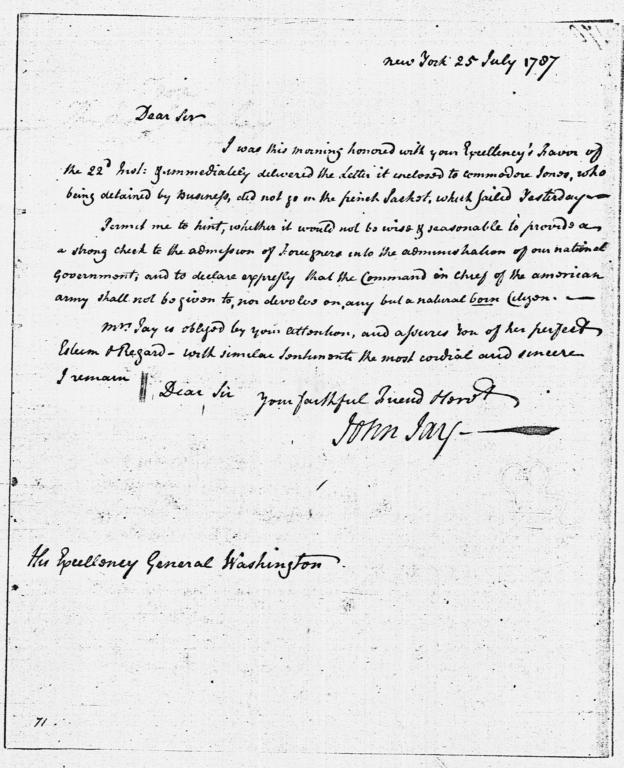
Jay to Washington, 25 July 1787, handwritten.
The Constitution does not say a mumbling word about parents, or their citizenship. The child in the United States of two illegal aliens, both in a detention center awaiting deportation, is born a United States citizen. A child of foreign parentage born on U.S. soil, acquires U.S. citizenship at birth unless he or she is the child of a visiting accredited diplomat or of visiting royalty, and thereby enjoys immunity from United States laws. The prevailing precedent is United States v. Wong Kim Ark, 169 U.S. 649 (1898).
In Wong Kim Ark the dissenting opinion of Fuller C.J., joined by Harlan J., at 169 U.S. 706, said in reference to the majority opinion of the Court,
The English common-law rule, which it is insisted was in force after the Declaration of Independence, was that “every person born within the dominions of the crown, no matter whether of English or of foreign parents, and, in the latter case, whether the parents were settled or merely temporarily sojourning in the country, was an English subject; save only the children of foreign ambassadors (who were excepted because their fathers carried their own nationality with them), or a child born to a foreigner during the hostile occupation of any part of the territories of England.” Cockb. Nat. 7.
That accurately states the state of English law that was in effect in the colonies when the Declaration of Independence was issued.
Every one of the original thirteen states adopted so much of the English common law as was not inconsistent with the state constitution. They did so explicitly, either in their written state constitution, or in their written state statute law.
As was stated in Won Kim Ark at 169 U.S. 702,
The fourteenth amendment of the constitution, in the declaration that “all persons born or naturalized in the United States, and subject to the jurisdiction thereof, are citizens of the United States and of the state wherein they reside,” contemplates two sources of citizenship, and two only: birth and naturalization. Citizenship by naturalization can only be acquired by naturalization under the authority and in the forms of law. But citizenship by birth is established by the mere fact of birth under the circumstances defined in the constitution. Every person born in the United States, and subject to the jurisdiction thereof, becomes at once a citizen of the United States, and needs no naturalization.
https://assets.documentcloud.org/documents/2755257/PA-TedCruzruling.pdf
Elliot v. Cruz, 137 A3d 646 (Pa Cmmw Ct 2016)
Having extensively reviewed all articles cited in this opinion, as well as many others, this Court holds, consistent with the common law precedent and statutory history, that a “natural born citizen” includes any person who is a United States citizen from birth. Accordingly, because he was a citizen of the United States from birth, Ted Cruz is eligible to serve as President of the United States, and the objection filed by Carmon Elliott to the Nomination Petition of Ted Cruz is denied.
To: woodpusher
I will consume your post and respond in the next day or two. Thanks
110
posted on
07/26/2024 5:15:41 AM PDT
by
frogjerk
(More people have died trusting the government than not trusting the government.)
To: woodpusher
Everyone born in the United States, subject to its jurisdiction, is born a citizen of the United States. A natural born American citizen, to use the emphasis of John Jay, is a person who acquired American citizenship at birth.Is this a court opinion? I don't think so. Secondly,
The Constitution does not in words say who shall be natural-born citizens. Resort must be had elsewhere to ascertain that. At common law, with the nomenclature of which the framers of the Constitution were familiar, it was never doubted that all children born in a country of parents who were its citizens became themselves, upon their birth, citizens also. These were natives or natural-born citizens, as distinguished from aliens or foreigners. Some authorities go further and include as citizens children born within the jurisdiction without reference to the citizenship of their [88 U. S. 168] parents. As to this class there have been doubts, but never as to the first. For the purposes of this case, it is not necessary to solve these doubts.
This is some very plain language. Also, De Vattel's "The Law of Nations" goes is very precise as to who is a natural-born citizen:
CHAPTER XIX: Of our Native Country, and several Things that relate to it. §211. What is our country.The whole of the countries possessed by a nation and subject to its laws, forms, as we have already said, its territory, and is the common country of all the individuals of the nation. We have been obliged to anticipate the definition of the term, native country (§122), because our subject led us to treat of the love of our country,—a virtue so excellent and so necessary in a state. Supposing then this definition already known, it remains that we should explain several things that have a relation to this subject, and answer the questions that naturally arise from it.
§212. Citizens and natives.The citizens are the members of the civil society: bound to this society by certain duties, and subject to its authority, they equally participate in its advantages. The natives, or natural-born citizens, are those born in the country, of parents who are citizens. As the society cannot exist and perpetuate itself otherwise than by the children of the citizens, those children naturally follow the condition of their fathers, and succeed to all their rights. The society is supposed to desire this, in consequence of what it owes to its own preservation; and it is presumed, as matter of course, that each citizen, on entering into society, reserves to his children the right of becoming members of it. The country of the fathers is therefore that of the children; and these become true citizens merely by their tacit consent. We shall soon see, whether, on their coming to the years of discretion, they may renounce their right, and what they owe to the society in which they were born. I say, that, in order to be of the country, it is necessary that a person be born of a father who is a citizen; for if he is born there of a foreigner, it will be only the place of his birth, and not his country.
I tie Obama to the last bolded sentence and who can deny that I would be wrong to do so?
From the Brave Browser search just for fun:
How influential was the de vattel law of nations?
De Vattel’s Law of Nations (1758) had a profound and lasting impact on the development of international law. Its influence can be seen in several aspects:
Founding principles: De Vattel’s work laid the groundwork for the principles of sovereignty, equality, and liberty among nations. These principles were later enshrined in the United States Declaration of Independence and have remained fundamental to international relations.
International law framework: De Vattel’s treatise provided a comprehensive framework for understanding international law, including the laws of war, neutrality, and diplomacy. This framework has been built upon and refined over time, but its foundation remains rooted in De Vattel’s work.
Influence on American thought: De Vattel’s Law of Nations was widely read and respected in 18th-century America. It influenced the thinking of prominent figures such as George Washington, Thomas Jefferson, and James Madison, who often cited it in their writings and debates.
Shaping international relations: De Vattel’s ideas on neutrality, trade restrictions, and the rights and duties of nations have continued to shape international relations, particularly during times of war and conflict.
Legacy in international law: De Vattel’s Law of Nations remains a foundational text in the study of international law, and its principles continue to be referenced and debated by scholars and practitioners today. Key quotes and endorsements:
Benjamin Franklin praised De Vattel’s work, stating that it was “constantly in the hands of the members of our Congress now sitting.”
James Madison critiqued De Vattel’s lack of precision and clarity in some areas, but acknowledged his importance in shaping international law.
George Washington had a copy of De Vattel’s Law of Nations in his personal library, indicating its significance and influence on his thinking.
Comparison to other influential works:
De Vattel’s Law of Nations was a major influence on Hugo Grotius’ work, which built upon De Vattel’s framework and expanded its scope.
The Law of Nations was also compared to and contrasted with the works of other influential thinkers, such as Jean Bodin and Samuel Pufendorf, who contributed to the development of international law.
Overall, De Vattel’s Law of Nations played a crucial role in shaping the principles and framework of international law, and its influence can still be seen in contemporary debates and discussions about international relations.
What bugs me is how this important and highly influential work that was continuously referred to by the Founders is just discarded as not relevant in determining the answer to the question: Who is a natural-born citizen?
Case law arguments are often stated as evidence to the answer but these are after the Constitution had already been effect for some time and the original founders long gone. Can we not refer to what the thought process was of the founders, what material they had reference to and why the definitions and influences at the time would have shaped their language similar to the discussions regarding the 2nd Amendment phrasing?
The letter image you posted is as such since I could not read it:
Dear Sir I was this morning honored with your Excellency’s Favor of the 22d Inst: & immediately delivered the Letter it enclosed to Commodore Jones, who being detained by Business, did not go in the french Packet, which sailed Yesterday.
Permit me to hint, whether it would not be wise & seasonable to provide a strong check to the admission of Foreigners into the administration of our national Government, and to declare expressly that the Command in chief of the american army shall not be given to, nor devolved on, any but a natural born Citizen.
Mrs Jay is obliged by your attention, and assures You of her perfect Esteem & Regard—with similar Sentiments the most cordial and sincere I remain Dear Sir Your faithful Friend & Servt
John Jay
John Jay, patriot, great American as he was, did not directly participate in the drafting of the US Constitution. So to state that Article III refers to what John Jay was thinking is not a good argument. The drafters of the US Constitution had "The Law of Nations" in their hands as per Benjamin Franklin, George Washington, President of the Constitutional Convention had the reference book as well, and in fact found many many years later after his death was found to have that book overdue from a library. James Madison, father of the US Constitution, spoke specifically about De Vattel's work at length with regards to the law of the seas and such so he was intimately aware and influenced by De Vattel's work.
I think these facts have to be given as much or even more weight than the case law you site because it gives us keen insight on what the founders were thinking, definitions of words, ideas, political philosophy, etc...The jist of my argument is truly Originalist, as I am getting to the heart of the ideas, meanings and thoughts of the Founders.
Anyway, great conversation...
111
posted on
07/26/2024 5:38:46 AM PDT
by
frogjerk
(More people have died trusting the government than not trusting the government.)
To: woodpusher
112
posted on
07/27/2024 11:54:15 AM PDT
by
AppyPappy
(Biden told Al Roker "America is back". Unfortunately, he meant back to the 1970's)
Navigation: use the links below to view more comments.
first previous 1-20 ... 41-60, 61-80, 81-100, 101-112 last
Disclaimer:
Opinions posted on Free Republic are those of the individual
posters and do not necessarily represent the opinion of Free Republic or its
management. All materials posted herein are protected by copyright law and the
exemption for fair use of copyrighted works.
FreeRepublic.com is powered by software copyright 2000-2008 John Robinson